Eating well in Japan on a budget: conbini, izakaya, and depachika

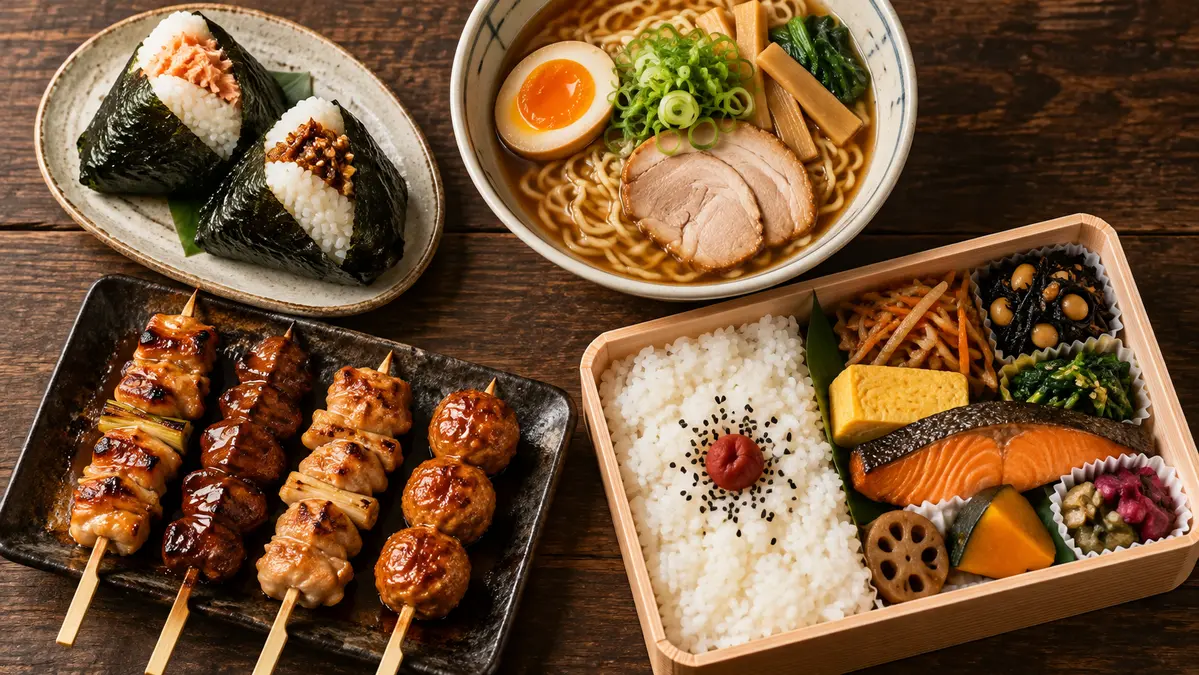
Japan has a reputation for being expensive, but the food math works in your favor once you know where to look. The cheapest meals in the country are often some of the best — a freshly made conbini onigiri at midnight, a standing-bar yakitori skewer with a ¥400 highball, a ¥900 depachika bento that cost ¥1,400 two hours earlier. This guide maps the three budget pillars that keep daily food spending in the ¥2,500–3,500 range without feeling deprived, and shows exactly how to use each one.
If you're coming from Korea or Singapore, the numbers here will surprise you. Breakfast, lunch, and a light dinner can each land under ¥1,000 with real food — not snacks, actual meals. The rest of this guide breaks down each pillar: what to buy, what it costs, when to go, and the small mechanics that make ordering painless even if you don't speak Japanese.
The three budget pillars: conbini, tachinomi, depachika
You can eat well in Japan for ¥2,500–3,500 a day using three budget pillars: conbini convenience stores for breakfast and snacks, tachinomi standing bars for cheap evening drinks and small plates, and depachika department-store food halls for discounted dinners after 7pm.
Why these three, and not just "eat cheap ramen"? Ramen is great, but the average bowl in Tokyo now runs ¥900–1,200, and it only fills one slot per day before it gets repetitive. Conbini cover breakfast and lunch with huge variety at ¥400–700 per meal. Tachinomi give you the full social experience of a Japanese night out — drink, food, atmosphere — at prices that undercut sit-down izakaya by 30–50%. Depachika solve the dinner problem elegantly: department-store food halls sell genuinely premium food (sushi, wagyu bento, seasonal side dishes) and mark it down late in the evening when they need to clear the day's stock.
The rhythm that works: conbini for breakfast, conbini or a cheap lunch spot midday, a standing bar in the early evening, and depachika for a takeout dinner or late snack. Rotate that pattern for a few days and the "Japan is expensive" fear quietly disappears. Below, each pillar gets its own section with concrete prices, what to actually buy, and timing rules.
Conbini meals that are actually good (and their prices)
Japanese convenience stores are a different species from what you'll find in Seoul, Singapore, or anywhere else. 7-Eleven, FamilyMart, and Lawson run their own food supply chains — most hot food is made in-store or delivered multiple times daily — and quality control is tight enough that locals genuinely buy dinner there. Here's what to get, with realistic price anchors.
Onigiri (¥140–200). The backbone of budget eating. The rice is seasoned, the fillings (salmon, tuna mayo, umeboshi, konbu) are generous, and the plastic-wrap peeling trick — pull 1, 2, 3 — actually works. Two or three onigiri plus a drink is a legitimate breakfast for under ¥500.
Fresh bento and sandwiches (¥500–700). The cold case holds pasta salads, egg sandwiches (7-Eleven's tamago sando has a real following), and full bento boxes with fish or chicken, rice, and sides. These are priced for office workers buying lunch, so quality has to be good enough to win repeat customers.
Hot case items (¥100–250 each). FamilyMart's Famichiki (fried chicken, ~¥250), Lawson's Karaage-kun (fried chicken bites, ~¥250), nikuman (steamed buns, ~¥150) — these sit under heat lamps and turn over fast during meal times. Buy during lunch or dinner rush for the freshest pieces.
Coffee and drinks (¥110–180). Machine-brewed hot coffee from the conbini is ¥110–180 and honestly drinkable. A large oolong tea or water is ¥100–150.
A realistic conbini breakfast: onigiri × 2 + banana + hot coffee ≈ ¥500–600. Lunch: bento + drink ≈ ¥650–800. Two conbini meals plus one convenience snack and you're under ¥1,500 for the day with room to spare.
Practical notes: almost every conbini has a microwave (レンジ, renji) you can use, a small eat-in corner in many locations, and staff who will happily heat your bento. Tax-included prices are displayed, so the shelf price is the final price. Look for the yellow 値引き (nebiki, discount) stickers in the evening — conbini also discount near-expiry items, typically from around 8–9 pm.
Beyond the headline items, the conbini dessert and bread sections punch above their price: fresh cream sandwiches, custard puffs, and melon pan from the in-store bakery run ¥150–300 and make a genuine afternoon snack. The refrigerated noodle section — soba, udon, and pasta that you heat at the store's microwave — lands at ¥400–550 and reads as a real lunch, not a compromise. If you're traveling with kids or picky eaters, the onigiri + tamagoyaki + fruit cup combo keeps everyone fed for under ¥600 per person with zero ordering stress.
For a fuller picture of where conbini food fits into Japanese food culture, and how it differs from the standing-bar scene covered below, the izakaya guide walks through ordering mechanics that also apply to tachinomi bars.
Izakaya ordering mechanics for first-timers
Izakaya are Japan's casual pubs — order small plates, share, drink, repeat. Tachinomi (立ち飲み) are the standing-bar subset: same concept, no seats, lower prices, faster turnover. If you're new to both, the mechanics are the real barrier, not the menu. Here's the playbook.
The seat charge (otooshi / osaki). Many sit-down izakaya charge a small seating fee (お通し, otoshi), typically ¥300–500, and in exchange you get a tiny appetizer you didn't order. It appears on the bill automatically. Tachinomi usually skip this or charge less — one more reason standing bars are cheaper.
"Toriaezu nama." This phrase — とりあえず生, "for now, a draft beer" — is the standard way to start. Say it when seated and a glass of nama biru appears within minutes. If you don't drink, "toriaezu oolong" (ウーロン) works the same way.
Ordering. Chain izakaya increasingly use tablets (often with English). Independent shops use paper slips or verbal orders. Pointing at the menu and saying "kore" (これ, this one) is universally understood. Menus with photos are common in chains; in smaller shops, the daily specials are often handwritten on the wall.
What to order for value. Edamame (¥300–400) and cabbage with miso (¥300–400) are cheap staples. Yakitori skewers run ¥150–250 each. Fried chicken (karaage, ¥500–700), sashimi moriawase (¥800–1,200), and grilled fish (¥600–900) round out a filling spread. Two people can eat generously with drinks for ¥4,000–5,000 total at a mid-range izakaya; a tachinomi session with two highballs and three small plates can stay under ¥2,000 per person.
No tipping. Japan has no tipping culture — the bill is the bill. The otoshi covers the service gesture. Don't leave extra cash on the table.
Exiting. At chains you may pay at the register (take the bill slip to the front); at smaller shops the bill comes to the table. Saying "okaikei onegaishimasu" (お会計お願いします) asks for the check.
Tachinomi specifics worth knowing: turnover is fast, so don't camp for hours over one drink — order, enjoy, move on or order more. Counter space is tight; keep bags small or on the overhead shelf. Solo visitors are completely normal, including solo women. Some tachinomi cash-only, some accept IC cards — check the register sign before ordering a lot. For a deeper dive into izakaya culture — what to drink beyond beer, how shochu and nihonshu work, and the etiquette that actually matters — see the izakaya guide.
Depachika timing: when premium food gets discounted
Depachika (デパ地下) are the basement-level food halls in Japanese department stores — Takashimaya, Daimaru, Hankyu, Mitsukoshi, and their regional peers. This is where the best-regarded bento, sushi, wagyu, and wagashi in the city are sold alongside produce, deli counters, and bakeries. The catch for budget travelers: the prices are full-price during the day, and genuinely cheap in the last 60–90 minutes before closing.
The discount window. Most depachika close around 19:30–20:00 (check each store). Discount stickers — 割引 (waribiki) or 値引き — start appearing from roughly 18:30–19:00, and discounts deepen as closing approaches: 20% off first, then 30%, sometimes half price (半額, hangaku) on perishable items like sushi sets in the final half hour. Arriving at 19:00 gives you selection plus real discounts; arriving at 19:45 gives you the deepest discounts with thinner selection.
What to target. Sushi sets (originally ¥1,000–1,500, discounted to ¥700–900), wagyu bento (¥1,200 → ¥800), side-dish packs (okazu, ¥400–600), and baked goods. The deli counters also sell individual items by weight or piece, so you can assemble a dinner for ¥600–800 if you're flexible about what exactly you get.
How it works mechanically. Food halls are a maze of counters, each independently run. You point, staff box it, you pay at each counter or at a central register depending on the store. Staff will ask if you want it heated (温めますか, atatamemasu ka) for hot items. Bags and chopsticks are included.
Strategy for a 3-day trip. Don't plan depachika for every dinner — once or twice is plenty. Pair it with a day you're near a major station anyway (Shinjuku, Umeda, Shibuya), and time your arrival so the discount window lines up with when you're genuinely hungry. One strong depachika dinner around ¥800–1,000 replaces a restaurant meal that would cost double.
Note the regional variation: department stores in Osaka and Kyoto tend to have especially strong food halls (Hanshin Umeda's depachika is famously competitive), while Tokyo's flagship stores carry the widest selection. The discount timing logic is the same everywhere.
A sample 3-day meal plan with real budgets
Here the pillars turn into actual days. Prices are tax-included and based on the anchors above; your totals will land in a band, not a fixed number.
Day 1 — Arrival day, Tokyo
- Breakfast: onigiri × 2 + hot coffee (conbini) — ¥550
- Lunch: conbini bento + tea — ¥700
- Early evening: tachinomi near the station — 2 highballs + yakitori × 4 + edamame — ¥1,800
- Late: depachika discount run at 19:30 — sushi set (discounted) — ¥800
- Day 1 total: ≈ ¥3,850 (arrival day, one premium meal — the baseline flexes down on normal days)
Day 2 — Full sightseeing day
- Breakfast: conbini — onigiri + yogurt + coffee — ¥550
- Lunch: chain gyudon (Yoshinoya/Matsuya, ~¥500–600) or conbini — ¥600
- Evening: tachinomi — nama + shochu highball + karaage + grilled fish — ¥2,000
- Day 2 total: ≈ ¥3,150
Day 3 — Slower day, Kyoto or Osaka
- Breakfast: conbini — sandwich + coffee — ¥600
- Lunch: depachika deli — okazu × 3 + onigiri — ¥800
- Evening: standing bar — 2 drinks + skewers + edamame — ¥1,800
- Day 3 total: ≈ ¥3,200
Three-day food total: roughly ¥10,200, or about ¥3,400/day. That's with real meals every day, alcohol on two evenings, and one premium sushi set. Drop the evening drinks and the same structure runs closer to ¥2,000/day.
Adjusting the plan: skip tachinomi on a tired day and double up on conbini — the structure doesn't break. Swap Day 1's depachika sushi for a ¥900 ramen if you'd rather sit down. The point isn't the specific line items; it's the habit of assigning each meal a pillar and a price anchor before you're hungry and decision-fatigued.
One more lever for stretching the budget further: drink spending is the biggest variable in the whole plan. A night of two draft beers at a tachinomi adds roughly ¥1,000; switching to highballs or chuhai (canned-style sour drinks, ¥300–450) keeps the social part of the evening at half the alcohol cost. Convenience-store chu-hi for a hotel-room nightcap is ¥150–200 per can — the same drink costs triple in a bar. Nothing here requires cutting alcohol entirely; it just means choosing where the drink budget goes.
Money traps to skip near major stations
The stations where you'll spend the most time — Shinjuku, Shibuya, Tokyo, Osaka/Umeda, Kyoto — are also where food money leaks fastest. These aren't scams; they're just the highest-priced versions of things you can get cheaper one street over.
Station-front sit-down chains at peak hours. The gyudon, ramen, and tonkatsu chains directly inside or in front of major stations charge the same menu prices as elsewhere — but the location means queues, rushed turnover, and zero discounts. Walk five minutes out and the same meal comes with shorter waits and often a lunch-set price.
"Tourist menu" izakaya on the main drag. Izakaya one block off the station-front street often list identical items for ¥100–200 less per plate. The station-front ones optimize for foot traffic, not value. If the menu is fully in English with photos and a tout outside, keep walking.
Overpriced station ekiben for short rides. Ekiben (station bento) are a joy — but a ¥1,300 ekiben for a 20-minute ride is the same food logic as a ¥700 conbini bento with prettier packaging. Save ekiben for actual shinkansen journeys, where the experience justifies it.
Cash-only surprise. Some of the cheapest standing bars and older shops are cash-only. Always carry ¥5,000–10,000 in cash; running to an ATM mid-meal (and paying the fee) is a dumb tax. 7-Eleven ATMs accept most foreign cards.
The "one more drink" markup. Bar districts like Golden Gai (Shinjuku) and Pontocho (Kyoto) charge cover fees (チャージ, typically ¥500–1,000) on top of drink prices, and the drinks themselves run ¥700–1,000. One night out there is a fine splurge; making it the default pattern doubles your evening budget. Tachinomi without cover charges — common in Ameyoko (Ueno), Shimbashi, and most shopping arcades — keep the same vibe at half the cost.
Put together, the honest version of "eating cheap in Japan" is this: conbini for fuel, tachinomi for the social evening, depachika for the discounted premium hit, and a short walk away from the station front for everything else. None of it requires Japanese fluency, none of it requires suffering, and none of it requires giving up good food. If you want the full mechanics of ordering and drinking at izakaya and tachinomi, the companion izakaya guide goes deeper.