Ordering food in China when you can't read the menu: a practical playbook

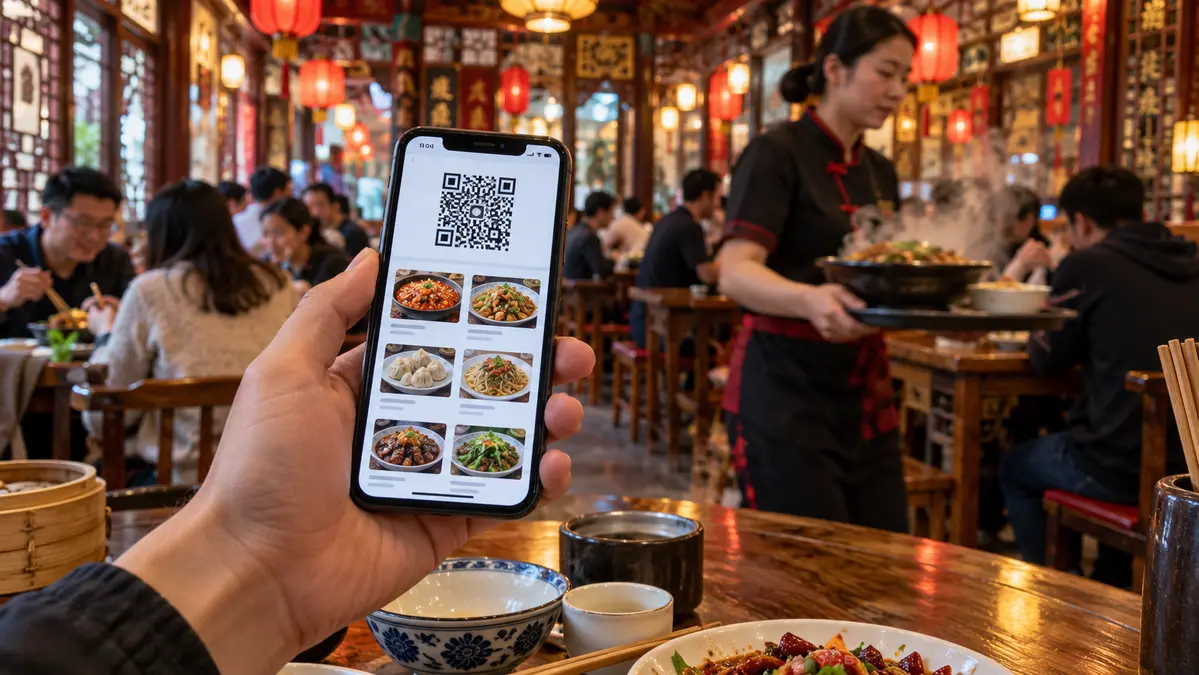
Walking into a restaurant in China where the menu is a wall of characters you cannot read is a specific kind of panic. The staff are watching, the person behind you in line is watching, and you have about thirty seconds to look like you know what you are doing. Here is the good news: you do not need to read Chinese to eat well in China. You need a phone, about ten characters, and the willingness to point.
This playbook covers the full ordering stack — from QR-code menus to market stalls — with the exact tools and phrases that work when nothing is in English.
The menu landscape: QR, photo, and no-menu spots
Most sit-down restaurants in major Chinese cities now use QR-code table ordering through WeChat or Alipay, putting the menu on your phone screen. You scan the table sticker, browse photo menus with yuan prices, and pay without talking to anyone.
Mid-range and tourist-area restaurants usually have paper photo menus — laminated books with a picture of every dish. These are straightforward: point at the photo, hold up fingers for quantity, done. The photos are generally accurate, though portion sizes in the pictures tend to be optimistic.
Then there are the no-menu spots: noodle counters, breakfast stalls, night-market vendors. Here there is no menu at all — just a display case of ingredients, a chalkboard of characters, or a cook who shouts options at you. These are the cheapest and often the best meals in China, and they are entirely navigable once you know the protocol in the next sections.
A fourth category deserves mention: the hybrid tabletops where a QR code exists but the WiFi does not reach your table, or the QR code is faded beyond scanning. Always have a backup plan. If the QR fails, ask for "càidān" (菜单 — menu) and you will usually get a paper version. If there is no paper version, you are in no-menu territory and the pointing protocol applies.
Regional variation matters too. In Shanghai and Beijing, QR ordering is near-universal even at small shops. In smaller cities and western provinces, paper menus and verbal ordering remain common. In night markets everywhere, there are no menus by design — the food is the menu. Adjust your expectations by city tier: the smaller the city, the more you will rely on pointing and the less on your phone.
Phone camera translation that actually works on Chinese text
Baidu Translate camera mode is the most reliable free tool for reading Chinese menus, outperforming Google Translate on handwritten and stylized characters. Point your camera at the menu, and it overlays English translations in real time. Download the offline Chinese language pack before your trip — restaurant basements and old buildings often have no signal.
For paper menus, take a photo first and translate from the gallery rather than trying to hold your phone steady while a waiter hovers. The photo-translate workflow is: snap the menu pages, open them in Baidu Translate, tap through the dishes at your own pace. Nobody minds you photographing a menu.
Google Translate camera works as a backup, but it struggles with vertical text, decorative fonts, and the abbreviated dish names that Chinese menus love. If you only install one app, make it Baidu. If you install two, add Pleco — its optical character recognizer lets you draw unknown characters with your finger when the camera fails on blurry or reflective surfaces.
One practical note: translation apps turn dish names into literal English that can be baffling. "Ants climbing a tree" is glass noodles with minced pork. "Husband and wife lung slices" is a cold beef appetizer. When a translation sounds like poetry or horror, it is probably delicious — order it.
Beyond the camera, learn to use the text-input translation for dish names you can partially read. If you recognize one character — say 鸡 (chicken) — type it into Pleco's dictionary to see compound words. 鸡丁 is diced chicken, 鸡汤 is chicken soup, 烧鸡 is roast chicken. One recognized character plus the dictionary unlocks the whole dish category.
A word on data: Baidu Translate's offline pack is about 200MB and covers the camera function fully offline. Download it on hotel WiFi, not on mobile data. The offline mode is slightly less accurate than online, but the difference is marginal for menu text — menus use standard vocabulary that the offline model handles well. Google Translate's offline Chinese pack is smaller but noticeably worse on stylized fonts, so prioritize Baidu's storage space.
If you are traveling with a companion, the divide-and-conquer method works brilliantly: one person photographs and translates while the other watches the kitchen output and flags dishes that look good coming out. You will order faster and better as a team than either person would alone.
The pointing and photo protocol for market stalls
At market stalls and no-menu counters, pointing is not rude — it is the expected ordering method. The protocol is: look at what is on display or what other customers are eating, point at it, and say "wǒ yào nà ge" (我要那个 — I want that one). Hold up fingers for quantity. Smile. This works in every province.
For stalls with a display case of raw ingredients — common at malatang (build-your-own hotpot) and barbecue skewer spots — grab a basket and point at what you want. The vendor weighs it, cooks it, and charges by weight. If you are unsure about spice levels, watch what locals are picking or ask for "wēi là" (微辣 — mildly spicy) as a safe default.
Photographing another table's food to show your waiter is completely normal. If something looks good at the next table, snap a quick photo, show it to your server, and say "yí yàng de" (一样的 — the same). Most diners will be flattered, not annoyed. In fifteen years of travel writing about China, I have never seen anyone object to this.
At breakfast stalls — jianbing crepe carts, baozi steamers, youtiao fryers — the menu is usually three to five items. Point at the one with the longest line of locals. The line is the review system.
Night markets deserve their own protocol because the dynamics differ from daytime stalls. Vendors call out to you, samples are offered on toothpicks, and the social pressure to buy is higher. The rule: accept the sample, and if you like it, buy a small portion. If you do not like it, smile, say "xièxie" (谢谢 — thanks), and move on. No one expects you to buy after tasting — sampling is the marketing.
For malatang specifically — the build-your-own hotpot where you fill a bowl with raw ingredients — the pricing is by weight, and the trap is overfilling. Leafy greens are light and cheap; mushrooms and premium meats are heavy and expensive. A good target is a bowl that looks modest — you can always go back for round two. The broth choice matters too: the default spicy broth (麻辣) is genuinely hot, so first-timers should ask for "yuānyāng" (鸳鸯 — half-spicy, half-mild split pot) if available.
Skewer stalls (烧烤) work on a per-stick price, usually 2-5 yuan per skewer for vegetables and 5-15 for meats. Point at the skewers you want from the display fridge, and they will grill them to order. The magic words are "shǎo là" (少辣 — less spicy) if you want flavor without pain, because the default seasoning at northern skewer stalls is aggressive.
Key phrases worth learning vs ones to skip
You do not need conversational Chinese. You need about ten food characters and five phrases. The characters worth recognizing on sight: 米 (rice), 面 (noodles), 鸡 (chicken), 牛 (beef), 猪 (pork), 辣 (spicy), 汤 (soup), 饺 (dumplings), 茶 (tea), 啤酒 (beer). With these ten, you can decode roughly half of any menu's categories.
The five phrases that cover ninety percent of ordering situations: "zhège" (这个 — this one, while pointing), "nàge" (那个 — that one), "yí yàng de" (一样的 — the same, while gesturing at another table), "mǎidān" (买单 — the bill), and "dǎbāo" (打包 — takeaway/bag it up). That last one is essential because Chinese portions are generous and you will want leftovers.
Phrases you can skip: anything involving negotiation, customization, or dietary philosophy. "Can you make it less oily with extra cilantro but no MSG" is not happening through a language barrier, and attempting it slows down a busy kitchen. Stick to pointing and the five phrases. Save the culinary diplomacy for restaurants with English menus.
Numbers matter more than you think. Learn 1-10 in Mandarin (yī, èr, sān, sì, wǔ, liù, qī, bā, jiǔ, shí) — you will use them for quantities, prices, and table numbers daily. Holding up fingers works too, but note that Chinese finger-counting for 6-10 differs from Western gestures, so verbal numbers avoid confusion for larger quantities.
Two bonus phrases earn their keep: "tài là le" (太辣了 — too spicy, said with feeling) will get you a sympathetic laugh and sometimes a milder replacement dish. And "hǎochī" (好吃 — delicious), said to the cook with a thumbs-up, is the single highest-ROI phrase in the language. Use it liberally. Kitchen staff remember the foreigner who appreciated their food, and the next visit gets you the good table.
What about "bú yào" (不要 — don't want)? It is useful but blunt — more "I don't want" than "no thank you." For declining extras, pair it with a smile and a hand wave. "Bú yào, xièxie" (不要,谢谢) softens it enough for most situations. You will use this when vendors pile extra skewers on your plate or when the tea keeps coming and you have had enough.
The nuclear phrase for spice emergencies is "bái kāishuǐ" (白开水 — plain boiled water). When your mouth is on fire and you need relief now, this gets you water faster than miming. Cold water is rarely served in China — room-temperature boiled water is the default — but in a spice emergency, temperature is irrelevant.
Allergy and dietary communication that holds up
If you have a serious allergy, do not rely on verbal communication or translation apps. Prepare a written card in Chinese characters — not pinyin, characters — stating your allergy clearly. Have it translated by a native speaker before your trip, print several copies, and show it before ordering. "Wǒ duì ___ guòmǐn" (我对___过敏 — I am allergic to ___) is the spoken version, but the written card is what keeps you safe.
For vegetarians: the character 素 (sù) means vegetarian/Buddhist-style. Look for 素菜 (vegetable dishes) on menus, or say "wǒ chī sù" (我吃素 — I eat vegetarian). Be aware that "vegetarian" in China often includes egg and dairy but may not exclude oyster sauce or chicken stock — if you are strict, the written card approach applies here too.
Halal travelers should look for 清真 (qīngzhēn) signage, which marks Hui Muslim restaurants. These are common in every major city, serve excellent noodle and lamb dishes, and eliminate the pork-cross-contamination worry entirely. The hand-pulled noodle shops (兰州拉面) are almost always halal and delicious.
For the merely picky: the safest strategy is to order dishes where you can see every ingredient — stir-fries, hotpot, grilled skewers — rather than soups, sauces, or minced-meat dishes where mystery ingredients hide. When in doubt, rice plus a visible stir-fry is always available.
A note on pork specifically: pork is the default meat in China the way chicken is the default in the West. If a dish just says "meat" (肉) without specifying, assume pork. This matters for halal and kosher travelers, for vegetarians who eat chicken but not pork, and for anyone with a pork allergy. When in doubt, ask "shì zhūròu ma?" (是猪肉吗 — is it pork?) while pointing at the dish. The written-card method is still safer for allergies, but this question handles the casual case.
For gluten issues: soy sauce contains wheat, and it is in almost everything. Truly gluten-free eating in China is extremely difficult without a detailed written card and a cooperative kitchen. Rice-based dishes (rice noodles, rice porridge, plain rice) are your safest base. The card should specify "búyào jiàngyóu" (不要酱油 — no soy sauce) among other restrictions, but be prepared for limited options — this is one dietary need where China is genuinely hard.
Children and bland-food needs: "bú là" (不辣 — not spicy) is understood everywhere and respected without judgment. Chinese parents order mild food for their own kids, so requesting non-spicy dishes for children is completely normal. Egg fried rice (蛋炒饭), tomato-egg stir-fry (番茄炒蛋), and plain noodle soup (清汤面) are the universal kid-safe orders.
What to do when nothing on the menu looks familiar
Sometimes you will open a menu — QR, photo, or paper — and nothing will look familiar. No recognizable protein, no safe-looking vegetable, just page after page of unknown. This is not a crisis. It is an opportunity with a protocol.
Step one: look for the rice and noodle section (米饭/面条). Every restaurant has one. A bowl of rice plus the simplest-looking stir-fry is a complete meal. Step two: order the restaurant's signature dish, usually marked with 招牌 (zhāopái — house specialty) or a star. The signature is what they do best, and it is usually the most approachable dish for newcomers.
Step three, the nuclear option: walk out and find the nearest place with a line of locals. There is always one within two blocks in any Chinese city. Join the line. Point at what the person ahead of you ordered. This has never failed.
The deeper truth is that unfamiliarity is the point. The meals you remember from China will not be the sweet-and-sour pork you could have ordered at home — they will be the weird, unidentifiable, spectacular thing you pointed at on a whim. The playbook gets you fed. Curiosity gets you the stories.
One final protocol for the truly adventurous: the "chef's choice" gamble. At small family-run restaurants, you can say "nǐ juédìng" (你决定 — you decide) to the owner, hold up fingers for how many dishes, and let them cook whatever they are proudest of. This works best at lunch when the kitchen is not slammed, and it works better if you have already ordered one safe dish as a base. What arrives is usually the best meal of your trip — the dish they would serve a respected guest, not the tourist-menu fallback.
And if it all goes wrong — if you order something inedible, if the spice level destroys you, if you accidentally get the chicken feet when you wanted chicken wings — laugh, pay, and walk to the next stall. A bad meal in China costs three dollars and lasts twenty minutes. The next one is always around the corner, and the line of locals will show you where.