China Airport Wheelchair Assistance: Planning a Connection

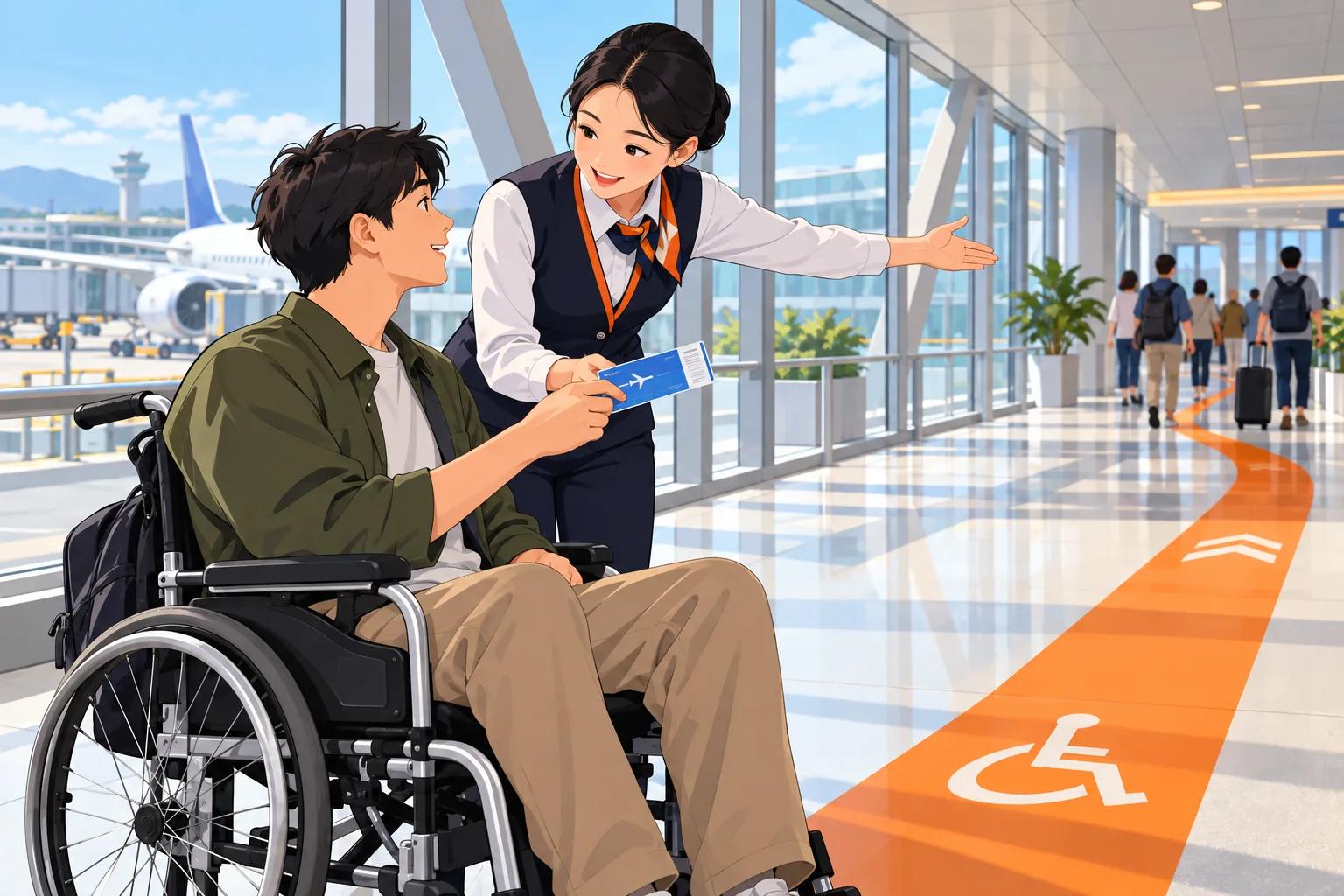
A connection through a Chinese airport can be straightforward on paper and stressful in a wheelchair. You may have one booking reference, yet two operating airlines, a change of terminal, a mobility aid in the hold and no clear name for the person meeting you at the aircraft door. Plan the handoffs before you book. Ask each airline to confirm exactly where its assistance starts and ends, and keep a workable fallback if the flight changes.
This guide is for a Singapore-based traveler connecting through a mainland China airport. It covers requests for airport and boarding assistance, the transfer from one flight to another, and a contingency if the planned connection breaks. It does not promise that a particular airport route, lift, vehicle or minimum connection time will work for every traveler. Those details depend on the flights, terminals, assistance type and equipment available on the day.
Request airport wheelchair assistance before departure
Contact the airline operating each flight and describe what you can do independently. Ask for help on both legs: terminal wheelchair, boarding support, aisle chair or seat transfer. If you bring your own wheelchair, provide dimensions, weight and battery details early. An online request is not necessarily confirmed.
Identify the operating airline on every leg
The flight number on an itinerary is not always the airline that operates the aircraft. Codeshare tickets can display a marketing airline while another airline supplies the crew, aircraft and ground operation. Read the line that says “operated by” for each segment. Then contact the operating carrier through its official special-assistance channel. If your ticket combines two carriers, ask both for written acknowledgement. A booking agent may pass notes along, but you should not assume one carrier's wheelchair request automatically appears in the other's reservation.
For example, Singapore Airlines' mobility-aid guidance describes its own meet-and-assist service and explicitly tells passengers connecting to another airline to check that airline's restrictions. China Eastern's wheelchair page describes assistance on its services, including boarding, disembarking and transit. Air China's special-passenger page says its special-service requests apply to Air China-operated flights. These are airline rules, not a universal airport promise.
A useful first message names both flight numbers, dates, airports and booking references. Ask the airline to repeat back the assistance entered for each segment. If it cannot see the onward flight, that is a signal to contact the other operator directly. Keep a record of the person or channel you contacted and the response date. Reconfirm after a schedule or carrier change, even if the ticket reference stays the same.
Ask for the right type of help
“Wheelchair assistance” is too broad a description if you cannot climb aircraft steps or need help between an aisle chair and your seat. Tell the airline whether you can walk short distances, climb steps, stand for a transfer and move along the aircraft aisle. Ask what equipment and staff will handle the specific steps you cannot do. A traveler who only needs a chair for a long terminal corridor has a different requirement from a traveler who cannot board without a lift or transfer assistance.
China Eastern distinguishes ground wheelchair, apron wheelchair and cabin wheelchair requests. Its published guidance asks for a ground or apron wheelchair request at least 24 hours before departure and a cabin wheelchair request at least 48 hours before departure. It also advises check-in at least 120 minutes before departure. Those are China Eastern's published conditions, not a safe universal booking deadline. Make the request as soon as the itinerary is known, especially when multiple airlines are involved, and check the current conditions for the actual operator.
Air China likewise describes separate assistance categories and asks travelers to book through its own channels. If you can walk in the cabin but cannot use aircraft stairs, say so clearly rather than accepting a terminal-only chair. Ask what happens if a jet bridge is unavailable and the flight parks remotely. The answer may involve a lift, a vehicle or another arrangement; obtain it for your flight instead of assuming every stand has identical facilities.
Assistance does not necessarily include lifting bags, caring for children, feeding a passenger, helping with personal hygiene or providing medical care. China Eastern sets out limitations for onboard care. If you need any of those forms of help, tell the airline and your travel companion in advance and ask about its companion or medical-document requirements. Do not describe essential personal care as a general wheelchair request, because the receiving team may prepare the wrong support.
Give the airline a complete mobility-aid record
If you bring a manual or powered wheelchair, create a short equipment sheet: make and model, dimensions when folded or configured for loading, total weight, battery chemistry, watt-hours where relevant, instructions for switching off or freewheeling, and the parts that must not be lifted. Add photos of the chair in travel configuration and any removable cushions or controls. Keep this sheet with your booking details, and send it to both operating airlines when they ask. It is easier to correct an equipment question before check-in than at a busy transfer desk.
Battery-powered aids require carrier approval and safe handling. Singapore Airlines says all battery-powered wheelchairs and assistive devices require airline approval, and it asks passengers to contact it at least 48 hours before departure. China Eastern also asks for advance notice to check an electric wheelchair and explains that operational capability can affect acceptance. Battery handling can depend on how the battery is fixed, protected or removed. Do not copy a limit from one airline or a generic power-bank rule onto another wheelchair model; get the operating carriers' instructions in writing for your specific aid.
Ask where your chair will be taken at Singapore departure, whether it can be handed over at the aircraft door, and where it will next be returned. “Gate check” and “collect at gate” are not interchangeable. At a China connection, your chair may remain checked through to the final destination or be needed during transfer. The answer can change with the ticketing arrangement, airport and equipment type. Ask what airport chair will be available if your own aid is not returned between flights.
Check confirmation, not just submission
An online form can acknowledge receipt without confirming that the airline can deliver the service. China Eastern states this distinction explicitly: submitting its online application does not itself mean approval, and capacity, seating or airport resources can affect the result. Save the confirmation message or reference and ask for the final status. If you only have an automated receipt, follow up through the airline's official support channel before departure.
Check the details shown in the reservation as well. A useful confirmation names the assistance type, the flights, the airports and the mobility aid. If an agent says the request is “in the system,” ask whether it covers the transfer and the onward leg. If the two legs have different operators, each operator should be able to confirm its own service. Build extra time into the itinerary while these answers are pending; do not treat an unconfirmed request as a reason to purchase a tight connection.
Map arrival to onward-flight transfer handoffs
Draw the connection as a chain: aircraft door, first escort, arrival corridor, transfer screening or border checkpoint, possible terminal change, second airline's transfer point, departure gate and aircraft seat. Ask who escorts you through each step and where the responsibility changes. A one-ticket itinerary, a short published minimum connection time and a wheelchair request do not prove that the accessible path works at your pace.
Start with the actual transfer path
Write down the arrival and departure airports, terminals and operating airlines. “Shanghai” is not a precise transfer plan when an itinerary may involve different airports or terminal areas. Check whether both legs use the same airport, whether you remain airside, and whether a passport or security process interrupts the route. Avoid assuming that a route described for a through-ticket also applies to two separately purchased tickets. The airline and airport should verify the route for your particular booking.
For background on reaching the city rather than changing flights, see our Shanghai airport transfer guide. This article addresses a different decision: whether the assistance handoff during a flight connection is confirmed and manageable. If your ticket requires leaving one airport and traveling to another, treat it as a landside journey with separate transport and check-in needs, not a standard airside connection.
Ask the first airline where staff will meet you after landing. Will an escort be at the aircraft door, at the end of the jet bridge or at a transfer counter? If you need an onboard aisle chair, confirm the arrangement from seat to door, then from door to the next airport chair. State whether you can wait standing, because “meet at terminal entrance” is not a workable handoff for someone who cannot walk there. Ask the onward airline where its responsibility begins and how the teams communicate if the inbound flight is late.
Test the time with your own steps
The shortest legal or published connection may be too short for a traveler who needs a lift, an escort, an equipment exchange and a terminal change. A minimum connection time is an airline scheduling rule, not a personal guarantee of accessible movement. Ask the airline whether the connection is suitable for the specific assistance requested, including a remote stand, a late arrival and a queue at transfer screening. If it cannot answer, seek a longer alternative before purchase.
Make a realistic timeline without pretending to know fixed minutes for each airport. Allow for the aircraft to park, doors to open, other passengers to leave if the escort arrives later, your transfer into a chair, the accessible route through checks, and boarding of the next flight. Ask when the departure gate closes; the next aircraft's departure time is not the time by which you need to arrive there. If the proposed connection has no buffer once those steps are included, choose another itinerary.
A single ticket usually makes it easier for the airline to see a protected connection and rebooking obligation, but it still does not prove the accessibility plan. Separate tickets can create additional check-in, baggage and rebooking risk. If you use separate tickets, ask whether you must collect baggage, enter China and check in again, and whether the wheelchair can be returned where you need it. If no operator can confirm the complete path, do not build a plan around an assumed airside transfer.
Identify the person who owns each handoff
At Singapore check-in, ask the agent to read back the assistance request for the inbound China flight and the onward segment. Confirm the boarding location and where your personal wheelchair will be tagged. Before landing in China, tell cabin crew you have an onward flight and ask them to check the expected meeting point. At the arrival door, confirm that the person assisting you knows the onward flight number and gate or transfer desk. If they do not, ask them to contact the relevant airline's transfer team before leaving the handoff point.
Keep your boarding passes, booking references and the airline's assistance confirmation on your phone and in a small paper copy. A simple card can say: “I have wheelchair assistance confirmed for flight [number]. I cannot [climb stairs / walk to the transfer desk / transfer without support]. Please confirm the next handoff and the location of my wheelchair.” You can show the same information to several teams without relying on a long spoken explanation in a noisy terminal. Add a travel companion's contact details if the companion is authorized to speak for you.
The chair you use in the terminal may belong to the airport or to a ground handler rather than the airline. That does not change the need for a clear owner of the request. Ask the airline to coordinate the handoff; do not assume a logo on the chair tells you who can change the booking or authorize a different connection. If help has not appeared at the agreed meeting point, stay where staff can find you and call the official airline contact or ask a uniformed airport staff member to contact the transfer team.
Plan for your own wheelchair's route
A mobility aid is not merely luggage; its absence can make a connection impossible. Before flying, agree whether the chair will be returned at the China transfer point, at the departure gate for the next flight, or only at the final destination. Ask what happens if the chair needs a different aircraft hold, a battery check or a size assessment. Photograph its condition, control settings and any detachable parts before handover, and keep essential cushions or removable controls according to the airline's safe-carriage instructions.
At the transfer, do not leave an airport chair until the next usable chair or boarding aid is actually present. If the onward flight changes aircraft, ask the second airline to reconfirm cargo-door clearance and battery acceptance for the replacement aircraft. Singapore Airlines advises passengers connecting to other carriers to check each carrier's restrictions for precisely this reason. A travel agent's assurance that the ticket is valid does not answer whether a powered chair fits a particular aircraft.
If your final destination is in China rather than another country, ask where you will receive your wheelchair after customs or baggage reclaim. The arrival hall is not necessarily the same place as the aircraft door, and assistance may end at a specified point. Plan onward transport separately. Our China travel planning guide covers wider arrival logistics, but confirm any wheelchair vehicle or local transport directly with its provider.
Prepare a backup when an accessible connection changes
Before travel, identify a longer alternative connection and save the operating airlines' support channels. If an inbound delay, gate change or aircraft swap threatens the original plan, tell staff which assistance and mobility-aid arrangements must be preserved. Ask for a confirmed replacement flight and a new handoff plan together. Rebooking the seat alone may leave the traveler without the help needed to reach it.
Define a workable alternative before the disruption
Find another itinerary that uses the same airport or gives you enough time to change terminals. Check whether it is on the same airline or introduces a new operator. A later flight on a different aircraft may require a fresh wheelchair or battery approval. Record the flight numbers only as options, not promises of inventory. If you booked through an agent, ask which airline or ticketing desk has authority to change the journey during disruption.
For a tight connection, decide in advance what you would prefer: a same-day later flight, an overnight connection with accessible accommodation, or returning to the departure point to travel another day. Your best choice depends on mobility, medication, companion availability and whether the wheelchair remains with you. An overnight option is not useful if transport to the hotel and an accessible room cannot be confirmed. Give the airline the practical constraints before it issues a replacement itinerary.
Carry essential medication and a compact mobility kit in permitted hand baggage rather than in the checked wheelchair case. Bring the chair's setup instructions, a charger or battery document where the airline permits it, and contact information for a companion or repair provider. Pack enough essentials to handle an unplanned delay, within the airline's baggage and security rules. Do not make the only copy of an equipment instruction sheet inaccessible inside checked baggage.
Respond to a missed or changed flight
If the inbound flight is late, tell cabin crew about the wheelchair connection before landing. At the arrival handoff, ask the escort to contact the transfer or rebooking desk while you remain in a safe seated location. Show both boarding passes and the special-assistance confirmation. If staff offer a replacement flight, check four things before accepting: operating carrier, terminal, aircraft compatibility with your aid, and the new confirmed assistance request.
Ask where you and your wheelchair will wait. If your chair is checked through, request an airport chair suitable for the waiting period and clarify whether your aid can be retrieved if the delay becomes overnight. If the chair is separated from you or arrives damaged, report it immediately through the operating airline's official process and get a written reference. Singapore Airlines' mobility-aid page describes its own damage-report route, but another airline's process may differ. Photograph visible damage and preserve tags and receipts.
A gate change is a smaller disruption that can still invalidate the walking distance assumed by a terminal-only request. Tell staff if the new gate is too far or the route has an inaccessible step. Ask the assistance team to escort you rather than trying to hurry independently. If a remote stand replaces a jet bridge, reconfirm the boarding aid. The correct response is an updated route and equipment plan, not an instruction to “just allow a little more time.”
Keep decisions and promises in a simple record
Make a one-page travel record with dates, operating carriers, booking references, assistance categories, chair details, request and confirmation numbers, transfer points, and the names or departments you contacted. Add a blank line for what happened on the day. If a staff member changes the plan verbally, ask them to note it in the booking or send a message where possible. This record helps the next team understand the situation without making you reconstruct every call.
An example entry might read: “Arrival flight confirmed for terminal wheelchair to transfer screening; onward airline to meet at transfer desk; personal power chair checked to final destination; boarding assistance requires a lift if remote stand; confirmation received on [date].” Replace each clause with your own verified answer. If any clause remains unknown, label it unknown and follow up before departure. A blank box is safer than an invented assurance.
Do not publish medical information or equipment serial numbers in a public social-media post to get attention. Use the airline's official support channel and provide only the details necessary for the service. If you need an interpreter, request one through the airline or use a trusted companion, while keeping the key mobility instructions in plain English and, if helpful, a professionally checked translation. At the airport, staff need a clear functional description more than a diagnosis.
Make the booking decision
Choose a connection only after you can answer three questions: who confirms the correct assistance on each operating flight, who meets you at every transfer handoff, and what happens to your own wheelchair when a flight changes. China Eastern, Air China and Singapore Airlines all publish useful assistance information, but their rules and coverage differ. The ticket's published connection time is only one input. A slightly longer, confirmed itinerary can be the more practical choice when a short one relies on an unverified handoff.
If the itinerary is already booked and one answer is missing, contact the operating airline now. Ask for a specific reply tied to your flight numbers and mobility needs. If the airline cannot support the service on that itinerary, ask for a workable alternative before travel day. This is the decision the guide is meant to support: a confirmed chain of care and equipment, not a generic promise that every China connection is accessible.
Official sources and verification
- China Eastern: Passengers with Wheelchairs — assistance categories, notice periods, transit support, equipment handling and confirmation conditions.
- Air China: Special Passengers Service Plan — operated-flight scope and assistance request channels.
- Singapore Airlines: Mobility Aids — meet-and-assist, powered-aid approval and onward-airline checks.
These pages were checked on 5 October 2026. Recheck current service rules and the actual operating carriers before booking or travel. The details of a specific China airport transfer must come from the airlines and airport handling your itinerary.