How do you buy and eat at Busan Jagalchi Market, Korea's biggest seafood market?

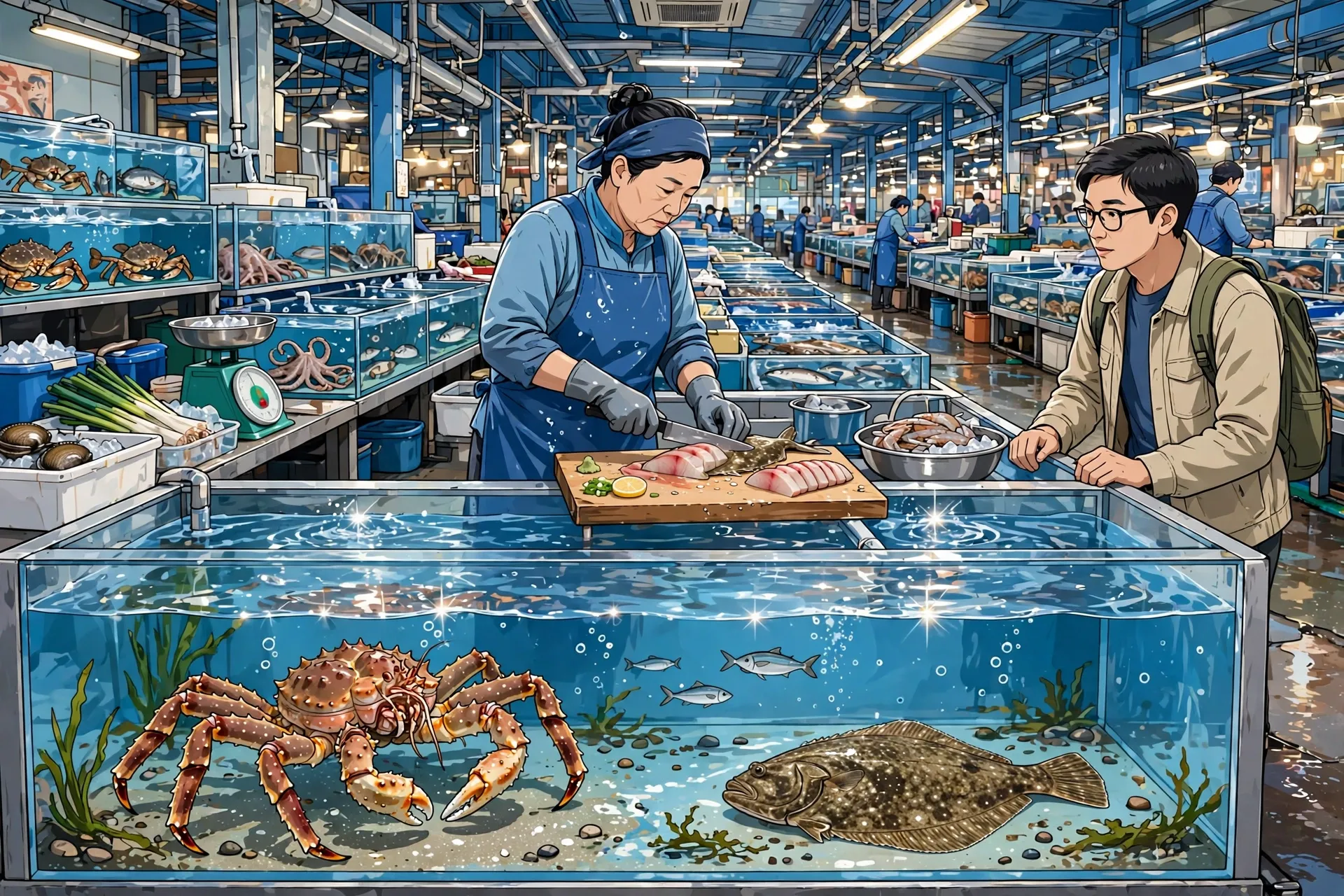
Jagalchi Market in Busan is one of Korea's largest seafood markets, and it works differently from any supermarket or restaurant you have used before. You buy live fish from the tanks on the ground floor, then carry it upstairs to a small restaurant that slices, grills, or steams it for a separate cooking fee. The fish bill and the cooking bill are separate, and that is the whole system to understand before you go. Confirm the weight and the price of the fish before it leaves the tank, and confirm the cooking fee before you sit down. Do that, and you get one of the freshest meals in Korea at a fair price. Hoe, raw sliced fish, is the signature order. Flounder and rockfish are the everyday choices vendors suggest to first-timers. King crab is the big-ticket draw, priced by live weight at the day's market rate. The market opens at 05:00 and runs to 22:00, closed on the first and third Tuesdays of each month. Jagalchi Station on Line 1, Exit 10, is a three-to-five-minute walk away.
What Jagalchi Market is — and why it is Busan's seafood centre
Jagalchi Market sits on the seaside road in Busan's Jung-gu, and it is one of the largest seafood markets in Korea, selling both live and dried fish. After the Korean War the market solidified itself as a fish market, and most of the vendors are women, known as Jagalchi Ajumeoni. That history is still visible in the building today: the ground floor is tanks of live fish and stalls of dried seafood, run by vendors who have worked these stalls for years. It is a working market first and a visitor attraction second, which is exactly why the food is so fresh — the fish you eat was swimming in a tank minutes before it reached your table.
How the two-bill system works: buy downstairs, eat upstairs
The system has two steps, and two bills. First, choose fresh live fish and seafood on the first floor. Then head upstairs to a chojangjip restaurant and have it served as sliced raw fish or grilled on the spot. The seafood price and the upstairs restaurant charge are two separate bills, so confirm three things before you agree: the weight, the seafood price, and the preparation method. Ask what the restaurant charge covers before sitting down. Cooking fees vary by restaurant, so confirm the fee before handing over the fish — there is no single standard charge to quote in advance. Once both prices are agreed, the restaurant takes your fish and prepares it while you sit down. The whole point of the system is choice: you pick the exact fish, and you pick how it is cooked.
What to order: hoe, king crab, and the grilled stalls
Hoe, raw sliced fish, is the market's signature order, and it is what most first-timers come for. Flounder and rockfish are the everyday choices vendors steer first-timers toward — familiar, fairly priced, and good sliced raw. King crab is the big-ticket draw. It is priced by live weight at the day's market rate, and most of it is imported live rather than caught locally, so no fixed price can be quoted in advance: ask the per-weight price and confirm the total weight before the crab leaves the tank. If raw fish is not for you, the grilled stalls cook fish on the spot upstairs — the same buy-downstairs, eat-upstairs system, with grilling instead of slicing. Order one fish to share if you are eating as a pair; the portions are generous, and you can always order more once you know what you like.
Hours, closed Tuesdays, and getting there
The market is open 05:00 to 22:00 and closed on the first and third Tuesdays of each month. One warning: the market operator also lists fifth Tuesdays as closed days, while Visit Korea lists only the first and third. Check the market notice before visiting on any Tuesday so a closed day does not catch you out. The nearest subway is Jagalchi Station on Busan Line 1, Exit 10, about 270 metres from the market at 52 Jagalchihaean-ro, Jung-gu, Busan — a three-to-five-minute walk. Allow 1.5 to 3 hours for the visit: time to browse the tanks, agree prices, eat upstairs, and wander the dried-fish stalls. If you are in Busan over Christmas, check the Christmas open/closed guide before you go, since holiday hours differ across the city.
A half-day around Nampo: Jagalchi, Gukje Market, and the rooftop view
Jagalchi pairs naturally with the streets around it. Gukje Market is about a five-minute walk away, and the market pairs naturally with BIFF Square and the Nampo-dong streets, so a morning at Jagalchi flows into an afternoon of browsing without any extra travel. Before you leave the building, go up to the free rooftop observatory, open approximately 09:00 to 21:00, for the harbour view over Nampo — it is the best way to end the visit, looking back over the waterfront where the fish came in. A simple half-day plan: arrive at Jagalchi in the late morning, eat upstairs, walk five minutes to Gukje Market, then loop through BIFF Square and the Nampo-dong streets before heading back.