Tokyo to Kyoto without the national rail pass

The 60-second no-pass playbook
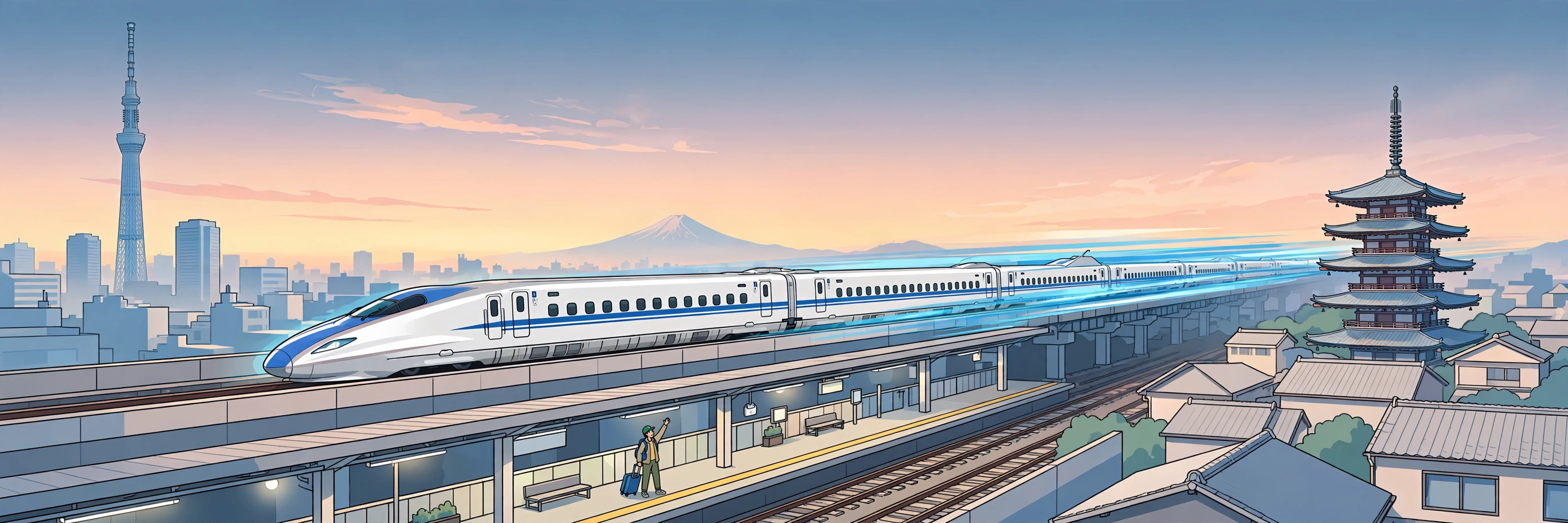
Traveling Tokyo to Kyoto without a rail pass is simple: buy a Nozomi ticket for the fastest 2-hour-20-minute ride, or a Hikari to save a few hundred yen. Reserve seats on busy days, forward large luggage a day ahead, and reach Tokyo Station 30 minutes early.
That is the whole decision in one paragraph. Everything below is about executing it without friction — which ticket type to pick for your schedule, what to do with your bags, and how to move through two of Japan's busiest stations without getting lost or stressed.
Nozomi vs Hikari: the speed and price trade-off
The Tokaido Shinkansen between Tokyo and Kyoto is served by three train types, but for this route only two matter: Nozomi and Hikari. (Kodama stops at every station and is the slow fallback — fine if you miss everything else, but not a plan.)
Nozomi is the fastest option on the route. A Nozomi from Tokyo reaches Kyoto in roughly 2 hours 10 minutes to 2 hours 20 minutes, depending on the specific departure. Every seat on a Nozomi is reserved — there are no non-reserved cars — so you pick your train and your seat when you buy. That rigidity is the trade: you get the fastest ride, but you are committed to a specific departure.
Hikari takes roughly 2 hours 40 minutes to 3 hours for the same trip and costs a few hundred yen less than a Nozomi on the identical route. Hikari trains carry non-reserved cars, which makes them the flexible option: if your morning runs late, you can take the next Hikari and sit in a non-reserved car without rebooking. During off-peak travel days, non-reserved Hikari seats are easy to find. During Golden Week, Obon, and the New Year holidays, assume they are full and reserve.
So the decision is mechanical, not philosophical:
- Your schedule is fixed and you want speed: Nozomi, reserved. Buy ahead on peak-season days.
- Your schedule is loose or you want to save a little: Hikari, and consider non-reserved if you are traveling light and off-peak.
- You are traveling during a major Japanese holiday: reserve a seat on whichever train fits, days ahead if possible. These are the days the Shinkansen genuinely sells out.
One more pricing note: the old Japan Rail Pass math no longer favors most single Tokyo–Kyoto trips. A 7-day pass costs several times what two one-way Shinkansen tickets cost, so for a trip that includes only this transfer, buying point-to-point tickets without a pass is usually the cheaper and simpler choice. The pass only starts to make sense with multiple long-distance legs in one week.
Forwarding luggage Tokyo to Kyoto: same-day delivery services compared
This is the decision that separates smooth transfer days from miserable ones, and it is the one most first-time visitors get wrong.
The oversized-baggage rule. On the Tokaido Shinkansen, any piece of luggage whose total dimensions exceed 160 cm must be placed in the designated oversized-baggage area, and that requires reserving a seat with oversized-baggage space in advance. Standard rolling suitcases (the common 60–70 liter size) usually fall under the limit, but large expedition-style bags and anything over 160 cm total do not. If you are unsure, measure height + width + depth before you go. Reserving the oversized-baggage seat is free; the penalty is only for showing up with a giant bag and no reservation, when staff may refuse boarding with it.
The practical answer for most travelers: forward your big bags. Japan's luggage-forwarding services (takkyubin, operated by companies like Yamato Transport) will take your suitcase from your Tokyo hotel's front desk and deliver it to your Kyoto hotel. The standard Tokyo-to-Kyoto service is next-day, not same-day: bags dropped in the morning typically arrive the following day. That means the correct move is to send your luggage the day before you transfer, travel with just an overnight bag on the Shinkansen, and have your suitcase waiting when you check in. Most hotels handle the paperwork at the front desk in a few minutes, and the fee per bag is roughly the price of a nice lunch — cheap compared to wrestling a 25 kg suitcase through station crowds.
If you must have your bags the same day you travel, carry them. Coin lockers at both stations can hold bags for a few hours if you want to sightsee before check-in, and the Shinkansen overhead racks fit standard carry-on sizes. What you should not do is drag a full-size suitcase onto a packed Nozomi during rush hour with no reservation for it — that is the single most common way to make enemies of your fellow passengers and your own shoulders.
A packing rule of thumb for this transfer: if you can lift your bag overhead with one hand without strain, carry it. If not, forward it a day early. Travelers following a wider Japan route can plan the whole sequence — including this transfer — with our 7-day Japan itinerary planner.
Tokyo Station shinkansen gates and Kyoto Station exits that save time
Tokyo Station is enormous, and the Shinkansen area is a station-within-a-station. The Tokaido Shinkansen departs from the Yaesu (east) side of the complex, through dedicated Shinkansen gates that are separate from the regular JR gates. The most common first-timer mistake is entering through a JR local-line gate and then wandering the underground maze looking for the blue Shinkansen signs.
Do this instead:
- Enter on the Yaesu side if you can. If you arrive by taxi or airport bus, ask for the Yaesu exit. If you arrive by JR or subway, follow the signs for the Tokaido Shinkansen (blue signs, English included) from the moment you step off — do not exit through a regular ticket gate first.
- Go through a Shinkansen gate, not a JR gate. Your Shinkansen ticket (or IC card linked via Smart EX) opens the Shinkansen gates. If you go through a regular JR gate by mistake, you will need staff help to sort out the fare — allow extra minutes for this.
- Check the departure board for your platform. Tokaido Shinkansen platforms are numbered in the mid-teens and sit above the concourse level. The board shows the train name (Nozomi/Hikari), departure time, and platform number in English.
- Buy food before the gate, not after. The concourse outside the Shinkansen gates has far better ekiben (station bento) and snack options than the platform kiosks. A bento and a drink make the 2-hour ride genuinely pleasant.
Timing: arrive at the station 30 minutes before departure. That sounds generous until you factor in the size of the building, the walk from the subway, and a possible wrong turn. Twenty minutes is the minimum for a confident traveler who knows the layout; first-timers should take the full thirty.
At the Kyoto end, the decision that matters is simpler: which side of the station your hotel is on.
The Shinkansen platforms sit at the south (Hachijo) end of the station. After you pass through the Shinkansen gates, you walk north through the station building toward the main exits. The two exits that matter:
- Karasuma (north) exit: faces downtown Kyoto. This is the side for the subway Karasuma Line, most city buses, and taxis into the central districts (Kawaramachi, Gion, central Nakagyo). If your hotel is in central or eastern Kyoto, exit here.
- Hachijo (south) exit: faces the newer development on the south side, with its own taxi stand and bus stops. Some business hotels and the newer station-front properties are on this side.
Check your hotel's address before you board in Tokyo and decide your exit in advance. Wandering the station for fifteen minutes at arrival, bags in hand, is the classic avoidable delay. If your hotel is near a subway station on the Karasuma Line, the subway entrance is right at the Karasuma-side underground level — one of the fastest ways out of the station area entirely.
A note for the return or onward journey: Kyoto Station's Shinkansen gates are at the south end, so if your hotel is on the north side, allow 10 extra minutes to walk the length of the station building to reach the gates.
Smart EX app vs station ticket machines for foreign travelers
You have two practical ways to buy a no-pass Shinkansen ticket. Both work; they suit different travelers.
The Smart EX app (JR Central's official booking service). You create an account, buy your ticket online, and link it to an IC card (Suica, ICOCA, etc.). At the station, you tap the IC card at the Shinkansen gate and board — no paper ticket, no machine queue. You can also change your reservation from the app if your plans shift. The catch: setup takes 10–15 minutes (account, payment card, IC registration), and the interface is functional rather than beautiful. Do the setup at your hotel the night before, not at the station with 20 minutes to departure. For travelers comfortable with apps, this is the smoothest option.
Station ticket machines. The Shinkansen ticket machines at Tokyo Station have full English interfaces and sell reserved and non-reserved tickets for Nozomi, Hikari, and Kodama. They accept cash and most credit cards. This is the better option if you prefer a paper ticket in hand, are buying for a group, or just don't want another app. The only real downside is the queue: at peak morning hours, allow 10 extra minutes for the machine line.
A quick word on IC cards. Even if you buy a paper ticket at the machine, having a charged IC card (Suica, ICOCA, or any major one — they work interchangeably across regions for gates and purchases) smooths everything around the transfer: subway rides to Tokyo Station, drinks from vending machines, and the Kyoto subway after arrival. You can buy and charge one at the airport or any major station.
What about buying from a travel agent or hotel concierge? Hotels can sometimes arrange tickets, but the markup and the back-and-forth rarely beat doing it yourself in five minutes on the app or at a machine. Save the concierge for restaurant reservations.
One thing neither option solves: peak-season sellouts. During Golden Week (late April–early May), Obon (mid-August), and the New Year period, Nozomi trains sell out days ahead. If your Tokyo–Kyoto transfer falls in one of these windows, buy your reserved ticket as early as your plans allow — the earlier you commit, the better your choice of departure times.
A travel-day timeline that actually works
Here is a concrete schedule for a morning transfer, assuming a 9:00 AM Nozomi and a hotel near Tokyo Station. Shift it to your own departure time.
- 7:30 AM — Check out and handle luggage. If you forwarded bags yesterday, confirm the delivery slip at the front desk. If carrying, have everything packed and ready.
- 8:00 AM — Leave the hotel. Walk or take one subway stop to Tokyo Station. Build in a buffer; morning trains run on time but your feet might not.
- 8:15 AM — Enter via the Yaesu side, buy your bento. Pick up food and drinks from the concourse shops before going through the Shinkansen gates.
- 8:30 AM — Through the Shinkansen gates. Tap your IC card or insert your ticket. Check the departure board, head to the platform.
- 8:40 AM — On the platform. Nozomi trains are long; your car number is on your ticket or in the app. Line up at the correct car marker.
- 9:00 AM — Departure. Stow small bags overhead, large bags in the designated end-of-car space if you reserved it. Settle in.
- ~11:20 AM — Arrive Kyoto. Follow the flow toward the Shinkansen gates, then walk north through the station to your chosen exit (decided yesterday, not today).
- 11:40 AM — Out of the station. Subway, bus, or taxi to your hotel. Most hotels hold luggage before check-in, so drop bags and start your afternoon.
Total active travel time: under four hours door to door. The rest of your day in Kyoto is free — which is exactly why the morning transfer is the right call. If this transfer is part of a longer route, our 7-day Japan itinerary planner shows how to sequence Tokyo, Kyoto, and Osaka without backtracking.
The five mistakes that cost people an hour
- Buying the pass out of habit. The national rail pass made sense when it was cheap relative to individual tickets. At current prices, a single Tokyo–Kyoto round trip does not come close to justifying a 7-day pass. Do the arithmetic for your actual itinerary before buying.
- Assuming Nozomi has non-reserved seats. It does not. Every Nozomi seat is reserved. If you show up hoping to hop on the next Nozomi without a reservation, you will be buying a new ticket or waiting for a Hikari.
- Bringing unreserved oversized luggage. Over 160 cm total dimensions without a reserved oversized-baggage seat is a boarding problem, not a minor inconvenience. Measure, reserve, or forward.
- Entering Tokyo Station through the wrong gate. The five minutes you save by entering on the correct (Yaesu) side compounds: no backtracking, no staff-assisted fare sorting, no sprint.
- Transferring in the afternoon. Morning Shinkansen trains are frequent and the arrival gives you a full Kyoto afternoon. Afternoon transfers eat the day and collide with check-in queues.
Bottom line
The no-pass Tokyo–Kyoto transfer is one of the easiest long-distance journeys in the world once you strip away the pass-era habits: pick Nozomi for speed or Hikari for flexibility, reserve when it matters, forward your big bag a day early, and give Tokyo Station the thirty minutes it deserves. Do those four things and the transfer becomes the relaxing part of your trip — two quiet hours watching the countryside slide past the window, arriving in Kyoto with the whole afternoon ahead of you.