Seoraksan's Sinheungsa Temple: Hiking, History & Mountain Views
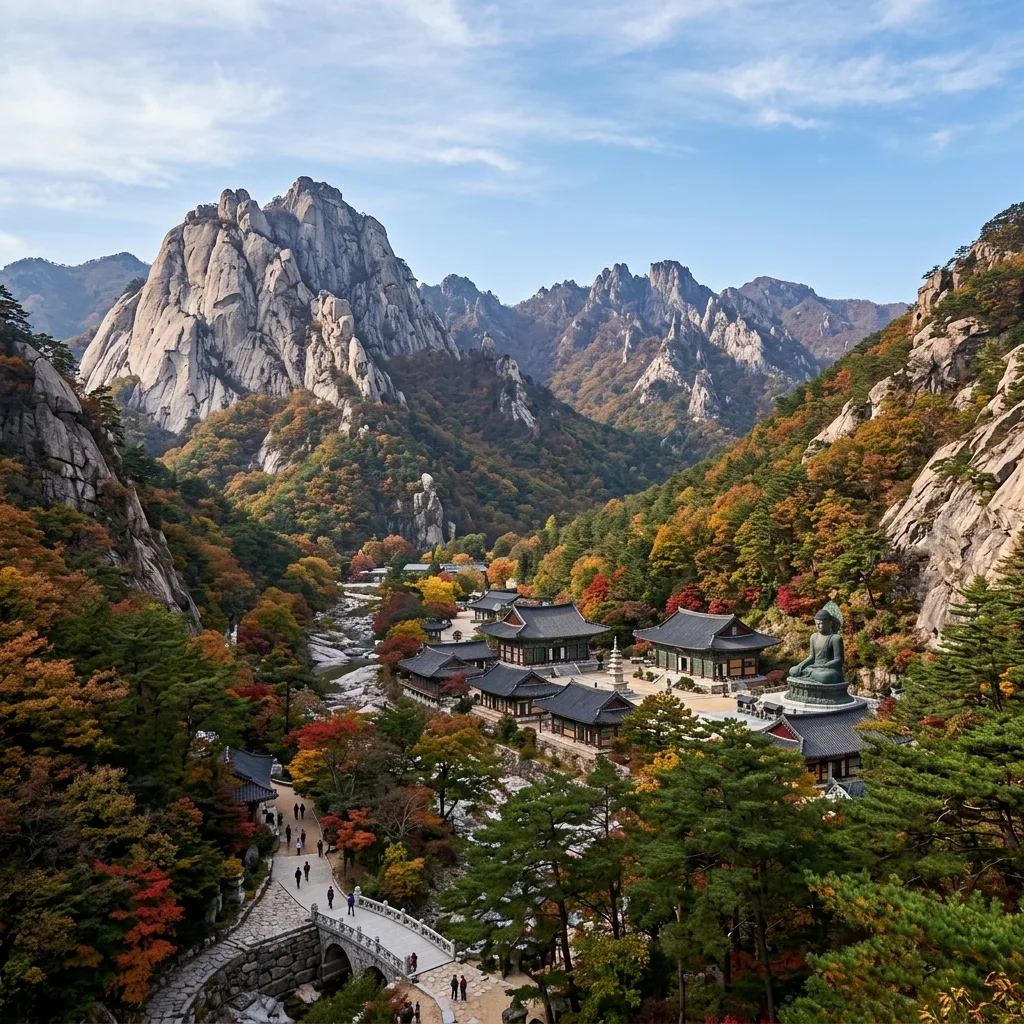
Most travelers rushing through Seoraksan National Park aim straight for the cable car or charge up to Ulsanbawi Rock without pausing at the ancient temple sitting quietly at the mountain's base. That's a mistake. Sinheungsa Temple isn't a footnote on the way to a better view — it is the beating cultural heart of Seoraksan, a 1,400-year-old sanctuary where granite peaks, whispering pines, and the sound of bronze bells create something you won't find anywhere else in Korea.
Whether you're a first-time visitor to Korea or a returning traveler who's already ticked off Gyeongbokgung and Bulguksa, Sinheungsa rewards the curious. This guide covers everything: the temple's layered history, the hiking trails that fan out from its gates, the giant bronze Buddha you probably didn't know was there, and all the practical details — buses, fees, and the best season to go.
A Brief History: 1,400 Years on the Mountain
Sinheungsa is one of the oldest Buddhist temples in Korea, with roots stretching back to 652 CE during the reign of Queen Jindeok of the Silla Dynasty. A monk named Jajang — the same revered figure associated with Tongdosa Temple in Yangsan — is credited with founding the original hermitage on this site, then called Hyangseongsa (향성사).
The temple's history since then has been anything but tranquil. Hyangseongsa burned down in 698 CE, was rebuilt, and burned again in 1645. After the second major fire, the monks chose a new location slightly downhill from the original site, naming the rebuilt complex Sinheungsa — meaning "newly flourishing temple." The main hall, Geungnakbojeon, dates from 1648, making it one of the older surviving wooden structures in the country.
Over the centuries, Sinheungsa became the administrative headquarters for a network of hermitages scattered across Seoraksan — including Boseok Hermitage, Gyejo Hermitage, and the famous Naksansa Temple on the coastal cliffs to the south. Today it oversees more than a dozen subsidiary temples and hermitages, making it one of the most organizationally significant Buddhist institutions in Gangwon Province.
Jajang and the Buddhist Legacy of Seoraksan
Monk Jajang is a towering figure in Korean Buddhist history. He traveled to Tang Dynasty China, studied under Chinese masters, and returned with relics of the historical Buddha — a piece of the robe and bone fragments — that he enshrined at key mountains across the peninsula. Seoraksan was one of his chosen sites. This connection gives Sinheungsa a spiritual prestige that goes beyond age or architecture, drawing Buddhist pilgrims from across Korea who see the mountain itself as sacred ground.
For a deeper look at the broader tradition Sinheungsa belongs to, Korea's Most Sacred Buddhist Temples: A Complete Visitor's Guide puts Sinheungsa in context alongside Tongdosa, Haeinsa, and Songgwangsa.
The Tongil Daebul: Korea's Giant Unification Buddha
The first thing you'll notice after passing through the temple's outer gate is not a wooden hall or a stone pagoda — it's a colossal bronze Buddha standing 14.6 meters tall on a 4.3-meter lotus throne, gleaming against the dark forest behind it.
This is the Tongil Daebul (통일대불), the Unification Buddha, completed in 1997 after seventeen years of construction. The statue was built with a specific purpose: to pray for the peaceful reunification of North and South Korea. It faces north, toward the divided peninsula, and is inscribed with the aspiration that one day Koreans on both sides will be able to visit freely.
The Buddha is cast in bronze — 108 tons of it — and depicts Amitabha, the Buddha of Infinite Light associated with the Western Paradise. The scale doesn't register until you're standing at its feet. Most visitors instinctively reach for their cameras and then spend a few minutes simply looking up. It's one of the largest outdoor bronze Buddhist statues in Asia, and somehow the drama of the mountain backdrop makes it feel earned rather than ostentatious.
On the inside of the stone base, a smaller interior hall contains additional Buddhist paintings and relics. If the doors are open, it's worth stepping in.
The Temple Grounds: What to See
Sinheungsa's main compound is compact but richly detailed. Allow 45 minutes to an hour to walk it properly.
Geungnakbojeon (극락보전) — The main hall, rebuilt in 1648, is dedicated to Amitabha Buddha. The interior is dim and fragrant with incense, painted in blues, reds, and greens that have faded beautifully over centuries. Monks lead morning and evening prayer services here; if you arrive around 4–5 AM or at dusk, you may catch the resonant chanting.
The Bell Pavilion — Houses a large bronze bell, a wooden fish drum (mokeo), and a cloud-shaped gong. The bell is rung at dawn and dusk, and the sound carries surprisingly far through the forest.
Stone Pagodas and Steles — Scattered throughout the grounds are carved stone lanterns, pagodas, and commemorative steles inscribed in classical Chinese. The oldest stele dates to the late Joseon period.
Auxiliary Halls — Several smaller shrine halls dedicated to Dokseong (the Mountain Spirit), Sanshin (the Recluse), and the Seven Star Deity ring the main compound. These halls blend Shamanist elements with Buddhist practice, a distinctly Korean synthesis you'll find at most major temples.
The grounds are kept immaculately by resident monks. Visitors are welcome but should move quietly, avoid pointing cameras directly at monks during prayer, and remove shoes when entering any hall.
Hiking Trails from Sinheungsa
The temple is the main trailhead for several of Seoraksan's most popular routes. Trails radiate out from the compound, meaning you can combine a temple visit with a hike without doubling back to the park entrance.
Biseondae Trail (Easy — 3.4 km one way)
The most accessible hike from Sinheungsa follows a stream valley to Biseondae (비선대), a cluster of smooth granite rocks beside a clear mountain river. The path is flat, shaded, and well-maintained. Round trip takes about 1.5–2 hours. This is the trail to choose if you're visiting with children, older family members, or simply want a peaceful walk without a serious climb.
Heundeulbawi (Rocking Rock) Trail (Moderate — 1.6 km from Biseondae)
Continue past Biseondae to reach Heundeulbawi, a roughly 16-ton granite boulder perched on a cliff edge. Despite its size, the rock actually oscillates slightly when pushed at the right point — a geological oddity that's been fascinating visitors for centuries. The hike from the temple to Heundeulbawi and back takes around 3–4 hours total.
Ulsanbawi Trail (Challenging — 6 km round trip from temple)
Ulsanbawi (울산바위) is the 873-meter granite formation that defines the Seoraksan skyline — six massive rock pillars rising dramatically above the treeline. The trail is strenuous, involving more than 800 stone steps cut into the cliff face near the summit, but the panoramic view from the top across Sokcho, the East Sea, and the surrounding peaks is the best in all of Outer Seoraksan.
Budget 4–5 hours for the round trip from the temple, more if you want to linger at the top. Bring water, wear sturdy shoes, and avoid the trail in rain or after heavy snow — the stone steps become slippery.
For a comprehensive breakdown of all the routes across the national park, including trails in Inner Seorak that require a different entrance, A Guide to Hiking Seoraksan National Park: Stunning Peaks and Temples covers the full picture.
The Seoraksan Cable Car (Optional Addition)
A few hundred meters from Sinheungsa's entrance gate, the Seoraksan Cable Car whisks passengers up to Gwongeumseong Fortress at an elevation of approximately 700 meters. The cable car is a completely separate attraction from the temple hike — it does not connect to the Ulsanbawi or Biseondae trails.
The 5-minute ride provides sweeping views over the forested valleys and out toward the sea. At the top, a short trail (about 10 minutes each way) leads through the ruins of a Goryeo-era fortress to a rocky summit with a 360-degree panorama.
Cable Car Prices (2026):
- Adults: 14,000 KRW (round trip) / 10,000 KRW (one way)
- Children: 10,000 KRW (round trip) / 8,000 KRW (one way)
Queues can be long on weekends and during the autumn foliage season. Arrive early or book in advance online if you plan to combine the cable car with the temple and a hike.
Practical Guide
Admission
Entry to Sinheungsa Temple is free. Since the Korean government reached an agreement with Buddhist authorities to fund temple maintenance through public funds, the separate "temple cultural heritage preservation fee" that was previously charged at many national park temples has been abolished.
Seoraksan National Park entrance itself currently charges 2,500 KRW per adult. This fee applies at the Seorakdong Entrance gate (the main outer gate before the temple). Children under 13 and seniors over 65 are generally exempt. Verify the current fee at the park entrance, as national park admission policies in Korea continue to evolve.
Opening Hours
The park's Seorakdong Entrance area and temple grounds are accessible from early morning (typically from 6:00 AM) until around 6:00 PM in winter and later in summer. The visitor center opens at 9:00 AM. Trail closures may apply during fire season (late spring and early autumn in dry years) or after heavy snowfall — check notices at the entrance gate.
Individual temple halls typically observe prayer services at dawn and dusk; outside those windows, the main hall is generally open to respectful visitors during daylight hours.
How to Get There from Sokcho
Sokcho is the gateway city for Seoraksan. It is connected to Seoul by express bus (about 2.5 hours from Seoul Express Bus Terminal) and by intercity bus from Gangneung (about 1 hour).
By local bus from Sokcho: Take Bus 7 or 7-1 from Sokcho Intercity Bus Terminal or from stops along the Sokcho waterfront. The ride takes approximately 25–30 minutes and drops you at the Seorakdong Entrance. Buses run frequently throughout the day. Fare is standard city bus rate (approximately 1,500 KRW, payable by T-money or cash).
By taxi: A taxi from central Sokcho to the Seorakdong Entrance takes about 15 minutes and costs roughly 8,000–12,000 KRW depending on exact starting point and traffic.
By car: Parking is available at the Seorakdong parking lot near the entrance. Parking fees apply and spaces fill quickly on weekends. Aim to arrive before 9:00 AM on busy days.
From the bus drop-off or parking area, it is a pleasant 15–20 minute walk along a tree-lined path to the temple. The path passes souvenir shops, restaurants, and the cable car station along the way.
Getting the Most Out of Your Visit
A well-organized visit might look like this:
- Arrive at the entrance by 8:30–9:00 AM
- Walk to the temple and spend 45–60 minutes in the compound
- Hike to Biseondae and back (1.5–2 hours), or push to Heundeulbawi (3–4 hours total)
- Return to the cable car station for the late morning ride (before lunchtime queues build)
- Grab a meal at one of the restaurants near the entrance before heading back to Sokcho
Best Season to Visit
Spring (April–May): Cherry blossoms and azaleas bloom along the path from the entrance to the temple in mid-April. Temperatures are mild (10–18°C), crowds are moderate, and the light on the granite faces of Ulsanbawi is exceptional in the mornings.
Summer (June–August): The national park fills with hikers escaping Seoul's heat. Trails to Biseondae become crowded by mid-morning. The mountain streams run full and fast, and the forest is intensely green. Expect afternoon showers during the monsoon season (late June to mid-July).
Autumn (October–November): Peak season. The maple and oak trees surrounding the temple turn brilliant red and orange, and the mountain views are sharpest in the dry air. Every weekend from late October to early November is busy — arrive early or on a weekday.
Winter (December–February): The fewest crowds, the deepest quiet, and snow-covered rooftops on the temple halls that make for extraordinary photographs. Some upper trails may be closed or require crampons. The cold is real (often below -10°C), but the clarity of the air and the emptiness of the paths are rewards in themselves.
Tips and Common Mistakes
Don't skip the grounds for the trails. Most visitors walk straight through the temple compound toward the hiking trails. Slow down. Read the stele inscriptions (some have English plaques), look at the painted murals on the eaves, and stand quietly by the Unification Buddha for a few minutes.
Dress in layers. Even on warm spring days, the mountain valleys generate their own cool breezes, and temperatures drop quickly once you gain elevation on the Ulsanbawi trail.
Pack lunch for the Ulsanbawi trail. There are no food vendors once you pass Biseondae. The restaurants near the park entrance are fine for before and after, but plan for a long outing without resupply.
Check trail conditions in advance. The Korea National Park Service website (knps.or.kr) posts real-time trail closure alerts in Korean. If you can't read Korean, check recent visitor reviews on Naver Maps for current conditions.
Consider a temple stay. Sinheungsa itself does not offer an overnight temple stay program, but the tradition of sleeping in a Korean Buddhist monastery — waking before dawn, joining morning prayers, eating temple food — is one of Korea's most distinctive travel experiences. If that sounds appealing, The Sound of Silence: Essential Etiquette for a Korean Temple Stay is the guide to read before you book.
Avoid arriving by car on autumn weekends. The parking situation at Seorakdong is genuinely chaotic during peak foliage season. Bus 7/7-1 from Sokcho eliminates the parking headache and is faster door-to-door during heavy traffic.
Frequently Asked Questions
Is Sinheungsa Temple free to enter? Yes. The temple itself has no admission charge. The Seoraksan National Park entrance fee is approximately 2,500 KRW per adult, paid at the outer gate before you reach the temple.
How long should I budget for a visit to Sinheungsa? Allow at least 45–60 minutes for the temple alone. Add 1.5–2 hours for the Biseondae hike, or 4–5 hours if you're going to Ulsanbawi. A half-day trip from Sokcho covering the temple and Biseondae is easily achievable.
Can I visit Sinheungsa as a day trip from Seoul? Yes, but it makes for a long day. Express buses from Seoul to Sokcho run regularly and take about 2.5 hours. Arriving in Sokcho by 9 AM, spending the morning at the temple and Biseondae, and catching an afternoon bus back is manageable. Staying overnight in Sokcho is much more comfortable and gives you time to explore the seafood market.
Is the hike to Ulsanbawi suitable for beginners? The trail is long and the final section involves steep stone steps, but it is not technically difficult — no scrambling or route-finding required. If you are reasonably fit and have good shoes, you can do it. Allow more time than you think you need and carry water.
What is the best way to reach Sinheungsa from Seoul without a car? Take the Seoul Express Bus Terminal bus to Sokcho (about 2.5 hours), then catch Bus 7 or 7-1 from the terminal to Seorakdong Entrance (about 30 minutes).
Final Thoughts
Sinheungsa doesn't demand anything dramatic from you. It asks only that you slow down for an hour in a place that has been asking exactly that of visitors for over a thousand years. The bells, the incense, the mossy stone lanterns, the granite peaks looming behind the main hall — it all adds up to something that feels genuinely old in a way that Korea's cities, for all their energy, simply cannot replicate.
Whether you come for the hiking, the history, or the bronze Buddha standing silently in the pines, Sinheungsa will likely be the part of your Seoraksan day you remember longest. Plan your trip to Sokcho around it, not just through it.