Fushimi Inari at Dawn: How to Beat the Crowds at the Torii Gate Trail

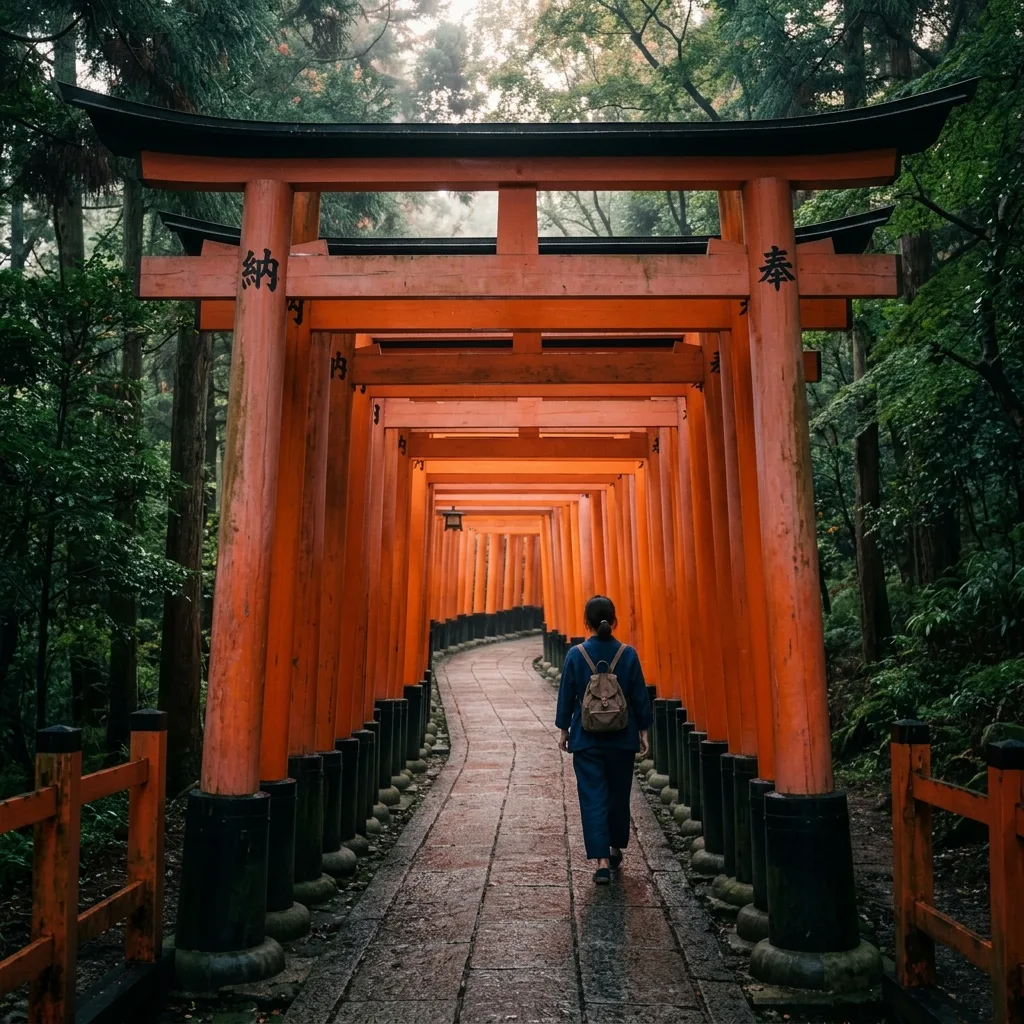
Every travel photo of Fushimi Inari tells the same lie. The frame is perfectly empty: a tunnel of vermilion torii gates curving into forested darkness, the air so still you can almost hear the cedar. What no one shows you is the stampede of selfie sticks waiting just off-frame. By 9 AM on any given day, the lower trail is so packed that moving through it feels less like a spiritual pilgrimage and more like a very photogenic subway platform. The fix is embarrassingly simple — get there before the sun does.
Why Fushimi Inari Deserves Its Reputation (And How Crowds Ruin It)
Fushimi Inari Taisha is one of Japan's most visited shrines for reasons that hold up even under scrutiny. The trail winds through roughly 10,000 vermilion torii gates donated by businesses and individuals over centuries, climbing the sacred Mount Inari to an elevation of 233 meters above southern Kyoto. The gates are not decorative props — each one is a dedication to Inari Ōkami, the Shinto deity of rice, foxes, sake, and prosperity. Walking through them is, by any measure, one of the more extraordinary things you can do in Japan.
The problem is volume. Fushimi Inari Taisha draws millions of visitors annually, and most of them arrive in a narrow window: 9 AM to 4 PM. During peak season (cherry blossom in late March and April, autumn foliage in November), the Senbon Torii — the famous double-lane tunnel of gates near the base — can become completely gridlocked. Photographers wait ten minutes for a clear shot. The meditative quality that makes the shrine special evaporates entirely.
The dawn strategy is the most reliable solution, and this guide tells you exactly how to execute it.
The Trail from Bottom to Top: What to Expect at Each Section
Understanding the trail's layout before you arrive prevents wasted time and sets realistic expectations for how long you will be on your feet.
The Main Shrine Approach (Base Level)
The formal entrance to Fushimi Inari Taisha is a wide stone plaza flanked by fox statues, the torii-shaped archways multiplying as you approach the main hall (Honden). At dawn, the plaza is yours. Lanterns may still be lit. The silence is complete except for birdsong and the occasional distant train.
Take a moment at the Omotesando — the main approach — before moving into the gate tunnels. This area floods first when crowds arrive and deserves unhurried appreciation.
Senbon Torii (Lower Gate Tunnels, 0–15 Minutes)
The iconic image everyone recognizes is here. The Senbon Torii is actually two parallel tunnels of densely packed gates, one for ascending and one for descending. At dawn, with no other visitors, the effect is disorienting in the best way: an infinite-seeming corridor of orange that narrows into shadow ahead of you.
Each gate has the donor's name and date of dedication painted in black on the back pillar. Reading a few as you pass gives a tangible sense of how deep this tradition goes — some dedications date back hundreds of years.
Kumataka-sha and Okusha Hohaisho (Lower Mountain, 15–30 Minutes)
Past the first tunnels, the trail opens into a clearing with smaller subsidiary shrines. This is where most day visitors stop. The stone lanterns here, particularly the pairs flanking shrine entrances, are atmospheric even in full daylight — at dawn, they have not yet been extinguished and cast warm pools of orange light across the moss-covered stone.
The Omokaru-ishi (weight-testing stones) are at Okusha Hohaisho: two stone lantern tops that visitors lift while making a wish. If the stone feels lighter than expected, the wish will come true. If heavier, it will not.
Yotsutsuji Junction (Halfway Point, 30–45 Minutes)
Yotsutsuji is the single most important waypoint on the trail. At roughly the halfway point of the ascent, the trail splits into a loop that circles the summit, and for the first time you get a panoramic view over Kyoto city below.
The junction is also where crowds stop. The vast majority of visitors turn around here; the stone steps beyond are quieter by an order of magnitude. Even during peak hours, continuing past Yotsutsuji means substantially better odds of a solitary gate-tunnel photograph.
At dawn, stand at the overlook for a few minutes. The city grid of Kyoto spreads south and west, still lit in pre-dawn amber before the lights blink off in sequence as the sky brightens.
Summit Loop (45 Minutes–2 Hours)
From Yotsutsuji, the trail forks right and left into a loop that circles the summit of Mount Inari. Both directions are well-maintained and lead back to the same junction. The right fork (counter-clockwise) is slightly steeper initially; the left fork (clockwise) has better pacing.
The summit itself is modest — a small cluster of shrines marked by stone lanterns, surrounded by dense cedar forest. There is no dramatic view from the very top; the reward is the journey through the upper gate tunnels, where the torii thin out and the forest presses close on both sides.
The full loop from Yotsutsuji back to Yotsutsuji takes roughly 45 minutes at a normal pace without photography stops. Budget more if you stop to read dedications or rest at the small tea houses (these open around 9 AM, so early risers will find them shuttered — bring your own water).
The Dawn Playbook: Exactly How to Do It
What Time to Arrive
Target: On trail by 5:30 AM. This gives you 30–45 minutes before the first light of sunrise (which varies by season; in April, civil twilight begins around 5:00 AM in Kyoto). The optimal window is from gate-in to 7:30 AM. After 8 AM, the first tour groups arrive, and the lower tunnels begin filling by 8:30 AM.
If a pre-dawn start is not feasible, the secondary window is after 6 PM. Evening visits have a completely different character — the stone lanterns glow softly, the forest sounds change, and the crowd disappears. The upper trail is dark, so bring a headlamp or phone torch if you plan to summit after dark.
What to Wear and Bring
- Comfortable walking shoes with grip. The trail is 12,000+ stone steps; flip-flops and new shoes both cause problems.
- A light layer. Even in summer, early morning at elevation is cooler than the city.
- Water. Shops and vending machines operate at the lower trail but nothing above Yotsutsuji before 9 AM.
- A small torch or phone with a bright flashlight if arriving before dawn in low-light months.
- Cash. The small tea houses and stalls on the trail are cash-only.
Photography Tips for Dawn Shooting
The pre-dawn and early dawn light is the best this trail ever looks. The gates, which photograph as vivid orange-red in midday, shift toward deep amber and rust in the blue-hour light. The misty forest backdrop frequently appears at dawn in spring and autumn.
Practical tips:
- Shoot looking into the tunnel rather than out of it. The compression effect of a long lens (50mm equivalent or longer) dramatically increases the sense of infinite gates.
- The slight curve in the lower Senbon Torii tunnel is the most compositionally useful section — position yourself just before the curve for the vanishing-point shot.
- Dew collects on the gates overnight. Before the sun burns it off, the surfaces have a subtle sheen that photographs well in low diffuse light.
- Avoid using a flash. It flattens the atmospheric depth that makes dawn shots compelling.
Practical Information
Admission and Hours
Admission: Free. Fushimi Inari Taisha charges no entrance fee. The trail and shrine grounds are open 24 hours, 365 days a year.
The shrine office operates from 9 AM to 5 PM, which means the staffed areas (amulet office, information) are closed for early visitors. This does not affect trail access.
Getting There
From Kyoto Station: Take the JR Nara Line local train from Kyoto Station (platforms 8, 9, or 10). The journey to Inari Station takes approximately 5 minutes. Important: express trains on the Nara Line do not stop at Inari Station. You must take the local (普通, futsuu) service.
Inari Station opens directly onto the shrine's main approach — from the ticket gate to the first torii gate is about 90 seconds of walking.
First trains: The JR Nara Line local begins service around 5:45 AM from Kyoto Station on most days. For a 5:30 AM start on the trail, this timing works well. Check the JR West timetable for the exact departure on your travel date, as weekend and weekday schedules differ slightly.
From Osaka: The Kintetsu Kyoto Line from Osaka-Namba connects to Kyoto Station. Alternatively, take the JR Osaka Loop Line to Tennoji and transfer to the Nara Line. Journey time from central Osaka to Inari is approximately 45–55 minutes depending on connections.
By taxi: A taxi from Kyoto Station to Fushimi Inari runs approximately ¥1,000–1,200. This is worth considering for very early morning visits (before the first JR local departs) if traveling with companions to split the cost.
Nearby Facilities
- Inari Station area: Convenience stores (7-Eleven, FamilyMart) open 24 hours — stock up on water and snacks before arriving.
- Lower shrine stalls: Open approximately 9 AM, selling Inari-zushi (fox-shaped sushi), soft drinks, and omamori (amulets).
- Tea houses mid-trail: Open approximately 9 AM at Yotsutsuji junction and a few points below summit.
Tips That Most Guides Miss
The Second Tunnel Is Less Photographed Than the First
The lower Senbon Torii is what appears in every article. Fewer visitors know that the trail continues through multiple gate clusters above this point, some of which are more densely packed and more dramatically lit in the forest canopy. The Nishisha cluster, approximately 20 minutes above the Senbon Torii, is consistently less crowded even during peak hours and contains some of the longest unbroken gate runs on the entire mountain.
The Fox Statues Are Worth Slowing Down For
Throughout the trail, hundreds of stone fox (kitsune) statues serve as messengers of Inari. Many are decorated by visitors with miniature torii, bibs, or written prayers. Looking at them closely rather than past them reveals the range of styles — some ancient, worn smooth by decades of weather; others recently donated and still sharply detailed.
Weekdays vs. Weekends Are Not Equally Crowded
Saturdays and Sundays draw significantly more visitors than weekdays, and Japanese public holidays (Golden Week in late April and early May being the worst offender) multiply the crowd density dramatically. If your schedule allows any flexibility, a Tuesday or Wednesday morning visit in mid-April can feel genuinely uncrowded even in the 8–9 AM range.
The Exit Route Matters
Most visitors enter and exit via the main Omotesando at the base. An alternative exit (for those completing the full summit loop) follows a small road down the mountain's east side to the Tofukuji area, avoiding the crowded base entirely. This route adds about 15–20 minutes of walking but lets you reach Tofukuji Station for the return journey, which reduces the chance of fighting for space on an Inari Station platform.
Do Not Confuse Fushimi Inari with Fushimi Momoyama
Fushimi Momoyama, a few stations further south on the Kintetsu line, is a separate district associated with sake production and a different historical castle site. It is a worthwhile visit, but it is not the same place, and arriving there by mistake is a more common error than you might expect.
Combining Fushimi Inari with the Rest of Kyoto
A dawn visit to Fushimi Inari slots neatly into a broader Kyoto day. If you are on the trail by 5:30 AM and complete the full summit loop, you can be back at Inari Station by 8:30–9:00 AM — comfortably ahead of the crowds and with most of the morning still available.
From Inari Station, Tofukuji (a Zen temple with outstanding autumn garden design) is two minutes by train. Gion, Kiyomizudera, and Nishiki Market are accessible within 30 minutes by bus or taxi. For a structured approach to a full day in the city, our guide on Kyoto temples and shrines: which ones are worth the entry fee covers admission decisions and priority rankings to help you allocate the rest of your time well.
If Fushimi Inari is one stop on a longer Kansai trip, it pairs naturally with Osaka and Nara. Our Kansai region travel guide lays out how to move efficiently between cities and what to prioritize in each. Fushimi Inari works best as a Kyoto morning activity rather than a day trip from Osaka, simply because the timing required — pre-dawn arrival — is easier when you are already sleeping in the city.
For travelers coming from Tokyo, the shinkansen journey to Kyoto takes about 2 hours 15 minutes. Our best day trips from Tokyo guide includes notes on overnight logistics and which destinations reward the commute time — Kyoto with a Fushimi Inari dawn visit is one of the strongest single-day shinkansen excursions available.
Frequently Asked Questions
Is it safe to visit Fushimi Inari at 5 AM?
Yes. The trail is well-worn stone steps with occasional handrails, and the path is marked throughout. The lower sections have enough ambient light from lanterns and nearby streets to navigate without a torch. Above Yotsutsuji, the forest is darker; a phone flashlight is sufficient for the upper trail. Kyoto is a low-crime city and early-morning visitors are a regular occurrence at Fushimi Inari — you will not be the only person there at dawn.
How difficult is the full hike?
The trail is classified as easy to moderate. The elevation gain is 233 meters over approximately 4 kilometers round trip. The steps are uneven in places and can be slippery when wet or covered in morning dew. Good walking shoes are sufficient; hiking boots are not necessary. The pace is set entirely by you — the trail is not timed and there are no restricted areas beyond the private shrine precincts.
Can I eat Inari-zushi (fox sushi) at dawn?
Unfortunately, no. The food stalls selling the local specialty — tofu pouches stuffed with seasoned rice, served since the Meiji era and associated with the fox deity — do not open until around 9 AM. Stock a convenience store onigiri before arriving if you need something to eat on the trail.
Is there a dress code?
No strict dress code exists for the trail, though the grounds are an active shrine and respectful attire is appropriate. There is no requirement to cover shoulders or knees as there is at some temples. Practical clothing is more important than formal clothing — you will be climbing steps.
What happens if it rains?
The trail is open in all weather. The stone steps can be slippery when wet; tread carefully. Rain at dawn at Fushimi Inari is, if anything, one of the more atmospheric experiences available to a visitor in Japan — the mist rising through the forested gate tunnels is genuinely extraordinary. Bring a compact umbrella rather than a rain jacket so your hands remain free for photography and handrails.
Conclusion
Fushimi Inari Taisha does not need to be the overcrowded Instagram stampede that many visitors describe. The trail opens at all hours, charges no admission, and empties dramatically before 7 AM and after 6 PM. The dawn visit requires only a slightly earlier alarm and a short train ride, and in exchange it offers one of the most genuinely atmospheric experiences in Japanese travel: ten thousand torii gates in near-silence, morning mist hanging between the cedars, the city of Kyoto glowing orange below the Yotsutsuji overlook.
The crowds will arrive. They always do. Be gone before they get there.