Kyoto Geisha Culture: Gion District Guide and Etiquette Rules

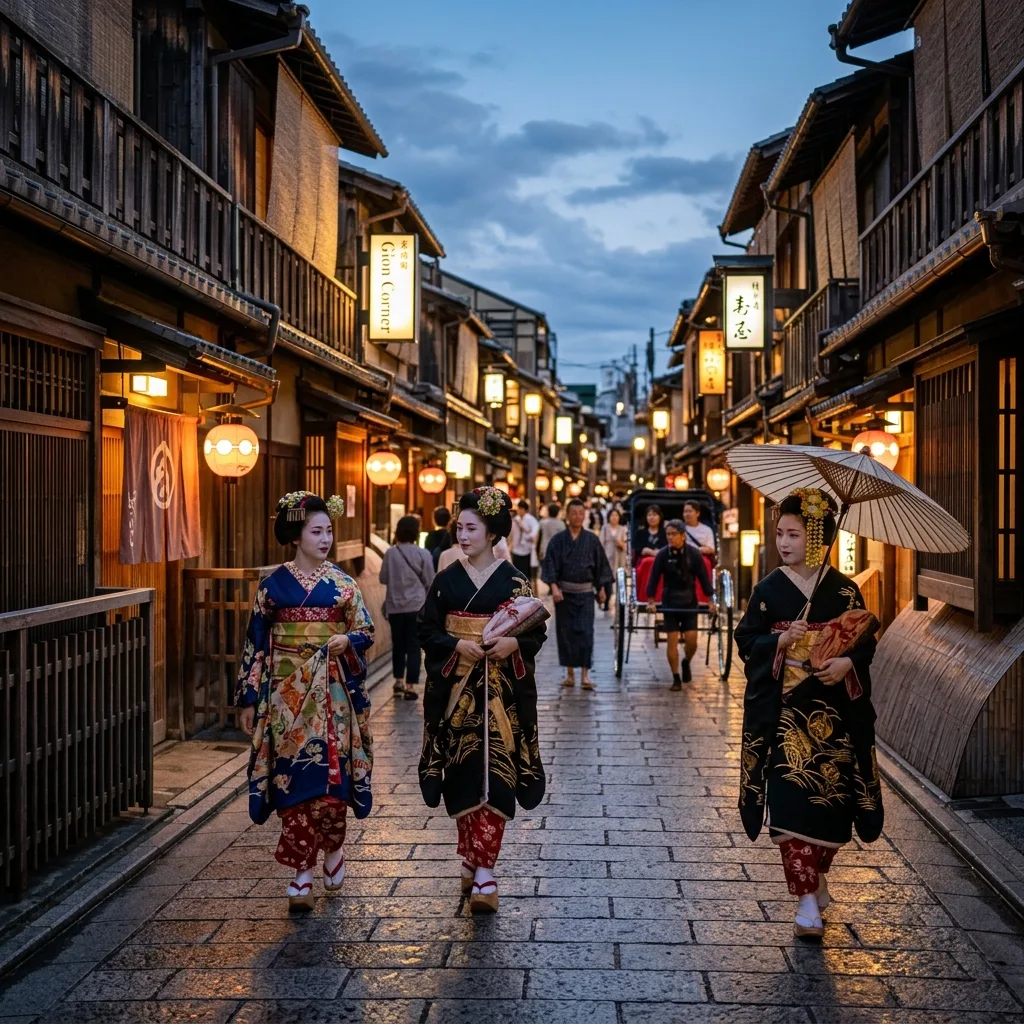
You arrive in Gion just after dusk. The stone lanterns along Hanamikoji Street are lit, the wooden machiya townhouses cast amber light onto wet cobblestones, and then — a figure in a pale green kimono glides around a corner and disappears before you can even raise your phone. That glimpse is what most first-time visitors remember most. But what most of them also remember is the awkward moment they stepped into a private alley chasing that glimpse, were stopped by a local, and realized they had no idea what the rules were.
This guide is for the traveler who wants to experience Gion the right way — understanding geisha culture before you arrive, knowing exactly where you can and cannot go in 2026, and having realistic expectations about what you might see and do. Gion is one of Japan's most atmospheric neighborhoods, but it rewards visitors who approach it with knowledge and respect, not cameras raised and elbows out.
What Is Gion and Why Does It Matter?
Gion is Kyoto's most famous hanamachi — a flower town, the Japanese term for a neighborhood where geisha (called geiko in Kyoto's local dialect) and maiko (apprentice geisha) work and live. It sits on the eastern edge of central Kyoto, bordered by the Kamo River to the west and the Higashiyama hills to the east. The district has existed in roughly its current form since the Edo period, and it remains one of the only places in Japan where the geisha tradition is practiced as a living profession, not a tourist performance.
The central spine of Gion is Hanamikoji Street, a roughly 400-meter stretch of preserved machiya townhouses running north to south between Shijo Avenue and Kennin-ji Temple. The northern section of Hanamikoji hosts some of Kyoto's most exclusive ochaya — traditional teahouses where geiko entertain clients with conversation, music, dance, and sake — alongside high-end restaurants and discreet entrance gates that, to an outsider, look like ordinary wooden doors. The canal district of Shirakawa-minami-dori, just north of Shijo Avenue, adds a second atmospheric zone with willow trees trailing over stone bridges and more ochaya lining the water.
Understanding that Gion is a working neighborhood — not a theme park — is the single most important thing to grasp before visiting. The geiko and maiko you see on the street are traveling to and from professional engagements. The ochaya along Hanamikoji are private establishments with century-old client relationships. The side alleys behind the main street are people's homes. This context shapes every rule in this guide.
If you are planning a broader Kansai trip, the Kansai Region Travel Guide: Osaka, Kyoto & Nara in One Trip is an excellent starting point for logistics before drilling into Gion specifically.
The 2026 Photography and Access Rules You Must Know
Gion has implemented a series of escalating restrictions in response to overtourism, and as of 2026 several rules carry legal weight — including fines. Here is what you need to know.
The Private Street Photography Ban
Since April 2019, photography on the private roads that branch off Hanamikoji Street has been prohibited. These roads — narrow alleys leading to ochaya entrances and residential okiya (geisha houses) — are marked with bilingual signs. Taking photos on them is punishable by a ¥10,000 fine (approximately $65–70 USD at current exchange rates). The fine is enforced by local patrol volunteers and by Gion's neighborhood association.
The private street ban covers a defined zone, not all of Gion. Hanamikoji Street itself, Shirakawa-minami-dori, and the public areas around Yasaka Shrine are not covered by the ban. You can photograph the architecture, the streetscape, and the general atmosphere freely in these public areas.
Photographing Geiko and Maiko
Even in public areas, photographing geiko or maiko requires their consent. The etiquette rule that has existed for decades — do not stop them, do not touch them, do not follow them — now has the weight of formal community policy behind it. In 2024, new signage throughout Gion made explicit that pursuing geiko or maiko for photographs, blocking their path, or touching their kimono is prohibited.
The practical guidance: if you see a geiko or maiko on Hanamikoji, step aside and let them pass. You may take a respectful photo from a distance only if you are not blocking their path and have not positioned yourself specifically to intercept them. Many visitors who try to do this quickly realize the lighting conditions at dusk — when sightings are most common — are not ideal for a casual phone camera anyway.
Access Restrictions in Residential Alleys
Since April 2024, several private alleys behind Hanamikoji that were previously technically accessible to tourists have been physically closed or gated. These closures were implemented after years of residents and ochaya owners documenting guests peering into windows, blocking doorways, and wandering into spaces that are genuinely private. Approximately 90% of Gion's tourist-accessible areas are unaffected, but assuming that every narrow alley in Gion is open to you is the most common mistake first-time visitors make.
The rule of thumb: if a pathway does not have clear signage indicating it is a public tourist route, or if it clearly leads to residential or commercial buildings without any visitor-oriented signage, treat it as private.
Understanding Geiko and Maiko: The Basics
Many visitors come to Gion with confused ideas about what geisha are, fueled by outdated stereotypes and the occasional Hollywood film. Getting the basics right makes the experience more meaningful.
Geiko (the Kyoto term for geisha) are fully trained professional entertainers. They have completed years of apprenticeship and specialize in traditional Japanese arts: nihon buyo (classical dance), shamisen (a three-stringed instrument), flute, hand drum, and the art of conversation in the context of formal banquets. They are not hostesses in any Western sense, and they are not involved in sex work — a persistent misconception that has no basis in the modern profession.
Maiko are apprentice geiko, typically aged 15 to 20. They undergo a minimum of five years of training before their debut (misedashi) as full geiko. Maiko are visually distinct from geiko: their kimono have longer trailing hems (hikizuri), they wear elaborate three-tiered wooden sandals (okobo), and their hairstyles are more ornate, with seasonal hair ornaments (kanzashi) changed monthly. Their makeup features painted red lips — only the lower lip is fully painted in the early stages of training, a sign of their apprentice status.
The total number of active geiko and maiko in Kyoto has declined significantly over the decades — from thousands in the postwar period to fewer than 200 as of 2026. Most are concentrated in Gion Kobu (the southern part of Gion) and in four other hanamachi: Pontocho, Miyagawacho, Kamishichiken, and Gion Higashi. This scarcity is part of why sightings on the street feel meaningful, and why the pressure of mass tourism on this small community has been so acutely felt.
Where to Go in Gion: A Practical Walking Route
Hanamikoji Street (Gion's Main Avenue)
Start at the intersection of Shijo Avenue and Hanamikoji Street. The southern portion, from Shijo to Shijo-dori's extension toward Kennin-ji Temple, is the most photographed. The preserved machiya facades, stone lanterns, and narrow streetscape are most atmospheric in the late afternoon and evening. The best photographs of the architectural streetscape are taken in the morning before 8:00 AM, when tour groups have not yet arrived and the low light is flattering.
As you walk south from Shijo toward Kennin-ji, pay attention to the discreet gates and noren (fabric dividers) on either side. Many of these are ochaya entrances. You cannot enter without an introduction through an existing client.
Shirakawa Canal Area
Walking north from Shijo along the Shirakawa-minami-dori canal brings you to one of Kyoto's most genuinely beautiful streetscapes: weeping willows, stone bridges, and the canal itself reflecting the lights of ochaya and restaurants. This area is somewhat less trafficked than Hanamikoji and more pleasant to walk slowly. The cherry blossoms along the canal in late March to early April are considered among Kyoto's finest.
Yasaka Shrine
At the northern end of Hanamikoji, Yasaka Shrine (Gion Shrine) marks the edge of the district and the beginning of Maruyama Park. The shrine is open 24 hours and free to enter. It is the site of the Gion Matsuri festival in July, one of Japan's three great festivals. Even outside festival season, the stone lanterns lining the approach and the main gate facing Shijo Avenue at night are worth the short walk.
Kennin-ji Temple
At the southern end of Hanamikoji, Kennin-ji is Kyoto's oldest Zen temple, founded in 1202. It is less visited than Kinkaku-ji or Fushimi Inari but arguably more atmospheric — dry rock gardens, painted fusuma doors, and a striking pair of painted dragons on the ceiling of the main hall. Admission is ¥600 and opening hours are 10:00 AM to 5:00 PM (4:30 PM last entry). This is covered in more detail in the Kyoto Temples and Shrines: Which Ones Are Worth the Entry Fee guide.
How to See a Geiko or Maiko (and What to Actually Expect)
On the Street: Evening Hours
The best time to see geiko or maiko walking on Hanamikoji is between 6:00 PM and 8:00 PM on weekday evenings. This is when they travel from their okiya to their ochaya appointments. Weekend evenings are less reliable because many clients prefer weekday engagements.
There is no guarantee of a sighting. On any given evening, you might see two or three maiko walking briskly past; on another evening, you might see no one. Managing expectations here is important. If your entire Kyoto experience is built around capturing a perfect photograph of a maiko on Hanamikoji Street, you will likely be disappointed. If you regard a sighting as a pleasant possibility rather than a target, you will enjoy the district regardless.
Visitor behavior during sightings matters enormously for the integrity of the experience and for the community. Do not run toward a geiko or maiko. Do not step in front of them to get a photograph. Do not call out to them. These are professionals walking to work; the equivalent in a Western city would be chasing someone down the street because they were wearing an interesting uniform.
Gion Corner: A Gateway Experience
Gion Corner, located on Hanamikoji Street, offers 50-minute performances featuring maiko dance alongside demonstrations of kado (flower arranging), chado (tea ceremony), koto (harp), and gagaku (court music). Shows run in the evenings and tickets cost approximately ¥5,500 per person. It is explicitly designed as a tourist introduction to Kyoto's traditional arts — it is not an authentic ochaya experience — but it is a legitimate and enjoyable way to see maiko dancing in a formal setting without needing the social connections an ochaya requires.
Booked Experiences: Tea Ceremony with Maiko
Several operators offer maiko tea ceremony experiences in Gion that are genuinely high quality. MAIKOYA's Gion location runs daily sessions where a maiko guides participants through chado and performs a short dance. Group sessions start from around ¥5,000–8,000 per person; private sessions for two can exceed ¥30,000. Booking in advance is essential — these experiences sell out weeks ahead during peak seasons (March–May and October–November).
For those interested in a more immersive traditional stay before or after visiting Gion, the Best Ryokan Stays Near Tokyo for a Traditional Japanese Night guide covers what to look for in a traditional Japanese accommodation experience, which applies equally well to Kyoto-area options.
Practical Guide: Getting to Gion
From Kyoto Station
Take the Keihan Main Line from Tofukuji Station (a 7-minute walk from Kyoto Station's central exit) to Gion-Shijo Station (3 stops, approximately 7 minutes, ¥220). Hanamikoji Street begins a 5-minute walk north from the station's east exit.
Alternatively, bus routes 100, 206, and 207 stop at Gion-Shijo on Shijo Avenue. Travel time from Kyoto Station by bus is approximately 20–25 minutes.
From Osaka
The Keihan Toku-Kyuko Limited Express from Yodoyabashi Station in Osaka to Gion-Shijo Station takes approximately 50 minutes and costs ¥430. This makes Gion very practical as a day trip from Osaka.
On Foot Within the District
Gion's main sights are compact. From Gion-Shijo Station to Kennin-ji Temple is a 15-minute walk along Hanamikoji. From Hanamikoji to Yasaka Shrine is another 10 minutes. Flat, walkable, and best explored slowly.
Tips Most Guides Miss
Go on a weeknight, not a Saturday. Gion on a Saturday evening in April is genuinely overwhelming. Weeknight crowds are significantly thinner, and geiko and maiko are more likely to be traveling to appointments. The district feels entirely different without tour groups.
Morning light beats evening for architecture photos. If photography of the streetscape (rather than geisha spotting) is your goal, arrive by 7:00 AM. The warm morning light on the machiya facades, with no crowds, produces far better photographs than the busy dusk period.
The back streets north of Shijo are worth exploring. The area around Shinbashi-dori and Shirakawa-minami-dori, north of Shijo Avenue, is significantly quieter than the Hanamikoji tourist stretch and equally beautiful. This is where local restaurants and smaller ochaya are concentrated, and where the canal streetscape is most intact.
Check the kanzashi for the month. Maiko's seasonal hair ornaments (kanzashi) change every month according to a traditional calendar — plum blossoms in February, cherry blossoms in April, morning glories in July. If you know what month's kanzashi looks like, spotting a maiko becomes immediately more meaningful. Many geisha culture guides and websites publish the monthly kanzashi calendar.
Do not confuse tourist photo maiko with real maiko. Several studios in Kyoto offer maiko makeover experiences where tourists dress in full maiko costume for photo sessions. These visitors sometimes walk through Gion for photos. Real maiko walk with purpose and wear okobo sandals, which produce a distinctive clacking sound on cobblestones. If someone in maiko costume seems to be posing for a camera on every corner, they are likely from a studio experience, not an actual apprentice geisha.
Restaurant reservations are required for serious dining in Gion. The high-end kaiseki restaurants along Hanamikoji require reservations weeks or months in advance. Walk-in dining in Gion is limited to a handful of more casual spots. If this district's restaurant culture interests you, plan accordingly before you arrive.
FAQ
Can tourists visit Gion for free?
Yes. The main public areas of Gion — Hanamikoji Street, Shirakawa Canal, and Yasaka Shrine — are free to enter. Kennin-ji Temple charges ¥600 admission. Ticketed experiences like Gion Corner and maiko tea ceremonies have separate costs.
What is the difference between a geisha and a maiko?
A geisha (called geiko in Kyoto) is a fully trained professional entertainer. A maiko is an apprentice, typically aged 15–20, who trains for five or more years before becoming a full geiko. Maiko are visually distinct: longer kimono hems, elaborate wooden sandals (okobo), and more ornate hairstyles with seasonal kanzashi.
Can I photograph geiko or maiko on Hanamikoji Street?
Photography on Hanamikoji Street (a public street) is not illegal, but photographing geiko or maiko without consent and in a way that blocks or harasses them violates formal community guidelines. Photography on the private side streets branching off Hanamikoji is banned and fined at ¥10,000. Always err toward giving way rather than raising your camera.
What is the best time of year to visit Gion?
April (cherry blossom season) and November (autumn foliage) are the most atmospheric but also the most crowded. July is exceptional if you visit during the Gion Matsuri festival, particularly for the Yamaboko Junko procession. Late February and early September are good shoulder season options with lower crowds.
Is it possible to attend an actual ochaya banquet?
Technically yes, but practically very difficult for foreign visitors without existing connections. Ochaya operate exclusively on a personal introduction system (icigen-san okotowari — no first-time customers without an introduction). Some newer ochaya or cultural experience companies offer structured ochaya-style banquets for tourists at premium prices, but these are not the same as a traditional ozashiki entertainment session.
Conclusion
Gion rewards visitors who arrive prepared. The district is genuinely extraordinary — a living piece of Edo-period Japan operating by its own logic, with a professional artistic tradition that has survived modernization, war, and mass tourism. But it is also a neighborhood under real pressure, and the rules that have been implemented reflect genuine harm done by visitors who treated it as a theme park.
Know what Hanamikoji Street is and is not. Understand the photography restrictions and why they exist. Approach any geiko or maiko sighting with the calm of someone who understands what they are seeing. And consider going beyond the main strip — the Shirakawa Canal area, the quieter alleys north of Shijo, and a morning visit before the crowds arrive will give you a version of Gion that most visitors never see.
The glimpse you catch at dusk, that figure in a pale kimono disappearing around a corner, will mean something entirely different when you understand the tradition behind it.