Korea Family Trip Food Guide: Feeding Kids in Seoul Without the Stress (2026)

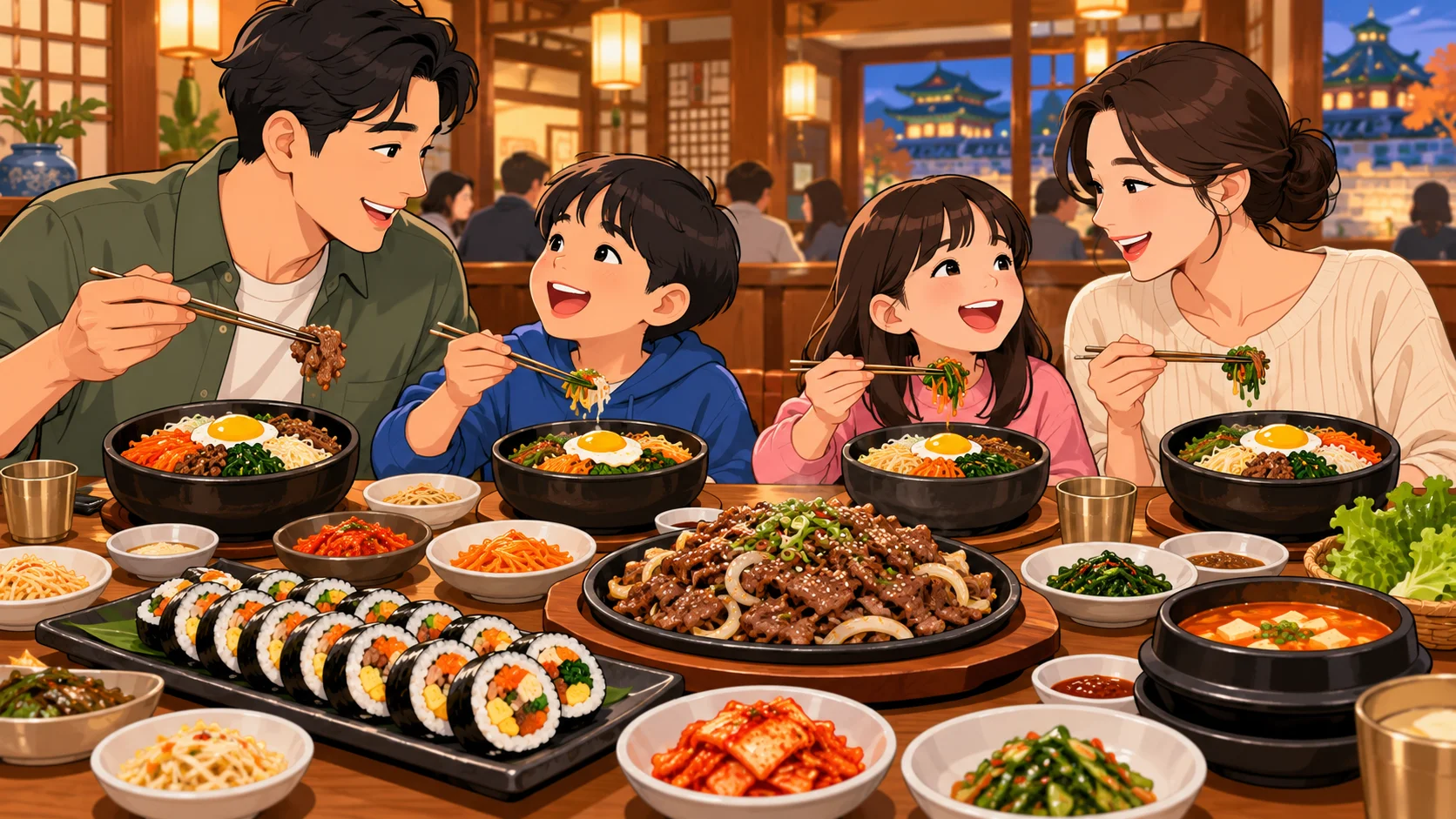
Feeding kids in Korea is easier than it looks — once you stop expecting kids' menus and high chairs. Most Korean restaurants don't have either, but the food culture itself is family-friendly: shared plates, mild dishes on every table, and staff who are genuinely happy to see children. This guide shows Singapore-based families exactly where to eat, what to order for picky eaters, where to find baby supplies, and what meals cost in 2026.
Korean dining runs on sharing. A typical family of four orders three or four dishes, plus rice, and everyone eats from the middle of the table. That single fact solves most of the "but what will my kid eat?" anxiety — because almost every Korean table has at least one mild dish a child will accept.
1. The First Thing to Know: How Korean Restaurants Work
Forget the Western family-restaurant playbook. Here's the reality:
No kids' menus. Typical Korean restaurants don't have them. You order extra portions of the shared dishes and the staff will happily bring extra empty plates and bowls for the kids. Ordering one more serving of meat or rice for the table is the standard move.
High chairs are rare. A 2025 Singapore family travel report found "most restaurants didn't have high chairs" — and recommended bringing a portable fabric booster seat that ties to a chair. It weighs almost nothing and fits in a daypack. Western-style family restaurants (VIPS, Outback) are the exception: they do have high chairs and children's menus.
Heat is optional. Korean food looks spicy, but spice almost always comes from sauces served on the side. Meat is grilled plain. Bibimbap without gochujang isn't spicy. This matters more than any other single fact in this guide.
Calling staff: say "jeogiyo" (저기요) to get attention — don't wave or snap fingers. It's polite, it works everywhere, and kids love learning it.
2. Where Families Actually Eat
Department-store food courts: your home base
If you remember one thing, remember this: department-store basement food courts are the family dining headquarters of Korea. Lotte, Shinsegae, and Hyundai department stores all have sprawling B1 food halls with bibimbap, kimbap, noodles, tonkatsu, and Korean-Chinese dishes at 8,000–15,000 won per meal. They're clean, bright, fast, and nobody cares if your toddler is loud. The same buildings have baby lounges with nursing rooms, changing stations, and toddler play areas.
Buffet chains: the picky-eater insurance policy
Ashley Queens (E-Land's buffet chain, 115+ stores) is the single best answer to "my kid won't eat anything." Adult prices run 19,900–27,900 won depending on lunch/dinner and branch (2026), and the spread includes gorgonzola pizza, egg sushi, honey butter potatoes, and mango salad alongside Korean dishes. Kids graze, parents relax, everyone finds something.
VIPS (CJ Foodville's steakhouse + salad bar) is the splurge version at roughly 50,000 won per adult. Flagship family branches have playrooms, a family room with a crib, and photo zones. Kid favorites: churros, ice-cream pearls, miniature sausage skewers. (Children's pricing varies by branch and isn't published consistently — check at the door.)
Korean BBQ: more kid-friendly than it looks
BBQ is genuinely great with kids. Floor seating entertains small children, there's always plain rice, and the sweet-salty dipping sauces (ssamjang is mild) keep picky eaters happy. Order samgyeopsal and let the kids eat rice, lettuce wraps, and grilled mushrooms while adults handle the rest. Expect around 60,000–90,000 won for a family of four.
Skip the hof. Pub-style chicken-and-beer joints (hof) are adult evening territory — not suitable for young children.
Kids cafes (키즈카페): lunch with a playground attached
Private kids cafes combine jungle gyms, slides, ball pits, and trampolines with a food area serving Korean and Western basics. Everyone wears socks (bring a pair). Pricing from older data runs about 20,000 won per child and 8,000 per adult for two hours — expect 2026 prices to be higher.
The budget alternative: Seoul-type public kids cafes — city-run, 153 locations and counting, at 2,000 won per child and 1,000 won per guardian for ages 12 months to 6 years, with nursing rooms included. Note that eligibility rules have applied to non-Seoul residents, so foreign tourists should check current admission rules before counting on this option.
3. The Picky-Eater Playbook
These dishes are reliably non-spicy and kid-approved:
- Bulgogi — sweet soy-marinated beef, the gateway dish
- Samgyetang — whole chicken soup with ginseng, mild and nourishing (Seoul average ~18,000 won)
- Kalbijjim — braised short ribs, sweet and tender
- Kimbap — seaweed rice rolls, the 3,581-won national-average lunch hero (Seoul ~3,869 won)
- Mandu — dumplings, steamed or fried
- Gyeran bap — egg over rice, the ultimate plain-food fallback
- Jajangmyeon — black-bean noodles, sweet and universally loved
- Hotteok / gyeran ppang — sweet street snacks for bribing through long days
- Juk — rice porridge, perfect for upset stomachs or jet-lagged mornings
Ordering tactics that work:
- Fried chicken: ask for "original" or "soy garlic" — yangnyeom is the sweet-spicy one.
- Bibimbap: order it and just skip the gochujang.
- Kimchi: ask for baek kimchi (white kimchi) — it's the non-spicy version.
- The magic phrase: "안 맵게 해주세요" (an maep-ge hae-juseyo — "not spicy, please"). Show it on your phone; it's widely understood.
Drinks kids actually like: banana milk (the iconic one), Milkis (milky soda), yuzu jelly tea.
4. Baby Supplies: Formula, Diapers, and Emergency Snacks
Large marts are your friend. E-Mart, Homeplus, and Lotte Mart have full baby aisles with major diaper and infant-formula brands — including single-serve sachet packets and ready-to-drink bottles. E-Mart runs Baby Week promotions (up to 50% off diapers, formula, and baby food) several times a year.
Convenience stores fill the gaps. CU, GS25, and 7-Eleven are everywhere for emergency snacks — CU even launched a kids' snack line for ages 2–7 in 2025. But don't count on corner stores for formula: stock varies by branch. Buy formula at large marts or pharmacies.
Pro move for Singapore families: order diapers and supplies on Coupang (English app, foreign cards now accepted for basic orders) to your hotel address before you arrive. Without a Korean resident card there's a ~19,800 won minimum order, but that's easy to hit with diapers.
For the full arrival-day setup — SIM cards, T-money, first grocery run — see our Korea family trip first day setup guide.
5. What a Family of Four Actually Pays (2026)
Using Korea Consumer Agency national averages (September 2026) and Seoul figures:
| Meal tier | What it looks like | Cost (2 adults + 2 kids) |
|---|---|---|
| Budget | Kimbap chain or convenience store | |
| Casual | Local eatery, bibimbap or noodle bowls each | |
| Mid-range | Korean BBQ, sharing | |
| Buffet | Ashley Queens | |
| Splurge | VIPS steakhouse + salad bar |
Reference prices: bibimbap ~10,300 won national average (~11,800 in Seoul), kimbap roll ~3,600 won, kimchi stew set ~9,100 won, samgyetang ~18,000 won in Seoul, samgyeopsal ~17,900 won per 200g (~21,300 in Seoul). Seoul runs noticeably higher than the national average on everything.
6. Etiquette Notes for Dining With Kids
- Wait for the eldest at the table to start eating before the kids dig in.
- Some traditional restaurants require shoes off — slip-ons make life easier.
- Tipping is not customary. Don't.
- Chopstick skills aren't required — ask for a fork and spoon ("포크 주세요") without embarrassment.
7. Breakfast: The Meal Most Guides Skip
Korean hotels aimed at tourists serve Western breakfast, but if you're in an Airbnb or guesthouse, breakfast needs a plan. The good news: Korea does breakfast well and cheaply.
Bakery chains (Paris Baguette, Tous les Jours) open early and sell milk bread, egg sandwiches, and pastries for 2,000–5,000 won. Kids who won't touch Korean food at 8 a.m. will eat a ham-and-egg toast without complaint.
Gimbap heaven (김밥천국) and similar 24-hour diners serve full Korean breakfast sets — rice, soup, eggs, and side dishes — for under 10,000 won. They're everywhere, they're fast, and nobody blinks at a family with kids at 7:30 in the morning.
Convenience store breakfast is a legitimate strategy: triangle kimbap (1,500–2,000 won), banana milk, and a boiled egg is a complete breakfast for under 5,000 won per person. Many stores have a small eat-in counter with a microwave.
8. Street Food With Kids: What's Safe to Try
Korean street food is a highlight, not a hazard — the turnover is high and everything is cooked fresh in front of you. Kid-safe picks:
- Hotteok — sweet pancakes filled with brown sugar and cinnamon, ~2,000 won. The universal crowd-pleaser.
- Gyeran ppang — egg bread, mild and filling.
- Tteokbokki (mild versions) — ask for less-spicy; many stalls will make a kid portion with reduced gochujang. When in doubt, the cheese tteokbokki is milder.
- Eomuk (fish cake skewers) — served in warm broth from street carts, ~1,000–2,000 won. Mild, savory, perfect for cold days.
- Bungeoppang — fish-shaped pastries with red bean or custard, ~1,000–3,000 won.
Hygiene rule of thumb: eat where locals queue. A stall with a line of Korean office workers at lunch is the safest bet in the city.
9. Allergies and Dietary Restrictions
Nut allergies: Korean cuisine uses sesame oil heavily and peanut less often, but cross-contact happens. Learn "견과류 알레르기가 있어요" (gyeon-gwa-ryu allergy-ga isseoyo — "I have a nut allergy") and show it on your phone. Packaged foods list allergens in Korean; Papago's camera mode reads labels well.
Halal: Korea is not a halal-majority country, but Itaewon has a cluster of halal-certified restaurants near the mosque, and major tourist areas increasingly label halal options. Seafood and vegetarian temple-food restaurants are practical fallbacks. For Singaporean Muslim families, the first day setup guide covers SIM and map setup that makes finding these spots easier.
Vegetarian kids: harder, because even "vegetable" dishes often use anchovy or beef stock. Buddhist temple-food restaurants (사찰음식) are reliably vegetarian — a good family experience in itself.
10. Delivery to Your Hotel: The Tired-Evening Lifesaver
After a full day at Lotte World, nobody wants to hunt for dinner. Food delivery in Korea is fast (30–45 minutes) and excellent — and foreign cards now work on the major apps for basic orders.
What to know: you'll need your accommodation's address in Korean (ask your hotel or host to write it down, or copy it from Naver Map). Delivery apps show photos for everything, which solves the language barrier completely — kids can point at what they want.
Family-friendly delivery picks: jokbal (braised pig's feet — sounds scary, tastes like mild tender pork), fried chicken (order "original" for kids), jajangmyeon sets, and pizza. A full family dinner delivered runs 30,000–50,000 won including delivery fees.
11. A Sample 3-Day Family Food Plan
Day 1 — Arrival day (keep it easy): Convenience store breakfast supplies → department-store food court lunch (everyone picks their own) → early BBQ dinner near the hotel. Total: ~70,000 won for four.
Day 2 — Big day out: Bakery breakfast → packed kimbap and snacks for the theme park or day trip → Ashley Queens buffet dinner (picky eaters get the full spread). Total: ~110,000 won.
Day 3 — Local flavor: Gimbap-cheonguk breakfast → street food lunch in Myeongdong or Gwangjang Market (hotteok, eomuk, gyeran ppang grazing) → VIPS or a nice Korean restaurant for the farewell dinner. Total: ~130,000 won.
Three days of eating well: roughly 300,000 won (~$215) for a family of four, and that's without trying particularly hard to save.
12. Beyond Seoul: Regional Food Worth the Trip
If your itinerary goes beyond the capital, two food cities are worth building a day around.
Jeonju is Korea's food capital and the home of bibimbap. The Hanok Village area is made for families — traditional houses, street snacks at every corner, and restaurants serving Jeonju-style bibimbap with a dozen side dishes. Kids love the visual spectacle of the full spread arriving at the table. It's an easy day trip or overnight from Seoul by KTX.
Busan's Jagalchi and street markets offer a different flavor: the world's energy is seafood. Even kids who "don't like fish" tend to accept eomuk skewers and the sweet hotteok sold around BIFF Square. The market walk itself is entertainment — noise, color, and samples pressed into your hands.
Quick Answers
Can my toddler eat Korean restaurant food? Yes — rice, soup, grilled meat, and egg dishes are all toddler-safe. Bring a portable booster seat and order an extra bowl of rice.
Is Korean food too spicy for kids? Only if you order the spicy things. Bulgogi, kimbap, mandu, jajangmyeon, samgyetang, and kalbijjim are all mild. Spice comes from side sauces you can skip.
What if my kid only eats Western food? Department-store food courts have pasta, pizza, and tonkatsu. Ashley Queens and VIPS have full Western spreads. Convenience stores have milk, bread, and cereal. You will not starve.
Do I need to tip? No. Tipping is not customary in Korea, including at restaurants.
Can I find baby food? Yes — large marts (E-Mart, Homeplus, Lotte Mart) stock formula, diapers, and baby food. Pharmacies too. Order ahead on Coupang to your hotel if you want zero stress on arrival day.
The bottom line: Korea feeds families well and cheaply once you work with the sharing culture instead of against it. Food courts for everyday meals, Ashley Queens when the kids are being difficult, BBQ when everyone's happy, and a convenience store always within 200 meters for emergencies. Pair this with our family trip itinerary and the packing guide and your food logistics are sorted.