Emergency & Healthcare in Korea: A Family Traveler's Medical Guide (2026)

Your child spikes a fever at 11 p.m. in a Seoul hotel. What do you do? If you know three numbers — 119 (ambulance), 1330 (tourist hotline with interpreters), and 1339 (medical consultation) — you're covered. Korea's emergency and healthcare system is excellent, but it runs in Korean by default. This guide gives Singapore-based families the exact numbers, the English-speaking hospitals, how pharmacies work (including at night), and the insurance checklist to sort before you fly.
The single most important fact: call 1330 first for anything non-life-threatening. It's the Korea Tourism Organization's hotline, it's free, it covers nine languages including English, and the staff will do three-way calls with hospitals, pharmacies, and taxi drivers on your behalf. Save +82-2-1330 in your phone before the trip (that's the number to dial from a foreign phone).
1. The Three Numbers Every Family Must Save
119 — Ambulance, fire, rescue
Korea's 911. Call it for anything life-threatening. Ambulance dispatch and transport are free — hospital treatment afterward is billed separately, but the ride itself costs nothing. 119 centers provide interpretation in English and other major languages for non-Korean callers. It's 24/7.
1330 — Korea Travel Hotline (your first call for most problems)
Run by the Korea Tourism Organization. What it does for you:
- Live interpretation in 9 languages (Korean, English, Japanese, Chinese, Russian, Vietnamese, Thai, Malay, Indonesian)
- Three-way calls — the operator stays on the line while you talk to a hospital, pharmacy, taxi driver, or police officer
- Tourist complaints and general travel help
- Transfers to 119 or immigration (1345) when needed
It's free to call (carrier charges may apply from a foreign SIM). Also reachable via real-time chat on the VISITKOREA website, KakaoTalk, Facebook Messenger, and LINE. Reported hours vary by source — some say 7:00 a.m. to midnight, others say 24/7 for English — so treat late-night English coverage as likely but not guaranteed, and use 119 for anything urgent overnight.
1339 — Medical consultation line (KDCA)
The Korea Disease Control and Prevention Agency's 24-hour medical line. Use it when you're not sure whether symptoms warrant an ER visit: they give medical advice, infectious-disease information, and emergency-response guidance — and can connect you to emergency services directly. Bilingual staff cover Korean, English, Japanese, and Chinese. They can also locate late-night pharmacies and after-hours clinics near you, and they're reachable free through the KDCA's official KakaoTalk channel.
Decision rule: life-threatening → 119. Unsure whether it's an emergency → 1339. Need an interpreter, a hospital recommendation, or help navigating the situation → 1330.
2. English-Speaking Hospitals in Seoul
Seoul's major hospitals all treat foreign patients, and the big three run dedicated international centers:
Severance Hospital (Sinchon) — International Health Care Center serving international patients since 1962. English-fluent medical staff plus consultants in Russian, Chinese, Japanese, Arabic, Mongolian, and Spanish.
Seoul National University Hospital (Daehakro) — International Healthcare Center with services in English, Chinese, Mongolian, Arabic, and Spanish. Billing is coordinated with embassies and international insurers, and they issue English documents (diagnosis letters, vaccination certificates).
Asan Medical Center (Songpa) — International center with interpretation in English, Japanese, Chinese, Russian, Arabic, Mongolian, and Vietnamese. English documents available, including visa-related physical-exam paperwork.
How to find the right hospital: use medicalkorea.or.kr (English) — the government registry of hospitals authorized to treat foreign patients, with international-center phone numbers per hospital.
Practical notes for the ER:
- Major hospital ERs run 24 hours and treat emergency patients regardless of nationality.
- Bring passport/ID, your travel insurance certificate, and a credit card.
- Foreign insurance is not accepted as direct payment. You pay the full bill upfront and claim it back home. This surprises people — plan for it.
- Going through a hospital's international clinic can bill higher than walking into the ER directly.
3. When It's Not an Emergency: Clinics, Moonlight Hospitals, and Telemedicine
Not everything needs an ER. Korea has a layered system for after-hours care:
Moonlight Children's Hospitals (달빛어린이병원) — state-designated after-hours pediatric facilities that treat children with non-emergency illness on weekday evenings, weekends, and holidays. This is the single most useful thing most traveling families don't know about: a feverish child at 9 p.m. doesn't need an ER, they need one of these. Find them via e-gen.or.kr or by calling 1339.
Telemedicine (비대면 진료) is now a permanent legal fixture. Video-consult apps offer English-language clinics — roughly 15,000 won for a consultation under 10 minutes. The prescription is filled separately at a nearby pharmacy (two legally separate steps). Tourist eligibility for foreign passports isn't fully verified, so treat this as a backup option rather than the plan.
Primary-care clinics handle daytime non-emergencies. The insured consultation fee baseline is about 18,840 won (2026 NHIS schedule) — but as a tourist you pay 100% with no copay subsidy, so expect to pay more than that figure.
4. Pharmacies (약국): Your Front Line
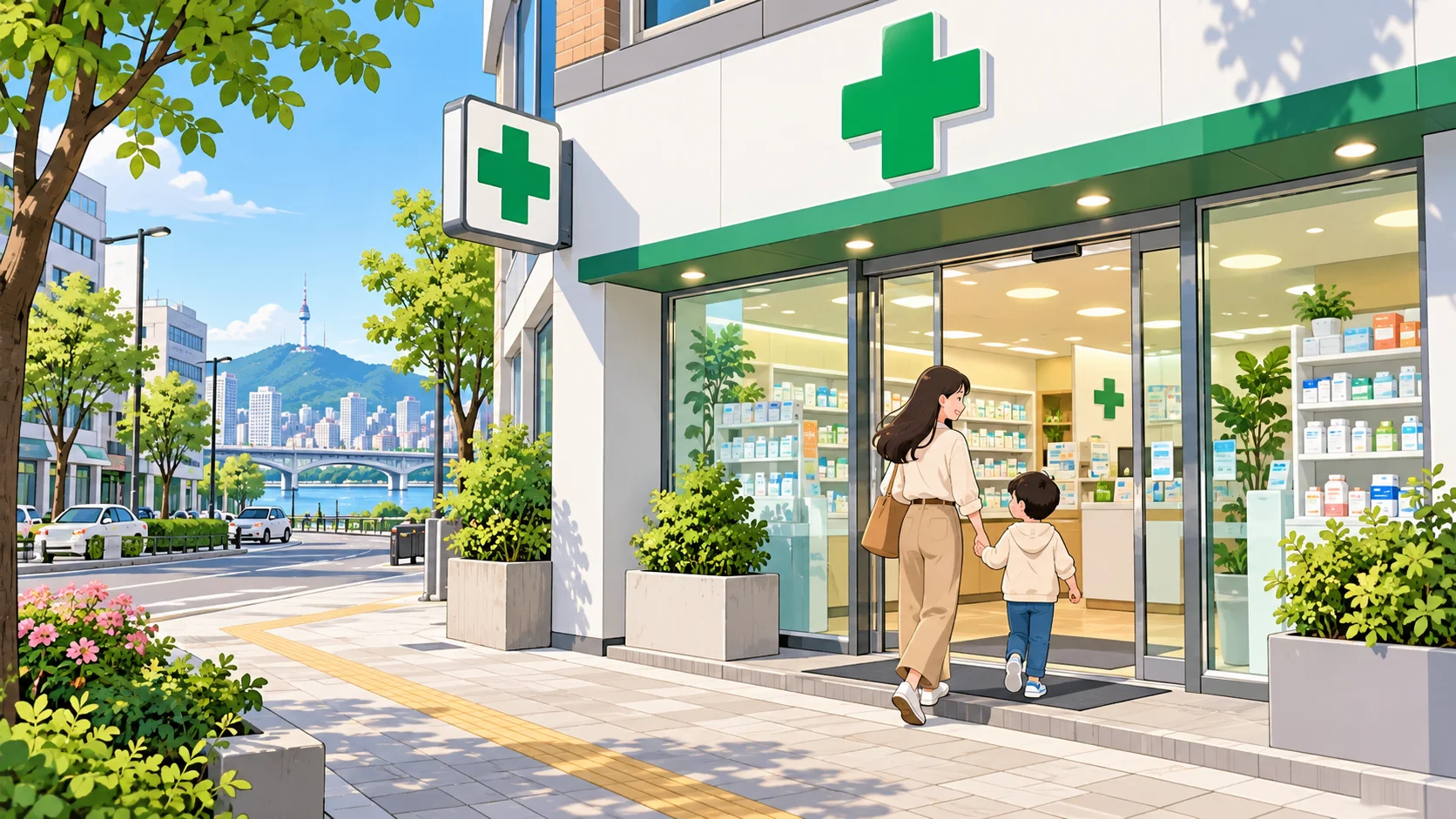
Look for the green cross sign. Korean pharmacists give free verbal consultation at the counter — dosage, side effects, whether you actually need a hospital. This is culturally normal; don't feel awkward asking.
What you can get without a prescription
Fever reducers, cold medicines, digestive aids, anti-diarrheals, and pain patches are all over the counter. Antibiotics require a doctor's prescription — no exceptions.
Finding a pharmacy at night or on holidays
Korea runs a designated on-duty system:
- 공공심야약국 (public late-night pharmacies) — typically open until midnight or 1 a.m.
- 휴일지킴이약국 (holiday duty pharmacies)
Find open ones through the government E-gen portal (e-gen.or.kr), the Smart Seoul Map's late-night pharmacy layer, or by calling 1339. True 24-hour pharmacies are very rare.
The surcharge rule
Pharmacy prices run ~30% higher after 6 p.m. on weekdays (after 1 p.m. Saturdays), on Sundays, and on holidays. Hospital and ER surcharges run 30–50% in the same windows. This is a standing government rule, not price gouging.
Phrases that solve 90% of pharmacy visits
- 해열제 (hae-yeol-je) — fever reducer
- 감기약 / 종합감기약 — cold / multi-symptom cold medicine
- 타이레놀 — Tylenol; Koreans use it as the generic word for acetaminophen
- 설사 (seol-sa) — diarrhea (the symptom word)
- "아이 열이 나요" — "my child has a fever"
Show these on your phone. In tourist areas (Myeongdong, Itaewon, near major hospitals), pharmacies increasingly have English signage and dedicated foreign-customer counters. Elsewhere, Papago handles the dosage conversation fine.
Convenience stores: the after-midnight option
24-hour CU, GS25, and 7-Eleven stores sell a basic OTC selection — fever reducers, multi-symptom cold remedies, digestive aids, anti-diarrheal, pain patches. Single-day packs only, and no pharmacist advice. Fine for 2 a.m. bridge treatment until a pharmacy opens.
5. Travel Insurance: The Checklist Before You Fly
Travel insurance is not required for entry to Korea. No certificate is checked at immigration. But going without it as a family is a bad gamble — a pediatric ER visit plus an overnight stay can run into the millions of won, and medical evacuation costs tens of thousands of dollars.
A 2026 Korea guide recommends minimum $50,000 medical coverage plus emergency medical evacuation. Your family checklist:
- Medical + hospitalization limits (min $50,000 per person suggested)
- Emergency medical evacuation and repatriation
- Coverage for each child — check age limits; some family plans include young kids, others don't
- Trip interruption and cancellation
- Personal liability
- Confirm whether the policy pays directly or is reimbursement-only (most are reimbursement-only in Korea — you pay upfront)
- Confirm planned activities are covered (theme parks, hiking, water sports)
Singapore-specific entry note (2026): Singapore is K-ETA-exempt through December 31, 2026 — but the e-Arrival Card is mandatory instead, filed at e-arrivalcard.go.kr within 3 days before arrival. Visa-free stay: up to 90 days. Don't confuse the exemption with "no paperwork."
6. The Family Medical Kit to Pack
Don't rely on buying everything there. Pack:
- Children's fever reducer (suspension + suppositories — suppositories are harder to find in Korea)
- Thermometer (a familiar one; pharmacy thermometers have Korean-only instructions)
- Oral rehydration salts
- Antihistamines your kids have used before
- Motion-sickness medicine
- Adhesive bandages and antiseptic
- Any prescription medicines in original packaging with a doctor's letter
- Sunscreen (Korean sunscreen is excellent and cheap, but bring what your kids tolerate)
Pair this with the packing guide for the full checklist.
7. Scenario Playbook: What to Do When…
Fever at 11 p.m.: convenience-store fever reducer for the night → Moonlight Children's Hospital or a morning clinic visit. Call 1339 if unsure.
Vomiting/diarrhea: pharmacy for oral rehydration salts and anti-diarrheal ("설사" + "아이" gets you there). If the child can't keep fluids down for 6+ hours, go to an ER.
Injury (cut, sprain): pharmacy for first aid; ER for anything deep, heavily bleeding, or possibly fractured. 119 if you can't transport safely.
Lost medication: bring the empty box or a photo of the label to any pharmacy — pharmacists can usually identify the Korean equivalent.
Allergic reaction: 119 immediately for breathing difficulty or facial swelling. For mild rashes, pharmacy antihistamines.
8. Dental Emergencies
Dental pain doesn't wait for business hours. Major hospital ERs handle dental trauma (knocked-out tooth: keep it in milk, get to a dentist within 60 minutes). For toothaches, international clinics at the big three hospitals have dental departments, and tourist-area dental clinics increasingly advertise English service. A knocked-out baby tooth in a toddler is usually not reimplanted — but a dentist should still check for fragments and gum injury.
9. What Things Actually Cost (Out-of-Pocket, 2026)
Tourists pay 100% — no national insurance subsidy. Indicative figures:
- Pharmacy OTC visit: 5,000–15,000 won for common medicines, plus the 30% night/holiday surcharge
- Clinic consultation: from ~18,840 won baseline (insured fee schedule) — expect 30,000–50,000 won+ uninsured for a basic visit
- Telemedicine consult: ~15,000 won
- ER visit: several hundred thousand won for examination + treatment; overnight admission runs into the millions
- 119 ambulance: free (transport only — treatment billed separately)
These are the numbers that make the $50,000-coverage recommendation concrete. A single ER visit with imaging can exceed what many families assume.
10. Communicating With Doctors: Phrases and Tactics
Even at international clinics, the doctor's English varies. These tactics close the gap:
- Write symptoms down first. A note on your phone — "fever 39.2°C since 6pm, vomited twice, no rash" — is clearer than a stressed verbal explanation in any language.
- Show, don't describe. Photos of rashes, videos of coughing or limping, and the actual medicine packaging beat words.
- Key phrases: "아이가 아파요" (my child is sick), "열이 나요" (has a fever), "토했어요" (vomited), "알레르기가 있어요" (has an allergy), "처방전이 필요해요" (need a prescription).
- Ask for English documentation. International centers issue English diagnosis letters and receipts — request them at the visit, because getting them later by email is slow. You'll need them for insurance claims.
11. After the Visit: Paperwork and Insurance Claims
Keep everything: receipts (영수증), prescriptions, diagnosis letters, and discharge summaries. Photograph them immediately — thermal-printer receipts fade.
For insurance claims back home, you typically need: the itemized bill, proof of payment, a diagnosis in English, and your policy number. File as soon as you're home; most policies have 30–90 day claim windows. If your policy promised direct billing, confirm with the hospital's international center before treatment — after you've paid, you're in reimbursement territory regardless.
12. Prevention Beats Treatment: Staying Healthy in the First Place
Most family medical incidents in Korea are preventable with boring basics:
- Water: tap water in Seoul is technically safe, but most families stick to bottled water for kids — it's 1,000 won everywhere and removes the variable entirely.
- Food safety: eat where locals queue, avoid raw seafood from street stalls (restaurants are fine), and keep hand sanitizer on the kids.
- Jet lag + exhaustion: the number-one cause of "my kid is sick" on day two is actually dehydration and sleep deprivation from the red-eye. Force water and an early night on arrival day — the first day setup guide is built around this.
- Air quality: check the fine-dust (미세먼지) level on your weather app. On bad days, keep asthmatic kids indoors and run the hotel air purifier — most Korean hotels have them.
13. Before You Fly: The Medical Prep Checklist
- Travel insurance with $50,000+ medical coverage per person, evacuation included, reimbursement terms understood
- Prescription medicines in original packaging + doctor's letter (especially for controlled substances — Korea is strict)
- Children's vaccination records (photo on your phone is enough for most situations)
- The three numbers saved: 119, +82-2-1330, 1339
- Papago app installed (camera mode reads Korean medicine labels and hospital signs)
- E-gen portal bookmarked (e-gen.or.kr) for finding open pharmacies and Moonlight Children's Hospitals
- Know your blood types — Korean hospitals will ask, and it's one less thing to figure out under stress
One more Singapore-specific note: if anyone in the family takes regular medication, check that it's legal in Korea before packing it. Some common ADHD medications and strong painkillers are controlled substances here — a doctor's letter helps, but verification ahead of time avoids a customs problem.
The bottom line: save 119, 1330, and 1339 before you land. For anything short of life-threatening, 1330's interpreters and three-way calling solve the language barrier for you. Know that you'll pay upfront and claim later. And sort insurance before you fly — it's the cheapest peace of mind on this entire list. For the rest of trip planning, see our family trip itinerary and first day setup guide.