DMZ Tour Guide: Visiting the Korean Demilitarized Zone from Seoul
The Korean Demilitarized Zone is the most heavily militarized stretch of land on Earth — a 4-kilometer-wide buffer zone running 250 kilometers across the Korean peninsula, dividing a country that has been technically at war for over 70 years. It is also, paradoxically, one of the most popular day trips from Seoul. This guide tells you what to expect, what's currently accessible, and how to do it right.
What the DMZ Is (and Why It Exists)
The Korean Demilitarized Zone (DMZ) was established by the Korean Armistice Agreement of 1953, which ended active fighting in the Korean War. It is not a peace agreement — Korea remains technically divided by a state of armistice, not a formal peace treaty — and the DMZ represents the ceasefire line, extending 2 kilometers on each side of the Military Demarcation Line (MDL).
Within and near the DMZ, a series of extraordinary sites have accumulated historical, military, and human significance: tunnels dug toward Seoul by North Korea, observation platforms offering the only legal view into North Korean territory, symbolic train stations built for a reunification that hasn't happened, and monuments to the millions of families separated by the division.
Visiting the DMZ is not conventional tourism. It is an encounter with one of the defining geopolitical realities of the modern world — and it is far more emotionally resonant than most first-time visitors expect.
JSA / Panmunjom: 2025 Status Update
The most-asked question for 2025: Is the Joint Security Area (JSA) open?
The Joint Security Area (JSA), also known as Panmunjom — where North and South Korean soldiers face each other across the Military Demarcation Line, and where the iconic blue conference buildings straddle the border — has been partially accessible for some periods and restricted during others.
Current situation (as of 2025):
- Civilian visits to the full JSA were suspended in July 2023 following an incident where a U.S. soldier crossed into North Korea
- As of late 2025, limited partial access to the JSA visitor center (Camp Bonifas) has resumed for foreign tourists
- The iconic Panmunjom buildings (Freedom House, the blue conference rooms) remain closed to tourists
- JSA tours when available run on limited days per month and require advance booking
- Full resumption of civilian JSA tours has no currently announced timeline
Practical implication: If you were hoping to stand in the actual blue conference room with your foot literally in North Korea — that is currently not possible. Standard DMZ tours without JSA access are what most visitors will experience, and they are still remarkable.
Check before you book: Review the current JSA status at your tour operator's website (Klook, Trazy, DMZtours.com) as access may change with limited notice.
What's on a Standard DMZ Tour (2025)
Standard DMZ day tours from Seoul are operating regularly and include a consistent set of sites. Most tours cover:
Imjingak Park
Imjingak (임진각) is the civilian-accessible zone nearest to the DMZ — a park and complex of monuments, exhibits, and memorials at the edge of the Civilian Control Zone. Key elements:
- Freedom Bridge — the bridge where Korean War POWs returned to South Korea in 1953; emotionally powerful for Korean visitors
- Steam locomotive — a bullet-riddled locomotive that was captured and left abandoned near the border; it remains rusted on the tracks as a historical monument
- Monument to the Divided Families — reflecting the mass separation of families in the North and South
- The "Wish Ribbons" fence — people tie prayer ribbons with messages about reunification; the fence is a dense tapestry of personal longing
The Third Infiltration Tunnel
One of four tunnels discovered (so far) that were dug by North Korea from north to south, intended for military infiltration. The Third Tunnel was discovered in 1978 and runs approximately 73 meters beneath the surface.
Visitors descend via a 400-meter downward slope (steep — wear sensible shoes and expect low ceilings) to reach the tunnel entrance. The tunnel itself extends only so far before a concrete wall marks the demarcation line. The experience is unforgettable: the close air, the tight space, the very specific knowledge of where you are.
Note: Cameras are not permitted inside the tunnel.
Dora Observatory
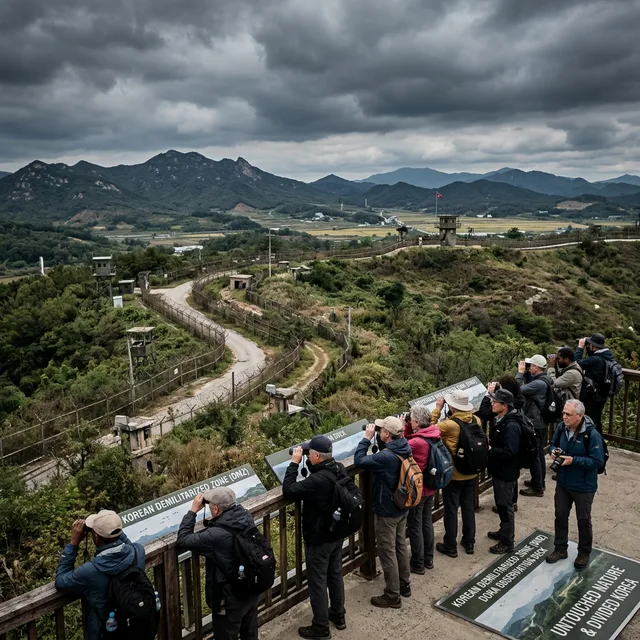
The Dora Observatory (도라전망대) sits on top of Dorasan Mountain and offers the only legal point from which visitors can look into North Korean territory with binoculars (provided). On clear days, you can see the Kijong-dong propaganda village (a North Korean village of elaborate buildings with no apparent residents) and the enormous North Korean flag flying across the border.
The experience of looking through binoculars at another country — one that is simultaneously familiar in language and history, and radically unknowable — is quietly affecting.
Dorasan Station
The Dorasan Station (도라산역) is the last train station in South Korea — built with the intention of one day connecting rail lines through North Korea to Eurasia. The station is fully constructed, the platforms are empty, and signs indicate distances to Pyongyang and points beyond. It is an eerie and poignant symbol of interrupted connections and unrealized reunification.
A souvenir stamp at the station is a popular keepsake.
Practical Information: Booking and Rules
Guided Tours are Mandatory
You cannot visit the DMZ independently. All visitors must join an official guided tour operated by UN Command-approved companies. This is a military zone; independent entry is not permitted.
Booking Platforms
Most English-speaking visitors book through:
- Klook — wide range of DMZ tour options; most popular with international tourists
- Trazy — Korea-specialist; sometimes includes JSA-specific tours when available
- GetYourGuide — international-facing; English-first interface
- Viator — additional private tour options
- DMZtours.com — specialist operator
Tours typically depart from central Seoul (Dongdaemun, Hongdae, or hotel pickup options available).
Prices and Duration
| Tour Type | Duration | Price Range |
|---|---|---|
| Standard DMZ tour (no JSA) | 6–7 hours | ~$50–80 USD |
| DMZ + JSA tour (when available) | 8–9 hours | ~$80–130 USD |
| Private DMZ tour | 6–8 hours | $120–200 USD |
Rules and Restrictions
- Passport required — bring the original physical passport. Copies are not accepted.
- Age restrictions — some tours require minimum age 11; check your specific tour.
- Monday closure — most DMZ tours do not operate on Mondays; the DMZ area is generally closed that day.
- Dress code — no torn jeans, no camouflage clothing (can be mistaken for military unifiliation). Smart-casual or neat casual.
- Camera restrictions — cameras permitted at Imjingak, Dora Observatory, and Dorasan Station. Not permitted inside the tunnel. Specific photography angles may be restricted at certain points.
- No photography toward North Korea at certain observation points beyond what's sign-indicated.
- Keep your tour group — independent movement away from the guide is not permitted.
What to Expect Emotionally
Most guides describe the DMZ tour as more affecting than visitors anticipate. People who go in expecting an interesting military history tour often come out differently.
The combination of specific elements — the family separation monuments, the ribbons on the fence, the empty station with signs pointing to Pyongyang, the tunnel that someone dug toward your country — creates an emotional register that geopolitical facts alone cannot. Korea's division is not abstract at the DMZ. It has faces and addresses and specific streets where families were cut off from each other within living memory.
Go with patience and some knowledge of Korean War history. The tour guides at DMZ sites are generally excellent, and the contextual information they provide makes the experience dramatically richer.
Extending Your Day: What to Do After
Most DMZ tours return to Seoul by early afternoon, leaving time for:
- Gyeongbokgung Palace (late afternoon, after the crowds lighten)
- Insadong for art galleries and traditional craft shops
- War Memorial of Korea in Yongsan — a powerful complement to the DMZ visit; free admission; the aircraft and tank displays outdoors are impressive
Before You Go: Korean War Context
The DMZ visit is far more meaningful with basic Korean War knowledge. Here is the essential context:
The Korean War (1950–1953) On June 25, 1950, North Korean forces invaded South Korea across the 38th Parallel. The United Nations (led primarily by the United States) intervened to defend South Korea; China intervened to support North Korea. The war killed approximately 3–4 million people — a majority civilian — and ended not in a peace treaty but in the armistice agreement of July 27, 1953, which established the DMZ at roughly the position of front lines at war's end.
Why "still at war"? The armistice agreement is a ceasefire, not a peace treaty. The United States and North Korea have never signed a formal peace treaty; technically, the Korean War never legally ended. This is not a historical technicality — it shapes every aspect of the political relationship on the peninsula today.
The separation of families When Korea was divided, millions of families were cut across the line. Many had no warning. Fathers were separated from children; siblings from siblings; spouses from spouses. The Korean phrase for this separation — 이산가족 (isanjagok) — means "scattered family" and carries enormous cultural weight. The reunion ceremonies between separated families (the most recent occurred in 2018) are major national events. When you stand at the "Wish Ribbons" fence at Imjingak, you are standing where those families have grieved for seven decades.
Detailed Site Guide
Imjingak Park: What to Spend Time On
The most important stops at Imjingak:
Steam locomotive (증기기관차) A Korean War-era locomotive sits on tracks just north of the main complex, riddled with bullet holes and abandoned where it was hit. It was never moved. Looking at this rusted machine — meant to run between Seoul and Pyongyang — is a viscerally specific way to understand the division.
The Bridge of Freedom (자유의 다리) This is the bridge where 12,773 South Korean prisoners of war returned home on August 3, 1953, following the armistice. Walking toward it — even just to the point where access is blocked — puts you at a physical location of extraordinary historical meaning.
The Wish Ribbon Wall The fence at the edge of the civilian control zone is covered in colored ribbons left by visitors, pilgrims, and separated family members — each carrying a personal message, prayer, or name of someone across the border. Allow time to read some of them.
The Third Tunnel: Practical Details
- Descent: 400 meters down an angled slope (about 11 degrees); wear comfortable shoes with grip
- Tunnel interior: Low ceilings (1.2–1.5m); medium-height visitors will bend slightly; wear the provided hard hat
- Length inside: Approximately 265 meters visible to tourists before the concrete wall
- Time inside: 30–45 minutes
- Photography: Strictly prohibited inside the tunnel; phones must be stowed before entry
- Physical demand: Moderate (the ascent back up the slope is tiring)
Dora Observatory: Photography Tips
Binoculars are provided at the railing for free. On clear days (best in winter and early spring when haze is low):
- The Kijong-dong village (what South Koreans call "Propaganda Village") is visible across the border — elaborate buildings, wide streets, and the largest flag in the world
- The North Korean town of Kaesong (an industrial complex that briefly operated as a joint North-South economic zone) is visible in the distance
- Photography at the observatory is permitted from designated areas; follow the marked line on the ground — do not photograph over the line
Dorasan Station: What Makes It Unique
Dorasan Station was completed in 2002 as part of the inter-Korean rapprochement period. For a brief window (2007–2008), freight trains actually ran through this station to Kaesong. When the Kaesong Industrial Complex closed in 2016 due to nuclear tensions, the station fell silent again. The timetable board still shows "Next Train: Pyongyang." The passport stamp souvenir (available at the station gift shop, 1,000 KRW) is a keepsake unlike anything else in Korean tourism.
Selecting the Right Tour
Half-Day vs. Full-Day Tours
| Half-Day Tour | Full-Day Tour | |
|---|---|---|
| Duration | 4–5 hours | 7–9 hours |
| Sites covered | Usually Imjingak + Observatory only | All major sites including tunnel + Dorasan |
| Best for | Time-constrained travelers | Those wanting the complete experience |
| Price range | $35–50 USD | $50–80 USD |
Recommendation: Book the full-day tour. The Third Tunnel and Dorasan Station are the most impactful DMZ experiences, and both require the full-day format.
Group vs. Private Tours
Private DMZ tours (available through operators like Klook and Viator) cost more (~$120–200 USD) but allow your guide's full attention, custom pacing at each site, and flexible pickup/return times. For history enthusiasts who want deeper discussion at each site, private tours are significantly better.
Pro Tips for Foreign Travelers (2025-2026)
To ensure your DMZ trip is smooth, keep these "insider" tips in mind:
- Book at least 2 weeks in advance: Even without full JSA access, DMZ tours remain one of Korea’s most popular day trips. Spots can fill up quickly, especially during peak seasons (Spring and Autumn).
- The "Monday Rule": Unlike many museums in Seoul that close on Mondays, some smaller DMZ-related exhibits might follow varied schedules. Double-check your specific tour operator if your only available day is a Monday.
- Food at Imjingak: There are several dining options at the Imjingak tourist area, including various Korean snack stands. However, prices are slightly higher than in central Seoul. Most full-day tours include a basic Korean lunch at a nearby restaurant—ask your guide about dietary requirements (halal/vegan) early.
- Binoculars: While Dora Observatory has many binoculars, they are sometimes crowded. If you have your own small travel binoculars, bring them for a more relaxed viewing experience of the North Korean propaganda village.
- Souvenirs: Beyond the Dorasan Station stamp, you can buy North Korean currency (bills and coins), jars of DMZ honey, and even North Korean blueberry wine at the souvenir shops. These are unique keepsakes you won't find in Myeongdong.
Frequently Asked Questions
Is the DMZ dangerous to visit? No. The civilian sections of the DMZ open to tourists are completely safe and have been visited by millions of international travelers without incident. The emotional weight of the experience is different from any physical risk.
What if the JSA opens up again? Check tour operator websites 2–4 weeks before your trip. JSA access has historically been restored and suspended multiple times in response to diplomatic developments. When available, JSA spots sell out extremely fast — book the same day access is announced.
Can I bring children? Some tours have minimum age restrictions (typically 11+). Check your specific tour. The content is sobering but not graphic; families with thoughtful teenagers find the experience educational and meaningful.
What should I read before going? Brief: "The Two Koreas" by Don Oberdorfer, or "The Impossible State" by Victor Cha for deeper context. Even reading the Wikipedia article on the Korean War the night before meaningfully enhances the experience.
2026 Booking Tip: Lock In Tours Early
DMZ tour availability tightens considerably during Korean national holidays (Chuseok, Lunar New Year) and around major diplomatic events on the peninsula — when news cycles flare, tour operators sometimes suspend departures on short notice. Book at least 2–3 weeks in advance for standard tours, and immediately if JSA access reopens. Klook and Trazy both offer free cancellation up to 24 hours before departure, so booking early carries no financial risk.
Final Thoughts
The Korean DMZ is one of the most geopolitically significant and emotionally complex destinations in all of East Asia. As a travel experience, it is impossible to reduce to simple categories — it is neither war tourism nor peace advocacy, but something particular to Korea's specific unresolved history. It is worth an entire day of your trip, and it will stay with you long after you return.
For more on Korean history and culture, see our Gyeongju Travel Guide: The Museum Without Walls, explore Seoul's Five Grand Palaces: A Complete Visitor's Guide, or learn how to Shop Like a Local: The Ultimate Guide to Korean Markets.