Crash Landing on You and Goblin: Landmark Scenery Tours in Korea
There is a moment in every K-drama fan's life when they stop watching the screen and start planning the trip. For millions of viewers worldwide, two shows did this more powerfully than any others: Crash Landing on You (2019–2020) and Goblin (2016–2017). One gave us a love story that transcended borders, the other a romance that transcended centuries — but both gave us something equally intoxicating: a vision of Korea so impossibly beautiful that it demanded to be seen in person. The emerald quarry lake of Pocheon. The granite cliffs wrapped in morning mist. The solitary man standing at a breakwater in Gangneung as ocean spray swirls around him. This guide is your field manual for reaching every single one of those scenes.
Whether you are a first-time visitor planning a dedicated K-drama scenery tour, or a returning traveler finally making time for the filming locations you bookmarked years ago, the routes below are organized by geography to minimize backtracking. We cover two main circuits — a North/West loop for Crash Landing on You fans and an East Coast route anchored by Goblin — plus logistics, photography tips, and overnight stays that make the most of both.
What Makes These Locations So Cinematic?
South Korea's natural and architectural landscape has always been photogenic, but CLOY and Goblin elevated specific locations into cultural landmarks. Both production teams deliberately chose places that felt slightly unreal — a quarry turned emerald lake, a centuries-old fir tree forest that looks permanently snow-dusted, a European-style village carved into Korean hillside — and their cinematographers leaned into the drama. Understanding why these spots were chosen helps you recreate those shots and appreciate the landscape beyond the fandom.
The key to the CLOY visual identity is contrast: North Korean officer meets Swiss chalet energy, vast military plains dissolved by soft romantic lighting. Director Lee Jung-hyo found that contrast in Korea's own backyard — in Pocheon's granite valley, in the Loire-meets-countryside pastoral of Gapyeong's Petite France. Goblin, directed by Lee Eung-bok, went further into myth, pairing the immortal Goblin (played by Gong Yoo) with settings that feel genuinely outside of time: for Korean scenes, two locations that exude ancient solitude — Woljeongsa's fir tree corridor and the wind-battered Jumunjin breakwater on the east coast.
Together, these core locations form a K-drama photography circuit that no studio re-creation can match.
The North/West Route: "Swiss" Vibes and Dramatic Cliffs (CLOY)
This loop operates out of Seoul and is easily done in a single long day or spread across a comfortable overnight in Gapyeong. The three locations below run roughly north to northeast of the capital.
Pocheon Art Valley
The undisputed crown jewel of the Crash Landing on You location tour is Pocheon Art Valley (포천아트밸리), a decommissioned granite quarry in Gyeonggi Province transformed into one of Korea's most surreal public parks. The quarry's sheer walls — grey and rose-tinted granite carved over decades — plunge down to a lake of impossible green-blue, the color the result of minerals leaching from the rock. It is the kind of place that looks filtered even without a filter.
In CLOY, the lake and cliff complex stood in for the North Korean countryside where Ri Jeong-hyeok (Hyun Bin) and Yoon Se-ri (Son Ye-jin) shared some of their most intimate early scenes. The drama's production team shot here extensively, and fans will immediately recognize the granite face that frames several mid-season episodes.
Practical info (2026): Admission is 5,000 KRW for adults, 3,000 KRW for teenagers, and 1,500 KRW for children. A monorail runs from the lower entrance up to the quarry for an additional 4,300 KRW (one-way) or 5,300 KRW (round-trip) — highly recommended if you are visiting with elderly travelers or simply want a dramatic entrance. The park operates Monday through Thursday from 09:00 to 19:00, with extended weekend hours until 22:00 on Fridays and Saturdays. Note: the park closes on the first Monday of each month.
Photography tip: Arrive before 10:00 AM on a weekday to catch the quarry light before tour groups arrive. The lake surface mirrors the cliffs most dramatically on still, overcast mornings. Stand at the eastern observation deck — not the main lower viewpoint — to get the full vertical drama of the granite wall behind you.
Hantan River Sky Bridge
Roughly 20 kilometers northeast of Pocheon Art Valley lies one of CLOY's most recognizable outdoor scenes: the Hantan River Sky Bridge (한탄강 하늘다리), a 200-meter suspension bridge strung above the dramatic volcanic basalt gorge of the Hantan River. This is where Ri Jeong-hyeok and Yoon Se-ri have their windswept reunion — two figures on a slender bridge, the gorge yawning below them, mountains closing in on all sides.
The bridge is free to cross and accessible year-round from the Hantan River Geopark Trail. The real challenge is the hike: the most scenic viewpoint requires walking about 1.5 kilometers along the gorge rim, which can be muddy after rain. Wear shoes with grip. The bridge sways gently in strong wind, which is atmospheric until it isn't — check the weather forecast before committing to this leg of the tour, especially in late autumn when Gangwon-do winds are punishing.
Re-enacting the scene: Bring a full-length coat in a solid color and stand at the midpoint of the bridge facing east. The gorge's columnar basalt formations provide the most dramatic background. Shoot wide to capture both the bridge railing and the valley below; a standard smartphone in Portrait mode works well here.
Little Switzerland and Petite France (Gapyeong)
About 40 minutes southwest of the Hantan bridge area, in the hills above the North Han River, sits Gapyeong County — and within it, two themed villages that both CLOY and Korean cinema return to when they need "Europe in Korea." The better-known is Petite France (쁘띠프랑스), a French-themed cultural village that appeared in My Love from the Star and briefly in CLOY, but for the most dedicated CLOY experience, seek out the Swiss Theme Village (스위스 테마파크) in the same area, which the production used to approximate the European setting of Se-ri's backstory.
Neither village is a filming location in isolation — they are texture. But when paired with the dramatic landscape of the North Han River valley, especially in autumn foliage season (late October to early November), they deliver the pastoral European-meets-Korean-countryside hybrid that defines CLOY's visual identity.
If you are visiting Gapyeong, the A Photographer's Guide to Nami Island and Gapyeong post covers the entire region in depth, including the optimal times of year to visit and how to combine Petite France with a Nami Island half-day.
The East Coast Route: The Iconic Ocean Meeting (Goblin)
The Goblin circuit is centered on the east coast and requires either an overnight stay in Gangneung or an early morning KTX from Seoul. These three locations form the emotional heart of the series — the places where the Goblin and his bride meet, remember, and grieve across lifetimes.
Jumunjin Breakwater, Gangneung
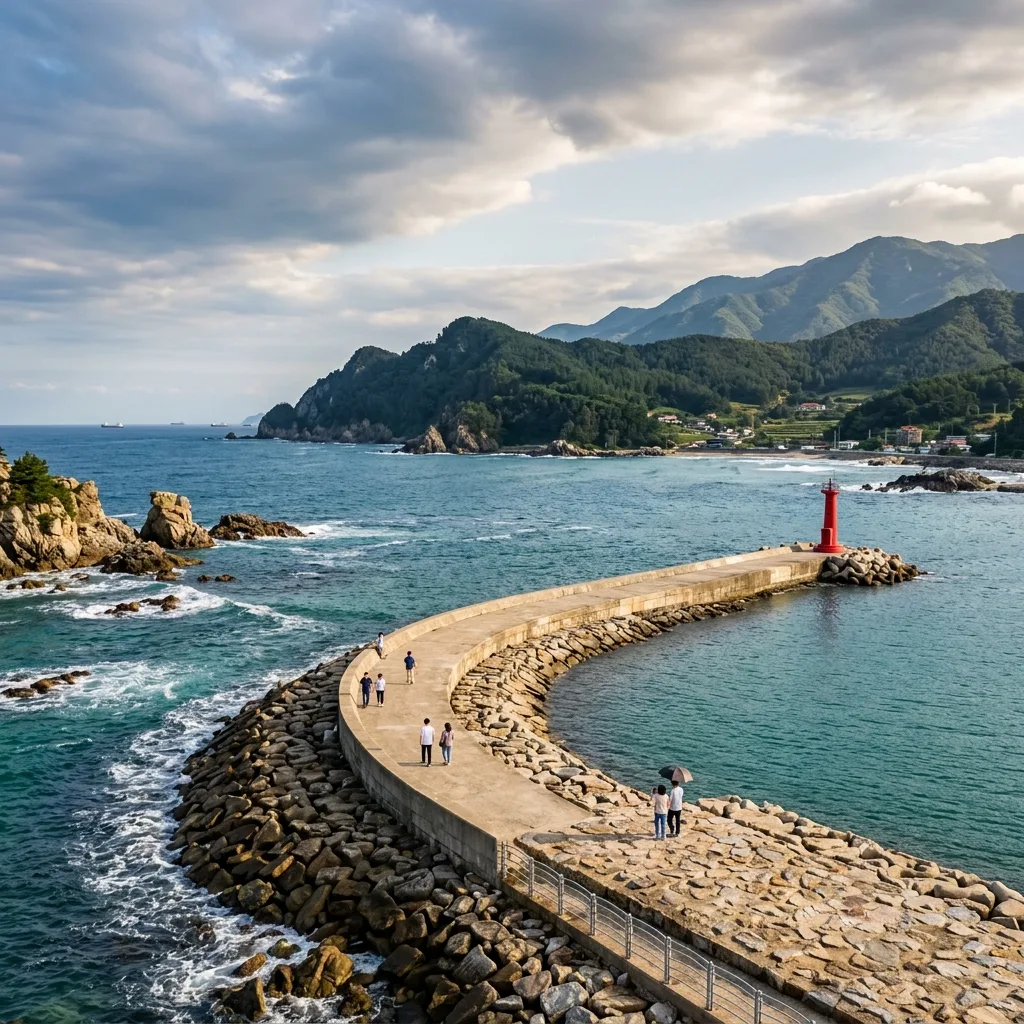
No single location is more associated with Goblin than the Jumunjin Breakwater (주문진 방파제) in Gangneung. It is the windswept pier where Ji Eun-tak (Kim Go-eun) first summons the Goblin by blowing out birthday candles in the ocean wind, and where multiple emotional reunion scenes play out across the series. The red lighthouse at the breakwater's end and the rhythmic crash of East Sea waves make it one of the most photographed spots in Korea by K-drama fans.
The breakwater is publicly accessible at all hours with no admission fee. Parking is available in a small lot adjacent to the pier and in the Jumunjin Port area. Early mornings offer the best photography conditions — the eastern horizon gives dramatic sunrise shots, and weekend tour crowds don't typically arrive before 10:00 AM.
Scene recreation tips: The key Goblin shot requires an open-knit scarf (ideally red or cream) and a white or camel-colored coat. Stand at roughly the midpoint of the breakwater, slightly left of center when facing the sea, to match the framing of the series' most-shared stills. If you want the lighthouse in the frame, you'll need a wide lens or to step back significantly — the pier is narrower than it appears on screen. The K-Drama Travel Bucket List: Iconic Destinations Featured on Screen post has additional framing guides for this and other east coast locations.
Woljeongsa Fir Tree Forest Path
Forty minutes inland from Gangneung, in the heart of Odaesan National Park, is Woljeongsa Temple (월정사) — and more specifically, the 1-kilometer fir tree forest path (전나무 숲길) that lines the approach road to the main temple complex. This is Goblin's most visually haunting Korean location: hundreds of centuries-old Korean fir trees, their trunks straight and silver-grey, create a cathedral corridor that appears permanently frosted even in summer, and in winter becomes the snow-world that frames the Goblin's loneliest wandering.
Admission and hours (2026): Entry to the national park area around Woljeongsa costs approximately 3,000 KRW for adults (1,500 KRW for teenagers, 500 KRW for children), which covers the fir tree forest path. The path can be walked at any time of day, though the main temple buildings observe standard Buddhist temple hours. Verify the current fee directly with the temple or national park office, as the fee structure has been under review.
The fir tree path is best experienced outside of summer and early autumn weekends, when the forest is quietest. In winter — January through mid-February — the trees hold snow on their branches and the trail becomes genuinely otherworldly, approximating the Goblin aesthetic better than any other season. Combine this with a sunrise visit to Gangneung's Gyeongpo Beach (15 minutes away) for one of Korea's best dawn photography mornings.
Hanmi Bookstore, Incheon
Rounding out the Goblin location circuit is a spot that requires a detour back west: the Hanmi Bookstore (한미서점) in Sinpo International Market, Jung-gu, Incheon. The famous yellow door — through which the Goblin passes into the magical library that serves as a portal between worlds — is a real shop facade in Incheon's oldest market area. It remains operational as a bookstore and has become one of the most pilgrimage-worthy small locations in K-drama tourism.
The bookstore is best combined with a half-day in Incheon's Jung-gu district, which includes the Chinatown area and the Japanese colonial-era architecture streets. Incheon is accessible directly from Seoul via Subway Line 1 (around 70–80 minutes) or express bus from Sinchon Station.
Logistics: Getting There from Seoul
Three main approaches work for this circuit, depending on your group size, budget, and comfort with Korean public transit.
Option 1: Guided Day Tours (Best for Non-Drivers)
For travelers who want a curated K-drama experience without navigating Korea's rural bus systems, guided day tours from Seoul are the most stress-free option. Multiple operators on Klook run dedicated Goblin shooting location tours and CLOY filming location day trips. Group tours typically run in the 50,000–90,000 KRW per person range for a full day including transport; private tours for groups of two run approximately $50–$100+ USD per person based on current listings.
When booking, confirm which specific locations are included — some "Goblin" tours focus exclusively on Incheon and Seoul urban locations (Hanmi Bookstore, the Goblin stairs in Hongdae) and don't venture to Gangneung. Tours labeled "Goblin + East Coast" or "Gangneung K-Drama" are more likely to include Jumunjin and Woljeongsa.
Option 2: Private Car Hire (Best for Groups of 3+)
For groups of three or more, a private car hire — either through a dedicated driver service or a rental with navigation — is often more cost-effective and significantly more flexible than a guided tour. The North/West (CLOY) route can be completed comfortably in a single day from Seoul: Pocheon Art Valley → Hantan River → Gapyeong, all within a 2–3 hour drive radius from central Seoul.
The East Coast (Goblin) route is harder as a single day: Gangneung is 2.5–3 hours from Seoul by car, so a private hire for Jumunjin and Woljeongsa works best as part of an overnight trip. Most car hire services allow hotel drop-off, making Gangneung an easy overnight base.
Option 3: KTX + Local Taxis
For the east coast Goblin locations, the most efficient public transit option is the KTX to Gangneung Station (approximately 2 hours from Seoul Station), followed by local taxis or the city's tourist shuttle to Jumunjin (about 20 minutes from the station). Woljeongsa requires a taxi or inter-city bus from Gangneung Bus Terminal — around 40 minutes.
The The East Coast Road Trip: Gangneung, Sokcho, and Yangyang guide covers the full Gangwon-do east coast transit options in detail, including bus schedules and taxi app recommendations for the region.
For the CLOY North/West circuit, Pocheon is reachable by Seoul Metro Line 1 to Dongducheon and then a local bus, but the Hantan River Sky Bridge location requires a taxi from the nearest bus stop. This route is manageable but slow — budget 3.5 hours each way from central Seoul if traveling by public transit alone.
Photography Masterclass: Re-enacting the Scenes
Visiting the locations is one thing. Walking away with images that genuinely capture the drama's visual language is another. Here is what separates a memorable fan photo from a snapshot.
What to Wear
Crash Landing on You is defined by its palette: military olive and muted earth tones on Hyun Bin, creamy whites and soft beiges on Son Ye-jin. For Pocheon Art Valley and the Hantan River Bridge, a solid-color long coat in camel, cream, or dusty rose photographs most cinematically against the grey granite. Avoid bold patterns — the landscape is already the pattern.
Goblin's visual identity leans toward cool blues, greys, and whites broken by one pop of warm color — typically Gong Yoo's scarf or Ji Eun-tak's accent pieces. At Jumunjin, a long wool coat in charcoal or navy with a single statement scarf matches the show's aesthetic. At Woljeongsa in winter, an all-white outfit against the snow-frosted trees creates an arresting image, but bring waterproof boots — the trail gets icy.
Identifying the Exact Camera Angles
Both shows used a consistent cinematographic technique: wide establishing shots with the subject slightly off-center, followed by tight close-ups that compress the background. To replicate this with a phone or DSLR:
- Pocheon quarry: Shoot from the eastern rim observation platform looking down and west. The subject should occupy the left third of the frame, with the lake and far cliff filling the right two-thirds.
- Jumunjin breakwater: Shoot at eye level with the lighthouse in the distant background, not directly behind the subject. The water should be visible on both sides of the pier.
- Woljeongsa fir path: Shoot looking straight down the corridor — the vanishing point perspective is the entire composition. The subject should be 10–15 meters ahead of the camera, centered, giving the trees room to converge behind them.
Shooting in the golden hour (first hour after sunrise, last hour before sunset) amplifies the soft, slightly melancholic light quality both shows favored. Morning light is cooler and more dramatic; evening light is warmer and more romantic — choose accordingly for the mood you want to capture.
Timing Your Visit by Season
Spring (March–May): Cherry blossoms transform Gapyeong and the Hantan River area into a pastel dreamscape. Pocheon Art Valley has its own cherry trees near the lower entrance. This is the most popular season; arrive early and book accommodations well in advance.
Autumn (October–November): The foliage along the North Han River valley is spectacular, particularly in the hills around Gapyeong. The Woljeongsa fir tree path takes on amber undertones as deciduous trees around the temple grounds turn. Crowds are present but manageable on weekdays.
Winter (December–February): The definitive Goblin season. Woljeongsa's fir path is genuinely transformed by snow, and Jumunjin breakwater in winter — with wind and sea spray — is raw and cinematic in a way no other season matches. Cold-weather clothing is non-negotiable; temperatures at Jumunjin regularly drop below -5°C with wind chill.
Summer (June–August): High humidity makes photography challenging and crowds peak at all locations. If you must visit in summer, go to Woljeongsa — the forest canopy keeps the trail cool, and the solid green of the fir trees against misty mountain air has its own quiet beauty.
Where to Stay for Multi-Day Tours
A well-structured K-drama filming location trip requires at least one overnight stay if you want to do justice to both circuits.
Staying in Gangneung
Gangneung is the natural east coast base. It puts Jumunjin Breakwater and Woljeongsa within a 40-minute drive, plus one of Korea's best sunrise beaches at Gyeongpo, and the celebrated Anmok Coffee Street for a leisurely post-shoot morning. The city expanded significantly for the 2018 Winter Olympics, and accommodations range from boutique beachfront guesthouses to international chain hotels near the station.
For K-drama fans, staying the night in Gangneung allows a golden-hour visit to Jumunjin (either sunset the day of arrival or sunrise the following morning), a mid-morning trip to Woljeongsa when mist still lingers in the trees, and an afternoon along the east coast road before catching the evening KTX back to Seoul.
Staying in Gapyeong
For the CLOY North/West circuit, Gapyeong is the ideal base. It puts you at the heart of the filming region — Petite France, the Swiss Village, and the North Han River — and within 40 minutes of Pocheon by car. Gapyeong is genuinely peaceful: quieter and more rural than Gangneung, with forested riverside guesthouses and pension-style accommodations that feel thematically aligned with the show's countryside aesthetic.
Combine a Gapyeong overnight with a Nami Island visit (reachable by a short boat ride from Gapyeong Wharf) if you are also a fan of Winter Sonata, the 2002 K-drama that first put this region on the international tourism map.
Final Thoughts: Seeing Korea Through a Director's Lens
What makes the CLOY and Goblin filming locations genuinely worth visiting — beyond the fandom — is that both production teams found real places of exceptional beauty and framed them with exceptional care. Pocheon's quarry lake would be breathtaking without Hyun Bin standing in front of it. Woljeongsa's fir tree path would be one of Korea's most quietly magnificent walks regardless of whether Gong Yoo ever wandered through it.
The K-drama connection gives you the reason to seek these places out. Korea itself gives you the reason to stay. The emerald water, the granite walls, the centuries-old trees, the wind off the East Sea — these are among the most visually stunning environments on the peninsula, and they deserve the pilgrimage on their own terms.
Visit in the right season, bring the right coat, and arrive before the tour buses. Then stand at the Jumunjin breakwater and let the ocean do the rest of the work. No director required.
Planning a broader K-drama travel itinerary? The K-Drama Travel Bucket List: Iconic Destinations Featured on Screen covers filming locations across the country, from Seoul rooftops to Jeju's coastal cliffs.