China visa-free transit: a pre-booking verification checklist

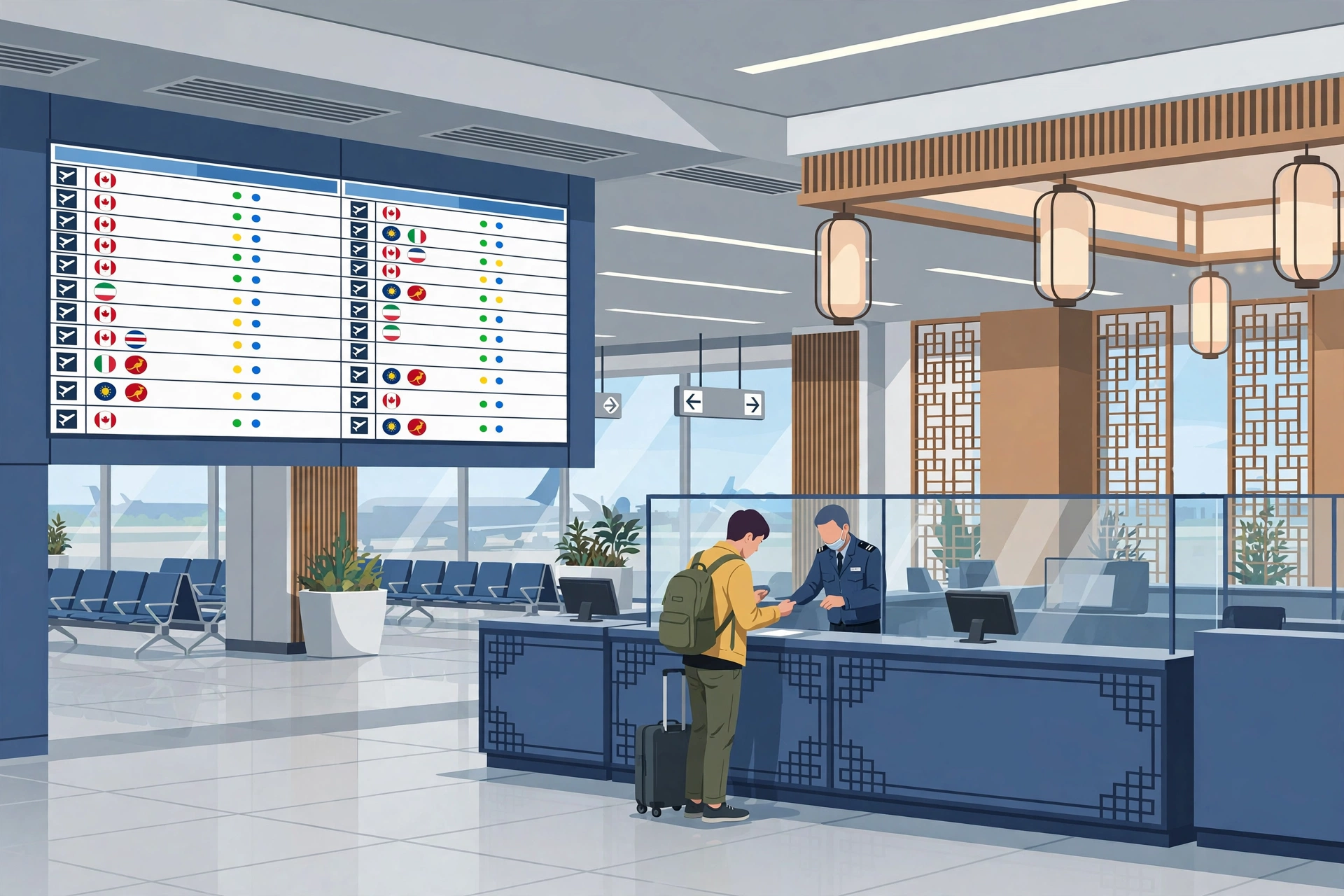
The 144-hour and 240-hour transit windows and which ports offer them
China's visa-free transit lets travelers from 54 countries pass through without a visa for up to 144 hours, or 240 hours at select ports. You must fly from country A through China to a different country B with a confirmed onward ticket.
The 144-hour policy applies at major international ports including Shanghai (Pudong and Hongqiao), Beijing (Capital and Daxing), Guangzhou Baiyun, Chengdu Tianfu, and over 30 other ports of entry. Each port has a defined transit zone. Shanghai covers Shanghai municipality plus Jiangsu and Zhejiang provinces. Beijing covers Beijing, Tianjin, and Hebei. Guangzhou covers Guangdong province. Chengdu covers Sichuan province. You cannot travel outside your zone, even on a day trip.
The 240-hour (10-day) transit is a newer, more generous option available at an expanding list of ports. As of 2026, it covers many of the same major hubs as the 144-hour policy but gives you four extra days. The eligibility requirements are the same: 54-country passport, onward ticket to a third country, and staying within the defined zone. If your itinerary needs more than six days, check whether your entry port offers the 240-hour option before booking.
The key difference is not just duration but planning flexibility. With 144 hours, a late-night arrival effectively gives you almost seven calendar days because the clock starts at midnight after you land. With 240 hours, you get ten full days plus the arrival day remainder. For travelers wanting to see both Shanghai and Hangzhou, or Beijing and Tianjin, the 240-hour window removes the time pressure that makes the 144-hour version feel rushed.
Not all ports offer both options. Smaller regional airports may only offer 72-hour transit or no visa-free transit at all. Before booking, verify which policy your specific entry port supports by checking the National Immigration Administration website. Do not assume that because Shanghai offers 240 hours, your regional airport does too.
Your passport needs six months validity and blank pages. This applies to both the 144-hour and 240-hour options. Airlines check this at boarding, and Chinese immigration checks it on arrival. If your passport expires in five months, renew it before you book anything.
Onward ticket rules: what counts as a qualifying exit flight
The onward ticket is the most scrutinized part of your transit application. You must have a confirmed ticket out of China to a third country or region within your transit window. The ticket must show your name, the flight number, the date, and the destination. A booking confirmation email is sufficient, but have it accessible both on your phone and as a printout.
The critical rule is that your origin and destination countries must be different. Singapore to Shanghai to Tokyo qualifies because Singapore and Japan are different countries. Singapore to Shanghai to Singapore does not qualify because you are returning to your origin country. This is the single most common reason for denied boarding. The system is designed for genuine transit, not for visa-free tourism with a return ticket.
Hong Kong, Macau, and Taiwan count as separate regions from mainland China for transit purposes. Shanghai to Hong Kong is valid onward travel. However, enforcement can be inconsistent, with individual officers sometimes questioning Hong Kong onward legs more closely. If your entire plan depends on a Hong Kong departure, have a backup plan and allow extra time at immigration.
Separate tickets are allowed but invite more scrutiny than a single through-ticket. If you booked Singapore to Shanghai on one airline and Shanghai to Tokyo on another, bring printed confirmations for both segments. Officers are more skeptical of separate tickets because they are easier to cancel after entry. A single booking reference covering the entire journey is always smoother.
The onward flight must depart from within your permitted transit zone. If you entered through Shanghai under the 144-hour policy, your onward flight must leave from Shanghai, Nanjing, Hangzhou, or another airport within the Shanghai-Jiangsu-Zhejiang zone. You cannot enter through Shanghai and depart from Beijing, because that would require traveling outside your permitted area.
Be wary of refundable or placeholder tickets. Some travelers book a fully refundable onward ticket with the intention of canceling it after entry. Immigration officers are aware of this tactic. If they suspect your onward ticket is not genuine, they can deny entry. Book a ticket you actually intend to use, or at minimum, one with a change fee rather than a full refund, which looks more legitimate.
If your onward flight is cancelled while you are in China, go to the nearest exit-entry administration office immediately. Do not overstay your transit window hoping for a rebooking. The authorities can grant a short extension in genuine disruption cases, but only if you report proactively. Overstaying, even by a few hours due to a cancelled flight you did not report, can result in fines and future entry bans.
The 240-hour option: which itineraries qualify for the longer window
The 240-hour visa-free transit gives you ten days instead of six, which fundamentally changes what kind of trip you can plan. With 144 hours, you are limited to one metropolitan area plus nearby day trips. With 240 hours, you can do a proper multi-city itinerary within your zone, or take a more relaxed pace with rest days built in.
To qualify for the 240-hour option, you must meet the same basic requirements as the 144-hour transit: hold a passport from one of the 54 eligible countries, have a confirmed onward ticket to a third country departing within 240 hours, and stay within the defined geographic zone for your entry port. The only difference is the duration and the list of ports that offer it.
The 240-hour policy is ideal for itineraries like this: arrive Shanghai, spend three days exploring the city, take the high-speed rail to Suzhou for two days of classical gardens, continue to Hangzhou for West Lake and tea culture, then return to Shanghai for your onward flight. Under the 144-hour policy this would feel rushed. Under the 240-hour policy it is comfortable.
Another strong use case is Beijing with side trips. Arrive Beijing, spend four days on the Forbidden City, Great Wall, and hutongs, take a day trip to Tianjin for the colonial architecture and street food, visit Chengde for the mountain resort if time permits, then depart. The extra days let you handle the jet lag and see things at a reasonable pace rather than sprinting.
The 240-hour option also helps if your flights have awkward timing. With 144 hours, a Tuesday arrival and Monday departure gives you less usable time than the headline suggests. With 240 hours, you have buffer for a delayed flight, a rest day after arrival, and a relaxed final day before departure. The psychological difference between counting hours and having days to spare is significant.
Check carefully whether your entry port offers the 240-hour option. As the policy expands, more ports are being added, but coverage is not universal. The National Immigration Administration publishes the current list. If your preferred entry point only offers 144 hours, consider whether rerouting through a 240-hour port is worth it for your itinerary. Sometimes a slightly more expensive flight into Shanghai instead of a regional airport buys you four extra days.
Note that the 240-hour clock works the same way as the 144-hour clock: it starts at midnight after your arrival day. A late-evening arrival effectively gives you ten days plus the remainder of your arrival day. Plan accordingly, but do not cut it close. Aim to depart with at least 12 hours of buffer before your window expires.
Which cities transit covers and which need a full visa
The transit zones are generous for regional exploration but do not permit cross-country travel. Understanding the boundaries prevents accidental violations that can result in fines, detention, or future entry bans. Hotels register foreign guests with the police, and the system automatically flags guests whose location is outside their permitted zone.
The Shanghai zone covers Shanghai municipality, Jiangsu province, and Zhejiang province. This includes Suzhou, Nanjing, Hangzhou, Ningbo, and Wuxi. It does not include Beijing, Xi'an, Guangzhou, or anywhere outside those three jurisdictions. The high-speed rail network makes Suzhou a 30-minute trip from Shanghai and Hangzhou about an hour, so this zone offers excellent day-trip options.
The Beijing zone covers Beijing municipality, Tianjin municipality, and Hebei province. This includes the Great Wall at Badaling and Mutianyu, the Eastern Qing Tombs, Tianjin's Five Great Avenues, and the Chengde Mountain Resort. It does not include Shanghai, Xi'an, or Pingyao, despite Pingyao being in neighboring Shanxi province. The boundaries follow administrative divisions, not geographic proximity.
The Guangzhou zone covers Guangdong province, including Guangzhou, Shenzhen, Zhuhai, Foshan, and Dongguan. This is useful for travelers combining Guangzhou's Cantonese food scene with Shenzhen's tech markets or a day trip to Zhuhai. It does not include Hong Kong or Macau as destinations within your permitted stay, though travel to Hong Kong can serve as your onward departure to a third region.
The Chengdu zone covers Sichuan province, including Chengdu, Leshan with its giant Buddha, Mount Emei, and Jiuzhaigou if you have time for the longer journey. It does not include Chongqing, which is a separate municipality despite being geographically adjacent and culturally similar. This is a common point of confusion.
If your dream itinerary involves multiple zones, such as Beijing and Shanghai in one trip, visa-free transit cannot accommodate it. Your options are to apply for a proper tourist visa, which allows unrestricted travel within China, or to split your trip into two separate visits. For travelers considering a longer China stay beyond transit limits, the long-stay visa options cover tourist extensions and residence permits in detail, including the paperwork and timelines involved. For travelers considering a longer China stay beyond transit limits, the long-stay visa options cover tourist extensions and residence permits.
Enforcement uses the hotel registration system. When you check into a hotel, your passport is scanned and your location is reported to the police. If you are registered in Shanghai but your phone location or train ticket shows you in Beijing, the discrepancy will be flagged. Do not attempt to travel outside your zone by bus, private car, or unregistered accommodation. The risk is not worth it.
For transit passengers who want to maximize their zone, the high-speed rail is your best tool. China's HSR network is extensive, punctual, and affordable. Within the Shanghai zone, you can reach Suzhou in 30 minutes, Wuxi in 45 minutes, Hangzhou in 60 minutes, and Nanjing in 90 minutes. Within the Beijing zone, Tianjin is 30 minutes by high-speed rail. These are easy day trips that keep you well within your permitted area while dramatically expanding what you can see.
Download a translation app with offline Chinese language pack before you fly. While major airports have English signage, some immigration counters have limited English support. Having a translation app ready saves time if you need to explain complex routing. Carry some Chinese yuan in cash for taxis and small restaurants, since setting up WeChat Pay as a foreigner takes time. Get a local SIM card at the airport for data access to show bookings and use maps. Keep your embassy's contact information saved in your phone as a safety net when navigating complex visa-free rules.
Download a translation app with offline Chinese language pack before you fly. While major airports have English signage, the exit-entry administration offices and some immigration counters may have limited English support. Having a translation app ready saves time if you need to explain a complex routing situation.
Carry some Chinese yuan in cash. While mobile payment via WeChat Pay and Alipay is ubiquitous in China, setting these up as a foreigner takes time and a Chinese bank account or specific tourist versions. For a short transit stay, cash is simpler for taxis, small restaurants, and convenience stores. ATMs at international airports accept foreign cards.
Get a local SIM card or eSIM at the airport. Having data access is crucial for showing booking confirmations, using maps, and contacting your airline if plans change. International roaming often works but can be expensive and slow. Airport SIM vendors are used to transit passengers and can set you up in minutes with your passport.
If you have a long layover but not enough time to enter the city, most major Chinese airports have excellent transit facilities. Shanghai Pudong has sleeping pods, showers, and a wide range of restaurants in the transit area. Beijing Daxing is architecturally stunning and worth exploring even without leaving the airport. Check whether your layover allows you to stay airside or requires entering through immigration.
For travelers with specific dietary requirements, research restaurant options in advance. While major Chinese cities have international restaurants, smaller cities in your transit zone may have limited options for halal, kosher, vegetarian, or allergy-specific needs. Having a few restaurant names and addresses saved offline helps.
Keep the contact information for your country's embassy or consulate in China saved in your phone. In the unlikely event of a serious problem at immigration or with local authorities, consular assistance is your safety net. This is standard travel preparation, but it is especially important when navigating a visa-free scheme where the rules are complex and enforcement can be strict.
The visa-free transit scheme is one of the most generous short-stay facilities in Asia, but it demands respect for its boundaries. Travelers who verify their eligibility, prepare their documents, stay within their zone, and keep their onward travel genuine will find it a smooth and rewarding way to add China to their itinerary. Those who try to stretch the rules will discover that China's immigration system is thorough, digitized, and unforgiving of violations. Plan carefully, and your transit stop becomes a highlight rather than a headache.