Beijing hutong guesthouse vs hotel: where first-timers should sleep

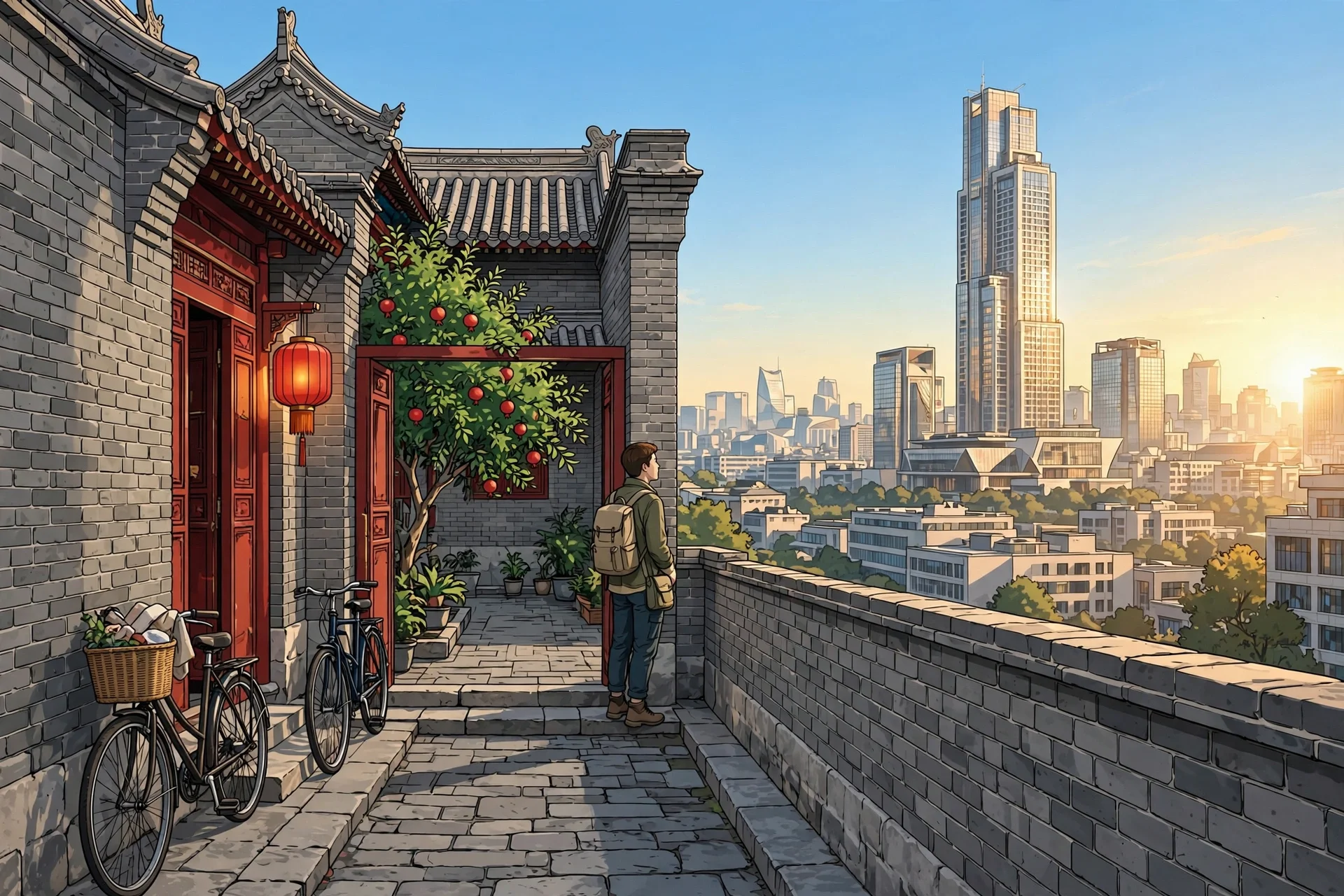
Courtyard life: what a siheyuan guesthouse stay actually includes
First-time visitors should pick a hutong guesthouse for courtyard atmosphere, neighborhood walks, and lower prices — or a hotel for predictable comfort and reliable heating. Guesthouses offer private rooms in converted siheyuan homes, usually with shared bathrooms; hotels offer en-suite rooms, central heating, and 24-hour front desks.
The first time you see a Beijing siheyuan guesthouse, it usually happens on foot: you push through a heavy wooden door off a narrow gray-brick lane, and suddenly the noise of the street drops away. You're standing in a rectangular courtyard paved with stone, a pomegranate tree in one corner, bicycles leaning against a wall, laundry lines strung between wooden posts. This is the classic siheyuan — the courtyard house that has been Beijing's signature dwelling for centuries — and for the past two decades, thousands of them have been converted into guesthouses aimed at travelers.
What exactly do you get for the night? Typically, a private bedroom in one wing of the courtyard house. The rooms vary enormously: some are recently renovated with double-glazed windows, memory-foam mattresses, and a mini-split air conditioner; others are simpler, with a hard kang-style bed (the heated brick platform that doubles as seating), a writing desk, and a window that opens directly onto the courtyard. Breakfast is often included and often home-cooked — congee, mantou, fried eggs, pickled vegetables — served at a communal table where you'll meet the other guests.
The host is the real product here. A good hutong guesthouse host is part innkeeper, part fixer: they'll call a taxi to the airport at 5 a.m., tell you which entrance of the Forbidden City has the shortest line, warn you that Tiananmen Square tickets need to be reserved ahead of time on WeChat, and mark up your phone's map app with the dumpling shop two lanes over. That kind of service doesn't exist at a mid-range chain hotel, where the front desk will hand you a brochure.
The price gap is real. On major booking platforms, a clean private room in a well-reviewed hutong guesthouse typically runs between ¥150 and ¥350 per night, while a comparable mid-range chain hotel near the Second Ring Road starts around ¥350 and climbs to ¥600 or more in high season. For a first-timer watching the budget, the difference over five nights can fund the entire sightseeing budget — entrance tickets in Beijing add up fast (the Forbidden City alone is ¥60 in peak season).
But before you book the courtyard room with the pomegranate tree, you need to understand the trade-offs. This article walks through them one by one: what each stay actually feels like, how location math works against the Forbidden City route, and the practical realities of bathrooms, noise, and Beijing winter — so you can pick the stay type that matches your trip, not someone else's.
Hutong locations vs subway lines for the Forbidden City route
Beijing's subway network is the great equalizer. It connects the major sights efficiently, and in practice, station proximity matters more than which famous district your bed happens to sit in. That said, the two stay types tend to cluster in different places, and the difference shows up in your daily itinerary.
Most of Beijing's famous hutong neighborhoods — Nanluoguxiang, Shichahai, Gulou, Dongsi, and the lanes around the Drum and Bell Towers — sit inside the Second Ring Road, in Dongcheng and Xicheng districts. If you stay in a hutong guesthouse here, you are within walking or cycling distance of the old city: the Forbidden City is often a 20–30 minute walk or a short subway ride away, and the lakes of Shichahai, with their evening crowds and bar streets, are your neighborhood. For first-timers, this is the big appeal: you step out of your door and you are already inside the Beijing you came to see.
The catch is the subway. The old hutong neighborhoods were laid out centuries before anyone imagined a metro system, and the stations are farther apart here than in the newer districts. From a guesthouse deep in the Nanluoguxiang lanes, the walk to the nearest subway station can be 10–15 minutes through winding alleys — fine in October, less fine in January when the temperature is minus 8°C and the wind finds every gap in your jacket. In summer, the same walk happens in 35°C heat with high humidity.
Standard hotels, especially mid-range chains like Home Inn, Hanting, or international brands at the 3-star level, cluster around subway stations and main roads. A typical setup: you exit the hotel, cross the street, and you're at a subway entrance with escalators, signage in English, and a direct line to Tiananmen East, the Summer Palace, or the Temple of Heaven. For a first-timer making four to six subway trips a day, saving ten minutes of walking per leg — twice a day, five days — is a serious quality-of-life difference. Beijing is enormous; the Forbidden City alone takes most of a day on foot, and you don't want your commute to the commute to tire you out before you start.
There's also the airport question. Beijing Capital International Airport is northeast of the city, and Daxing International Airport is far to the south. From a hutong guesthouse, getting to the airport usually means a taxi or a taxi-plus-Airport Express combination, because the lanes are too narrow for large vehicles and the nearest Airport Express transfer point is a walk away. From a station-adjacent hotel, you can often reach an Airport Express or subway-to-airport route without a car at all — and the hotel front desk will arrange a fixed-price taxi without the lane-navigation problem.
So the location math: hutong guesthouses win on neighborhood charm and walking access to the old-city core; hotels win on transport efficiency for the full multi-day circuit. If your itinerary is heavy on the big-ticket sights spread across the city — the Great Wall at Badaling or Mutianyu, the Summer Palace, the 798 Art District — the hotel's subway adjacency pays off every single day. If your trip is shorter and centered on the old city — Forbidden City, Jingshan Park, the hutongs themselves, Shichahai — a well-located guesthouse puts you in the middle of it.
One practical note on legality that first-timers should know: Chinese regulations require all accommodation providers to register foreign guests with the local police. Licensed hotels do this automatically at check-in. Reputable hutong guesthouses that accept foreigners do it too — but some smaller ones do not accept foreign guests at all, precisely because of the registration requirement. When booking, filter for properties that explicitly accept foreign passports, and confirm in a message before you arrive. A booking that gets canceled at the door at 11 p.m. is a bad start to any trip.
For a broader look at where budget travelers sleep across the country — including capsule hotels and hostels that Beijing's guesthouses are often compared against — see our China budget accommodation guide: hostels, guesthouses & capsule hotels.
Shared bathrooms, winter heating, and noise in old courtyard homes
This is the section that decides it for most people. A hutong guesthouse is a converted home, and it behaves like a home — which means the bathrooms, the heating, and the soundproofing follow residential logic, not hotel logic.
Bathrooms first. Many siheyuan guesthouses have shared bathrooms: two or three shower rooms and toilets serving six to ten guest rooms. The better ones keep them spotless, with on-demand hot water and heated floors; the weaker ones have a single shower with a 15-minute hot water window and a queue at 8 a.m. Some guesthouses have renovated to add en-suite bathrooms in a few rooms, but those rooms cost nearly as much as a mid-range hotel room, which erodes the price advantage. If you need an en-suite bathroom at a budget price, the hotel wins outright.
Then there's the plumbing itself. Beijing's old neighborhoods run on old pipes. Water pressure can be inconsistent, and in a few remaining properties the plumbing is, frankly, primitive. Reading recent guest reviews — not the property's own photos — is the only reliable filter here. Look for reviews from the last three months that mention the bathroom specifically, and be wary of properties where every review is older than six months.
Heating is the second big divider, and it deserves its own section below — but the short version: hotels have building-wide central heating from mid-November to mid-March; guesthouses have whatever the renovation installed. A well-renovated guesthouse with underfloor heating and double glazing can be perfectly comfortable. A lightly renovated one with a single space heater and drafty single-pane windows will be miserable in January. The variance between guesthouses is the problem: you can't assume.
Noise is the third factor, and it's the one travelers underestimate. A siheyuan is organized around an open courtyard, and sound travels across it freely. You will hear other guests' conversations, the host's morning routine, the neighbor's dog, and — in the older lanes — the sounds of the neighborhood waking up around 6 a.m. Some people find this charming; light sleepers find it ruinous. Hotels, with their sealed windows, corridors, and concrete construction, are dramatically quieter. If you are a light sleeper and you choose a guesthouse anyway, bring earplugs and an eye mask as non-negotiable packing items — the courtyard gets bright early and stays lively late.
There are also the small frictions of old-house living: steep stone thresholds that trip you in the dark, uneven paving that floods in summer rain, Wi-Fi that drops in the far wing, and the occasional power trip when everyone runs their air conditioners at once. None of these are deal-breakers, and many travelers shrug them off as part of the experience. But they are real, and they are exactly the things a hotel eliminates by design.
None of this means guesthouses are bad — the best-reviewed hutong guesthouses in Beijing have ratings that rival any hotel, precisely because the hosts manage these frictions well. It means the quality variance is much wider than with hotels. A 4.5-star chain hotel is a known quantity anywhere in the world. A 4.5-star hutong guesthouse is a known quantity only if the recent reviews say the same things the old reviews said. Do the homework: read the last two pages of reviews, filter for your travel month, and look for the words "bathroom," "heating," "noise," and "hot water."
Winter in a courtyard: heating realities from November to March
Beijing's winter is dry, sunny, and genuinely cold. Daytime highs in January hover around freezing; nighttime lows drop to minus 10°C or below, and the wind across the North China Plain has a way of finding every crack in old construction. How your accommodation handles those four months is the single biggest practical difference between the two stay types.
The baseline to know: Beijing has district central heating from roughly November 15 to March 15. Apartment buildings, office blocks, and hotels are connected to it — indoor temperatures in a heated building sit reliably around 20–22°C, and you will be comfortable in a T-shirt indoors. This is one of the great underappreciated comforts of winter travel in northern China.
Most hutong guesthouses are not on district heating. The old courtyard houses were built for a different era — coal stoves and kang beds — and while coal heating is long gone, many guesthouses heat with a patchwork: electric underfloor heating in the renovated rooms, wall-mounted air-conditioner units running in heat mode, and portable oil or electric radiators as backup. The good news is that a properly renovated guesthouse can be genuinely warm. The bad news is the variance: in a poorly insulated room with single-pane windows, a space heater keeps a two-meter radius warm and leaves the bathroom and the path to the bathroom freezing.
The courtyard itself is unheated, obviously. In winter, the courtyard — the architectural heart of the siheyuan, the thing you came for — becomes a cold stone well that you cross quickly, head down, on your way to breakfast. The romantic image of sipping tea under the pomegranate tree belongs to spring and autumn. In January, the courtyard is beautiful for about ninety seconds.
Practical winter advice if you choose a guesthouse: book a room described as having underfloor heating (地暖) or a recently renovated bathroom; confirm with the host that the room stays warm in January, not just that heating exists; pack warm sleepwear anyway, because the bathroom run at 3 a.m. will be cold; and check that the windows are double-glazed. If the listing's winter reviews complain about cold, believe them — heating is the one thing a guesthouse cannot fix between your booking and your arrival.
If you choose a hotel for a winter trip, you mostly don't have to think about any of this. Central heating, sealed windows, hot water on demand, and a lobby you can retreat to. The trade-off is atmosphere: you get a room that could be in any city, in exchange for not thinking about temperature for five days. For many first-timers visiting between December and February, that trade is worth making — you can still spend your days in the hutongs, eat in the courtyard restaurants, and walk the lanes; you just sleep somewhere warm.
Spring (April–May) and autumn (September–October) are the sweet spots for the guesthouse experience: mild weather, the courtyard at its best, windows open, breakfast outside. Summer brings heat and the rainy season; winter brings the heating question. Match your stay type to your month, not just your budget.
The decision, by traveler type
By now the pattern should be clear: neither option is universally better. The right choice depends on what kind of traveler you are and when you're going. Here's how it breaks down.
Choose the hutong guesthouse if: you're traveling in spring or autumn; you value neighborhood atmosphere and local interaction over standardized comfort; you're a sound sleeper or you pack earplugs; you don't mind shared bathrooms or you've found one with en-suite at a good price; and you've read the recent reviews carefully. The ideal guesthouse traveler is curious, flexible, and treats the stay as part of the sightseeing.
Choose the hotel if: you're visiting in winter (December–February) or the height of summer; you need an en-suite bathroom and reliable hot water without reading fifty reviews; you're a light sleeper; you plan a packed multi-day itinerary across the whole city and want subway adjacency; or it's your first trip to China and you want one fewer variable to manage. The ideal hotel traveler wants the trip's friction concentrated on the sights, not the sleep.
The hybrid option — and it's a good one — is to split the stay: three nights in a hutong guesthouse for the old-city days, then move to a hotel near a subway hub for the Great Wall day trip and the departure. Beijing's sights naturally divide this way, and you get the courtyard mornings and the warm, quiet nights. Just remember the foreign-guest registration rule applies at each property, so bring your passport to every check-in.
A final practical note: whichever you choose, book accommodation that explicitly accepts foreign guests, confirm the booking a few days before arrival, and save the address in Chinese characters on your phone — taxi drivers in the hutong lanes navigate by landmarks and Chinese addresses, not by English property names. Your first night in Beijing should start with stepping into the courtyard, not with standing on a dark lane arguing with a map app.