Japan regional rail passes: a break-even worksheet
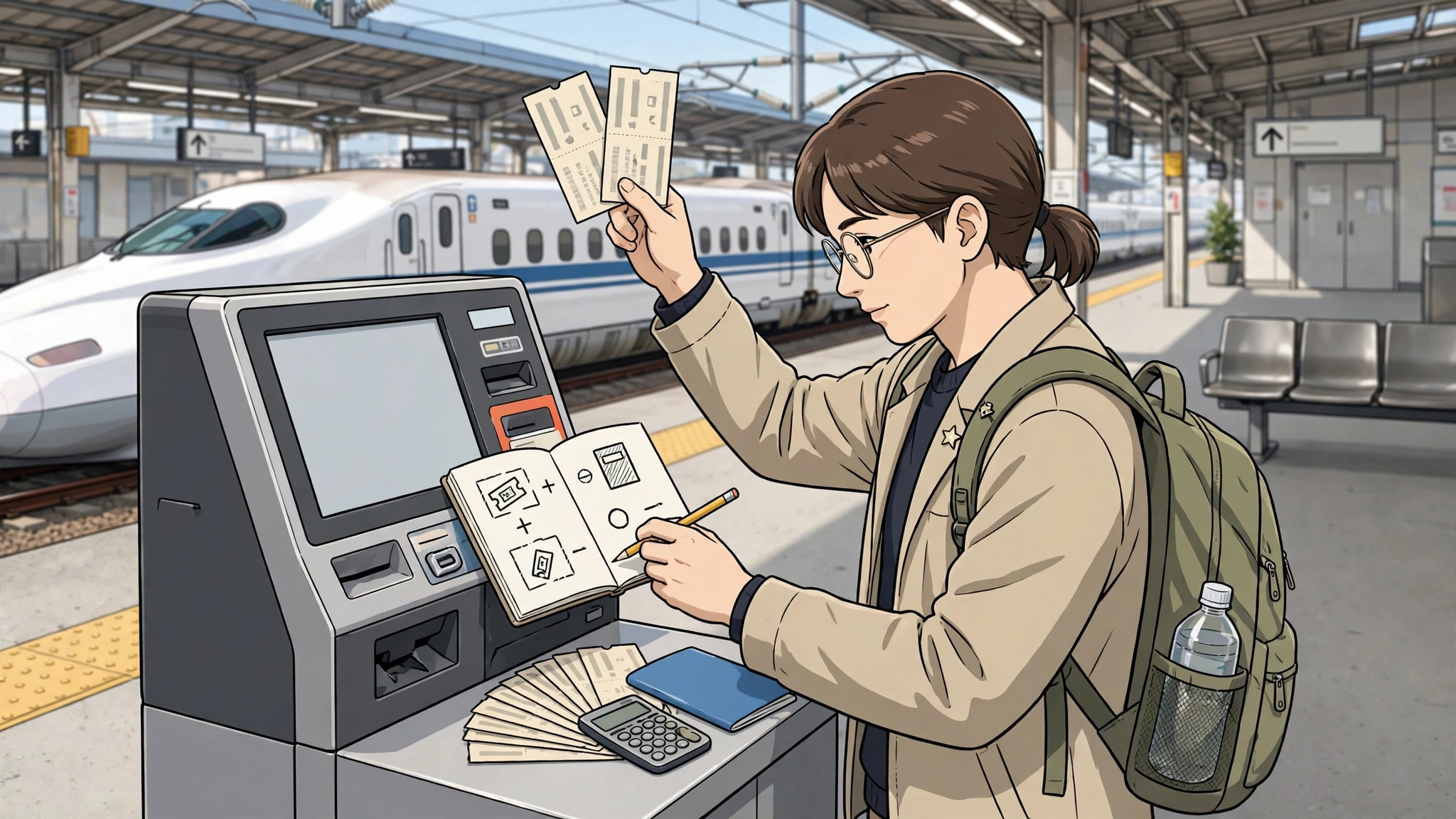
Add up your long-distance legs as individual shinkansen tickets
Before comparing any rail pass, list every long-distance leg and price each as a single ticket. This baseline anchors the decision. Tokyo-Kyoto, Kyoto-Hiroshima, and a Nara day trip each have fixed fares, and their sum shows the true pay-as-you-go cost. Travelers who skip this step guess, and guessing overbuys passes.
Start with your route map. Write down each city-to-city move in order: Tokyo to Hakone, Hakone to Kyoto, Kyoto to Osaka, Osaka to Hiroshima, Hiroshima back to Tokyo. Then look up the shinkansen fare for each leg. The Nozomi is fastest on the Tokaido line; the Hikari is cheaper and only slightly slower. Local and rapid trains handle the short hops like Kyoto to Nara or Osaka to Kobe, and these cost a fraction of shinkansen fares. Add them all up.
The key insight is that short legs barely move the total. A 580-yen local train to Nara does not justify a pass; a 14,000-yen shinkansen leg does. Travelers routinely overestimate how much their little hops cost and underestimate the big jumps. When you see the real numbers, the pass decision often becomes obvious: either your long legs clearly exceed a pass price, or they clearly do not.
Keep this baseline written down. Every pass comparison that follows gets measured against it, and the worksheet only works if the baseline is honest. Do not include subway rides or local buses; rail passes rarely cover city transport well enough to matter, and mixing them in muddies the math.
The post-hike decision tree: when any pass still beats single tickets in 2026
Japan's rail pass landscape changed when the national JR Pass price jumped sharply, and the decision tree is different now. The national pass only makes sense for aggressive itineraries: Tokyo to Kyoto to Hiroshima to Tokyo within seven days, with minimal backtracking. For most travelers, the question is now which regional pass fits, or whether single tickets win outright.
Run through this tree. First, count your shinkansen legs longer than two hours. Zero or one: buy single tickets, no pass pays off. Two: compare against the regional pass covering your area. Three or more across distant regions: price the national pass, but verify against your baseline before committing. The 2026 reality is that two well-chosen regional passes often beat one national pass for the classic Tokyo-Kyoto-Osaka triangle plus a Hiroshima extension.
Second, check your geography. Staying within Kansai (Osaka, Kyoto, Nara, Kobe)? The Kansai-area passes are cheap and the distances are short, so a pass pays off with just two or three day trips. Adding Tokyo? That single Tokyo-Kyoto leg dominates the math; everything else is rounding. Crossing to Hiroshima or Kyushu? Now the Sanyo-San'in area passes enter the picture, and the per-day cost drops if you move fast.
Third, factor in your travel pace. Passes reward movement and punish lingering. If you spend four days in Kyoto and take one day trip, a pass is dead money. If you hop cities every other day, the pass earns its keep. Be honest about your pace: most travelers move slower than their spreadsheet assumes. For a deeper catalog of the pass options themselves, see our guide to Japan's discount pass system.
A worked break-even: Tokyo day trips where the JR East pass pays off
Let us run the numbers on a concrete itinerary. You base in Tokyo for five days and plan day trips to Nikko, Kamakura, and Hakone, plus the Narita airport transfer. As single tickets: Narita to Tokyo on the Narita Express runs about 3,000 yen, Tokyo to Nikko around 2,800 yen round trip on the right combination, Kamakura about 1,800 yen round trip, and Hakone via Odakyu roughly 2,300 yen round trip with the right ticket. Total: around 10,000 yen.
The JR East options change this picture. A Tokyo Wide Pass covers three consecutive days including Nikko, Kamakura, and the Narita Express, for a price that undercuts the single-ticket total if you cluster those trips into the pass window. The trick is the clustering: spread the same day trips across five days and the three-day pass cannot cover them all, so the math flips back to single tickets.
Here is the worksheet in action. Write your five days in a row. Mark which days have JR East-eligible long legs. If three consecutive days each have a leg worth 2,500 yen or more, the pass likely wins. If your expensive days are scattered, perhaps Nikko on day two and Hakone on day five, single tickets win. The pass does not care about your intentions, only your clustering.
The common mistake is buying the pass first and planning around it. Reverse the order: plan the trip you actually want, then check whether a pass-shaped hole exists in it. Travelers who buy the pass first end up taking day trips they did not want, just to justify the purchase. That is not saving money; that is spending time to defend a sunk cost.
When the 7-day national pass still wins despite the price hike
The national JR Pass is not dead; it is just selective now. It wins for the classic blitz: land in Tokyo, shinkansen to Kyoto, day trip to Nara, on to Hiroshima and Miyajima, back to Tokyo, all within seven days. Price those legs individually: Tokyo-Kyoto around 14,000 yen, Kyoto-Hiroshima around 11,000 yen, Hiroshima-Tokyo around 19,000 yen. The sum clears the 7-day pass price with room to spare, and every extra leg is pure savings.
It also wins for Hokkaido or Kyushu extensions. A Tokyo to Hakodate or Tokyo to Fukuoka round trip alone approaches the pass price; add any Kansai movement and the pass is clearly ahead. Long-distance travelers who cross the country should still start their math with the national pass as the default and try to disprove it.
Where it loses: the Golden Route at a relaxed pace. Tokyo for four days, Kyoto for four days, with one shinkansen between them, does not come close. Neither does a single-region trip, no matter how many day trips you stack, because regional trains are cheap. The pass needs at least two long shinkansen legs to break even; one leg plus local trains never gets there.
A final nuance: seat reservations. The pass covers reserved seats on most shinkansen, which matters during Golden Week, Obon, and New Year when unreserved cars fill. If you travel in peak season, add the value of guaranteed seats to the pass side of the ledger. Off-peak, ignore this factor entirely.
Putting the worksheet to work
Do the baseline first, run the decision tree second, and only then look at pass prices. Write the numbers down; the travelers who get this wrong are the ones who do it in their heads. Your itinerary is specific, so your answer should be specific too. The right choice for a Tokyo-Kyoto blitz is the wrong choice for a slow Kansai week, and no blogger's rule of thumb survives contact with your actual route.
Recheck prices before you buy. Fares and pass prices shift, and a worksheet built on last year's numbers can mislead. The official JR sites publish current fares in English, and a ten-minute verification beats a confident mistake. Once the numbers are in, the decision is usually obvious, which is exactly what a good worksheet should deliver.
Regional pass deep dive: Kansai, JR East, and Kyushu
Beyond the national pass, the regional options deserve their own math. The Kansai-area passes are the best value in the country for travelers staying put in one region. A two-day Kansai pass costs less than a single Kyoto-Hiroshima shinkansen leg, so two day trips from Osaka, say Nara and Kobe, already break even. Add Himeji and the pass is printing money. The mistake travelers make is buying the Kansai pass for a trip that is really just Osaka plus Kyoto; the Haruka airport express plus two short hops does not clear the bar, and ICOCA pay-as-you-go wins.
The JR East passes serve a different pattern: the Tokyo Wide Pass covers three days of Kanto-area travel including Nikko, Karuizawa, and the Izu peninsula. It pays off when you stack two or more long day trips into its three-day window. The five-day JR East-South Hokkaido pass is the sleeper value for travelers heading north: a single Tokyo to Hakodate round trip on the Hayabusa shinkansen nearly covers the pass alone, and everything else rides free. If Hokkaido is on your itinerary, price this pass before anything else.
Kyushu's passes follow the same logic at a smaller scale. The northern Kyushu pass covers Fukuoka, Nagasaki, Kumamoto, and Beppu, and two intercity legs break even. Southern Kyushu needs the all-Kyushu version. The pattern across all regional passes is identical: cluster your long legs into the pass window, and verify with the baseline. Regional passes are precision tools, not blanket coverage, and they reward travelers who plan around them deliberately rather than hoping for the best.
Seat reservations, luggage, and the fine print
Passes cover reserved seats on most trains, but the reservation itself takes effort. During peak seasons (Golden Week in late April to early May, Obon in mid-August, and New Year), unreserved cars on popular shinkansen fill up, and pass holders who skip reservations can end up standing. Reserve at JR ticket offices or machines as soon as your plans firm up; it costs nothing extra with the pass and guarantees your seat.
Luggage rules add another wrinkle. The Tokaido, Sanyo, and Kyushu shinkansen require reservations for oversized baggage areas, and this applies to pass holders too. If you travel with large suitcases, reserve the oversized baggage seats when you reserve your train seats. The rule is enforced, and the alternative is awkward negotiations with the conductor. Consider forwarding luggage between cities for the long legs; it costs around 2,500 yen per bag and frees you from the baggage-seat hunt entirely.
Not all trains take all passes. The Nozomi and Mizuho, the fastest services on their lines, are excluded from the national JR Pass (though some regional passes include them, check the current terms). This matters on the Tokyo-Kyoto run: pass holders ride the Hikari instead, adding about 20 minutes. On most itineraries this is irrelevant, but if you are racing a tight connection, know which trains your pass allows before you are standing on the platform.
IC cards deserve a mention as the complement to any pass strategy. Your Suica or ICOCA handles subways, local trains, buses, and convenience store purchases, covering everything the rail pass does not. Load 5,000 yen at the airport and top up as needed. The pass-versus-ticket decision is only about the long legs; the IC card quietly handles the rest, and no worksheet is complete without budgeting for it.
Common worksheet mistakes
The most expensive mistake is counting legs you will not take. Travelers list aspirational day trips, Nara, Kobe, Himeji, Koyasan, then actually visit one of them. The worksheet only works with honest inputs. If a day trip is a maybe, leave it out of the baseline; you can buy that ticket individually if the maybe becomes a yes.
The second mistake is ignoring the airport transfer. Narita to Tokyo costs real money, and several passes include it. If your pass window covers arrival day, the Narita Express leg alone can be worth 3,000 yen toward break-even. Kansai travelers get the Haruka express from Kansai Airport under several regional passes. Always include the airport leg in the baseline; it is the easiest money in the worksheet.
The third mistake is forgetting that children change the math. Child fares run at half price, and child pass prices are proportionally cheaper, but the break-even point shifts with the mix. A family of four with two children should run the worksheet per person, not per group, because the adult and child numbers diverge. In most cases the conclusion holds for everyone, but verify rather than assume.
Finally, do not let the worksheet override the trip. If the numbers say single tickets but you value the freedom to hop on any train without thinking, the pass buys peace of mind, and that has value too. The worksheet tells you the price of that freedom. Pay it knowingly, and enjoy the ride.
A note for Singapore travelers
Singapore-based travelers have one structural advantage: the direct flights land at Narita or Haneda, and Haneda's proximity to central Tokyo changes the airport math. A Haneda arrival on the Tokyo Monorail or Keikyu line costs under 1,000 yen, which weakens the case for passes that bundle the Narita Express. If you fly into Haneda, remove the airport leg from the pass side of the worksheet and rerun the numbers; the answer often flips.
The return leg matters too. An evening departure from Narita pairs well with a final-day Tokyo Wide Pass leg, since the Narita Express runs directly from Shinjuku, Shibuya, and Tokyo stations. A morning departure means leaving the city before the pass window is useful, so do not count it. Match the pass window to your actual flight times, not to the calendar days of your trip, and the worksheet stays honest to the end.
Quick reference: fares to memorize
A few benchmark fares make the worksheet fast. Tokyo to Kyoto on the Hikari runs about 13,500 yen; the Nozomi costs roughly 1,000 yen more for 20 minutes saved. Kyoto to Hiroshima is about 11,000 yen. Tokyo to Nikko day-return lands near 5,500 yen with the right combination. The Narita Express into Tokyo is about 3,000 yen, while the Keisei Skyliner to Ueno is slightly less. None of these move much year to year, so memorizing the rough bands lets you estimate any itinerary in your head before verifying exact numbers online.