KTX, SRT, or express bus: choosing intercity transport in Korea

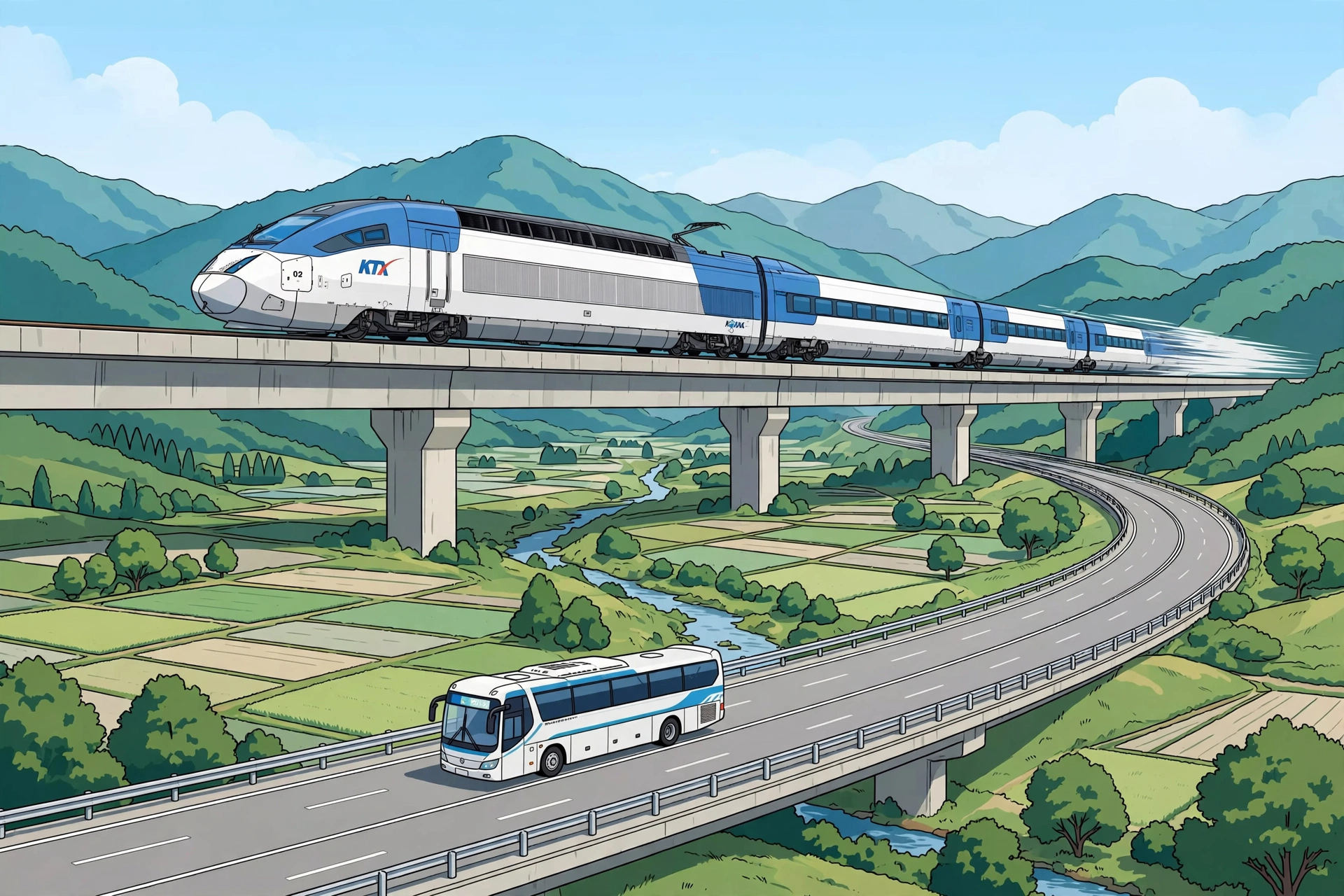
Compare door-to-door time, not just top speed
Korea gives you three solid intercity options: the KTX high-speed train, the cheaper SRT on overlapping routes, and a surprisingly comfortable express bus network. The right choice depends on your route, luggage, booking window, and where you are actually headed.
The SRT from Suseo Station is closer to Gangnam, saving you 20 minutes on access. The express bus from the Express Bus Terminal at Banpo might be a 10-minute taxi from your Gangnam hotel, and while the bus takes 4 hours 30 minutes to Busan, your total door-to-door time is 4 hours 45 minutes versus the KTX's 3 hours 15 minutes. The train still wins, but the gap is smaller than the headline times suggest.
For shorter routes the math shifts further. Seoul to Daejeon is 1 hour by KTX but the stations are on opposite sides of the journey. Add 45 minutes of Seoul subway to reach Seoul Station and 20 minutes at the Daejeon end, and you are at 2 hours 5 minutes total. The express bus from Banpo takes 2 hours and drops you closer to central Daejeon. The time difference is negligible, but the bus costs half as much. Always calculate from your hotel door to your actual destination, not from terminal to terminal.
The practical method is simple. For each option, add three numbers: time from your accommodation to the departure terminal, the scheduled travel time, and time from the arrival terminal to your final destination. The option with the smallest total wins on speed. Then compare prices. If the faster option costs three times more for a 30-minute saving, the slower one is the rational choice unless your schedule is tight.
Consider a concrete example. You are staying near Hongdae and need to get to Busan. Option one: subway to Seoul Station (35 minutes), KTX to Busan (2 hours 15 minutes), subway to your Busan hotel in Haeundae (40 minutes). Total: 3 hours 30 minutes, cost 59,800 won plus subway fares. Option two: subway to Suseo (50 minutes via transfer), SRT to Busan (2 hours 20 minutes), subway to Haeundae (40 minutes). Total: 3 hours 50 minutes, cost 52,600 won plus subway. Option three: taxi to Express Bus Terminal (25 minutes), premium bus to Busan (4 hours 30 minutes), subway to Haeundae (40 minutes). Total: 5 hours 35 minutes, cost around 34,000 won plus taxi. The KTX wins on time, the bus wins on price, and the SRT sits in the middle. Your choice depends on whether you value two hours or 25,000 won more.
This calculation changes dramatically for shorter routes. Seoul to Cheonan is 40 minutes by KTX but the access time on both ends can exceed the train ride itself. The bus from Banpo takes 1 hour 20 minutes door to door for many travelers. When the train's speed advantage shrinks to 20 minutes but costs twice as much, the bus becomes the obvious choice. Always do this math for your specific origin and destination rather than relying on general rules.
Choose by route: where each mode actually wins
Seoul to Busan is train territory. Take the KTX from Seoul Station or the SRT from Suseo depending on which is closer to your hotel. The KTX runs from Seoul Station and Yongsan at up to 305 km/h, reaching Busan in 2 hours 15 minutes on the fastest services. The SRT runs from Suseo to Busan in about the same time but costs around 52,600 won versus the KTX's 59,800 won. For a family of four, that difference buys lunch. Check both apps for departure times, because the cheaper SRT might have a better slot, or the KTX might have more frequency.
Seoul to Gyeongju is trickier. The KTX goes to Singyeongju Station, which sits outside the city center, requiring a bus or taxi into town. The express bus goes directly to Gyeongju Bus Terminal, which is more central. Total journey time is similar once you factor in the transfer. If you are heading straight to Bulguksa temple, the bus is arguably better. If you are connecting to Busan afterward, the KTX to Singyeongju then local train to Busan works well.
Seoul to Jeonju, famous for its hanok village and bibimbap, is well served by both modes. The KTX takes about 1 hour 30 minutes to Jeonju Station. The bus takes about 2 hours 30 minutes to Jeonju Bus Terminal, which sits closer to the hanok village than the train station. For a food-focused day trip, the bus terminal's location can save you 30 minutes of local transit, partially offsetting the longer intercity ride.
Seoul to Sokcho and the east coast is bus territory. There is no high-speed rail to Sokcho. The KTX to Gangneung followed by a bus to Sokcho is slower than the direct express bus from Dong Seoul Terminal, which takes about 2 hours 30 minutes and drops you in the center of town near the beach and Seoraksan trailheads. Similarly, Seoul to Andong and the Hahoe folk village is best by direct bus from Dong Seoul, taking about 2 hours 40 minutes with no transfers.
The pattern is clear. If your destination is on the high-speed rail network and you value speed, take the train. If it is not, or if the train station is far from where you actually want to be, check the bus. The bus network covers far more destinations than the rail network, and for many secondary cities it is the only direct option.
Seoul to Daegu is another route where both modes compete well. The KTX takes about 1 hour 40 minutes to Dongdaegu Station, which is well connected to the city center. The express bus takes about 3 hours to Daegu Bus Terminal. The train's time advantage is significant here, and Daegu's subway connects Dongdaegu efficiently. Take the train unless budget is the primary concern.
Seoul to Gwangju follows a similar pattern. The KTX takes about 1 hour 30 minutes to Gwangju Songjeong Station. The bus takes about 3 hours 20 minutes. However, Gwangju Songjeong is somewhat removed from the downtown area, while the bus terminal (U-Square) is more central. For travelers heading directly to the downtown area or the 5-18 Memorial Park, the bus terminal's location partially offsets the longer ride.
For Jeju Island, fly. This deserves emphasis because some travelers try to be creative with ferries. The flight from Gimpo to Jeju takes 1 hour and budget carriers often sell tickets for 30,000 to 50,000 won when booked in advance. The ferry from Incheon or Mokpo takes 12 to 14 hours overnight. Unless you specifically want the ferry experience, flying is faster, cheaper, and more reliable. Book early for the best fares on this extremely competitive route.
Handle luggage and seating differences
Luggage handling is where the bus pulls ahead decisively. Buses have a large cargo hold underneath, and the driver handles loading. You do not wrestle your suitcase through a crowded carriage or worry about it being stolen from an overhead rack. For travelers with heavy bags, skis, golf clubs, or multiple large suitcases, the bus is the clear winner. Korean train stations do not have porters, and dragging two suitcases through Seoul Station at rush hour is miserable.
On the KTX and SRT, luggage space is adequate but not generous. There are overhead racks for small bags and luggage areas at the ends of each carriage for larger suitcases. During peak times these fill up, and you may end up with your bag in the vestibule where it blocks the doors. There is no checked luggage service. If you are traveling with more than one large suitcase per person, think carefully before choosing the train.
Seating comfort favors the premium express bus (우등고속) for personal space. These buses have three seats per row instead of four, with wider seats, generous legroom, and often individual entertainment screens. The premium bus from Seoul to Busan is genuinely comfortable, more so than KTX standard class in terms of elbow room. The fare premium over a standard bus is modest, usually 20 to 30 percent, bringing the total to around 30,000 to 35,000 won for Seoul-Busan, still roughly half the train fare.
KTX first class costs about 40 percent more than standard and gets you a wider seat with more legroom. It matters on the two-hour Busan run but is unnecessary for shorter hops. SRT standard class is comparable to KTX standard. All trains have clean restrooms, though the bus rest stops every two hours at highway service areas with surprisingly good food courts, which many travelers prefer to the train's onboard facilities.
For travelers with mobility issues, the trains are better than the bus. KTX and SRT stations have elevators and accessible boarding, and staff can assist if you contact Korail in advance. Buses require climbing steps, and the rest stop breaks involve navigating highway service areas. If accessibility matters, take the train.
Food deserves a mention for longer journeys. KTX and SRT have no dining car, but vendors walk through selling snacks, drinks, and simple meals. The selection is basic but adequate. You can also bring your own food, and the selection at Seoul Station before boarding is excellent. The Paris Baguette, Lotteria, and various kimbap shops in the station concourse offer portable meals that beat anything served onboard. For the Busan run, grab kimbap and a coffee before boarding and you are set.
Buses stop at highway rest areas every two hours or so for 15-minute breaks. Korean highway rest stops are a cultural experience in themselves, with food courts serving everything from udon and ramen to Korean set meals with rice and soup. The quality is surprisingly high, and prices are reasonable. Many travelers actually prefer the bus rest stop to train food because the options are better and the break lets you stretch your legs. The rest stops on the Gyeongbu Expressway between Seoul and Busan are particularly well equipped.
Connectivity is adequate across all modes but not perfect. KTX and SRT offer onboard WiFi, but it drops in tunnels and rural areas. Premium buses often have WiFi as well, with similar reliability issues. Download movies, podcasts, or work documents before boarding. Power outlets are available at most KTX and SRT seats and on newer premium buses, but they are not guaranteed. A portable battery pack is essential if your phone serves as your map, translator, ticket wallet, and entertainment system.
Book at the right window for each mode
Korail releases KTX tickets one month in advance, and for holiday travel you need to act fast. Seollal (Lunar New Year), Chuseok (harvest festival), and the summer peak in early August see tickets sell out within minutes. Set an alarm and book through the KorailTalk app the moment tickets go on sale. If you miss out, check back frequently because cancellations happen and seats open up in the days before departure.
The SRT uses a separate booking system with its own website and app. Tickets also go on sale about a month ahead, with similar holiday pressure but slightly less competition because fewer people know about the SRT. If the KTX is sold out for your preferred time, always check the SRT before giving up on the train entirely.
Express bus tickets are more forgiving. The Kobus website and app handle bookings with English support and foreign card acceptance. Outside of major holidays, you can usually book a few days ahead or even on the day of travel. During holidays, bus companies add extra services, so seats remain available longer than on trains. The bus is your reliable backup plan when the trains are full.
A critical rule for round trips: book your return when you book your outbound. Travelers get caught booking a one-way train to Busan on Friday and discovering on Sunday that every train back to Seoul is full. The Sunday evening Busan-to-Seoul run is one of the most competitive routes in the country. This applies equally to buses during holidays. Always secure both directions before you leave.
For groups, book together in one transaction to ensure adjacent seats. Korean booking systems assign specific seats, and separate bookings risk scattering your party across the carriage or bus. This matters more on trains, where the seat map fills unpredictably, than on buses, but it applies to both.
Pricing is fixed on trains with no advance-purchase discount and no surge pricing. The KTX from Seoul to Busan costs 59,800 won whether you book a month ahead or an hour before. This simplifies decisions: there is no penalty for waiting, but also no reward for planning early, except for seat availability. Bus fares are similarly fixed. The only variable is whether seats remain.
Foreign tourists should know about the Korail Pass, which offers unlimited travel on Korail-operated trains (including KTX) for a fixed number of days. The pass comes in 2-day, 3-day, 4-day, and 5-day versions, with prices starting around 121,000 won for a 2-day pass. If you plan to take three or more long-distance train trips within the validity period, the pass pays for itself. However, it does not cover the SRT, which is operated by a different company. Do the math based on your specific itinerary before buying.
There is no equivalent pass for buses, but the fares are already low enough that one is unnecessary. A Seoul to Busan premium bus at 34,000 won is cheaper than most train passes on a per-trip basis. For budget travelers doing a multi-city Korea itinerary, mixing buses for shorter hops and trains for the longest legs often produces the lowest total cost.
One final booking tip: the Korail website and app sometimes struggle with foreign credit cards despite officially supporting them. If your card is declined, try a different card or use the app instead of the website. The SRT app tends to be more reliable for foreign cards. For buses, the Kobus app works well with international cards. As a last resort, you can always buy tickets at the station, where staff can process foreign cards manually and English support is available at major terminals.
For detailed guidance on booking KTX tickets specifically, including the app walkthrough and seat selection tips, see how to book KTX train tickets. If your Korea trip involves airport transfers as well, planning those alongside your intercity transport saves both time and money.