Nara vs Kobe: which day trip from Kyoto fits your travel style

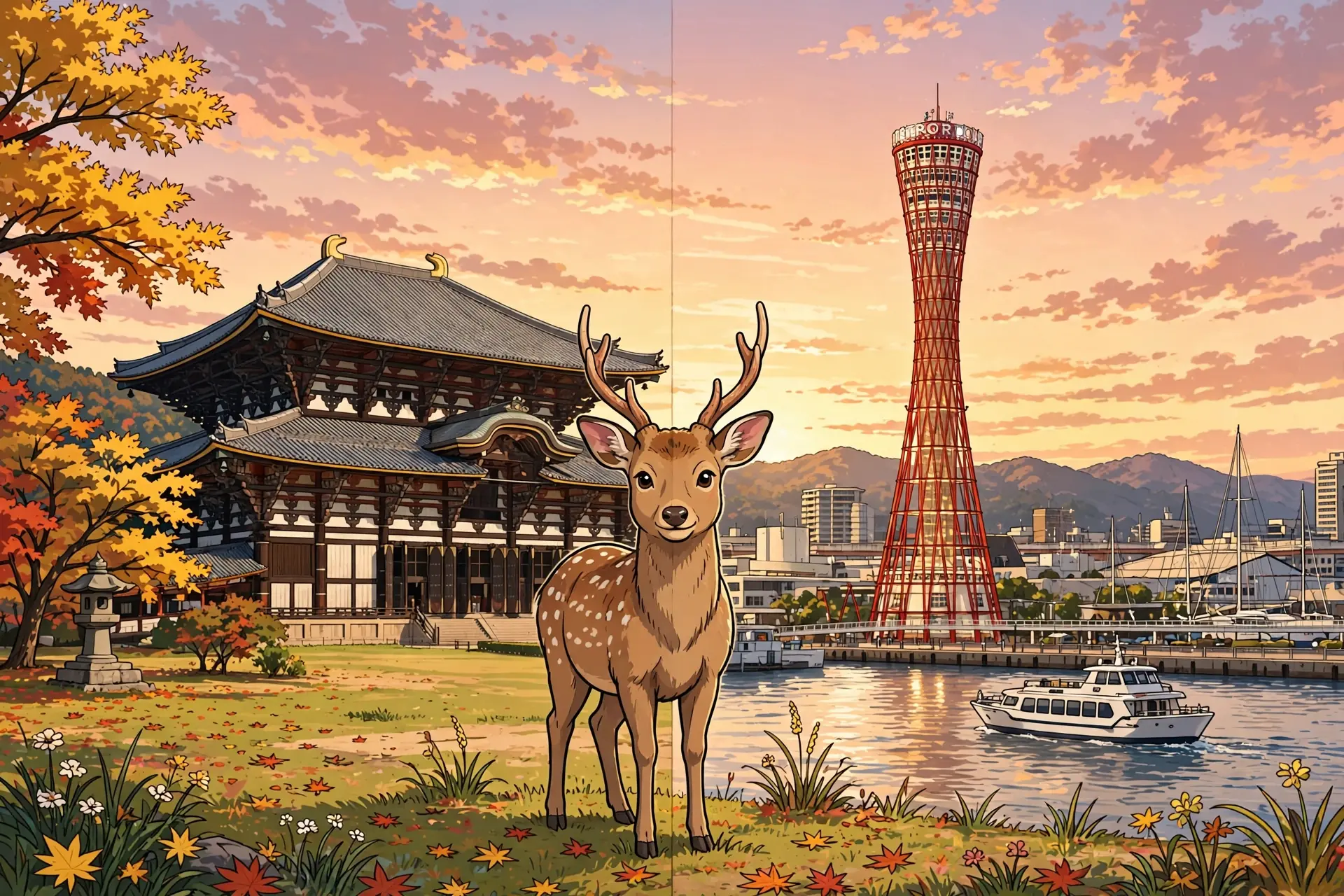
Kyoto is the kind of base that makes you greedy. You wake up with one free day, look at the map, and realize two completely different cities are both within reach: Nara, with its eighth-century temples and famous deer, and Kobe, with its working harbor, Chinatown, and food scene. Both are easy day trips. Both are worth it. You only have one day.
This guide is a decision, not a roundup. It compares what each trip actually feels like hour by hour, what the trains cost in time and money, and which travel style each city rewards. Pick the one that fits your day, then stop second-guessing and enjoy it. If you are still planning the broader trip, the Kansai region travel guide covers how Osaka, Kyoto, and Nara fit together in one itinerary.
Nara in half a day: Todaiji, deer park, and the Kintetsu vs JR choice
Choose Nara if you want temples, the Great Buddha, and deer in a compact half day — its sights cluster in walkable Nara Park, roughly 45–60 minutes from Kyoto. Choose Kobe if you want a full day of harbor views, Kobe beef, and Chinatown, with an optional Arima onsen stop.
Nara is Japan's first permanent capital, and its greatest hits are packed into one large green space rather than scattered across a city. That single fact shapes the whole trip. You arrive, you walk into Nara Park, and within about fifteen minutes on foot you can go from feeding deer to standing inside one of the largest wooden buildings in the world. There is very little transit faffing between sights, which is why half a day is genuinely enough for the core experience.
The anchor is Todai-ji and its Great Buddha Hall (Daibutsuden). The bronze Buddha inside is about 15 meters tall, and the hall housing it is monumental even before you register the statue. Expect it to take 60–90 minutes including the queue and the grounds. This is the sight the whole trip is built around — if giant-Buddha-plus-temple-architecture is your thing, Nara is already winning.
From Todai-ji, the deer are not a separate attraction; they are everywhere in the park. The sika deer are famously tame and will approach you, especially if you are holding the rice-bran crackers (shika senbei) sold from stalls around the park. A couple of practical notes: only feed them the official crackers, not your snacks; keep paper, maps, and plastic bags tucked away because the deer will investigate anything that rustles; and yes, some deer have learned to bow for a cracker, which is charming right up until one headbutts your thigh for a second helping. Budget about an hour of unstructured deer time — it always takes longer than you plan.
The secondary sights fill whatever time you have left. Kasuga Taisha, with its hundreds of stone and bronze lanterns, is a pleasant uphill walk through the park's forested section. Kofuku-ji's five-story pagoda is worth a look from the outside even if you skip the interior. None of these require the kind of dedicated expedition that Todai-ji does. The honest truth about Nara: after the park, the town itself is quiet. Most travelers are back in Kyoto by mid-afternoon, and that is the correct pace. Nara rewards the traveler who wants the ancient-Japan checkbox done well and done efficiently.
One more consideration: Nara works well as a half day precisely because the afternoon decision is easy. You return to Kyoto with daylight left for Gion, a tea house, or simply a nap before dinner. That flexibility is part of what you are choosing when you choose Nara.
Kobe as a full day: harbor, Chinatown, and Arima onsen options
Kobe is a port city, and it feels like one — cosmopolitan, hilly, a little more relaxed than Osaka and much more international in flavor than Kyoto. Unlike Nara's compact park, Kobe's sights are spread along the coast and up the slopes behind it, so the trip naturally becomes a full day. Plan for it that way; trying to squeeze Kobe into a half day means skipping something you came for.
Start with the harbor. Meriken Park and Harborland give you the classic Kobe waterfront: the port tower, the maritime museum, cruise boats, and a long promenade that is best in the late afternoon when the light softens. If you are a boat person, the short bay cruises (typically 40–45 minutes) are an easy, low-commitment way to see the city from the water. This is the "harbor views" half of the Kobe promise, and it costs almost nothing to enjoy from the promenade.
Then there is Nankinmachi, Kobe's Chinatown — one of only three in Japan. It is compact (a few streets) but dense with street food: steamed buns, fried snacks, and the famous pork buns that locals queue for. It makes a natural lunch stop and pairs well with a general food-crawl approach to the day. Kobe's identity as a food city goes well beyond Chinatown, of course — the bakeries, the coffee culture, the Western-influenced yoshoku restaurants in the Kitano foreign-settlement district all reflect 150 years of port-city exchange.
The Kobe beef question deserves its own paragraph, because it is the reason many travelers choose Kobe at all. Certified Kobe beef is expensive — expect a proper teppanyaki or steak lunch to run several thousand yen per person at minimum, with dinner much higher. Lunch deals at reputable shops are the budget-conscious move: same meat, smaller portions, friendlier prices. Be aware that "Kobe beef" is a protected brand, and shops outside Japan (and some inside) use the name loosely; if the certification matters to you, eat it at a certified shop in Kobe itself. Nobody needs to spend the money to enjoy Kobe — but if the beef is your motivation, budget for it deliberately rather than discovering the prices mid-trip.
The optional second half of a Kobe day is the choice between two directions: up or out. Up means Mount Rokko for the evening view — one of Japan's celebrated night views, reachable by a combination of train, cable car, and bus. Out means Arima Onsen, one of Japan's oldest hot spring towns, tucked into the mountains behind Kobe. Arima's "gold" and "silver" waters (kinsen and ginsen) are the draw, and the town is small enough to enjoy in two to three hours including a public bathhouse soak. You realistically get one of these, not both. Pick the onsen if you want to end the day soaking; pick Rokko if you want the skyline photo.
Kobe rewards the traveler who wants variety in a single day — food, water, and either mountains or hot springs — and who is comfortable with a bit more transit between sights. It is a fuller, busier, more indulgent day than Nara, and you will likely be back in Kyoto after dinner.
Kintetsu vs JR to Nara: the price gap and station convenience
The travel math matters because it is what turns "both are day trips" into an actual plan. Here is the practical version, with the caveat that fares and schedules shift — check a route app on the day.
Kyoto to Nara: Kintetsu vs JR. You have two good options, and the choice is mostly about which station is closer to your Kyoto base. Kintetsu runs from Kyoto Station (and Kintetsu Tambabashi) to Kintetsu Nara, usually with one easy cross-platform transfer at Yamato-Saidaiji; the ordinary fare is roughly ¥700–¥800 and the trip takes about 50–60 minutes. The key advantage: Kintetsu Nara station sits right at the edge of Nara Park, so you are at the deer within minutes of exiting. JR's Miyakoji Rapid runs from JR Kyoto to JR Nara in about 45 minutes for a similar fare, but JR Nara station is roughly 15–20 minutes on foot west of the park. If your hotel is near Kyoto Station and you value raw speed, JR is fine; if you want to minimize walking at the Nara end, Kintetsu wins. Note that Kintetsu limited expresses cost extra and save only a few minutes — the ordinary service is the value pick.
Kyoto to Kobe: JR vs Hankyu. This is the longer leg, and it shapes Kobe into a full day. JR's Special Rapid from Kyoto Station reaches Sannomiya (central Kobe) in roughly 75–80 minutes for a fare in the low four figures; Hankyu runs from Kawaramachi (in central Kyoto, convenient if you are based in Gion or downtown) to Kobe-Sannomiya in about 65–70 minutes for a noticeably lower fare. Hankyu is the usual recommendation for travelers staying in central Kyoto: cheaper, faster, and it drops you in the middle of Kobe. Either way, budget a solid hour-plus each way. A one-way trip of over an hour is exactly why Kobe demands the full day — the travel time alone eats the margin that makes Nara a half-day trip.
Within each city, Nara is a walking trip (the park is flat and everything is on foot), while Kobe mixes walking with short train or subway hops — the harbor, Chinatown, and Kitano are close together, but Arima Onsen or Mount Rokko each need their own transit leg. Factor that into your energy budget, not just your yen budget.
The one-day rule: temples and deer vs food and harbor views
Could you do both Nara and Kobe in one day? Technically the trains allow it. Practically, no — and the reason is instructive. Nara needs about four to five hours including travel; Kobe needs eight to ten. Stacked together they become a nine-hour forced march with no slack for the things that make either city good: lingering at Todai-ji, a slow Chinatown lunch, the onsen soak. A day trip should leave you pleasantly tired, not defeated. Pick one city and do it properly.
So here is the decision, reduced to travel styles:
Pick Nara if you: want the ancient-Japan greatest hits in the least time; travel with kids (the deer are a guaranteed hit); prefer walking over transit; want to be back in Kyoto by mid-afternoon; are watching your budget (Nara is the cheaper day by a clear margin); or feel that a trip to Kansai is incomplete without the Great Buddha.
Pick Kobe if you: want a full, indulgent day rather than a half-day add-on; care about food as a primary activity; want harbor and city views; would enjoy an onsen or a night view to close the day; prefer a cosmopolitan, modern-Japan contrast to Kyoto's temples; or specifically want to eat certified Kobe beef at the source.
There is also a weather angle worth a sentence. Nara is an outdoor park day — rain turns it into a slog, and the deer are less charming in a downpour. Kobe's Chinatown, harbor promenades, and beef restaurants are more weather-resilient, with the onsen as the ultimate rainy-day upgrade. If the forecast is grim, Kobe (or Kobe plus Arima) is the safer bet.
And if you are traveling with a companion who wants the opposite city? Nara in the morning is genuinely half a day — one of you could theoretically do Nara while the other sleeps in, but splitting the group across two cities is a logistical headache neither of you will thank yourselves for. The one-day rule holds: decide together, commit, enjoy.
Two sample itineraries
Nara half day (back in Kyoto by 2–3 PM). Depart Kyoto around 8:30–9:00 AM; arrive Kintetsu Nara or JR Nara by 10:00. Walk to Todai-ji via the park (say hello to the deer, but save the crackers for after the temple — your hands will be cleaner). Spend 60–90 minutes at Todai-ji. Buy deer crackers and spend an hour wandering the park. If energy remains, walk up to Kasuga Taisha for the lanterns. Lunch near the station or back in Kyoto; the park area has options but they skew touristy. Afternoon free in Kyoto.
Kobe full day (back in Kyoto by 9–10 PM). Depart Kyoto around 8:00–8:30 AM; arrive Sannomiya by 9:30–10:00. Morning around the harbor — Meriken Park promenade, port tower area, optional bay cruise. Lunch in Nankinmachi Chinatown (arrive before noon to beat the worst queues). Early afternoon: Kobe beef lunch at a certified shop, or Kitano's foreign-settlement streets for the architecture and cafes. Mid-afternoon decision point: Arima Onsen (two to three hours, public bathhouse, back via Kobe) or stay in the city for shopping and the harbor at dusk. Evening: Mount Rokko night view if you skipped Arima, then dinner and the train back to Kyoto.
Practical notes before you go
Deer etiquette in Nara. The deer are wild animals that happen to be tame, and the distinction matters. Feed them only shika senbei; human food makes them ill. If a deer gets pushy, hold your empty hands up and open — they understand the gesture means no more crackers. Keep children close around the bolder deer near the main paths. And the famous bow: it is a learned behavior for soliciting food, not politeness, but it is delightful anyway.
Kobe beef budgeting. Decide your beef budget before you go, not at the restaurant door. A lunch set at a reputable certified shop is the sweet spot — real Kobe beef at a fraction of dinner prices. Walk-ins at popular shops can mean long waits; a reservation or an early lunch slot helps. If the prices still make you wince, Kobe's non-beef food scene (Chinatown, bakeries, yoshoku) is excellent on its own — the city does not require the splurge.
Shoes and pacing. Both days are walking-heavy, but differently: Nara is flat park ground (easy), Kobe involves slopes around Kitano and potentially stairs at Rokko or Arima (plan footwear accordingly). Neither city requires serious hiking fitness, but a full Kobe day will put up real step counts.
The broader trip. This decision sits inside a bigger Kansai itinerary for most travelers. If you have not yet mapped out how many days to give each city, the Kansai region travel guide walks through combining Osaka, Kyoto, and Nara in a single trip, which helps you see where this day trip fits.
Nara or Kobe is not a test with a right answer — it is a question about what kind of day you want. Temples and deer, done by lunch, with the afternoon still yours: that is Nara. Harbor air, a long food crawl, and a soak or a skyline to end the night: that is Kobe. Know your travel style, trust it, and have the day.