Seoul Subway With a Stroller: Check the Elevator Route Before You Travel

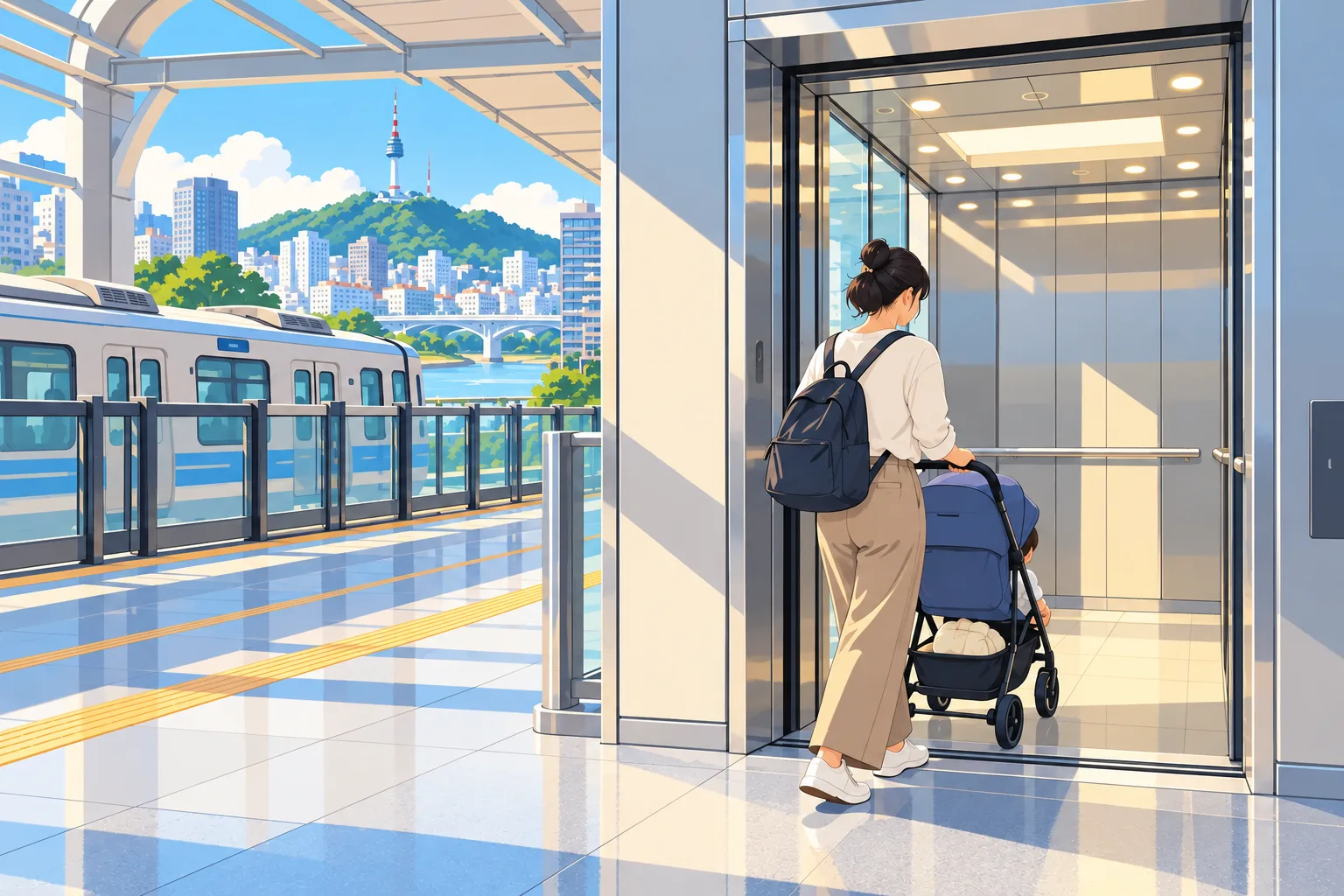
A hotel described as “two minutes from the subway” can still involve the wrong entrance for a stroller. The nearest staircase, the street lift and the platform you need may sit in different places. That matters much more when you are pushing a sleeping child than when you are walking alone.
For parents visiting from Singapore, the useful question is whether you can repeat the whole journey comfortably: hotel door, station entrance, train, transfer and destination entrance. Check that route before you build the day around a fast journey time.
Check the complete elevator route
For a Seoul subway journey with a stroller, check the street entrance, ticket gates, platform access and every transfer at both ends. One accessible route through a station does not make every exit convenient. Choose a simpler rail journey or a taxi when the complete route becomes impractical.
Seoul's December 2025 accessibility announcement reported one independent street-to-platform elevator route at 338 stations across the city lines covered by its programme. That is useful progress, but it describes at least one route through each station rather than equal access at every entrance.
The announcement covers the stated stations on Lines 1–9, Ui-Sinseol and Sillim. It should not be stretched into a guarantee about every service in the wider metropolitan rail network. It also discusses further transfer improvements; a future transfer-time goal is not a promise about your journey today.
This distinction changes how you read travel advice. A broad statement that Seoul has lifts can be true while your preferred entrance is inconvenient. An older warning that a particular city station has no street-to-platform elevator may also need checking against newer official information.
Use current station information for the exact journey. The municipal accessibility directory lists facilities by station and line. Its counts establish infrastructure, but do not tell you the complete walking route or whether a particular lift is currently operating.
For the wider family planning context, see our Korea family public-transport guide. This article focuses on the additional checks needed when the stroller must travel with you.
Audit a journey in five parts
Write the trip as a sequence, not just two station names. You need the route from your accommodation to the entrance, from entrance to platform, between lines if transferring, from destination platform to street, and from that street exit to the attraction.
| Part of the journey | What to check | Why it affects the decision |
|---|---|---|
| Hotel to entrance | Actual usable street route | The closest stairs may hide the longer lift approach |
| Entrance to platform | Lift locations and line direction | One lift may take you only part of the way |
| Transfer | Complete route between platforms | A short map connection can involve substantial walking |
| Destination to street | Usable exit and its position | The accessible exit may be farther from the attraction |
| Street to venue | Crossing, pavement and entrance | Leaving the station does not complete the journey |
Start with the destination's actual address rather than a neighbourhood label. A district can contain several reasonable stations, and the one that appears nearest may not produce the easiest route to that particular door.
Start with the official Ttota Subway app linked in Seoul’s accessibility update, which provides exit elevator locations and platform-gap information. Check the departure, transfer and destination stations. Use the station diagram to trace the street lift to the correct gates and the lifts serving your platform direction; a lift to another line does not complete your route. Confirm unclear connections with station staff before committing to them. Save the usable street entrance and your return direction, rather than only the station name.
At the station, follow current signage and ask staff when necessary. A saved map helps orient you, but it cannot settle a temporary closure. Do not keep searching the same stair-only entrance simply because it is the entrance named in an old hotel review.
Finally, check the return journey. You may reach a different platform, need a different crossing or travel with a much more tired child. A route that looks manageable in the morning should still have a sensible return or a clear alternative.
Compare transfers before comparing train times
A route planner's fastest journey can make sense for an adult travelling alone while being awkward for a parent managing a stroller and a day bag. You do not need to reject transfers altogether. You need to understand what the particular transfer adds.
Compare a direct train with a route involving one change. Look at the walk to each departure station and the walk from each destination exit as well. A longer direct ride may reduce the number of decisions, lifts and chances to head towards the wrong platform.
For a transfer you have not used before, check the station information for both lines. Do not assume the lift indicated for the first platform also serves the second. Large interchange names can make different station areas look like one simple point on the network map.
Think about your family configuration. Two adults can divide navigation and stroller handling, whereas one adult may also be responsible for bags, payment and a toddler who wants to walk. The same transfer can place very different demands on those groups.
Avoid placing a first unfamiliar transfer immediately before a timed reservation. If an attraction has a strict entry slot, choose a route you have checked and add your own margin. Your family should not have to improvise a difficult station movement to protect a booking.
Keep a simpler alternative in mind. That might mean changing the order of attractions, visiting one neighbourhood instead of two, or taking a taxi for a single leg. The objective is a workable day, not proving that every possible journey can be completed by rail.
Plan the entrance from your hotel door
Before booking accommodation, inspect more than the straight-line distance to a subway station. You want the path from the hotel's actual entrance to a lift entrance that serves the line you expect to use.
An address near an interchange may look ideal because several lines are available. But if you spend each morning finding a distant lift and each evening crossing a busy road to return, the apparent convenience can lose its value.
Ask the accommodation a precise question: which station entrance should a guest with a stroller use, and how do you reach it from reception? A useful answer provides an identifiable location. “There is a station nearby” is not enough to evaluate the journey.
Consider a normal wet-weather day as well as a sunny arrival. You may need to push the stroller while carrying rain protection, guide another child and cross the street. Choose a hotel route you can perform repeatedly without having to lift the occupied stroller.
When comparing two properties, use your likely daily destinations. A slightly longer walk to a direct line can work better than a shorter walk followed by repeated changes. This depends on your itinerary; a transport-rich area is not automatically the best base for every family.
Our family accommodation guide helps connect the transport choice with the wider stay. The specific entrance check should happen before you rely on a hotel's proximity claim.
Organise the station movement before tapping in
Pause somewhere clear of the entrance flow and organise the group. Decide who is navigating, who controls the stroller, and who handles payment. If both adults try to solve everything simultaneously, small mistakes become harder to notice.
Look for a gate that can accommodate the stroller, and ask staff if the usable gate or payment procedure is unclear. Do not force wheels through a narrow opening. Let each person complete the movement before rushing towards the next lift.
Keep transport cards accessible in a pocket or bag section that does not require letting go of the stroller. Prepare them before reaching the gate. Our T-Money guide covers the payment basics, which are easier to arrange while still at the hotel.
Use a lift for the stroller route. If the lift is unavailable, stop and ask about another usable path rather than attempting an occupied-stroller escalator manoeuvre. Your backup may be another entrance, another station or a different mode of transport.
At the platform, give arriving passengers space to leave before boarding. Avoid creating pressure to squeeze into the first carriage if there is not enough room to position the stroller safely. Missing one train can be a reasonable choice when you have time.
Once aboard, keep control of the stroller and use its brake as appropriate. Keep bags from destabilising it, and avoid blocking the doorway. These are practical handling precautions, not a claim that every train provides a dedicated stroller parking area.
Before your stop, prepare without crowding the door prematurely. Have the destination station name visible and agree where to regroup if the family is briefly separated by the passenger flow. Clear roles reduce the temptation to rush.
Decide when a taxi improves the whole journey
A taxi can reduce station walking and transfers, but it introduces a different set of checks: vehicle capacity, stroller storage, pickup point, traffic and child restraint. Compare those checks with the entire subway journey rather than the train portion alone.
Consider a taxi when the day has become physically demanding, the attraction entrance is awkward to reach from the usable station exit, or several bags make station movement difficult. It can also make sense for one short connection between otherwise simple rail journeys.
Do not assume any arriving sedan can hold your stroller and luggage comfortably. Know whether the stroller folds, how bulky it is folded, and how many other bags need boot space. Tell a booked service the relevant details rather than discovering the capacity problem at pickup.
Child restraint is a separate requirement from stroller storage. Confirm an appropriate restraint with the booked transport provider or plan one you can use. Do not assume a street-hailed vehicle supplies a child seat simply because you are travelling with an infant.
Choose a pickup point that the driver can locate and that your family can reach safely. A clearly identified hotel entrance or venue pickup area may be easier to coordinate than a busy intersection with several possible sides.
Keep the destination address available in Korean as well as the venue name if possible. An address helps distinguish branches and entrances. Check that the driver or booking has the correct location before leaving, particularly if your venue occupies a large complex.
A taxi is not a guarantee of a shorter journey. Road conditions can change the result. Its main benefit for a particular family leg may be reducing walking and transfer effort rather than winning a comparison of arrival times.
Budget for the actual taxi trip
The official Seoul taxi fare table lists standard daytime sedan fares: KRW 4,800 for 1.6 km, then KRW 100 per 131 metres and KRW 100 per 30 seconds. Below 15.72 km/h, time and distance charging are partially combined. The outside-city surcharge is 20%; consult the linked night-rate bands for 22:00–04:00. These meter rules are not a fixed route quote. Check your booking estimate and service category.
That starting amount is not a fixed fare for crossing a neighbourhood. Congestion, route length and service category can change the total. A premium vehicle or another booking product should be evaluated using its own pricing rather than the ordinary sedan's starting amount.
For family budgeting, compare the taxi estimate for everyone with the public-transport cost for the people who need tickets. Then consider the walking and transfer burden you are avoiding. There is no universal number at which a taxi becomes worthwhile.
If you have reserved only a small daily transport budget, keep a separate margin for a difficult return. Otherwise, the day can force a bad choice: continue an exhausting journey to preserve the spreadsheet, or spend more than planned without knowing how it affects the rest of the trip.
Write down a personal switching condition. For example, your family might choose a taxi after an activity ends late enough that another complex transfer would threaten dinner and bedtime. This is a household planning decision, not an official transit rule.
Avoid treating airport transport as an ordinary short city taxi leg. The destination, luggage volume, journey length and possible city-boundary charges require their own check. Reuse this article's capacity and restraint questions, then make a separate departure plan.
Three hypothetical family journeys
A direct train to one neighbourhood
Suppose your hotel and final destination are served by the same line, and you have checked the lift route at both ends. This is a strong candidate for rail because you avoid the most uncertain part of the station journey: an unfamiliar transfer.
Build the day around that neighbourhood instead of adding a distant lunch for variety. Fewer changes leave more capacity for the activity itself. Keep the return exit noted so you do not replace a successful arrival route with an unnecessarily difficult route home.
A timed attraction with two proposed transfers
Suppose the fastest app suggestion involves two changes and reaches a ticketed attraction shortly before entry. Compare a slower direct-line approach, even if the final walk is longer. Check whether that walk is manageable with the stroller and weather.
If neither rail option gives your family a reasonable margin, compare a taxi estimate and confirm capacity and restraint. The cost belongs to the whole attraction plan. A cheaper ticket or route is less useful if reaching it requires a rushed, uncomfortable journey.
An easy morning followed by a tired return
Suppose you successfully use the subway in the morning, but the activity runs longer than expected and the child is tired when you leave. You do not need to repeat the morning choice automatically. Check the return route against the family's condition now.
If rail remains direct and the usable entrance is nearby, it may still be the simplest option. If the remaining route requires several uncertain movements, a suitable taxi may save effort. Make the choice before everyone reaches the station entrance and becomes committed to it.
These examples are planning patterns, not audited itineraries for named stations. Apply them to your actual accommodation, attraction address, stroller dimensions and travel time.
Questions parents commonly need to settle
Does a lift count prove my route is suitable? No. It tells you equipment is listed, not that your chosen entrance reaches your chosen platform directly. Follow the complete path on the station information and confirm current conditions when you arrive.
Must the stroller always be folded on the train? This guide does not claim a universal folding rule. Follow the operator's current instructions and staff guidance. A compact stroller gives you more options, but you should not plan on folding an occupied stroller under pressure.
Can we use a double stroller? Judge the actual equipment and your handling capacity. Width affects gate and lift movement, while folded bulk affects taxis. If you cannot confidently manage an awkward route, simplify the itinerary before buying non-refundable timed tickets.
How much extra time should we allow? There is no single reliable allowance for every station and family. Make the first journey low pressure, observe your own pace, and use that experience when planning later reservations. Include the destination walk rather than stopping the calculation at the platform.
What if the lift is closed? Ask staff about another usable route before committing to stairs. If the alternative is impractical, change the journey. Your planned backup should protect the family day without requiring an improvised lifting exercise.