Seoul Luggage Storage After Checkout: Lockers, Counters and Airport Timing

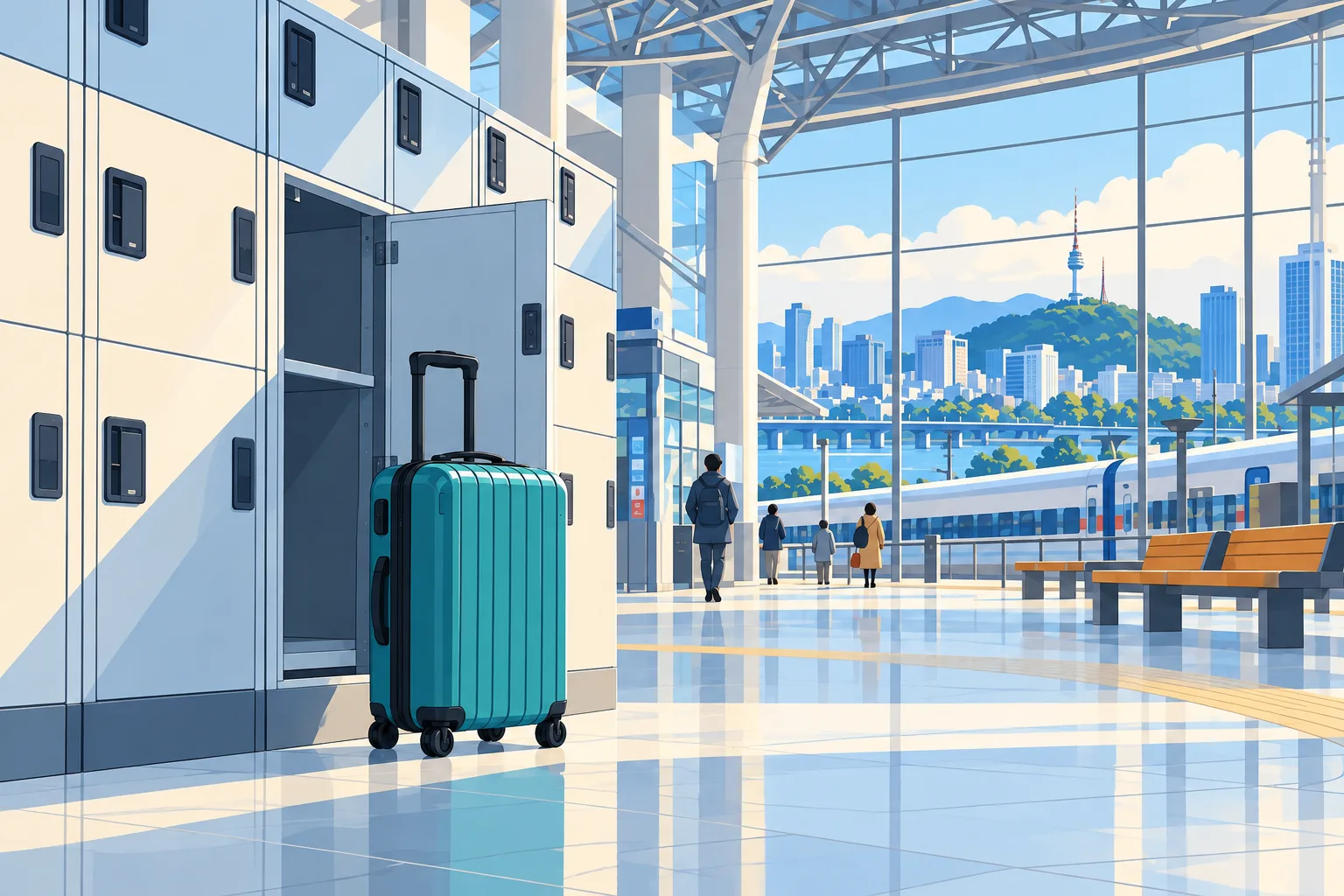
A late flight from Incheon can leave you with most of a useful day in Seoul and two suitcases that have nowhere obvious to go. The nearest locker may solve the bag problem while creating a worse problem: collecting everything from the wrong side of town before your airport journey.
For Singapore-based visitors, checkout-day storage works best when it follows the departure route. Start with where you will collect your bags, then decide what sightseeing fits around that point.
Choose storage around your airport journey
After hotel checkout in Seoul, first ask your accommodation to hold your bags. If returning there creates a detour, compare a station locker with a staffed luggage counter on your airport route. Check the complete storage price, suitcase dimensions and collection deadline before committing to your last sightseeing stop.
The question is not simply where you can leave a suitcase. It is where you can leave it without spending your final afternoon retracing the morning. Hotel storage, a station locker and a staffed counter each make sense under different conditions.
Ask the hotel before your final night, rather than arriving at reception with packed bags and assuming storage is available. Confirm whether departing guests can use it, whether there is a fee, when you must collect, and whether the desk will still be staffed. An apartment rental or self-check-in property may offer a different answer from a staffed hotel.
If the hotel is already close to your airport departure point, leaving bags there may keep the day simple. You avoid learning a new payment system and can put your farewell lunch nearby. If the hotel lies behind your sightseeing route, however, the return journey deserves a place in your budget alongside any storage charge.
Draw a rough sequence: hotel, final neighbourhood, bag collection, airport transport. A good storage choice removes a journey from this sequence. A poor one adds a journey merely because its advertised starting price looks attractive.
Use our Seoul airport transfer guide to decide the departure transport first. You can then choose a collection point that actually serves that decision.
Understand the three options before comparing prices
| Option | Good reason to choose it | Check before leaving bags |
|---|---|---|
| Your accommodation | Collection fits naturally into the departure route | Guest eligibility, fee and desk hours |
| A station locker | Your bag fits and you can collect independently | Dimensions, availability, access hours and payment |
| A staffed counter | You prefer a handover or need help checking acceptance | Branch location, collection hours and full price |
These are planning distinctions, not a ranking of security. A staffed handover can feel easier when you are tired, while a locker can be efficient when you already know the station. Neither removes your responsibility to keep the collection details.
A fourth option, luggage delivery, changes the process more substantially. Instead of returning to the storage point, you collect elsewhere under the operator's delivery conditions. That can be useful, but it introduces dispatch cutoffs, destination arrangements and a delivery promise that must match your flight.
Do not assume a storage purchase includes airport delivery. Ask for the actual delivery service, its acceptance deadline and its airport collection instructions. If those answers are unclear, ordinary storage with a planned collection journey gives you fewer moving parts.
Monthly storage products are a different category again. A service whose name resembles a tourist locker may be designed for longer rentals. Read what you are buying rather than treating every station storage listing as a four-hour checkout solution.
Check the suitcase against the locker compartment
The Seoul government's storage guide lists T-Locker compartments in three sizes: 50 × 30 × 60 cm, 50 × 45 × 60 cm and 50 × 90 × 60 cm, stated as width × depth × height. Measure the whole bag, including wheels and handles.
A suitcase sold as a particular inch size is not automatically compatible with a compartment. The retail label and the locker measurements describe different things. Expandable luggage creates another problem: the case that fitted your airline allowance on arrival may be deeper after shopping.
Before paying, compare the physical dimensions with the compartment you intend to use. If the machine or app gives a different current specification, use that information for that unit. Do not try to make a tight fit work by leaning on the door.
Think about smaller bags as well. A suitcase might fit alone but leave no sensible room for a tote containing souvenirs. Plan whether the group needs one compartment per large bag, a second smaller locker, or a counter that accepts the full set.
Take fragile shopping out of a tightly packed bag before you test the fit. If the suitcase would need to be compressed against breakable contents, choose a different solution. Saving a small storage charge is a poor trade for damaged gifts.
Availability also matters independently of size. Finding a large locker on the map does not mean it is empty. Keep a realistic backup close enough to reach without abandoning your airport plan. For example, ask your hotel whether you can return if the intended locker is full before you leave reception.
Compare the full cost rather than the starting price
Municipal reference charges are in KRW; confirm the unit or branch tariff and partial-hour rounding before payment.
| Service/size | Weekday four-hour base | Weekend base | Extra/hour |
|---|---|---|---|
| Locker S | 2,200 | 3,100 | 500 |
| Locker M | 3,300 | 4,600 | 800 |
| Locker L | 4,400 | 6,100 | 1,000 |
| Counter S | 3,000 | 4,000 | 1,000 |
| Counter M | 4,000 | 6,000 | 1,000 |
| Counter L | 6,000 | 9,000 | 1,000 |
| Counter XL | 9,000 | 13,000 | 1,000 |
For exactly eight weekday hours, the illustrative large-locker total is 4,400 + (4 × 1,000) = KRW 8,400; the large-counter total is 6,000 + (4 × 1,000) = KRW 10,000. The KRW 1,600 difference excludes collection transport. A counter's L category is not the same physical compartment as a locker L; confirm acceptance for your actual bag.
For budgeting, write down the quoted charge for your intended collection time. If you only compare the initial block, you may choose the cheaper-looking option even though your afternoon extends well beyond it.
The number of bags can change the result too. A family might need multiple lockers, while a couple travelling lightly might need only one. Compare what your group will actually purchase instead of comparing one small-locker advertisement with one large-bag counter quote.
Add any journey needed solely to collect the bags. If the storage point forces another taxi ride or a return across town, that cost belongs in the decision. Include the time as well: another transfer can reduce the final activity you hoped to enjoy.
Keep your working budget in Korean won. Converting every small line into Singapore dollars can obscure the comparison, particularly if you are mixing an approximate exchange rate with card charges. Convert the final total for your own planning if helpful.
A useful comparison has four lines: storage, collection transport, extra walking, and deadline risk. The cheapest storage line does not necessarily produce the best complete checkout day. Equally, a staffed counter is not automatically worth more money if your bag fits an available locker exactly where you need it.
Choose a collection point you can find again
City reference locations are below; confirm the current branch with the operator.
| Station | Reference location |
|---|---|
| Seoul Station | B1, Exit 1 |
| Hongik University | B1, Exits 3/4 |
| Jamsil | B1, Exits 3/4 |
| Myeongdong | B1, Exits 9/10 |
| Gimpo Airport | B1, information centre |
| Jongno 3-ga | Line 5 B1, Exit 6 |
The city gives 09:00–22:00 beside its T-Luggage booking link, under a mislabeled T-Storage heading. Use this as a reference, then confirm your branch's actual collection deadline.
A station name is only the start of the directions. Large interchanges can have several lines, concourses and entrances. The platform you use after sightseeing may place you on a different side of the building from the locker you used in the morning.
Photograph the locker number and a nearby location sign after storage. Save the station name, floor and identifying directions in a note that someone else in your group can understand. A photograph of the suitcase inside the compartment will not help you locate the compartment later.
For a staffed counter, save its booking confirmation and map pin. Check whether you must return to the same counter, whether access depends on a station gate, and whether the route to your airport service requires moving to another part of the station.
Do not select an exit just because it is closest on a map if you cannot comfortably manage the loaded bag there. A short staircase can be more awkward than a slightly longer route with a usable lift. On departure day, choose directions for your luggage rather than directions for an unencumbered walker.
Before sightseeing, look at the journey from the collection point to your next transport. That small rehearsal makes the afternoon easier: you know where to regroup, which direction to walk, and where to check the departure information after retrieving the bags.
Keep collection proof and essential belongings with you
The T-Luggage operator's terms allow staff to require pickup evidence and, when necessary, identification. They also restrict various valuables and electronic equipment. Keep your passport, phone, laptop, cash and flight documents with you, and check the service's current acceptance rules for your contents.
Prepare the day bag before reaching the storage point. Repacking on the station floor while other people wait is an avoidable strain. Put the essentials in one bag at the hotel, zip the suitcase, and check that everyone can manage the bags they are carrying.
Retain the receipt or confirmation until the luggage is back in your possession. If access uses your phone, keep enough battery for collection and save relevant details where you can find them. Do not rely on remembering a code after several hours of sightseeing.
Decide who owns the booking within the group. If one person stores the luggage and another intends to collect, ask the operator about its handover requirements first. An informal assumption between family members may not match the service's identity check.
Photograph the condition of the suitcase before handing it over if you want a personal record. At collection, inspect it before walking away. This is a practical way to catch an obvious problem while the bag and the counter are still together, rather than discovering damage after boarding airport transport.
Treat storage as a convenience with service terms. Avoid placing irreplaceable items inside because a listing uses reassuring language about security. Your departure documents and the objects needed to complete the airport journey are more useful in your hand than behind any storage door.
Work backwards from the flight before planning lunch
T-Locker's municipal reference gives access hours of 05:00–24:00 and says retrieval is unavailable outside operating hours. Staffed services have their own opening hours. The latest possible collection time is therefore not necessarily the time that makes sense for your flight.
Start with your airline's recommended airport arrival time and check-in requirements. Then subtract the airport journey, the move from storage to that transport, and the time needed to retrieve the bags. Add your own margin for queues or a wrong turn.
This is a planning method, not a universal rule that every traveller needs the same number of minutes. A solo traveller with one small suitcase can organise collection differently from a family with a stroller, shopping bags and several pieces of luggage.
Set the bag-collection alarm before the final activity starts. An alarm labelled “leave lunch” is more useful than one labelled “airport” if the airport journey still requires a storage stop. Make the next step obvious while you are enjoying the day.
Do not use the last departure you can theoretically catch as the centre of the plan. Storage has an additional handover or access step; the transport schedule alone does not describe the whole journey. A workable departure plan has room for that step to take longer than hoped.
Our Incheon airport guide provides broader airport context. For checkout day, confirm the terminal and the specific departure service you will use rather than reversing your arrival journey from memory.
Three hypothetical checkout-day decisions
Myeongdong hotel, local shopping and an evening flight
Suppose your accommodation agrees to hold bags and you plan to spend the remaining hours nearby. Hotel storage can be a good fit because collecting the suitcases is already part of leaving the neighbourhood. There is little reason to introduce a separate locker merely because lockers exist.
The useful work is checking the hotel's collection arrangement and choosing a lunch that ends within your departure boundary. If you decide to visit another district, recalculate the return journey before committing. The storage itself has not changed; the day's geography has.
Hongdae hotel, sightseeing elsewhere and airport rail
Suppose your final sightseeing stop lies away from Hongdae but you plan to depart through that area. Storage near the departure route may simplify the sequence, provided the actual unit or counter is convenient to the rail service you will take.
Compare this with collecting at the hotel. If the hotel is nearby and storage is available, it may still be the simpler choice. A station counter is useful only if its location removes effort. “Near airport rail” does not automatically mean “closer than my hotel.”
Jongno morning, different departure station and large suitcases
Suppose you want one last walk in the historic centre, then intend to leave through another station. A locker beside the morning attraction may be convenient for sightseeing but inconvenient for departure. The large cases also make a speculative locker search less attractive.
In this situation, a confirmed staffed booking on the later route may be worth considering. Alternatively, shorten the morning plan and retain hotel storage. Choose based on a known collection arrangement, not a hoped-for empty compartment that requires backtracking if it fails.
For a bag measuring 70 × 45 × 28 cm, neither the small nor medium locker offers a straightforward axis-aligned fit: each compartment’s longest side is 60 cm. The large reference compartment can accommodate 45 cm width × 70 cm depth × 28 cm height within its 50 × 90 × 60 cm dimensions. Confirm the door opening and actual fit before payment. In the Jongno example, an eight-hour collection window makes the worked totals above more relevant than the four-hour headline. These are hypothetical dimensions and duration, not availability or airport journey estimates.
Questions to settle before you pay
Can I leave bags overnight? Check the specific service's rules and retrieval hours. A bag being physically inside a locker does not mean you can access it whenever you need it. For a late flight, arrange collection while access is available and leave enough time for departure.
Can I open the locker during the day? Check whether opening ends the paid session and whether storing again requires another payment. Do not assume a locker works like a hotel luggage room with unlimited access. Keep likely purchases and essentials in your day bag.
Is airport delivery better? It can remove collection travel, but only if the accepted bags, booking cutoff, delivery timing and airport handover fit your departure. Ask about those conditions before paying. If you cannot establish them, ordinary collection is easier to plan.
What if my intended locker is full? Use the backup selected before leaving the hotel. Avoid spreading your bags across distant lockers merely to preserve an advertised bargain. One collection point is usually easier to organise when you have a flight ahead.
If your storage plan adds another public-transport trip, prepare payment before you leave the hotel. Our T-Money guide covers the transport-card basics. A final-day balance check is a small task that prevents a storage decision from turning into an unnecessary payment stop.