Seoul Child Transit Fares and T-money: A Family Guide

Seoul transport gets easier when every family member's fare is settled before you reach the gate. A child's ticket can depend on age, transport mode and whether a card has been registered correctly. Do not assume that the youngest traveler should simply follow an adult through a barrier, or that the child rule in another Korean city applies in Seoul.
Start with each child's age and the mode of transport
For Seoul metro and bus rides, check each child's official age band and choose an eligible ticket or card. A registered child T-money card can make frequent rides easier; a single-use ticket may suit occasional trips. Check the current fare table because free travel and discounts have conditions.
This guide is the payment companion to the Seoul subway stroller and elevator route. Knowing which station exit has a lift solves one problem; knowing how your party gets through the gates solves another. Plan both before a rush-hour transfer. For broader pacing and activities, see our South Korea family travel guide.
Create a small fare list before leaving the hotel: each traveler, date of birth or age on the travel day, intended modes and payment method. Seoul's official modes-of-transport information describes the age categories and distinguishes rules for different modes. The subway fare page publishes fare tables. Read the current version just before travel, because fares and categories may change. If a child has a birthday during the trip, check the rule for the actual journey date rather than the booking date.
An adult's contactless payment method is not automatically a child's discounted ticket. Nor should several people try to pass a gate on one tap. Each person who needs a fare needs an appropriate ticket or card, and the youngest child's eligibility should be confirmed with station staff if it is unclear. This matters when an adult is carrying a toddler through an accessible gate: the physical convenience of one wide gate does not change the fare rules.
T-money: useful, but configure it correctly
Seoul's public transport guidance explains T-money and how it is used on local transport. For a family making many metro and bus trips, a separate card for each fare-paying traveler usually avoids repeated ticket-machine stops. Keep cards physically separate and label them discreetly so a child does not tap the wrong one. The adult holding a stroller should be able to retrieve their own card without opening a backpack at the gate.
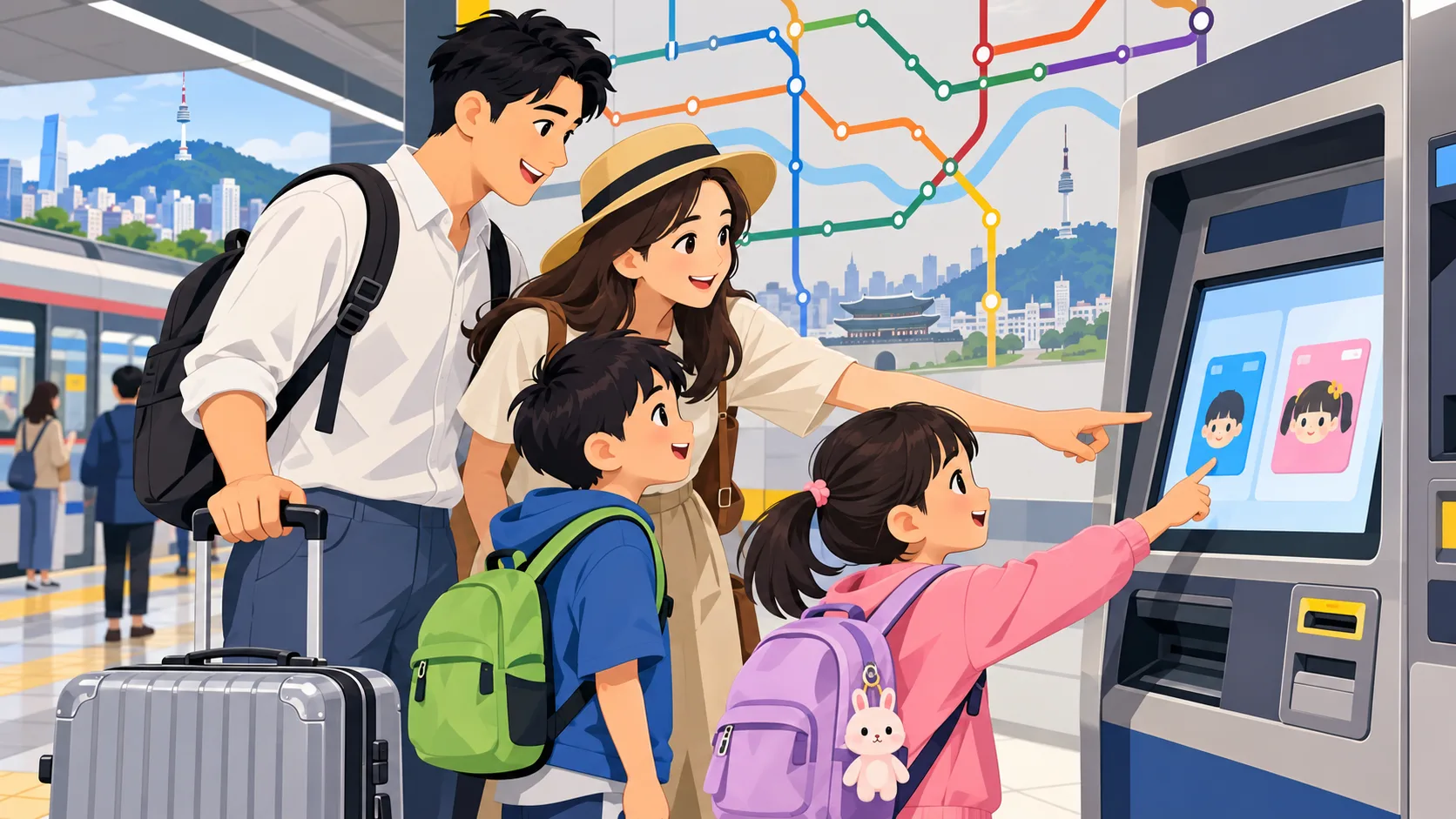
Buy cards from an authorized retailer or station channel and confirm how to add value. The card's purchase cost and its stored travel balance are separate. Ask whether a child's card must be registered with a birth date to receive the child fare, and complete any required registration before relying on the discount. A colorful card sold as a souvenir is not proof that the system knows the holder's age. Retain the receipt or note the retailer if you need to resolve a registration problem later.
Top up enough for the first day, then add more when you understand your actual travel pattern. A family that mostly walks and uses taxis may need far less stored value than one using the metro four times a day. Avoid loading a large balance onto a card a young child may misplace. Carry a modest backup payment method for a machine that is out of service or a card that fails to read. Check the current retailer and machine options for foreign-issued cards or cash; do not assume every machine accepts the same payment type.
Before the first crowded ride, let each child practice holding their card ready and waiting for the gate signal. One adult goes first and waits just beyond the barrier; the other stays with the last child. If using an accessible gate with a stroller, follow the station's posted instructions and staff direction. Never push the stroller into a closing barrier to save a few seconds. The right fare setup should reduce pressure, not make the family hurry.
A practical card setup
For two adults and a school-age child, think in terms of three fare media, subject to the official age rule. Put one adult's card in a jacket pocket, the other's with the travel wallet, and the child's in a secure sleeve or lanyard under supervision. Keep a phone note of which card belongs to whom, without storing a full personal identifier. If a child is too young to manage the card, an adult can hold and tap it separately; ask staff how to move through the accessible gate together.
For a toddler, check whether a fare or separate card is required for the specific mode and circumstances. A free-travel rule may have conditions, such as accompaniment or a limit per paying adult. Do not generalize from a metro sign to a bus or vice versa. When in doubt, show the child's age to staff politely and ask which gate or ticket to use. A quick question at a quiet station is easier than sorting it out in a queue.
Metro fares: read the table rather than an old screenshot
The official Seoul subway fare table distinguishes fare media and age groups. A base fare is only the starting point; distance, route and ticket type can affect the amount deducted or charged. Do not build a family budget by multiplying a single blog-post fare by every trip. Save the official page and review it shortly before departure.
At a metro station, check the destination and line before entering. Some interchanges are within the paid area; others require a different path. When traveling with a stroller, the shortest map route may include stairs, so compare it with the lift route. Our stroller elevator guide covers this distinction. A child who has already tapped into a station can be tired or anxious if the adults discover they entered from the wrong side of a road, so decide the station entrance as well as the line.
Tap in and out as instructed for your ticket. Keep every card until the whole party has left the station; do not hand all cards to one adult who races ahead. If a child's card shows an unexpected adult fare, record the card and the station, then ask staff or the issuer to check the age registration. Do not repeatedly tap in an attempt to correct the price yourself, because that can create additional journeys or confusion.
Single-use tickets may be sensible if you expect only one or two rides and do not want several stored-value cards. However, they add ticket-machine time every journey and may require understanding deposits or return procedures. For a family with multiple children and a stroller, this time cost can exceed a small fare difference. Decide based on how many rides you genuinely expect, not on the idea that a travel card is always the best deal.
Buses: payment and boarding require a different routine
Seoul's transport guidance includes bus information, and the public transport page explains card-based use and transfers. Check the current bus rule for children, including any accompaniment condition. A child fare on the metro does not prove that the same child has the same treatment on every bus type.
At a bus stop, first confirm the route number and direction. A stop can serve many lines, and two buses with similar numbers can head to different destinations. Have the cards ready before boarding. Let children step aboard one at a time while an adult supervises the stroller and bags. If the stroller must be folded or secured on that vehicle, follow the operator's direction. A quiet off-peak bus is a better first attempt than a packed commuter bus with an unfamiliar payment routine.
If the bus requires a tap on exit to calculate a fare or preserve transfer eligibility, make sure every paying traveler completes it. One missed tap can affect the next trip or the amount charged. Do not infer transfer rules from the metro alone. They can depend on the route, elapsed time and whether the same card was used correctly. Keep a simple mental rule: one card per eligible paying person, tap where the operator instructs, and ask when a fare or transfer is ambiguous.
For a short cross-town ride, consider whether walking or a taxi is easier when the child is exhausted. A cheap bus is not economical if it leads to a missed nap and a disrupted afternoon. The fare decision is part of the itinerary, not an abstract exercise in finding the lowest per-trip cost. Families with toddlers may benefit from fewer longer journeys and more time in one neighborhood.
Transfers and passes: compare your actual day
Transfers can make a card more convenient, but only if you follow the current conditions. Check whether your route and timing qualify; do not assume every change of vehicle is one continuous paid journey. It helps to write down a typical day: hotel to museum, museum to lunch, lunch to park, park to hotel. Count the likely transit legs for each person, then compare ordinary fares with any pass under consideration.
The Climate Card page publishes coverage, purchase options and current conditions. It is tempting to buy a pass because the daily cost sounds simple. But coverage can exclude a service or part of a journey you actually need, and a child may have a different fare situation from the adults. Check the exact lines, buses, period and card availability for your itinerary. A pass is good value only when its eligible rides replace enough separate fares.
Airport rail and intercity rail deserve separate checks. A local Seoul pass should not be assumed to cover your Incheon Airport to Seoul transfer or a future KTX ticket. These are different operators and products, with different reservation and fare rules. Keep airport, city and intercity transport as three budget lines. This makes family costs easier to understand and prevents a card surprise at a station gate.
If your party will split for an afternoon, check that each subgroup has its own payment media. One adult cannot leave with every card while the other takes a child back to the hotel. The same applies when an older child travels with a grandparent. Assign each card to the traveler, not to a backpack or a person who happens to carry the money. Then keep a small emergency balance or alternative payment method with both adults.
A station routine that works with children
Before descending to the platform, pause away from the flow of commuters. Confirm line, direction, destination and whether you need an elevator. Give children one simple job each: hold a hand, carry their card or watch the station name. Do not ask a young child to manage directions and payment simultaneously. If one adult is alone with children, it can be worth waiting for the next train rather than rushing through a closing door.
At the barrier, send the first adult through and have them wait on the safe side. Move the children and stroller with the second adult, using the appropriate gate and separate taps. Reassemble the group before walking on. This may seem slow, but it avoids the more stressful situation of one child trapped on the opposite side of a closed gate. At the destination, repeat the same order and check that no card has been dropped.
On the platform, stand behind the safety markings and keep a child away from the edge. If the carriage is crowded, leave space for passengers to exit first. A folded stroller, when practical, can make a short busy journey easier; a child who cannot stand safely may make waiting for a less crowded train the better choice. Do not block a carriage door with luggage. Keep snacks packed until you have checked the operator's rules and have a place to eat them without creating a mess.
After exiting, follow the planned lift route. The nearest stairs on a map are not a usable exit for a large stroller. Check the exit number and street side before committing to a corridor. If a lift is unavailable, ask staff for an alternative accessible path; do not carry a child in a stroller down a long flight of stairs. The payment routine and the physical route should be one plan.
Troubleshooting without derailing the day
If a card fails at a gate, step aside with the child and let the queue move. Check the balance, the card orientation and whether it was used for an earlier incomplete trip. Ask station staff to inspect it. Do not pass a card back through the barrier for another person to reuse. If a child fare was not applied, note the transaction and confirm whether birth-date registration was completed for that specific card.
If a ticket machine is confusing, use a staffed counter or an authorized shop rather than repeatedly buying a product you do not understand. A clear explanation of the child's age and your destination usually resolves more than guessing at the screen. Keep cash or an accepted payment card available for an unexpected single-use ticket. If the family is tired, a taxi back to the hotel can be a sensible fallback, provided you have considered suitable child restraints.
If you lose a card, do not spend the whole morning retracing a low-balance card. Check the issuer's current lost-card policy, buy a replacement if needed and continue the day. For a child's card, repeat any required age registration before assuming discounted fares will work. This is one reason to keep early top-ups modest and cards in secure sleeves.
The goal is a predictable trip, not a perfect fare optimization. Confirm ages and current rules, set up separate cards when appropriate, practice one off-peak journey, and use the official pages when a mode differs. With that settled, you can focus on where the family is going rather than on a fare gate. The same age-and-operator check will matter again when you later take the train to Busan.