Korea Family Trip Public Transport Mistakes to Avoid

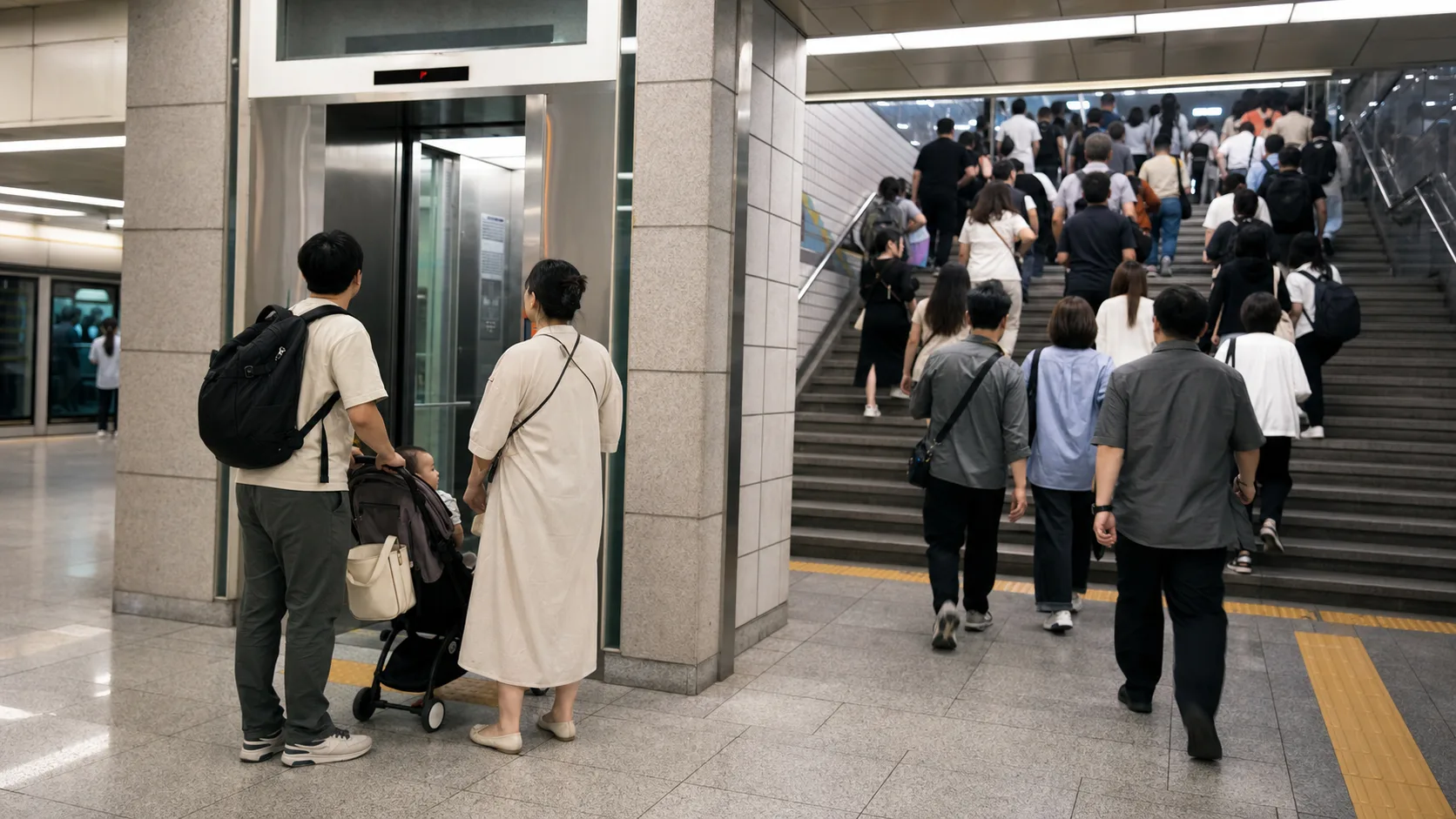
If you are taking kids, grandparents, or a mixed-age group to Korea, public transport can be the easiest part of the trip or the most tiring one. The difference usually comes down to planning: choosing the right station exits, avoiding peak-hour crushes, carrying the right payment method, and knowing when a taxi is the better family decision.
Fast Answer
The biggest mistake families make in Korea is treating public transport like a simple point-to-point ride instead of a system with stairs, transfers, rush-hour pressure, and uneven walking distances between exits and attractions. On paper, the subway and bus network looks easy. In practice, a family with a stroller, a tired child, or an older parent can burn energy fast if the route includes long transfers, multiple escalators, or a crowded station with no elevator near the exit you need.
The practical solution is to plan the trip around comfort, not just fare savings. Use subway lines for long cross-city travel, but switch to taxis for short hops when the last 800 meters involve hills or narrow sidewalks. Load a transit card before you need it, keep one backup payment method, and check whether your destination is closer to a subway line, a bus stop, or a taxi drop-off point. If you do that, Korea public transport becomes an asset for family travel instead of a daily stress test.
The other rule is to move slower than you think you should. Families usually do better with fewer transfers, earlier departures, and more buffer time than solo travelers. Korea is efficient, but efficiency only helps when your plan fits the group’s energy level.
Context You Need
Korea’s public transport system is one of the most useful in Asia for visitors, especially in Seoul, Busan, Daegu, Daejeon, and other major cities with dense rail and bus networks. For families, that density is both the advantage and the trap. It is easy to believe that every attraction is “near a station,” but station proximity does not always equal easy access. A museum may be close to a subway stop yet require a long underground walk, several stairs, and a final uphill street crossing. A theme park might be reachable by rail but still demand a shuttle or a taxi from the arrival stop. A family that looks only at the map often underestimates the final walk.
This matters more when your group includes children, elderly travelers, or anyone who gets tired after long days of sightseeing. A trip that feels simple for one adult with a backpack can feel heavy when you are managing snacks, a stroller, rain gear, a diaper bag, and someone who needs a bathroom break every hour. Korea’s transit system is built for volume, speed, and regular commuting. It is less forgiving if your goal is to travel slowly, sit together, and avoid physical strain.
For Singapore-based families, the familiar parts are useful: clear payment systems, strong station signage, and an overall expectation that transit works on time. The difference is scale and terrain. In Korea, you can have beautiful underground connections, but you can also have stair-heavy exits, crowded platforms, winter weather that makes surface walking unpleasant, or summer humidity that turns a “short” walk into a draining one. Those are not reasons to avoid public transport. They are reasons to plan it correctly.
Another key point is that Korea has multiple transport layers. Subway, city bus, intercity bus, airport rail, taxis, and ride-hailing each solve a different problem. Many first-time family travelers pick one mode and try to force it into every situation. That is usually where mistakes begin. The best family trips mix modes. Use the subway when the route is direct. Use buses when they truly stop closer than the train. Use taxis when you are conserving energy. Use airport rail when it is clearly better than a taxi, but not when a late-night arrival or heavy luggage changes the equation.
The goal is not to become transit experts. The goal is to avoid the common friction points that turn a good itinerary into a tiring one.
Step-by-Step Guide
1. Build the day around the least mobile traveler
Start with the person who will struggle most, not the person who moves fastest. If your child needs a nap by 2 p.m., or your parent cannot handle repeated stairs, the day’s route should be built around those limits. In a family group, the weakest transport link usually determines everyone’s mood by the afternoon.
Ask three practical questions before you choose a route:
- How far can the slowest traveler comfortably walk after getting off transport?
- How many transfers is everyone willing to tolerate before the trip feels annoying?
- Is the final destination easier from a station, a bus stop, or a taxi drop-off?
If the answer to any of those is uncertain, simplify. One direct ride with a short walk is usually better than one “cheaper” ride with two transfers and a long station exit.
2. Check the last 500 meters, not just the station
This is the mistake that catches families most often. Travelers see a station name and assume the attraction is nearby. But the final stretch may involve hills, crosswalks, long blocks, or awkward stairs. In Korea, the distance from platform to street exit can also be longer than expected, especially in major transfer stations.
Before you leave the hotel, look up:
- Which exit is closest to the attraction.
- Whether that exit has an escalator or elevator.
- Whether the route is on flat ground or uphill.
- Whether a taxi would actually save energy and time.
For families, a taxi for the last segment is often money well spent. It is easy to see taxi use as a failure to “use transit properly,” but the real objective is to conserve the family’s energy for the activity you came to enjoy.
3. Load your payment and backup options before the first ride
Do not wait until you are already standing in a station to figure out payment. Have at least one transit card ready, and make sure the adults know who is carrying it. Families often split into two categories: the person who pays for everything and the rest of the group who assumes the system will somehow work out.
That works until one person walks through a gate first, another family member gets separated, or you reach a bus stop with everyone ready to board but only one card is available. Keep the payment logic simple:
- One main transit card for local rides
- A backup card or cash option if a machine fails
- A fully charged phone if you use mobile payment
If you are traveling with children, avoid making every boarding a payment negotiation. The more automatic the payment process is, the smoother the trip feels.
4. Choose transport mode by fatigue, not pride
Families often overuse the subway because it feels like the “smart” option. Sometimes it is. Sometimes it is not. A bus may place you closer to your destination with less walking. A taxi may be cheaper than the energy cost of an extra transfer. A direct airport rail line may be better than a multi-step subway route if you have luggage and jet lag.
Use this rough decision rule:
| Situation | Best default |
|---|---|
| Long cross-city trip with few transfers | Subway |
| Short hop with a better street-level drop-off | Taxi |
| Route with a direct stop close to the attraction | Bus |
| Airport arrival with moderate luggage and no time pressure | Rail |
| Late-night arrival with kids already asleep | Taxi |
The best family travelers in Korea are not the ones who use the cheapest option every time. They are the ones who choose the option that keeps the day from unraveling.
5. Plan boarding order and station behavior
Korea’s transit is orderly, but that order only helps if your family knows how to move together. Before boarding, decide who enters first, who handles the stroller, who holds the child’s hand, and where the family should regroup after exiting.
For subway and train use:
- Stand to the side of doors and let others exit first.
- Keep children close in crowded stations.
- Avoid clustering right in front of the platform screen doors.
- Have one adult identify the correct transfer direction while the others keep the group together.
If you are using a stroller, test whether the station path includes long stairs or narrow gates. In some places, the official elevator exists but is not near the exit you need. If the elevator adds too much detour, a taxi can be a better family choice.
6. Build a buffer into every transfer
Transit schedules in Korea are good, but family pacing is not. A route that works in 35 minutes for an adult alone can become a 50-minute experience with a child, a snack stop, and a bathroom break. Transfer times that look generous on a map can shrink quickly once the group has to locate an elevator, walk to a different platform, or wait for everyone to regroup.
For families, add buffer time to:
- Morning departure from the hotel
- Airport arrival transfer
- Any route with a transfer station
- Time-sensitive reservations, such as lunch slots or shows
The simplest habit is to arrive 15 to 20 minutes earlier than you would for a solo trip. That buffer can save you from rushed meals, missed buses, and a frustrating first impression of a city that was actually very manageable.
Costs, Hours, and Logistics
Public transport in Korea is usually affordable for family travel, but the real cost question is not just the fare. It is the combined price of tickets, transfers, convenience, and fatigue. A subway ride may be inexpensive, but if it leaves the youngest traveler in tears, the trip becomes expensive in another way.
In major cities, subway and bus fares are generally low enough that families can use them daily without blowing the budget. Taxis are naturally more expensive, but they often make sense for:
- Late-night returns to the hotel
- Rainy days
- Routes with awkward stair-heavy access
- Trips where one transfer would save little time but add a lot of strain
Operating hours vary by city and line, but the practical family takeaway is simple: Korea’s transit is best during the day and early evening, while late-night logistics need more care. If you are planning a very early departure or a very late arrival, assume your family will have fewer rail and bus options and verify the route in advance. Do not leave a 5 a.m. airport run or a midnight hotel return to chance.
Payment also matters. Transit cards are the easiest option for repeated rides, and families should treat them as a trip essential rather than an accessory. If one adult carries all the transit cards, the group is vulnerable to separation. If every adult knows where the cards are, the day becomes much easier.
For logistics, remember these practical points:
- Station elevators may be present but not convenient to every exit.
- Some bus stops are near the attraction, but not always near the most family-friendly entrance.
- Crowded peak-hour rides are much harder with children.
- A direct taxi may be the best value when energy is limited.
If you are traveling in summer, heat and humidity make walking segments feel longer. If you are traveling in winter, cold weather turns a short outdoor transfer into a more serious issue for children and elderly family members. That means transport choice is seasonal, not fixed. The same route can be reasonable in spring and frustrating in August.
The most useful planning habit is to treat each day as a route design exercise. Ask not only “How do we get there?” but “How do we get there without exhausting the family before the main activity starts?”
Variations and Edge Cases
Families with strollers
Strollers make Korea completely manageable, but they change the route calculus. A station with good train service can still be annoying if the only elevator is on the opposite side of the complex. Some subway rides are straightforward once you are inside, but the entrance and exit paths can be the real problem.
If you are using a stroller:
- Favor routes with fewer transfers.
- Check for elevator access at both ends.
- Avoid the busiest commute windows if possible.
- Use taxis more freely than you would on a solo trip.
The best stroller strategy is not perfection. It is reducing unnecessary lifting, folding, and stair climbing.
Families with older parents
If a grandparent is traveling with you, the most important factors are seating, walking distance, and bathroom access. Even if everyone is healthy, repeated transfers can become draining. Older travelers often appreciate direct routes more than the theoretical savings of a more complicated transfer.
For mixed-generation trips, it is often worth choosing:
- A hotel closer to the core sightseeing area
- A route with a single transfer instead of two
- A taxi for the last segment of the day
This is one of those cases where a more expensive ride can preserve the quality of the entire trip.
Families with school-age children
Children who can walk well still create planning issues because they tire suddenly, get hungry suddenly, and lose patience fast in crowded spaces. Public transport can work beautifully with school-age kids if you time the day correctly.
The best approach is to:
- Avoid very early starts on consecutive days.
- Carry snacks and water.
- Build one predictable “quiet period” into the itinerary.
- Keep rides direct whenever possible.
Children tend to handle transport better when they know the sequence: hotel, transit, activity, food, rest. Constant switching between transport modes can make them feel like the day has no rhythm.
Rain, heat, and winter weather
Weather changes the value of public transport in Korea. In good weather, a family may happily walk 12 minutes from station to attraction. In heavy rain or winter wind, that same walk becomes much less pleasant. The transport mistake is assuming that a short distance is always a short effort.
In bad weather:
- Choose stations with easier exits.
- Use taxis to reduce exposed walking.
- Avoid open-air transfer points if you have heavy bags.
- Give yourself more time than usual.
Airport arrivals and departures
Airports are where families most often overcomplicate transit. Jet lag, baggage, and grumpy children reduce decision quality. Do not try to optimize too aggressively after a long flight. If the airport rail is easy and direct, use it. If a taxi will save you from multiple transfers and a staircase-heavy route, take the taxi.
For departure day, build a calm route rather than a clever one. The airport ride should feel boring and reliable, not adventurous.
Mistakes to Avoid
The first mistake is choosing the lowest fare without considering the total effort. A cheap route that requires two transfers and a long walk is often the wrong family choice.
The second mistake is ignoring station exits. In Korea, the “right” station can still be the wrong exit if you have a stroller, an elderly parent, or a child who is already tired.
The third mistake is traveling like a commuter. Families do not need to mimic office-hour efficiency. They need predictability, buffer time, and enough flexibility to stop for food or rest.
The fourth mistake is assuming everyone will stay together automatically. In crowded stations, groups can split quickly. Decide who leads, who follows, and where you regroup.
The fifth mistake is refusing taxis out of principle. For family travel, the right question is not “Is this the cheapest mode?” It is “Is this the best way to preserve energy for the day?”
FAQ
Is Korea public transport good for families?
Yes, but it is best when your plan matches the family’s pace. Korea’s subway and bus systems are excellent for moving across cities efficiently, but they are not always the easiest option for strollers, grandparents, or very young children. The more you simplify transfers and walking, the better the experience becomes.
Should I use a subway or taxi with kids?
Use the subway for longer direct routes and taxis when the final walk, the transfer count, or the weather makes transit tiring. Many families do best with a mixed approach rather than forcing one mode for the whole trip.
Do I need a transit card in Korea?
Yes, if you plan to use public transport more than once or twice. A transit card reduces friction, avoids repeated ticket purchases, and makes family boarding easier. It is one of the simplest items you can prepare before the trip.
Are buses harder than subways for visitors?
Sometimes. Buses can be great when they stop closer to your destination, but they require more confidence about stop names and boarding order. For a first family trip, subways are often easier to predict, while buses become useful once you are comfortable with the city layout.
What is the best way to avoid getting exhausted on transit days?
Reduce transfers, travel outside peak hours when possible, and use taxis for the last segment when walking would be unpleasant. Also, choose attractions that cluster by neighborhood so the day does not involve constant back-and-forth movement.
Should families stay near a subway station?
Yes, but “near a station” is not enough. The better rule is to stay near a station with an easy route to the places you plan to visit and with simple elevator or escalator access. A slightly more expensive hotel in a better location can save time and energy every day.
What if my child hates crowded trains?
Travel earlier in the day, avoid rush hour, and switch to taxis for the most crowded segments. A child who gets overwhelmed quickly can turn a cheap ride into a stressful one. The goal is not to force transit; it is to keep the trip usable.
Next Steps
The best next move is to map your hotel, the attractions you care about, and the family members who need the smoothest route. Once you do that, you can decide where transit works well and where a taxi is worth it. If you are planning more Korea logistics, keep building around comfort, directness, and predictable movement.
If your family trip includes more city-specific planning, the same approach applies to airport transfers, day trips, and neighborhood-to-neighborhood movement. Start with the hardest traveler in the group, then design the route around that person. That is usually what turns Korea public transport from a source of friction into one of the easiest parts of the trip.
Related: korea-family-trip-first-time-travel-guide-for-short-holidays
Related: korea-family-trip-budget-travel-guide-for-singapore-travelers
Related: korea-family-trip-itinerary-for-singapore-travelers