Seoul to Busan by KTX With Kids: Seats, Strollers and Bags

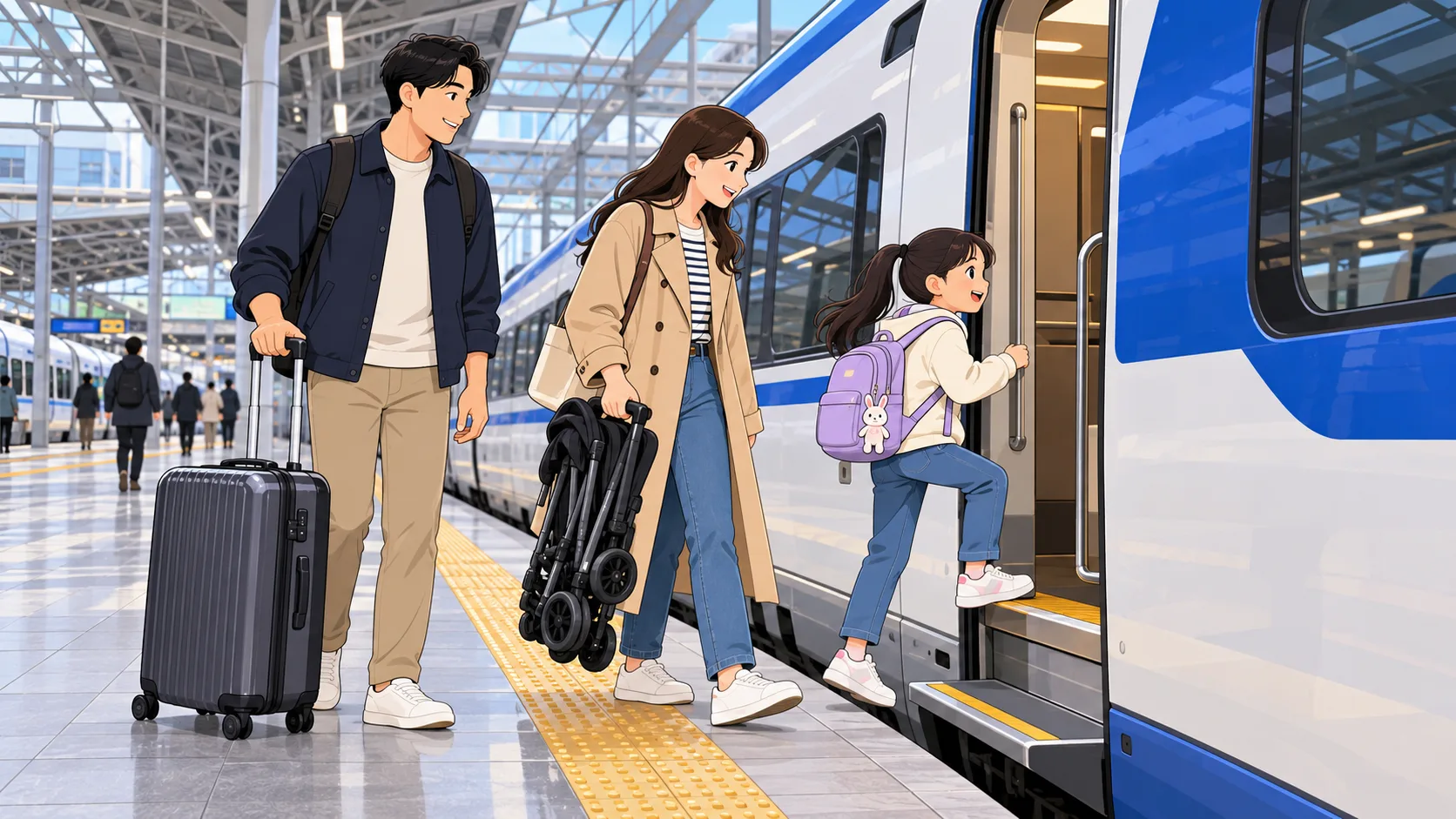
The Seoul-to-Busan train looks simple on a route map: board KTX, sit down and arrive in Busan. With children, the important decisions happen before boarding. You need the right ticket for each child, seats that work for your party, a realistic plan for bags and a stroller, and enough time to reach the correct platform without a sprint.
Book for the children you actually have
When booking Seoul-to-Busan KTX, enter every traveler's age and decide whether each child needs a reserved seat. KORAIL applies eligible discounts according to the selection; a no-seat infant option differs from a paid seat. Check current rules, operator and stations before paying, and keep tickets accessible.
This rail leg follows the family arrival and city travel decisions in our South Korea family travel guide. It is also a different kind of journey from the Seoul child transit fare guide: a T-money card for local metro trips is not a KTX reservation. Do not turn up at the intercity platform assuming a city pass, a local child fare or an airport ticket covers the train.
Start with the KORAIL booking site or another authorized channel that clearly identifies the operator and train. Check the departure station, arrival station, date, time, train number and class. A search result for “Seoul to Busan” can include more than one station or operator. The railway journey you choose should connect sensibly with your hotel at each end. A cheaper departure that forces a difficult early-morning cross-city transfer may not save the family anything meaningful.
KORAIL's official FAQ explains that child and infant discounts are selected during booking. Its passenger conditions distinguish a young child traveling without a separate seat from a child with a purchased seat. Read the current policy for the child's age and your party. If a child is likely to sleep, eat or need space for most of the trip, paying for a seat can be more comfortable than relying on a no-seat entitlement. If the journey is short for your child and the budget is tight, the permitted no-seat option may be reasonable. Make the choice deliberately.
Do not guess whether two adults can share the benefit for more than one young child. Official conditions can specify how many no-seat infants are allowed per accompanying guardian and when a separate ticket is needed. Enter the full party in the booking flow, then check the fare breakdown. If the screen does not reflect the ages and seats you expected, stop before payment and ask the operator. Correcting a family reservation at a crowded station is harder than checking it at home.
Choose seats as a family, not five separate prices
Seat layout matters more than a tiny difference in departure time. Look for adjacent seats if the booking interface allows selection, and avoid leaving a young child separated from both adults. If only scattered seats are available, choose another departure or ask KORAIL about options before buying. Do not plan to persuade strangers to swap; they may be traveling with their own children or have a reason for their choice.
Think about who will sit where. A child who needs help with food or the toilet should be next to the adult who can assist. A toddler who naps on an adult may need a window seat less than room for the adult's arm and a small bag. An older child may enjoy a window but still need easy access to a parent. If you are traveling with one adult and two children, select seats so both children can be supervised without the adult crossing the aisle repeatedly.
Check the current carriage facilities and accessibility information for your specific train if you need wheelchair space, a particular toilet or more room to handle a stroller. Train types and carriage layouts are not interchangeable. A generic photo from a blog may not match your service. If a child has a medical or mobility need, contact the operator before booking and keep its guidance with your reservation.
Book with a family-friendly departure time. A very early train may require waking a toddler before breakfast and reaching the station in commuter traffic. A late train can put hotel check-in, dinner and bedtime under pressure. A midday train often gives a calmer morning but consumes a sightseeing day. Compare the whole day: checkout, station transfer, platform wait, rail journey, Busan Station exit and the last ride to your accommodation.
Pack bags for boarding, not just for the holiday
Separate the luggage into three categories: items you will not touch on board, items needed during the journey, and valuables that must stay with an adult. The journey bag should hold tickets, passports or identification if required, wipes, a change of clothing, medicine, water and quiet activities. Avoid burying a child's medication under a large suitcase. A child who spills a drink during boarding should not force the whole family to unpack in the aisle.
Keep large bags within the operator's current luggage rules and do not block doors, aisles or other passengers' space. The carriage may have overhead racks or designated places, but their availability depends on the train. If you cannot lift a case safely, do not assume another passenger can do it for you. Pack fewer large pieces, travel with smaller cases, or arrange help. A stroller plus two huge suitcases can be more difficult than the rail journey itself.
Practice folding the stroller before travel. Remove hanging shopping bags first; they can swing into another passenger or prevent the frame from closing. If your child can walk the short platform distance, have one adult fold the stroller before the train arrives while the other holds the child. If the child must remain seated until boarding, leave more time and ask station staff where to wait. Never push a stroller up or down a moving escalator simply because a lift is inconvenient.
For a child who may sleep, decide whether the stroller needs to be accessible immediately on arrival or can remain folded throughout the rail ride. A compact folding stroller is easier to carry but still needs a safe storage place. Do not park it in front of an emergency exit or across a carriage doorway. Ask crew if the appropriate storage location is unclear. Likewise, keep small bags off the aisle floor so people can pass during the journey.
The Korea with toddlers guide helps with broader packing and pacing. For this train, think especially about the transition moments: leaving the hotel, finding the platform, boarding, taking a seat, visiting the toilet and getting off. Pack for those moments rather than carrying every possible toy. A slim pouch of familiar items usually serves a child better than a heavy backpack they cannot manage.
Get to the correct Seoul station with time to spare
Confirm the departure station on the ticket. “Seoul” as a city is not enough. Put the exact station entrance and departure hall on your map. If traveling by subway, check whether there are lifts along the route; if traveling by taxi, allow for traffic and a drop-off point that may not be beside your platform. A hotel desk can help explain which entrance is easiest with bags, but verify the route against current signs on the day.
Set a station-arrival target that gives you time for a toilet visit and locating the platform, not just the advertised boarding time. Children may need a snack or a last-minute change. Security and ticket checks can vary, so follow the operator's current guidance. When you arrive, look at the departure board and match the train number and departure time, not merely the destination “Busan.” Several services may head in the same general direction.
Buy food before reaching the platform if your family needs a specific meal or allergy-safe item. Onboard choices can be limited or change. Keep snacks tidy and considerate of other passengers. A small meal that a child can manage in a seat is easier than a hot, spill-prone dish. Put rubbish in a bag until you reach a suitable bin, and keep the area around your seats clear for the people getting on and off.
Agree on a boarding order. One adult boards with the child and the journey bag; the other handles the folded stroller and large case. If traveling alone, ask station staff for assistance rather than trying to push a child, stroller and suitcase through a narrow doorway at once. Check the carriage number before the train arrives and wait near the marked area. Keep fingers away from closing doors and do not let a child run ahead to “find the seats.”
If you miss the train, do not board a later service without checking the ticket conditions. Ask the operator about changes, refunds or replacement tickets. The rules depend on the fare and timing. Keep the booking reference and payment record accessible. A flexible itinerary with a light Busan afternoon is easier to recover than one tied to a timed attraction immediately after arrival.
Make the ride comfortable without overplanning it
After boarding, find the seats and settle the children before arranging luggage. Keep the ticket or digital reservation available in case staff ask. Point out the carriage toilet to an older child, but accompany younger children. A toilet break shortly after departure may be easier than waiting until everyone needs one. Keep shoes on when walking through the carriage and hold hands if the train is moving.
Set a simple sequence for the ride: snack, quiet activity, rest and preparation for arrival. The exact travel time varies by service and stops, so do not promise a child a fixed number of minutes based on another family's itinerary. An offline story, coloring sheet or small game can absorb a delay without needing a data connection. Headphones should be quiet enough that the child can hear an adult and announcements.
If a child becomes upset, take a short pause, offer water or move briefly to an appropriate area if safe and permitted. Do not feel obliged to entertain them constantly. A tired toddler may need less stimulation, not more. If you are traveling with another adult, alternate who supervises so both get a short break. Keep the aisle free even when handling a restless child.
Watch the stops and the expected arrival time. Begin packing a few minutes before Busan, but do not stand with all bags in the aisle too early. Check the seat area for small toys, cards and a child's jacket. Fold the stroller fully before reaching the door if that is your plan. One adult can take the children and hand luggage off first while the other follows with larger pieces, provided they remain in sight and do not block passengers.
Busan Station is another transfer, not the finish line
Your accommodation may be near Busan Station, or it may require metro, bus or taxi. Save the exact address and the preferred route before leaving Seoul. A family with a stroller may choose a slightly longer lift route over a short staircase. Do not assume a Busan metro child-card condition is identical to Seoul's; check it before the first local ride. If arriving at dinner time, identify a simple food option near the station or hotel.
If you plan to use Busan Metro, check the current fare medium and the elevator path for your station. The city has its own rules for child cards and QR tickets. A change of operator is a good moment to reset assumptions. If your hotel is distant from an accessible metro exit, a taxi may be a practical final leg after the long train ride. Confirm child-restraint and vehicle-size needs in advance.
Give the children a short pause after leaving the train. Find a toilet, distribute water and make sure everyone has a layer suitable for the weather. Then take the final ride. This buffer can prevent a small problem from becoming a stressful rush through an unfamiliar station. If the accommodation cannot accept luggage yet, ask about storage rather than carrying every bag around Busan.
Booking and departure checklist
Before payment, verify date, exact stations, train number, operator, each traveler's age, each child's seat status, adjacent seats and the fare conditions. After payment, save the booking reference offline and confirm how tickets are presented at the station. Check whether the official website's displayed time is local Korean time and make sure it matches your calendar. If your plans change, use the operator's current change or refund procedure rather than assuming a booking agent can solve it at the platform.
The evening before travel, check the journey to the station, weather, train status, food plan and stroller fold. Put tickets and child essentials in the small bag. Leave the hotel with enough time for a toilet stop and a wrong turn. At the station, match the departure board to your reservation and locate your carriage. After boarding, focus on one comfortable family journey rather than maximizing every minute of the day.
The KTX trip is often the easiest part once those decisions are made. Seats, luggage and a little margin turn an intercity move into a manageable family day. Busan's local transport is the next separate decision: check its fare and station-access rules on their own terms, then choose the simplest final route to your hotel.
If your child has a food allergy, disability or another need that changes the trip, build that requirement into the booking rather than treating it as an afterthought. Ask the operator what assistance can be arranged for the exact train and station, and bring any food or supplies you know are suitable. A family member who needs more boarding time may be better served by a departure with a calmer station transfer, even if it is not the fastest train. Keep any written assistance confirmation available offline. That practical planning can be the difference between a comfortable ride and an avoidable scramble at the carriage door.