Hokkaido Winter Road Trip: A 5-Day Driving Itinerary from Sapporo

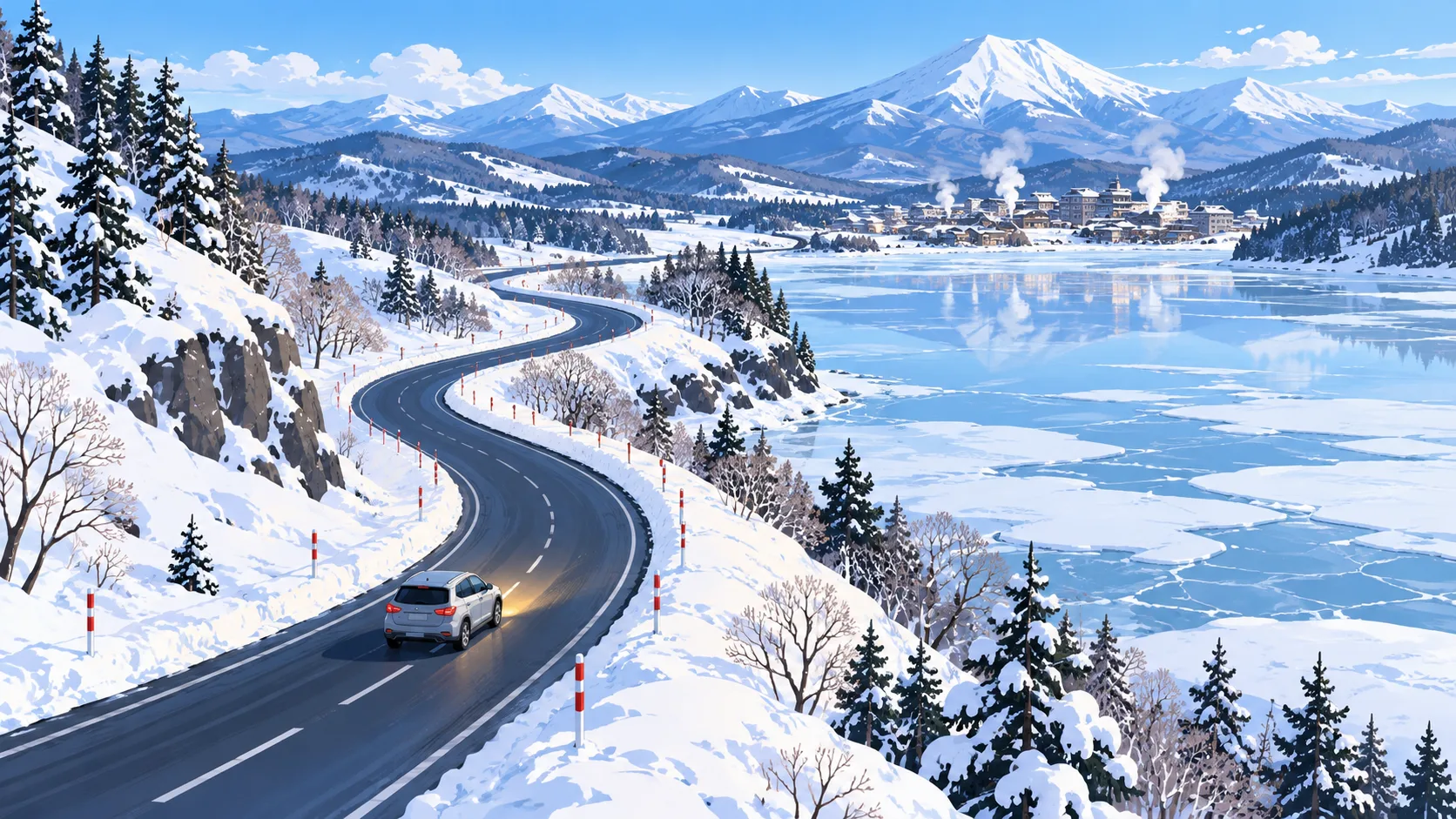
Most Hokkaido winter itineraries are built around trains: the JR network is excellent, and for good reason — winter driving here means blizzards, black ice, and expressway closures. But a car unlocks the island's southwest loop in a way trains can't: the Shakotan Peninsula's winter capes, a ski-town detour through Niseko, the unfrozen caldera of Lake Toya, and a steaming Hell Valley finale at Noboribetsu, all in five days from Sapporo. You set the pace, stop where the light is good, and carry your winter gear in the boot instead of on your back.
This guide lays out that exact loop day by day, with the winter-driving rules Singaporeans need first: the International Driving Permit requirement, how to handle blizzard closures, where fuel gets scarce, and what the five days actually cost. It's written for confident drivers — if you've never driven on snow, the train-based alternatives are noted throughout.
Can you drive in Hokkaido in winter: IDP and rental rules
Singaporeans can legally drive in Japan with a 1949 Geneva Convention International Driving Permit, obtained in Singapore before you fly — Japan accepts no other convention, and it can't be arranged after arrival. Carry the IDP with your Singapore licence and passport whenever you drive.
Rent at New Chitose Airport or in Sapporo, where the big operators (Toyota Rent a Car, Nippon Rentacar, Times, Orix) keep English-capable desks. In winter, Hokkaido rental cars come with winter tires fitted as standard — confirm this at pickup rather than assuming — and 4WD is the sensible choice for the mountain passes on this loop. Book the 4WD explicitly; the default compact may be front-wheel drive. Add the ETC card for expressway tolls (a small rental fee on top) and take the full insurance package: winter fender-benders are common enough that the excess matters.
One more rule that surprises first-timers: Japan drives on the left, like Singapore, so the road layout feels familiar — but winter road behavior does not. Which brings us to the tires, the blizzards, and the contingency plans.
Winter tires, 4WD, and blizzard contingency plans
Winter tires are necessary but not sufficient. Hokkaido's winter roads punish the habits that work in Singapore: brake early and gently, never swerve suddenly on ice, and double the following distance you'd keep at home. Black ice forms on bridges and in shaded mountain stretches even when the main road looks clear. If the car starts to slide, ease off the accelerator and steer gently in the direction you want to go — do not slam the brakes.
Blizzards are the real trip-breaker. Hokkaido storms can shut expressway sections with gusts over 30 m/s and half a meter of snow in hours — the December 2025 blizzard did exactly that across the prefecture. Build your itinerary with slack: never plan a same-day flight connection after a long winter drive, and keep one buffer activity per day that can absorb a delay. If a blizzard warning is issued, the correct move is to stay put — hotels and onsen towns are well stocked, and no sightseeing is worth a whiteout drive.
Check conditions every morning before setting off. NEXCO East Japan's official portal DraPla (driveplaza.com) publishes expressway closures and restrictions; on the Do-O Expressway, the Ebetsu Higashi interchange to Fukagawa junction stretch is particularly prone to speed restrictions and closures in snow. Your hotel front desk and the rental company's local line are also reliable sources for "should I drive this road today."
What to keep in the car
Treat the car as a survival kit, not just transport. Every winter morning, make sure you have: a fully charged phone plus a car charger, drinking water and snacks, a blanket or spare warm layer, the snow brush and ice scraper (most rentals include them — confirm at pickup), and a printed or offline-saved copy of your day's route. If you're driving the Nakayama Pass or any mountain stretch, add a small shovel; they're cheap at Hokkaido home centers and invaluable if you slide into a snowbank. Keep the fuel above half a tank as a matter of policy — a stranded car with fuel is a heated waiting room, while one without is an emergency.
Day 1-2: Sapporo to Otaru and the Shakotan Peninsula
Day 1 is the easy leg: Sapporo to Otaru, about 45 minutes by car along the coast. Otaru rewards slow exploration — the canal district at dusk, the Sakaimachi shopping street's glass workshops and sweet shops, the music-box museum's main hall with its steam clock, and LeTAO's famous cheesecake for the road. The city's herring-mansion history and warehouse-lined waterways feel a world away from Sapporo's grid, which is exactly the point of the detour. If you're traveling in February, time your evening for the Otaru Snow Light Path, when the canal glows with candles and snow sculptures. Overnight in Otaru — the morning light on the canal is worth the early start, and you'll want to be on the road to the cape by mid-morning.
Day 2 heads up the Shakotan Peninsula to Cape Kamui, the loop's most weather-dependent stop. The cape publishes winter gate hours of 10:00–15:00 from December to March, but strong winds close it without notice — check conditions in the morning and have a fallback. The reward on a clear day is the famous "Shakotan blue" sea against snow-dusted cliffs. Note that one third-party listing claims the tip trail is closed for maintenance from October 2026 to early April 2027, but the official Shakotan tourism site shows no such notice; confirm directly before making it the centerpiece of your day.
From the cape, drive south through Yoichi toward Niseko (roughly two hours). The Nikka Whisky Yoichi Distillery makes a natural afternoon stop if time allows. Overnight in the Niseko area — Hirafu village if you want the resort buzz, or a quieter pension if you don't.
Day 3: Niseko and the ski-town detour
Day 3 is your flex day, and Niseko gives you options. Skiers can buy into a day on the mountain: the 2026–27 Niseko United all-mountain adult pass runs ¥13,500 in the peak window (24 December to 28 February), with the season stretching 28 November 2026 to 5 May 2027. Non-skiers can explore Hirafu's cafes and shops, ride the gondola for the view, or simply enjoy a slow morning — the drive ahead is short.
If you do ski, read our Hokkaido ski resort comparison for how Niseko stacks up against Furano and Rusutsu on price and crowds, and first-timers should read the Japan first-timer ski guide before booking lessons.
In the afternoon, drive south over the Nakayama Pass toward Lake Toya — about 90 minutes in good conditions, longer in snow. This is the one mountain pass on the loop where winter closures bite most often, so check DraPla before leaving Niseko; the fallback is the longer low-elevation coastal route, which adds roughly an hour but avoids the high pass. Don't attempt the pass after dark in active snowfall — an early lunch in Niseko and a mid-afternoon departure keeps you over the top in daylight. Overnight at Toyako Onsen on the lake's southern shore, where lakeside hotels pair dinner with a rotenburo overlooking the water.
Day 4-5: Lake Toya and Noboribetsu onsen finish
Day 4 belongs to Lake Toya. The lake never freezes — it's a volcanic caldera, geothermally warmed — which makes its winter shoreline walks surreal: steam, snow, and open water together. Walk the lakeside promenade from Toyako Onsen town in the morning, when the air is clearest and Mt. Yotei sometimes shows itself across the water. The town itself is compact and built for lingering: foot baths along the promenade, small museums, and cafes with lake views. The headline winter event is the Illumination Tunnel at Nigiwai Hiroba in Toyako Onsen, a 70-meter tunnel of roughly 400,000 bulbs lit daily from 5pm to 10pm through the end of March, free to enter. It's a genuine winter-only draw and the reason to overnight here rather than pushing on — time your evening stroll to walk through it after dinner.
Day 5 drives east to Noboribetsu (about an hour), the loop's onsen finale. Walk the Hell Valley (Jigokudani) main pathway — roughly 570 meters, about ten minutes — where volcanic steam vents tear through the snow and the sulfurous river runs hot beside the path. The walkway stays open in winter but ices over, so wear traction footwear or strap-on spikes; the Oyunuma pond side trails close for the season. Give the valley a full hour — the colors and steam are at their most dramatic in cold air. Then soak it off in one of the town's storied onsen hotels before the final drive back to Sapporo (about 90 minutes) or onward to New Chitose Airport.
If you'd rather not drive the last leg, Noboribetsu connects to Sapporo by JR limited express in about 1 hour 10 minutes for ¥4,890, plus a short bus into the onsen town — a comfortable fallback if you're returning the car early. For the broader seasonal context around a February trip, our Japan winter travel guide covers the festivals and illuminations running across the island.
Expressway winter closures: how to check and reroute
Treat closure-checking as a daily ritual, not an emergency measure. Each morning, check DraPla (driveplaza.com) — NEXCO East Japan's official portal — for closures and speed restrictions on your day's route, and glance at the Japan Meteorological Agency's warnings for blizzard advisories. The Do-O Expressway's Ebetsu Higashi to Fukagawa stretch deserves particular attention, as it closes or restricts speeds more often than most sections.
When a closure hits, you have three options in descending order of preference: wait it out (most closures lift within hours), reroute via national highways (slower, but plowed and open), or replan the day (swap a driving day for an onsen or town day). Never try to "beat" a closure by taking unplowed local roads — this is how winter driving stories become cautionary tales. Keep your hotel bookings flexible where possible; the small premium for free cancellation pays for itself the first time a blizzard rearranges your days.
If closures strand you between towns, Hokkaido's roadside stations (michi-no-eki) are heated, have restrooms and food, and are designed exactly for waiting out weather. Know where the next one is on your route before you need it.
Fuel, parking, and konbini stops on winter roads
Hokkaido's fuel reality surprises drivers used to Singapore's station density: many rural areas have limited gas stations, some close in the evening, and expressway stretches can run long distances without fuel — LIVE JAPAN notes around a hundred gas-out incidents a year on the network. The Sapporo–Otaru–Niseko–Toyako–Noboribetsu corridor is more populated than the far east, with stations in every town on this loop, but the rule still holds: keep the tank topped up and never start a rural leg below half.
Refuel when you see a station in daylight rather than assuming the next town has one open late. Diesel vs. petrol matters less than simply not running dry; if you're unsure which fuel your rental takes, check the filler cap and the rental paperwork at pickup. Parking is rarely a problem in winter Hokkaido — attractions and hotels have cleared lots — but carry a small snow brush and ice scraper (most rentals include them; confirm) because you'll clear the car most mornings.
Konbini are your winter road-trip infrastructure: hot coffee, onigiri, and restrooms every few dozen kilometers on the main routes. Stock the car each morning — if a closure or delay strands you for hours, you'll be glad of it. And plan your driving day to end before dark: Hokkaido's winter sun sets around 4pm, rural roads are unlit, and everything — fuel stops, visibility, your own alertness — gets harder after sunset. The itinerary above is deliberately built around short driving legs for exactly this reason.
Total cost: rental, tolls, fuel, and onsen stays
A five-day winter loop breaks into four cost buckets. Rental: a compact winter-tired car from New Chitose or Sapporo, with 4WD specified and full insurance — rates move sharply with season, so the Christmas–New Year and February weeks cost more than early December. The ETC card adds a small rental fee on top of the tolls themselves. Tolls: expressway segments (Sapporo–Otaru, the Do-O stretches) add up over five days; ETC gives a modest discount over cash. Fuel: Hokkaido distances are real — this loop covers roughly 500km of driving — so budget accordingly at local pump prices. Stays: onsen hotels at Toyako and Noboribetsu are the splurge nights (dinner-inclusive plans are the norm and good value); Otaru and Niseko-area lodging spans pensions to luxury.
The honest total varies too much by season and taste for a single number, but the structure is predictable: the car and the two onsen nights dominate, typically accounting for two-thirds or more of the trip cost. A realistic budgeting order: first the rental car with 4WD and full insurance (get quotes for your exact dates — winter premiums are real), then the ETC card fee, then tolls for the expressway segments you'll actually use, then fuel for roughly 500km, and finally the onsen hotels. Dinner-inclusive onsen plans look expensive until you price a restaurant dinner separately — they're usually the better deal. Book the car and the onsen hotels first — they're the capacity-constrained pieces — and let everything else flex around them. For travelers weighing whether to drive at all, November and January's quieter weeks offer the same loop with lower prices and thinner crowds; our guide to Japan's underrated months makes the case.
Five days, one car, and the best of southwest Hokkaido in its most dramatic season. The loop works because every leg is short enough to drive in daylight, every overnight has an onsen, and every day has a built-in bad-weather alternative — the cape can become an Otaru day, the pass can become the coast road, and a blizzard day is just an excuse for a longer soak. Drive conservatively, check DraPla each morning, keep the tank full, and Hokkaido's winter will do the rest.