Chinese Culture Guide: Customs, Etiquette & Dos and Don'ts for Travelers

Navigating Chinese culture etiquette in China is easier when you treat it as a set of social signals instead of a test. The real challenge is usually knowing how to speak, pay, refuse, or disagree without creating unnecessary friction.
Introduction
Planning Chinese culture etiquette in China is rarely difficult because of a single major obstacle. The real problem is usually a collection of smaller decisions: when to go, how to book, what the local etiquette expects, and how to keep the trip from becoming more expensive or stressful than it needs to be. That is why a practical guide helps more than a checklist of trivia.
This article keeps the focus on the choices that matter to a traveler on the ground. Along the way, I have connected it to a few useful nearby reads such as Currency in China: Where to Exchange, Use Cards & Avoid Scams, China SIM Card Guide 2026: eSIM, Local Cards & Roaming Options, and Beijing Hutong Experience: How to Explore the Old Alleyways so you can move from one part of the trip to the next without guessing your way through the site.
Primary Topic Section
Chinese culture etiquette starts with tone, greeting, and how directly you answer simple questions is the part of Chinese culture etiquette that most visitors notice first, but the useful lesson is what it changes in real life. For travelers, that usually means a small adjustment in tone, timing, price expectations, or the way you ask a question.
Politeness in China often manifests through warmth and attentiveness rather than Western-style transactional pleasantries. When approaching service desks, hotel concierges, or street vendors, a courteous "Ni hao" accompanied by a gentle nod establishes rapport far better than launching directly into demands.
Keep verbal requests clear and unhurried, especially when using translation applications. Speaking in complete, uncomplicated sentences without colloquial slang allows automated translation tools to render accurate Mandarin, preventing confusing misunderstandings during train station check-ins or restaurant ordering.
Indirect refusals and gentle corrections usually save everyone from unnecessary friction is the part of Chinese culture etiquette that most visitors notice first, but the useful lesson is what it changes in real life. For travelers, that usually means a small adjustment in tone, timing, price expectations, or the way you ask a question.
Blunt refusals such as an emphatic "no" can cause social discomfort or cause the other party to lose face (mianzi). Instead, native speakers soften negative responses by saying "bu fangbian" (inconvenient) or "bu tai qingchu" (not entirely clear), signaling hesitation gently.
When you need to decline a tour package, renegotiate an item, or correct an incorrect bill, frame your response around personal circumstance rather than pointing out someone else's mistake. A phrase like "I have already made other arrangements" allows both sides to step back gracefully without friction.
Dining, toasting, and splitting costs can work very differently from what many visitors expect is the part of Chinese culture etiquette that most visitors notice first, but the useful lesson is what it changes in real life. For travelers, that usually means a small adjustment in tone, timing, price expectations, or the way you ask a question.
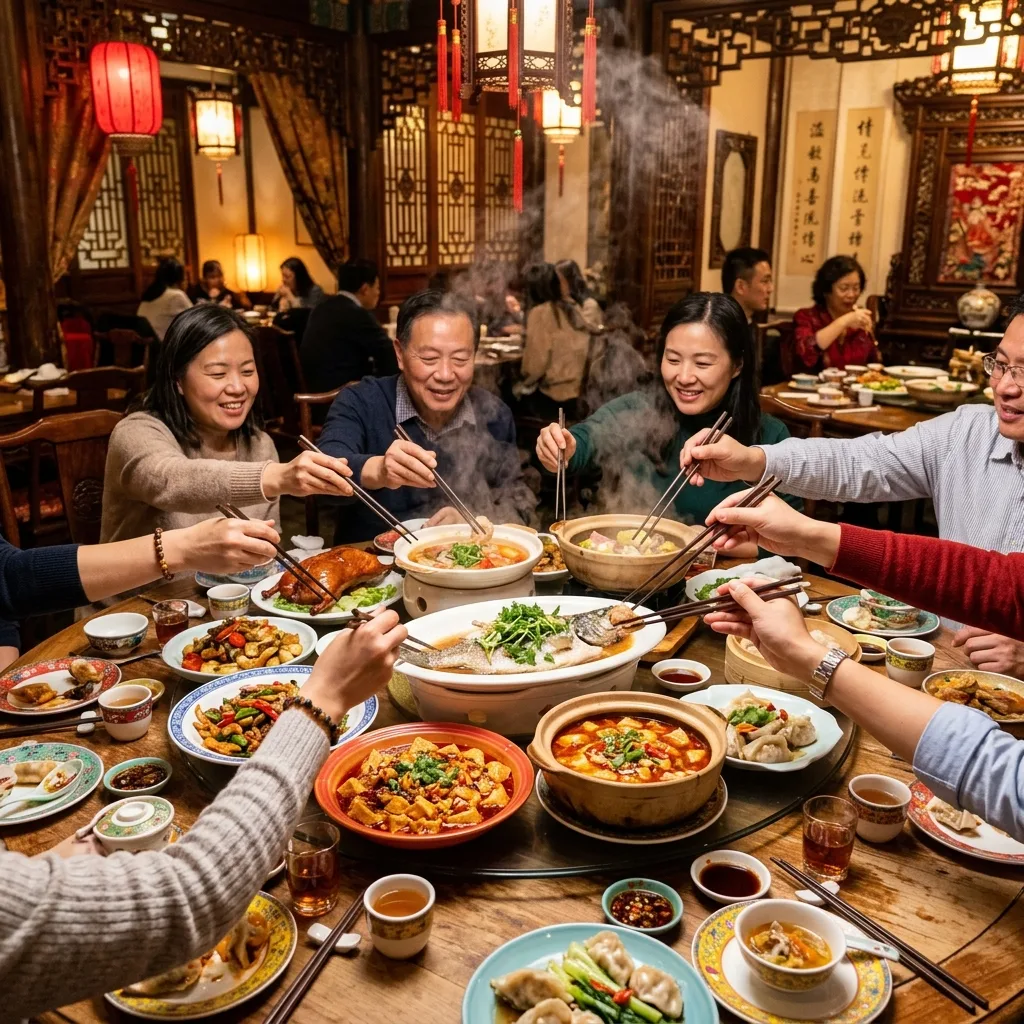
Banquet and restaurant dining in China is an inherently collective ritual centered around large lazy susan turntables. Dishes are ordered for the entire table to share, and diners serve themselves modest portions progressively rather than piling food high on a single plate.
Toasting etiquette carries significant social weight. When clinking glasses with someone senior or a gracious host, holding the rim of your glass slightly lower than theirs conveys sincere humility and respect. If paying the bill, fighting enthusiastically over who settles the tab is customary; splitting costs down to individual pennies (AA zhi) is generally reserved for casual peer gatherings.
Shoes, seating, doors, and indoor boundaries matter more than most first-timers realize is the part of Chinese culture etiquette that most visitors notice first, but the useful lesson is what it changes in real life. For travelers, that usually means a small adjustment in tone, timing, price expectations, or the way you ask a question.
Stepping across thresholds into traditional courtyard homes (siheyuan) or Buddhist temple halls requires attention to feet. Never step directly on the wooden raised threshold bar, as folk belief regards it as the spiritual spine of the entrance; always step cleanly over it with your left foot first.
Inside residential apartments, removing street shoes and stepping immediately into provided house slippers is universally expected. Seating arrangements at formal dinners also follow age and status hierarchies, with the guest of honor seated opposite the main entrance facing the room.
Secondary Topic Section
Public disagreement is usually better handled privately than in front of a group is the part of Chinese culture etiquette that most visitors notice first, but the useful lesson is what it changes in real life. For travelers, that usually means a small adjustment in tone, timing, price expectations, or the way you ask a question.
Raising your voice, expressing open anger, or arguing aggressively in public spaces rarely resolves conflicts in China. Public confrontations force service staff or officials into defensive postures where backing down risks severe loss of dignity in front of peers.
If an issue arises regarding a hotel deposit or train ticket cancellation, pull the manager or supervisor aside for a quiet, low-voiced discussion. Framing the issue as a joint problem to be solved together ("How can we fix this discrepancy?") almost always yields swift, sympathetic cooperation.
Messaging and translation apps work best when the wording is concise and respectful is the part of Chinese culture etiquette that most visitors notice first, but the useful lesson is what it changes in real life. For travelers, that usually means a small adjustment in tone, timing, price expectations, or the way you ask a question.
Digital communication via WeChat and translation tools like DeepL or Baidu Translate forms the backbone of day-to-day interactions. When typing into translation software, use concise, grammatically complete phrases rather than fragmented idioms.
Showing the translated Chinese text politely on your smartphone screen, paired with a pleasant smile, bridges the language gap seamlessly in taxis, pharmacies, and high-speed rail ticket counters. Avoid typing long paragraphs of rambling text, which frequently produce garbled translations.
Saving face matters because it protects dignity, not because everyone is being dramatic is the part of Chinese culture etiquette that most visitors notice first, but the useful lesson is what it changes in real life. For travelers, that usually means a small adjustment in tone, timing, price expectations, or the way you ask a question.
In densely populated transit hubs and subway stations, the concept of personal physical buffer zones differs noticeably from Western norms. Minor bumping or close proximity in crowded subway cars is not considered rude or aggressive, but simply a normal reality of urban density.
Modern subway platforms and high-speed train gates feature painted queue lines on the floor, and travelers are expected to line up orderly behind them. Maintaining personal calm and moving steadily with the flow of commuters prevents travel stress in vast hubs like Shanghai Hongqiao or Beijing South.
A soft refusal or a carefully phrased disagreement usually works better than a blunt correction is the part of Chinese culture etiquette that most visitors notice first, but the useful lesson is what it changes in real life. For travelers, that usually means a small adjustment in tone, timing, price expectations, or the way you ask a question.
Whenever you exchange name cards, transit cards, cash, or small gifts, always extend and receive the item using both hands accompanied by a slight bow of the head. This universal physical gesture communicates full attention and sincere respect for the counterparty.
After receiving a business card, take a few thoughtful seconds to read the name and title before carefully placing it on the table or inside a cardholder. Shoving someone's card immediately into your back pants pocket is perceived as careless and dismissive.
Practical Guide
A good practical plan for Chinese culture etiquette starts with the parts that affect cost, timing, and convenience. In China, that usually means deciding whether the experience works better as a same-day outing, a half-day visit, or a booking that is tied to a larger itinerary.
- If you are paying, shopping, or bargaining, keep the discussion calm and avoid making the other person look foolish in front of staff or friends.
- In hotels and taxis, a short sentence plus a translation app is often better than a long explanation filled with apologies.
- Cashless payment has become more important in many cities, so travel with a backup payment method and a phone setup that works locally.
- The best first trip is usually the one where you watch more than you speak during the first hour or two, then adjust your tone once you see the rhythm.
Set up Alipay and WeChat Pay with an international credit card before landing, as almost all urban transactions from street fruit stalls to subway fares rely on QR scanning. When greeting hotel staff, shopkeepers, or ticket agents, a simple nod accompanied by Ni hao (Hello) or Xiexie (Thank you) creates immediate goodwill without requiring formal physical bowing.
Essential Chinese Social Etiquette at a Glance
| Situation | Recommended Action | Common Mistake to Avoid |
|---|---|---|
| Dining at Round Tables | Wait for elders to take their seats and pick up chopsticks first; serve tea to table neighbors before filling your own cup. | Sticking chopsticks vertically into a rice bowl (resembles funerary incense rites) or spinning the turntable while someone is reaching. |
| Handling Bills & Payments | Offer to pay the entire bill warmly for peers or hosts, or quietly settle payment at the cashier counter before the meal concludes. | Insisting loudly on calculating precise cents at the table, which interrupts warm social harmony. |
| Addressing Strangers | Use respectful universal titles such as Shifu (for drivers/tradespeople), Fuwuyuan (for waitstaff), or Tongxue (for young students). | Snapping fingers or waving aggressively to summon staff across a crowded restaurant. |
| Exchanging Contact & Money | Present WeChat QR codes, name cards, and cash payments using both hands while maintaining polite eye contact. | Flinging cards onto desks or accepting documents with a casual one-handed wave. |
| Navigating Public Transport | Allow arriving subway and train passengers to alight completely before stepping through train car doors; keep luggage compact. | Blocking boarding aisles with oversized bags or speaking on speakerphone in quiet commuter cars. |
Tips & Common Mistakes
The easiest mistakes around Chinese culture etiquette usually come from assuming the rules are either stricter or looser than they really are. In practice, the gap is usually somewhere in between: local expectations are real, but they are often straightforward once you slow down and watch what people actually do.
- Do not treat every disagreement as a direct confrontation; often the smoother path is to step back and rephrase.
- A loud public correction is one of the fastest ways to make a small issue feel much bigger than it needs to be.
In bustling metro stations and popular dumpling restaurants, physical queues can feel tight and fluid compared to Western lines; step forward briskly when space opens rather than taking close proximity as personal rudeness. At shared dining tables, avoid waving chopsticks in the air while speaking, and let the table host invite everyone to begin eating before reaching for communal plates.
FAQ
What matters most for travelers?
Tone and timing. If you keep your voice calm, wait for the other side to finish, and avoid forcing a blunt answer, you will navigate most situations well.
Will one mistake offend people?
Usually not. Most people understand that visitors do not know every rule, but they do notice whether you are trying to be considerate once the situation is explained.
Should I memorize every custom?
No. Learn the high-value rules first: how to greet, how to pay, how to decline gently, and how to behave in public spaces. That covers most traveler situations.
How formal should I be?
Formal enough to show respect, but not so formal that you become stiff or theatrical. In many settings, a relaxed but careful tone is the most natural choice.
Conclusion
The best way to approach Chinese culture etiquette is to treat it as a set of small decisions that all work together: timing, etiquette, booking, budget, and how much flexibility you leave in the day. If you want to keep planning, the most useful next reads are Currency in China: Where to Exchange, Use Cards & Avoid Scams, China SIM Card Guide 2026: eSIM, Local Cards & Roaming Options, and Beijing Hutong Experience: How to Explore the Old Alleyways, because they help turn this guide into a complete itinerary instead of an isolated decision.
Meals, gifts, and invitations often carry more social meaning than the item or restaurant itself is the part of Chinese culture etiquette that most visitors notice first, but the useful lesson is what it changes in real life. For travelers, that usually means a small adjustment in tone, timing, price expectations, or the way you ask a question.
When someone refills your small tea cup at a dim sum restaurant or teahouse, tapping the index and middle fingers lightly on the tabletop twice is the customary southern Chinese gesture for silent thanks. This prevents interrupting lively conversations while acknowledging the host's care.
Similarly, keep an eye on your companions' tea cups. When a teapot runs low on water, resting the lid propped upside down on the rim signals the waitstaff to provide a fresh hot-water refill without needing to shout across the busy dining hall.
When you are unsure, keep the tone warm, specific, and a little less direct than you would use at home is the part of Chinese culture etiquette that most visitors notice first, but the useful lesson is what it changes in real life. For travelers, that usually means a small adjustment in tone, timing, price expectations, or the way you ask a question.
While scenic public landscapes and modern city skylines are freely photographed, sacred spaces and specific infrastructure require strict discretion. Most Buddhist and Daoist temples explicitly forbid photographing consecrated deity statues inside main altar halls out of religious reverence.
Always ask permission before photographing street artisans, market vendors, or elderly residents in historic alleyways (hutongs). Furthermore, photography is strictly prohibited around military installations, border inspection zones, and high-security government compounds.
Additional Notes
A useful final lens for Chinese culture etiquette is that the experience becomes much easier once you stop treating it as a single decision and start treating it as a sequence. When you know what the next conversation, booking step, or arrival detail is supposed to do, you can move through the day with less friction and fewer surprises.
Indirect communication is central in China when resolving misunderstandings or declining an offer. If a driver, vendor, or ticket clerk answers that a request is bu tai fangbian (not very convenient), understand that this is a polite refusal; pressing repeatedly for an exception causes embarrassment and creates unnecessary friction. Stepping aside calmly and asking for an alternative solution keeps interactions constructive.