Cantonese Food vs Sichuan Food: A Regional Chinese Cuisine Comparison

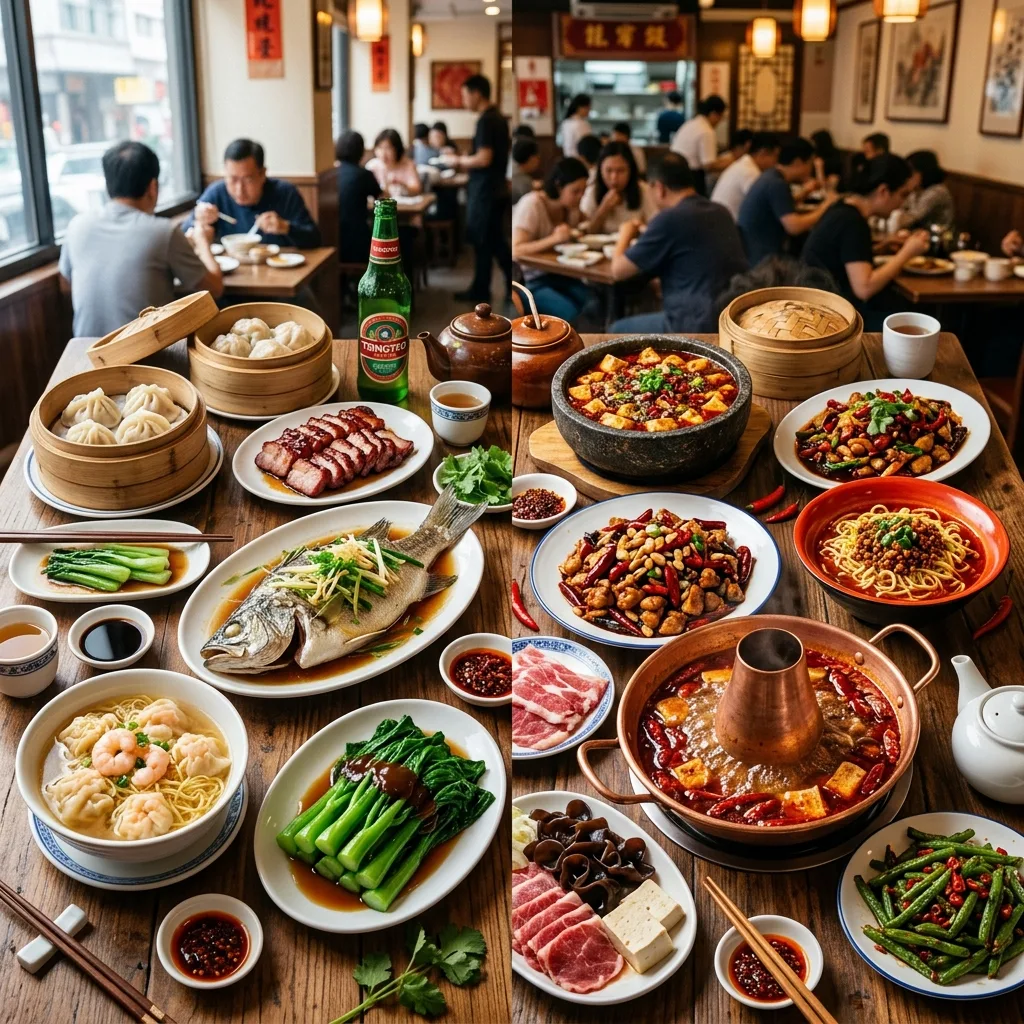
You've landed in China, you're standing in front of a restaurant menu, and nothing makes immediate sense. One dish is listed as "twice-cooked pork" and the other is "steamed grouper with ginger." Two items, two completely different philosophies — one a Sichuan classic built on bold, transformative spice, the other a Cantonese showcase of the ingredient itself. Understanding that difference before you eat changes everything. This guide breaks down both regional cuisines side by side, so you know exactly what you're ordering and why.
What Separates Chinese Regional Cuisines in the First Place?
China's culinary landscape isn't one thing — it's dozens of distinct food cultures shaped by geography, climate, and centuries of local tradition. The classical Chinese framework identifies Eight Great Cuisines (八大菜系), each tied to a specific region: Cantonese, Sichuan, Hunan, Jiangsu, Fujian, Zhejiang, Anhui, and Shandong. For most travelers, Cantonese and Sichuan are the two they'll encounter most often — both abroad and within China. Understanding what drives each tradition helps you order with confidence, choose the right restaurants for your palate, and plan a food itinerary that actually matches your trip.
Cantonese cuisine originates in Guangdong Province in southern China, including the Pearl River Delta cities and Hong Kong. Sichuan cuisine comes from the landlocked Sichuan Basin in southwestern China, centered on Chengdu and Chongqing. The geographic contrast alone — coastal versus landlocked, subtropical versus humid continental — goes a long way toward explaining the flavor difference. Where Cantonese cooking has access to abundant seafood and a warm, mild climate that grows delicate produce year-round, Sichuan cooking developed in a damp, foggy basin where preserved foods and warming spices became staples. The result: two of the most distinct, confident, and influential food cultures in the world.
Cantonese Cuisine: The Art of Letting the Ingredient Speak
Cantonese cooking operates on a single guiding principle — don't get in the way. The goal is to preserve the natural flavor of the ingredient as faithfully as possible. A fresh grouper gets a few slices of ginger, a drizzle of hot oil, and a scatter of scallions. A winter melon becomes a gentle, silky broth. Shrimp dumplings (har gow) are wrapped in a thin rice-flour skin so translucent you can see the pink filling inside. Everything is calibrated to highlight the primary ingredient rather than transform it.
This philosophy makes Cantonese cuisine one of the most technique-intensive in the world. When seasoning is minimal, execution is everything. Steaming times are measured in seconds, not minutes. Blanching temperatures are precise. A Cantonese chef's skill shows not in what they add to a dish but in what they resist adding. The cuisine rewards fresh, high-quality ingredients — which is why the best Cantonese restaurants in Guangzhou and Hong Kong spend as much time sourcing as they do cooking.
Signature Flavors of Cantonese Cooking
- Light and clean: Cantonese food is rarely heavy on the palate. Sauces tend toward oyster sauce, light soy, or Shaoxing wine rather than thick, spiced pastes.
- Slightly sweet: A subtle sweetness appears in marinades, glazes (char siu pork), and many stir-fry sauces. It's not dessert-sweet — it's a background note that balances umami.
- Umami-forward: Dried seafood, fermented black beans, and oyster sauce are common umami anchors. Many dishes achieve depth without using a single chili.
- Minimal heat: Cantonese cuisine is not a spicy cuisine. Fresh green chili appears occasionally, but the heat level is negligible compared to Sichuan.
Key Techniques in Cantonese Cuisine
Steaming (蒸, zhēng) is the backbone of Cantonese cooking. Dim sum wouldn't exist without it — har gow, siu mai, and cheung fun all rely on perfectly timed steam to achieve their signature textures. Whole fish steamed with ginger and scallion is one of the most common Cantonese dinner dishes, and the art lies in getting the flesh just barely set, silky and moist through the center.
Blanching and poaching — bringing vegetables, proteins, or dumplings to precisely the right internal temperature in simmering water or broth — produces the clean flavors Cantonese cuisine is known for. Silk squash with fermented tofu sauce, poached chicken (白切雞, bai qie ji) served at room temperature with ginger-scallion oil — both are blanching showcases.
Roasting (燒烤, shāo kǎo) is the one Cantonese technique that prioritizes crust and caramelization. Char siu (叉燒, barbecue pork) is glazed and roasted until the exterior lacquers into a sweet-savory crust. Crispy-skin roast pork (燒肉) involves a complex two-day preparation to achieve that shatteringly crisp skin. Hong Kong roast meat shops (燒臘店) that line street-level storefronts are among the most accessible — and best — entry points into Cantonese cooking.
Must-Try Cantonese Dishes
| Dish | Cantonese Name | What It Is |
|---|---|---|
| Har gow | 蝦餃 (hā gāu) | Steamed shrimp dumplings in translucent rice-flour skin |
| Siu mai | 燒賣 (sīu-mái) | Open-topped pork and shrimp dumplings |
| Char siu | 叉燒 | Roasted barbecue pork with honey glaze |
| Bai qie ji | 白切雞 | Poached chicken with ginger-scallion dipping oil |
| Wonton noodle soup | 雲吞麵 | Egg noodles in clear shrimp-based broth with plump wontons |
| Congee (jook) | 粥 | Rice porridge, often with century egg, pork, or preserved vegetables |
| Crispy-skin fish | 脆皮魚 | Deep-fried whole fish with sweet-sour sauce |
| Egg tart | 蛋撻 | Flaky pastry shell with silky egg custard — a Cantonese-Portuguese hybrid |
For a deeper dive into the dim sum experience — the ritual, what to order, and how to avoid rookie mistakes — see our guide to dim sum for travelers.
Sichuan Cuisine: The Art of Transformation
Where Cantonese cooking defers to the ingredient, Sichuan cooking transforms it. The Sichuan kitchen is built around a set of powerful flavor-building tools — fermented chili bean paste (豆瓣醬, dòubànjiàng), Sichuan peppercorns, dried chilies, black bean paste, fermented black vinegar — and a philosophy that views bold, layered flavor as the highest culinary goal. The same pork belly prepared two ways — first boiled, then sliced and stir-fried — becomes "twice-cooked pork" (回鍋肉, huíguō ròu), one of the most iconic Sichuan dishes, in which the second pass through a hot wok with doubanjiang and preserved vegetables creates something entirely different from its raw ingredients.
The defining characteristic of Sichuan cuisine is mala (麻辣) — the combination of numbing (麻, from Sichuan peppercorns) and spicy heat (辣, from chili). Mala isn't just a flavor — it's a sensation. Sichuan peppercorns don't merely tingle; they create a mild anesthetic effect on the tongue and lips that prolongs and enhances the perception of chili heat. The interplay of these two sensations is what makes Sichuan food addictive. Once you understand it, you start tasting it in every dish.
Signature Flavors of Sichuan Cooking
- Mala (numbing + spicy): The signature combination of Sichuan peppercorns and dried chilies. Appears in mapo tofu, boiled fish in chili oil, and Sichuan hotpot broth.
- Savory and funky: Fermented black bean paste, doubanjiang, and pickled vegetables add deep, complex savory notes. The fermentation process takes weeks or months and is central to Sichuan flavor.
- Aromatic: Garlic, ginger, star anise, cinnamon, and Sichuan peppercorns create a layered aromatic base. Many Sichuan dishes are built by blooming aromatics in hot oil before adding anything else.
- Sour and preserved notes: Pickled mustard greens (酸菜, suāncài) and Yibin yacai (fermented preserved vegetables) appear in dishes like dan dan noodles and fish-fragrant eggplant, cutting through richness.
Key Techniques in Sichuan Cuisine
Dry stir-frying (干煸, gānbiān) involves cooking over intense heat with minimal liquid until the ingredients are slightly dried out, concentrated, and fragrant. Dry-fried green beans are one of the most copied Sichuan techniques in overseas Chinese restaurants — the beans are blistered until wrinkled, then tossed with pork mince, fermented black beans, and chili. The lack of sauce makes every bite concentrated.
Red braising in doubanjiang (豆瓣, dòubàn) is the technique behind mapo tofu, braised fish heads, and dozens of other Sichuan staples. A tablespoon of Pixian doubanjiang — the prized fermented chili-bean paste made in Pi County outside Chengdu — fries in hot oil until the paste darkens and the fat turns red and fragrant, then everything else is built on top of that base. The color of a well-executed Sichuan braise is a deep, burnished red.
Cold dressing in chili oil (紅油, hóngyóu) is used for cold dishes like mouthwatering chicken (口水雞, kǒushuǐ jī) and cold cucumber smashed salad. Sichuan chili oil — made by pouring hot oil over ground dried chilies, Sichuan peppercorns, and aromatics — is both a sauce and a finishing oil. It's punchy, fragrant, and entirely different from the generic chili oil used in most non-Sichuan Chinese kitchens.
Must-Try Sichuan Dishes
| Dish | Chinese Name | What It Is |
|---|---|---|
| Mapo tofu | 麻婆豆腐 | Silken tofu in fiery doubanjiang and mala sauce with minced pork |
| Twice-cooked pork | 回鍋肉 | Boiled then wok-fried pork belly with leeks and fermented black beans |
| Dan dan noodles | 擔擔麵 | Thin wheat noodles in sesame-chili-vinegar sauce with minced pork |
| Kung pao chicken | 宮保雞丁 | Stir-fried chicken cubes with dried chilies, peanuts, and Sichuan peppercorns |
| Fish-fragrant eggplant | 魚香茄子 | Eggplant in a sauce of doubanjiang, ginger, garlic, vinegar — no fish involved |
| Mouthwatering chicken | 口水雞 | Cold poached chicken drenched in red chili oil and Sichuan peppercorn paste |
| Sichuan hotpot | 四川火鍋 | Communal pot of mala broth for cooking raw ingredients tableside |
| Boiled fish in chili oil | 水煮魚 | Thin slices of fish poached in a pool of chili oil, dried chilies, and peppercorns |
For a complete guide to the Sichuan hotpot experience — heat levels, what to order, and the best chain restaurants — the Sichuan hotpot guide covers everything you need.
Cantonese vs Sichuan: A Direct Comparison
| Cantonese | Sichuan | |
|---|---|---|
| Core philosophy | Preserve natural flavors | Transform through bold seasoning |
| Heat level | Very mild | High to extreme |
| Primary flavor | Clean, umami, slightly sweet | Mala (numbing-spicy), savory, fermented |
| Signature technique | Steaming | Wok-frying in doubanjiang |
| Key ingredients | Fresh seafood, light soy, oyster sauce | Doubanjiang, Sichuan peppercorn, dried chili |
| Best for | Delicate flavors, fresh ingredients | Bold, punchy, warming dishes |
| Spice tolerance needed | None | Medium to high |
| Most iconic dish | Dim sum (har gow + siu mai) | Mapo tofu |
| Where to eat it | Guangzhou, Hong Kong | Chengdu, Chongqing |
| Globally familiar versions | Cantonese is the dominant style in overseas Chinese restaurants | Kung pao chicken, general tso's — though both are heavily adapted |
Where to Eat Cantonese Food in China
Guangzhou is the capital of Cantonese food — not metaphorically but literally, as the provincial capital of Guangdong. The city's tea houses and yum cha restaurants are among the oldest operating dim sum institutions in the world. The neighborhood of Liwan District, in particular, has dim sum restaurants that have been running the same morning service for four or five generations. Expect to queue.
Hong Kong, while technically a separate administrative region, shares the Cantonese culinary tradition and has arguably refined certain elements of it further. The roast meat shops, wonton noodle stalls, cha chaan tengs (Hong Kong-style cafes), and seafood restaurants of Hong Kong represent a distinct branch of Cantonese cooking shaped by British colonialism, Shanghainese refugee culture post-1949, and decades of food-obsessed local culture.
Shenzhen, the tech city adjacent to Hong Kong, has a strong Cantonese food scene as well — particularly for fresh seafood, since the city sits on a bay with direct access to southern Chinese fishing grounds.
Shanghai has a large Cantonese community and several excellent Cantonese restaurants, though it competes with strong local Shanghainese and surrounding Jiangsu culinary traditions. The Shanghai food scene runs on its own distinct logic — Shanghainese food is sweeter and richer — but good Cantonese restaurants are accessible here too.
Practical Cantonese Dining Tips
- Arrive early for dim sum: The best items sell out by 11:00 AM. Arrive by 8:30–9:00 AM at a Guangzhou or Hong Kong dim sum restaurant to get your first pick.
- Order by looking: Many traditional dim sum halls use a trolley or tray system — flag down servers pushing carts with bamboo baskets and point to what you want. Modern restaurants use paper order forms.
- Tea protocol: At yum cha, pour tea for others before yourself. If the teapot runs low, leave the lid ajar to signal to staff that you need a refill. Never leave an upturned cup — that signals you're done.
- Price categories: Dim sum baskets are priced by size — small, medium, large, or special. Most diners can eat well for 80–150 RMB per person at a good Guangzhou tea house.
Where to Eat Sichuan Food in China
Chengdu is the undisputed home of Sichuan cooking and has been recognized as a UNESCO Creative City of Gastronomy since 2010. The city's food scene is dense and accessible — street snacks, hole-in-the-wall noodle shops, and formal restaurants all operate at an extremely high level. Jinli Ancient Street and Kuanzhai Alley offer tourist-friendly Sichuan snacks, while neighborhood restaurants in the Chunxi Road and Tianfu Square areas serve locals.
Chongqing is technically a separate municipality but shares the Sichuan culinary tradition — with its own intensity. Chongqing hotpot is arguably even more aggressive than Chengdu's version, using more tallow (beef fat) in the broth base and higher concentrations of dried chilies. Chongqing is also the home of xiaomian (小麵), a spicy noodle dish eaten at breakfast that's simpler and hotter than dan dan noodles.
Beijing and Shanghai: Sichuan cuisine has spread across the entire country. Every major city in China has Sichuan restaurants — it's one of the most popular regional cuisines nationally. In Beijing, the Sichuan restaurant Huang Ting at the Peninsula Hotel is a well-known upscale option; countless neighborhood spots serve solid weekday mapo tofu and twice-cooked pork.
Practical Sichuan Dining Tips
- Know the spice levels: Many Sichuan restaurants offer spice level options — 微辣 (wēi là, mild), 中辣 (zhōng là, medium), 重辣 (zhòng là, heavy). If you're sensitive to heat, start with medium.
- The mala tingle is normal: First-timers are often alarmed by the lip-numbing sensation from Sichuan peppercorns. This is expected — it peaks after a few bites and is not a sign that something is wrong.
- Order the cold dishes too: Sichuan cold dishes (涼菜) are often overlooked. Mouthwatering chicken, smashed cucumber salad, and cold jellyfish are lighter and less spicy than the main dishes but showcase the same complex flavors.
- Hotpot etiquette: At Sichuan hotpot, thin-sliced meats cook in 15–30 seconds; thicker items like potato slices take 3–5 minutes. Dip finished ingredients in a sesame oil and garlic sauce to cool the heat before eating.
For a fuller picture of the Chinese regional food landscape — including Beijing duck, which is its own separate tradition — see the Chinese regional food guide covering all three major styles.
Which Should You Try First?
This depends entirely on what you want from the experience.
Choose Cantonese if:
- You prefer subtle, delicate, high-precision cooking
- Spicy food isn't your strength
- You're traveling through Guangzhou, Hong Kong, or Shenzhen
- You want to experience the culture of yum cha and communal dim sum service
- You're focused on fresh seafood and clean flavors
Choose Sichuan if:
- You enjoy bold, punchy food and don't mind significant heat
- You're traveling through Chengdu or Chongqing
- You want a full-body flavor experience rather than a showcase of individual ingredients
- You're interested in fermented and preserved flavors, or the communal hotpot ritual
- You want to understand why Sichuan cuisine is currently the most exported regional Chinese cuisine worldwide
If you can do both: Start with Cantonese dim sum for breakfast on your first day — it's a gentle, social, and approachable introduction to Chinese food culture. Then work up to Sichuan mapo tofu or hotpot for dinner after your palate has had a day to calibrate.
Common Mistakes When Ordering at Each
Cantonese Mistakes
- Arriving too late: The best dim sum restaurants wind down before noon. A 1:00 PM arrival often means limited selection and reheated baskets.
- Avoiding the "unusual" items: Chicken feet (鳳爪, fèngzhuǎ), turnip cake (蘿蔔糕), and tripe (牛柏葉) are Cantonese staples that look unfamiliar but reward the adventurous eater.
- Over-ordering: Dim sum dishes are small but they accumulate quickly. Start with 2–3 baskets per person and reorder as you go rather than ordering everything up front.
- Skipping the roast meat shops: Cantonese char siu and crispy roast pork shops (燒臘) are standalone institutions and among the most accessible and affordable meals in any Cantonese city. Don't skip them in favor of a formal restaurant.
Sichuan Mistakes
- Underestimating the heat: Even "medium" Sichuan can be intense for people not accustomed to mala. Have plain rice, cold tofu, or dairy on hand to cut the heat.
- Ignoring the menu's mild options: Many Sichuan restaurants have dishes that are barely spicy — kung pao chicken, gong bao prawns, and bang bang chicken are all manageable for most palates.
- Drinking water to cool down: Water spreads capsaicin oil across your mouth rather than neutralizing it. Dairy (milk, yogurt), rice, or fatty foods work significantly better.
- Treating hotpot like a restaurant meal: Sichuan hotpot is a social event that typically runs 2–3 hours. If you're in a hurry, it's the wrong choice — but if you have an evening to spend, it's one of the most memorable meals you'll have in China.
FAQ
Is Cantonese food always mild? Almost always, yes. Cantonese cuisine is one of the least spicy of China's major regional traditions. Some dishes include a small amount of fresh green chili for fragrance rather than heat, but nothing in the repertoire approaches Sichuan levels. If you're heat-averse, Cantonese is a safe choice.
Can I find authentic Cantonese food outside Guangdong? Yes — Hong Kong is arguably the world's most accessible destination for high-quality Cantonese food. Major cities like Shanghai and Beijing have strong Cantonese restaurants, though quality varies. Outside Asia, cities with large Cantonese diaspora communities (San Francisco, Vancouver, London, Sydney) have authentic yum cha and roast meat shops that trace directly to the Guangdong tradition.
Is Sichuan food always red? Not always. While many Sichuan dishes get their red color from doubanjiang and dried chilies, others — like fish-fragrant eggplant, twice-cooked pork, and bang bang chicken — are brown, gold, or lightly colored. The misconception that all Sichuan food is visually fiery comes from the fame of its most photogenic dishes (boiled fish in chili oil, mapo tofu) rather than the full range.
What's the difference between Sichuan and Hunan cuisine? Both are spicy, but Hunan food (湘菜) is hotter without the numbing quality. Sichuan uses Sichuan peppercorns to create the mala (numbing + spicy) effect. Hunan cuisine uses fresh and dried chilies for pure heat, often combined with garlic and preserved vegetables. Hunan food tends to be oilier and more intensely spicy but lacks the lip-numbing, layered complexity of mala.
Should I order Sichuan food at a non-Sichuan restaurant in China? With caution. Sichuan cuisine is so popular nationally that most Chinese restaurants offer some Sichuan dishes — but quality varies significantly. The doubanjiang used matters enormously (Pixian County's version is considered the gold standard), and many simplified Sichuan dishes cut corners on the peppercorn content or fermentation quality. For an authentic experience, seek a dedicated Sichuan restaurant (川菜館) rather than a general Chinese restaurant serving Sichuan items on a broader menu.
Which is more popular globally? Cantonese cuisine dominated overseas Chinese restaurant culture for most of the 20th century — the first wave of Chinese immigrants to North America and Europe came primarily from Guangdong, which is why "Chinese food" outside China historically meant dim sum and roast meats. More recently, Sichuan food has expanded rapidly internationally, driven partly by the global popularity of mapo tofu, kung pao chicken (in its adapted forms), and the rise of Sichuan hotpot chains outside China.
Conclusion
Cantonese and Sichuan are both world-class culinary traditions — they simply operate on different assumptions. Cantonese cooking asks: what does this ingredient taste like at its best? Sichuan cooking asks: what can this ingredient become when you apply heat, fermentation, and mala? Neither question is wrong. Both produce extraordinary food.
If you're planning a trip to China, the most satisfying approach is to experience both — even briefly. A morning dim sum session in Hong Kong or Guangzhou and an evening mapo tofu or hotpot dinner in Chengdu or Chongqing gives you a full cross-section of what Chinese regional cooking can be. The contrast alone is worth the trip.