Zhangjiajie National Forest Park: Avatar Mountains, Skywalk & Glass Bridge

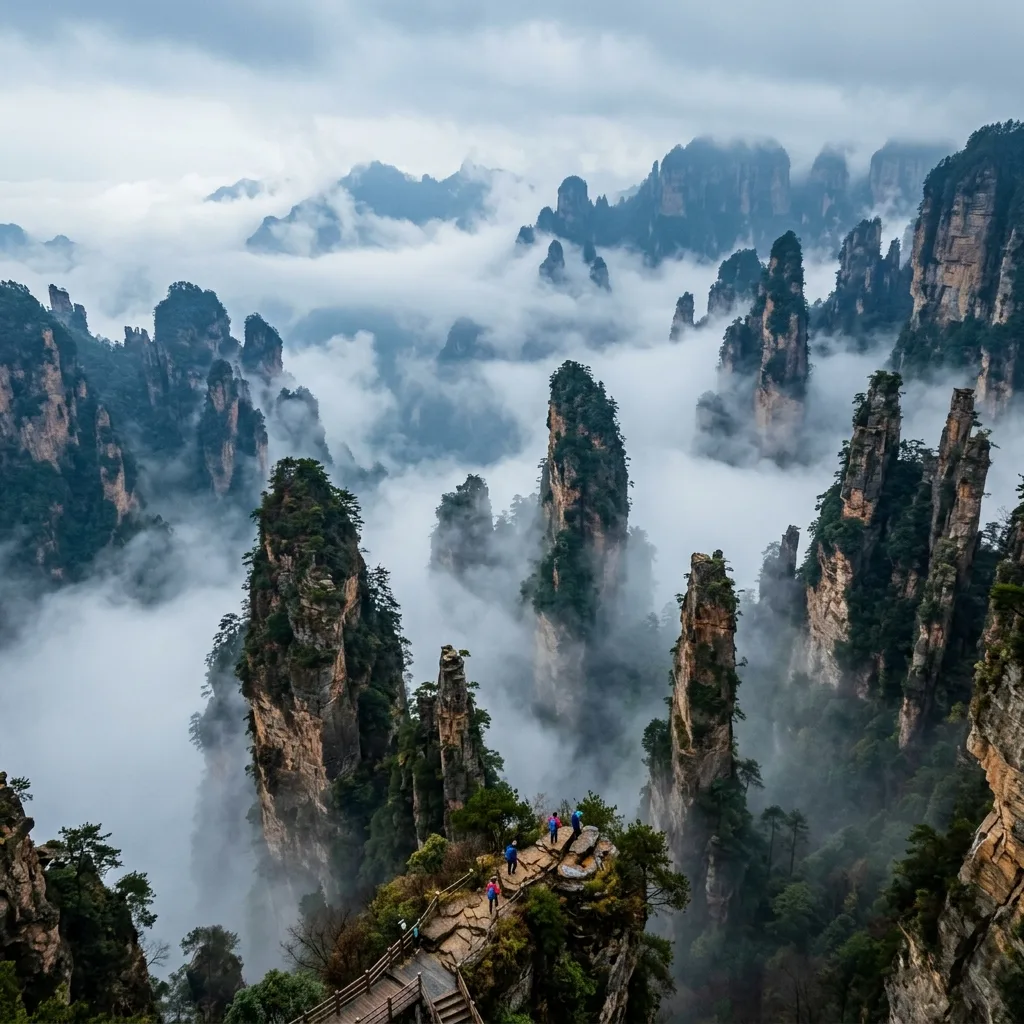
Zhangjiajie National Forest Park is a place where reality feels like science fiction. Home to the towering sandstone pillars that inspired James Cameron’s Avatar, this UNESCO World Heritage site is a bucket-list destination for anyone traveling to China. But Zhangjiajie is more than just a forest park; it is a region filled with heart-pounding attractions, including the world’s longest glass bridge and the terrifying "Skywalk" clinging to the cliffs of Tianmen Mountain. In this comprehensive 2026 guide, we break down everything you need to know to navigate this vertical wonderland.
Zhangjiajie National Forest Park is best visited from April to May or September to October. In 2026, a 4-day pass costs approximately CNY 225. The Grand Canyon Glass Bridge requires a combo ticket of CNY 178, while Tianmen Mountain admission is around CNY 278, including the world-famous cable car and glass skywalk.
The Cultural Significance of Mountains in China
To understand the beauty of China’s natural wonders, one must first understand the deep cultural and philosophical connection the Chinese people have with their mountains. For millennia, mountains have been viewed as sacred spaces, the dwelling places of immortals, and the physical manifestations of the world's life force, or qi.
The Five Great Mountains (Wu Yue)
Historically, the most important peaks were the Five Great Mountains, each associated with a cardinal direction and a different element. While sites like Zhangjiajie and Huangshan are now more famous globally, the tradition of mountain worship remains the same. Climbing a mountain in China is often seen as a spiritual journey, a way to leave the mundane world behind and reach for the heavens. This is why you will find ancient temples, inscriptions carved directly into the rock, and red ribbons tied to trees along almost every major trail.
Landscape Painting and Shanshui
The very term for "landscape" in Chinese is shanshui (山水), which literally translates to "mountain-water." This binary of the stable, vertical mountain and the fluid, horizontal water is the foundation of traditional Chinese aesthetics. When you stand on the banks of the Li River or at the edge of a cliff in Zhangjiajie, you aren't just looking at scenery; you are looking at a living scroll of art that has influenced East Asian culture for two thousand years.
The Floating Peaks of Zhangjiajie: A Deep Dive
Zhangjiajie National Forest Park, often referred to as the "Avatar Mountains," is a surreal landscape of more than 3,000 quartzite sandstone pillars. This UNESCO World Heritage site was the inspiration for the Hallelujah Mountains in James Cameron’s Avatar, and it is easy to see why. The mist that often clings to the peaks gives the illusion that they are floating in the air.
The Geology of the Pillars
These unique formations are the result of millions of years of physical erosion. The quartzose sandstone was uplifted from the ocean floor during the Devonian period, and the expansion of ice in the cracks, along with the growth of plants, slowly broke the rock apart into the towering columns we see today. Unlike karst limestone formations found in Guilin, which are formed by chemical dissolution, Zhangjiajie's pillars are purely mechanical wonders.
Key Areas to Explore in Detail
- Yuanjiajie: This is the most popular area of the park, housing the "First Bridge Under Heaven" (a natural stone bridge connecting two peaks) and the "Hallelujah Mountain" pillar. It is also where you will find the Bailong Elevator, the world's tallest outdoor elevator, which whisks you up 326 meters (1,070 feet) in just 88 seconds.
- Tianzi Mountain: Known for its "sea of clouds," particularly after rain. The "Imperial Brush Peaks" are a highlight here—a series of thin, pointed pillars that look like traditional Chinese calligraphy brushes resting in a holder.
- Yangjiajie: A more rugged and less crowded section, famous for its "Natural Great Wall" rock formations. This area requires more hiking and is perfect for those looking to escape the tour groups.
- Golden Whip Stream: A peaceful walk along the valley floor, offering a different perspective of the towering pillars from below. The stream stretches for about 7.5 kilometers and is home to curious monkeys and diverse flora.
Wildlife and Flora: The Hidden Residents of the Pillars
Zhangjiajie is more than just stone; it is a vibrant ecosystem teeming with life.
- Rhesus Macaques: These monkeys are the park's most famous (and mischievous) residents. You will find them primarily along the Golden Whip Stream and in the Yuanjiajie area. While they are a delight to photograph, they are wild animals. They have learned that human bags often contain food, and they will not hesitate to grab a colorful plastic bag from a traveler's hand.
- Rare Flora: The park is home to several ancient and rare plant species. One of the most famous is the Dove Tree (Davidia involucrata), often called the "Living Fossil" of the plant world. Its large white bracts resemble doves perched on the branches. You can also find ancient ginkgo trees and over 3,000 species of medicinal plants.
The History of the Bailong Elevator: Engineering vs. Environment
The construction of the Bailong Elevator (Hundred Dragons Elevator) was one of the most controversial projects in Chinese tourism history. Completed in 2002, it was designed to reduce the need for hotel construction at the summit by allowing tourists to reach the top in under two minutes and return to the base by evening.
Environmentalists initially argued that the massive steel structure would ruin the natural aesthetic of the pillars. However, the government argued that the elevator actually protected the park by centralizing traffic and preventing the over-development of summit trails. Today, it stands as a marvel of engineering, having carried millions of passengers and holding three Guinness World Records, including the tallest outdoor elevator.
Avoiding Common Scams and Overpricing
Traveling in a high-profile destination like Zhangjiajie requires a bit of street smarts.
- The "Tea Ceremony" Trap: If a friendly local invites you to a "traditional tea ceremony" to practice their English, be cautious. You may end up with a bill for hundreds of dollars. Stick to established tea houses with clear pricing.
- Overpriced Taxis: Taxis at the Zhangjiajie West high-speed rail station often refuse to use the meter. Always use the Didi app (integrated into Alipay) to ensure you pay the correct fare.
- Fake Relics: Shops in the Wulingyuan area often sell "ancient" Tujia artifacts. Most are mass-produced replicas. Buy items for their beauty, not their supposed historical value.
Planning Your 2026 Nature Expedition
Digital Payments and Connectivity
In 2026, China is almost entirely cashless.
- Alipay and WeChat Pay: These are essential. Even a small fruit vendor at a remote mountain trailhead will expect digital payment. Ensure you have linked your international credit card to Alipay before you arrive.
- Connectivity: While most major parks have 5G coverage, mountain terrain can lead to dead zones. Download offline maps and translation dictionaries (like Pleco).
Essential Packing List
- Comfortable Hiking Shoes: You will be walking thousands of stone steps. Good grip is essential, especially if it's wet.
- Layers: Mountain weather is unpredictable. Even in summer, summit temperatures can be chilly.
- Power Bank: Between taking photos and using navigation apps, your battery will drain quickly.
Detailed 14-Day Nature Itinerary
For those who want to see it all, here is a suggested route for 2026:
- Days 1-3: Guilin & Yangshuo. Start with the Li River cruise, followed by two days of cycling and bamboo rafting in Yangshuo.
- Days 4-7: Zhangjiajie. Take the high-speed train from Guilin. Spend three full days in the forest park and one day at Tianmen Mountain.
- Days 8-10: Jiuzhaigou. Fly from Zhangjiajie to Jiuzhaigou. Two days in the valley and one day at Huanglong.
- Days 11-14: Huangshan. Fly to Huangshan city. Spend two days on the mountain (staying overnight) and one day exploring the ancient villages.
A Day in the Life: A Traveler’s Journal from Zhangjiajie
To truly understand the rhythm of Zhangjiajie, you have to experience it from dawn to dusk. Here is a glimpse into what a perfect day in the forest park looks like in 2026.
6:00 AM – The Early Bird Advantage The alarm goes off in my boutique hotel in Wulingyuan. The air is crisp and smells of pine and damp earth. I grab a quick breakfast of Baozi (steamed buns) from a street vendor and head to the East Gate. Being the first in line means I avoid the massive tour groups that arrive by bus around 8:00 AM.
7:30 AM – Climbing the Sky I’m one of the first people on the Bailong Elevator. As the glass doors close and we begin our ascent, the valley floor drops away with dizzying speed. Suddenly, the forest opens up, and I’m eye-to-eye with the sandstone giants. The morning mist is still clinging to the "Avatar Hallelujah Mountain," and for a moment, it really does look like it’s floating in a white sea.
10:00 AM – The Silence of Yangjiajie After the crowds begin to build at Yuanjiajie, I take a park shuttle bus to Yangjiajie. This area is much quieter. I hike the trail to the "Natural Great Wall," a series of thin, flat rock peaks that resemble an ancient fortification. There are no tour guides with megaphones here—just the sound of the wind through the pines and the occasional call of a bird.
1:00 PM – A Spicy Mountain Lunch I stop at a small local eatery near the Tianzi Mountain cable car station. I order the "Three-Pot Stew." It’s incredibly spicy, flavored with the famous Hunan chili peppers, but it’s exactly what I need to recharge my energy. I wash it down with a cold bottle of local beer, sitting on a wooden bench overlooking a canyon that seems to go on forever.
4:00 PM – The Descent and the Stream I take the cable car down from Tianzi Mountain. The view is different now—the sun is lower, casting long shadows across the pillars. Once at the base, I walk along the Golden Whip Stream. A group of monkeys is playing near the water. One of them watches me closely, hoping I have a snack in my hand, but I know better and keep my hands in my pockets.
7:00 PM – Evening Reflections Back in Wulingyuan, I find a foot massage parlor. My legs are aching from the thousands of steps, but my mind is buzzing with the images of the day. As I sit there, I realize that Zhangjiajie isn't just a place you see; it’s a place that hums with a frequency of ancient, raw power.
Practical Language Guide: Essential Mandarin for the Mountains
While many people in the tourist areas speak basic English, having a few Mandarin phrases will make your trip much smoother.
| English | Pinyin | Chinese |
|---|---|---|
| Hello | Nǐ hǎo | 你好 |
| Thank you | Xièxiè | 谢谢 |
| Where is the bathroom? | Cèsuǒ zài nǎlǐ? | 厕所在哪里? |
| How much is this? | Zhège duōshǎo qián? | 这个多少钱? |
| Too expensive! | Tài guìle! | 太贵了! |
| I don't want spicy | Wǒ bùyào là | 我不要辣 |
| Cable car | Lǎnchē | 缆车 |
| Elevator | Diàntī | 电梯 |
| Entrance | Rùkǒu | 入口 |
| High-speed rail | Gāotiě | 高铁 |
Hunan Cuisine in Zhangjiajie: A Spicy Culinary Adventure
You cannot visit Zhangjiajie without experiencing the fire of Hunan cuisine, also known as Xiang cuisine. It is one of the Eight Great Traditions of Chinese culinary art and is famous for its use of chili peppers, shallots, and garlic. Unlike the "numbing" heat of Sichuan cuisine (which uses Sichuan peppercorns), Hunan heat is "dry" and direct.
The Famous Three-Pot Stew (Sanxiaguo)
This is the quintessential dish of Zhangjiajie. Legend has it that the dish was created during the Ming Dynasty when the Tujia soldiers needed a quick, nutritious meal before heading into battle. They threw everything they had into a large pot—pork, radish, and tofu—and cooked it over an open flame. Today, Sanxiaguo is a refined but still rustic stew. You can choose your protein (typically pork tripe, beef, or mutton) and it is simmered with local mountain vegetables and a healthy dose of dried chilies. It’s a social dish, best shared with friends while sitting around a low table.
Smoked Pork with Dried Long Beans
Because of the mountainous terrain and high humidity, smoking and curing meat is a traditional way of preservation for the Tujia people. The smoked pork (La Rou) has a deep, woody flavor and a firm texture. It is often stir-fried with dried long beans and fresh green chilies. The contrast between the salty, smoky meat and the spicy crunch of the beans is addictive.
Spicy Steamed Fish Head
While Zhangjiajie is landlocked, its proximity to the Dongting Lake region means freshwater fish is a staple. The steamed fish head topped with chopped salted chilies (Duojiao Yutou) is a masterpiece of balance. The fish is tender and sweet, while the fermented chilies provide a bright, acidic heat that cuts through the richness of the fish.
Wildlife Conservation and Monkey Safety
The Rhesus Macaques of Zhangjiajie are a protected species and a key part of the park's natural heritage. However, the interaction between humans and monkeys has become a complex management issue in recent years.
Understanding Monkey Behavior
The monkeys in Wulingyuan are highly intelligent and social. They have learned to associate humans with food, and more specifically, with colorful plastic bags. In the wild, fruit and nuts aren't typically found in bright blue or red crinkly wrappers. To a monkey, a plastic bag is a "treasure chest" of high-calorie snacks. This is why you will see signs everywhere advising you not to carry plastic bags in your hands.
Safety Protocol for Travelers
- Don't Feed Them: Feeding the monkeys disrupts their natural foraging habits and makes them more aggressive towards the next traveler who doesn't have food.
- Avoid Eye Contact: In the primate world, a direct stare is a challenge or a threat. If a monkey approaches you, look away and slowly move away.
- No Plastic Bags: Keep all your snacks inside your backpack. If you need to eat, do it in a crowded area or inside one of the park's designated eating zones.
- Don't Touch: They may look cute, but they are wild animals with sharp teeth. They can also carry diseases that are transmissible to humans.
Traveler's Packing Checklist: Seasonal Guide
To ensure you are fully prepared for the vertical terrain of Zhangjiajie, here is a detailed packing checklist.
Summer (June – August)
- Lightweight, moisture-wicking shirts: You will sweat. A lot.
- Sun hat and UV-protective sunglasses.
- High-SPF sunscreen: The mountain sun is surprisingly strong.
- Cooling towels: A small microfiber towel soaked in cold water can be a lifesaver.
- Handheld fan: Popular among locals and very effective while waiting in line for cable cars.
Winter (December – February)
- Thermal base layers (Merino wool is best).
- Down jacket or high-fill synthetic parka.
- Windproof hiking pants.
- Wool socks: Keep your toes warm during long waits at high altitudes.
- Gloves with touchscreen tips: So you can take photos without freezing your fingers.
Conclusion
Zhangjiajie is a destination that defies belief. Whether you are looking for cinematic landscapes or adrenaline-pumping skywalks, this corner of China delivers an unforgettable experience. By following this 2026 guide, you can navigate the crowds and the logistics to make the most of your journey into the heart of the Avatar mountains.
Planning a longer trip? Pair this with the China natural wonders hub, the Li River cruise guide, and the China travel planning guide. That gives you the route, the booking flow, and the practical setup in one place.