Luoping Canola Flower Fields: China's Yellow Spring Carpet

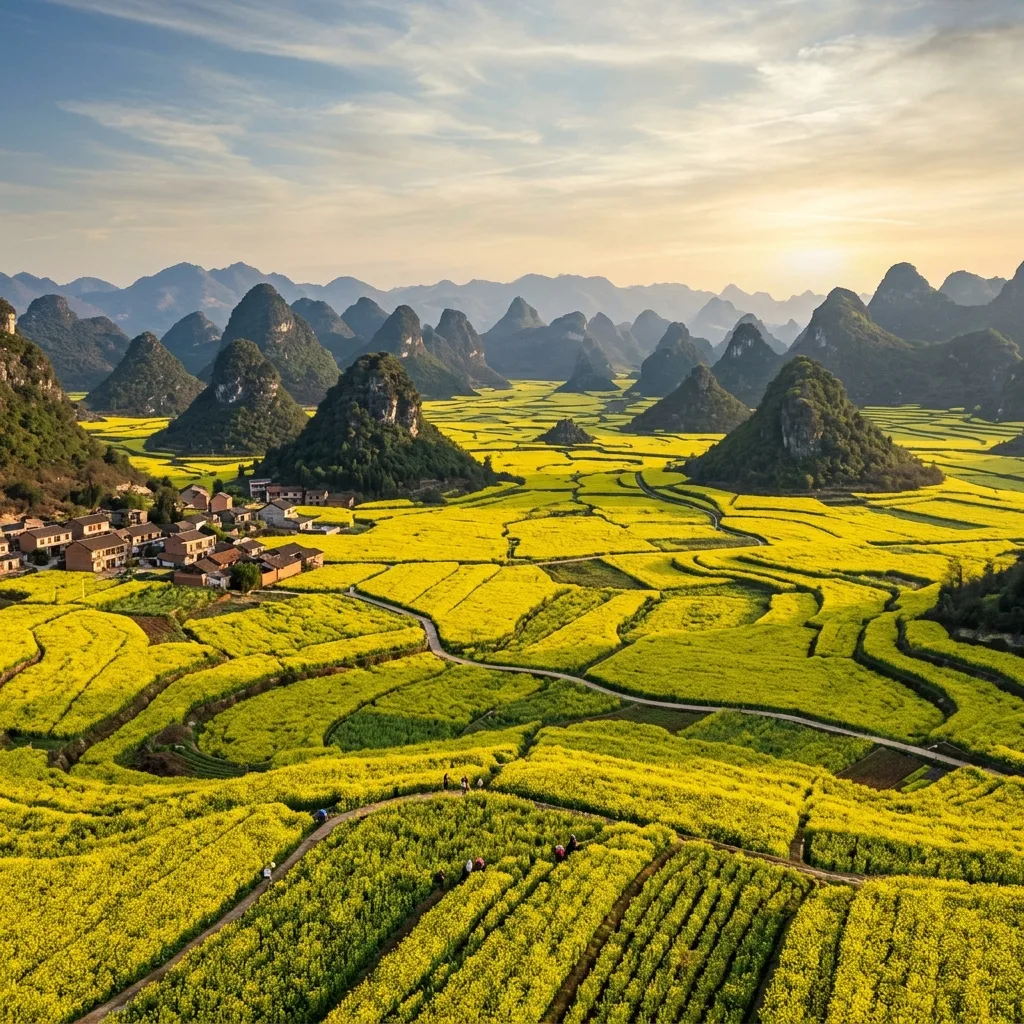
Every year, as the chill of winter begins to fade, a profound transformation occurs in the eastern reaches of Yunnan Province, China. The county of Luoping, ordinarily a quiet agricultural region, erupts into an ocean of blindingly bright yellow. This is the blooming of the canola (rapeseed) flowers, creating what is widely considered the largest natural flower garden on Earth.
Spanning hundreds of square kilometers, this "golden sea" is punctuated by dark, cone-shaped karst mountains that rise abruptly from the yellow carpet, creating a surreal, fairy-tale landscape that draws photographers, nature lovers, and romantics from across the globe. For travelers in 2026, Luoping offers a breathtaking escape into rural China and an unparalleled opportunity for landscape photography.
However, because the bloom is an agricultural event dictated by nature, timing is everything. Furthermore, navigating the rural infrastructure requires some planning. This comprehensive 2026 guide will detail exactly when to go, how to get there, the best photography spots (including Jinjifeng and the Niujie snail farms), and how to immerse yourself in the local Buyi minority culture.
1. Understanding the Luoping Phenomenon
Before diving into logistics, it helps to understand what exactly you are looking at. Canola, or rapeseed (Brassica napus), is cultivated primarily for its oil-rich seed, which is crushed to produce cooking oil and biodiesel. Yunnan’s unique climate—mild winters and early springs—allows the farmers of Luoping to plant the crop in the fall and harvest in late spring.
What makes Luoping unique is not just the flower itself, but the sheer, unfathomable scale of the cultivation combined with the dramatic topography. The region sits on the edge of the Yunnan-Guizhou Plateau. Over millions of years, water eroded the limestone bedrock, leaving behind the solitary, cone-like karst peaks that characterize the area. When the farmers plant the canola in every available valley, crevice, and terraced slope around these peaks, it creates a striking visual contrast: a flat, vibrant yellow sea interrupted by dark, forested islands of rock.
The Beekeepers of the Golden Sea
The blooming season is not just a visual spectacle; it is an economic cornerstone. As the flowers bloom, thousands of beekeepers from all over China descend upon Luoping. They set up temporary camps—often just simple canvas tents—along the edges of the fields. As you walk through the area, the air hums with the sound of millions of bees pollinating the crop. The local honey produced during this short window is renowned for its purity and floral notes, making it the perfect souvenir to purchase directly from the roadside tents.
2. Timing Your Visit in 2026
The most crucial aspect of a trip to Luoping is timing. Miss the window, and you will find a sea of green seed pods rather than yellow flowers.
- The Bloom Window: Generally, the canola flowers begin to bloom in early to mid-February, peak in late February to early March, and begin to fade by late March.
- The 2026 Prediction: Based on typical weather patterns, the prime viewing window for 2026 is expected to be between February 22nd and March 15th.
- Weather Dependency: The exact timing shifts slightly every year based on winter temperatures and rainfall. A warmer winter means an earlier bloom. If you are planning a trip, it is highly recommended to monitor Chinese social media (like Xiaohongshu or Weibo) or check with your Kunming hotel concierge for real-time updates on the bloom status a week before you depart.
- Crowd Control: The peak bloom often coincides with the weeks following the Lunar New Year. Weekends in late February and early March will be heavily crowded with domestic tourists. If your itinerary allows, plan your photography sessions for Tuesday through Thursday.
3. Getting to Luoping
Luoping is located about 220 kilometers (136 miles) east of Kunming, the capital city of Yunnan Province. Kunming serves as the gateway to the region.
From Kunming to Luoping
In 2026, transportation options are highly efficient:
- The Train: This is the most comfortable and scenic option. Regular trains run from Kunming Station or Kunming South Station to Luoping Station. The journey takes approximately 1.5 to 2 hours. Tickets are inexpensive (around CNY 40-60) but should be booked in advance during peak flower season via the official 12306 app or Trip.com.
- The Coach Bus: Buses depart frequently from the Kunming East Bus Station. The ride takes about 3.5 to 4 hours depending on traffic. It is a reliable backup if train tickets sell out.
- Private Car/Taxi: For ultimate flexibility, you can hire a private driver in Kunming. This is more expensive but allows you to stop at viewpoints along the highway.
Getting Around Luoping
The flower fields are not a single, fenced-off park; they are vast agricultural lands surrounding the town. The main scenic spots are scattered in different directions from Luoping city center.
- Local Taxis/DiDi: You can use ride-hailing apps or hire local taxis. Often, photographers will negotiate a daily rate with a taxi driver (around CNY 300-400) to take them to different spots for sunrise and sunset.
- Local Buses: Mini-buses run from the main Luoping bus station to the major scenic areas (Jinjifeng, Niujie). They are very cheap but operate on "fill-and-go" schedules rather than strict timetables.
- Electric Scooters: Many guesthouses rent electric scooters. This is a fantastic way to explore the quieter, less famous fields at your own pace.
4. The Big Three: Must-Visit Photography Spots
To capture the true essence of Luoping, you must visit three distinct geographical areas, each offering a completely different perspective on the golden sea.
1. Jinjifeng (Golden Chicken Peak Cluster)
If you have seen a famous photograph of Luoping, it was almost certainly taken here. Located about 12 kilometers northeast of the town, Jinjifeng is a vast, flat basin filled with canola, from which dozens of independent karst cones rise.
- The Experience: This is the premier spot for wide-angle landscape photography.
- Sunrise Magic: Jinjifeng is famous for its sunrises. In the early morning, a thick layer of mist often settles in the valley, partially obscuring the bases of the karst peaks. As the sun rises, the mist glows orange and pink, and the peaks appear to float above a golden, glowing cloud.
- Logistics: You must arrive early. Photographers typically leave their hotels by 5:30 AM to secure a spot on one of the designated viewing platforms (which require a small entry fee, usually around CNY 20). Bring a tripod and a warm jacket, as mornings are freezing.
- Exploring: After sunrise, you can rent a bicycle or take an ox-cart ride down into the fields themselves to wander among the towering stalks.
2. Niujie "Snail" Farms (Luosi Field)
Located about 10 kilometers northwest of Luoping, the landscape here changes dramatically. Instead of flat basins and sudden peaks, Niujie features rolling hills and deep, bowl-like depressions.
- The Aesthetic: The farmers here have planted the canola in circular, concentric terraces following the contours of the land. From above, the fields look exactly like the spiral shells of giant snails, creating mesmerizing, geometric patterns of green and yellow.
- Photography: Unlike Jinjifeng, where you shoot across the landscape, Niujie requires an elevated perspective. The designated viewing platform is built onto the side of a hill overlooking the main "snail."
- Drone Paradise: If you travel with a drone (DJI is highly recommended), Niujie is where you deploy it. Top-down, 90-degree aerial shots of these spirals yield incredible, abstract agricultural art.
- Best Time: Late afternoon is ideal, as the shadows accentuate the depth of the terraces.
3. Jiulong (Nine Dragons) Waterfalls
While not a flower field per se, the Jiulong Waterfalls are inextricably linked to the Luoping experience. Located 22 kilometers northeast of the town, this is one of the most magnificent waterfall clusters in China.
- The Landscape: The river drops over a series of ten distinct, terraced limestone faults. The largest drop, known as the "Shenlong Waterfall," is 56 meters wide and drops 46 meters.
- The Contrast: During the spring, the banks of the river and the surrounding hills are planted with canola. The contrast of the roaring, white-and-jade water cutting through the bright yellow fields is visually stunning.
- Viewing Strategy: Enter through the West Gate (the higher elevation) and walk downstream. This allows you to face the waterfalls as you descend, making the hike much easier and providing constant photo opportunities. A cable car is also available to take you to the highest panoramic viewing deck.
5. Cultural Immersion: The Buyi People
Luoping is not just a visual treat; it is a cultural destination. The region is home to a significant population of the Buyi (or Bouyei) ethnic minority. The Buyi are an agricultural people with a rich heritage closely tied to the land and water.
- Traditional Dress: As you travel between the fields, especially near the Jiulong Waterfalls, you will see Buyi women wearing their traditional indigo-dyed clothing, often featuring intricate batik patterns and silver jewelry.
- The Water Festival: If you visit slightly later in the season (usually early March, tied to the Lunar calendar), you might witness the traditional "Er Yue Er" (Second Day of the Second Month) festival. This is a massive celebration involving antiphonal singing (call-and-response folk songs), water-splashing for good luck, and vibrant dances.
- Five-Color Sticky Rice: The Buyi are famous for their festive food, most notably the five-color sticky rice. They use natural plant dyes (leaves and flowers) to color the rice black, red, yellow, purple, and white. It is usually served steamed and has a subtle, sweet, herbal flavor.
6. Practical Tips for the 2026 Traveler
Traveling in rural Yunnan requires a bit more preparation than visiting Shanghai or Beijing.
- Accommodation: Luoping town has numerous hotels, ranging from budget guesthouses to comfortable 4-star accommodations. During the 3-week bloom, hotels book up months in advance, and prices double or triple. Book your room as soon as you confirm your travel dates. Some photographers prefer to stay in simple guesthouses directly at the foot of Jinjifeng to save travel time for sunrise.
- Wardrobe: The temperature swing in early spring is massive. It can be near freezing (0°C/32°F) at 6:00 AM on the viewing platform, and a sweltering 25°C (77°F) by 1:00 PM in the sun. Layering is absolute key. A windbreaker, a fleece, and a t-shirt is the standard uniform.
- Toilets: Be prepared for rural Chinese plumbing. While the main viewing platforms have public restrooms, they are often traditional squat toilets. Always carry your own toilet paper and hand sanitizer, as they are rarely provided.
- Allergies: If you suffer from hay fever or pollen allergies, Luoping will test you. You are walking into hundreds of square miles of blooming flowers. Bring adequate antihistamines and consider wearing a high-quality mask if the pollen count is high.
- Digital Payments: Like the rest of China in 2026, cash is rarely used. Ensure you have Alipay or WeChat Pay set up and linked to your international credit card. Even the beekeepers selling honey by the side of the road will expect a QR code scan for payment.
7. Suggested 3-Day Itinerary
To fully appreciate the area without rushing, a three-day, two-night itinerary is optimal.
Day 1: Arrival and The Snails
- Morning: Take the train from Kunming to Luoping. Check into your hotel in Luoping town.
- Lunch: Try local Luoping cuisine, such as sour bamboo shoot fish or Buyi smoked meat.
- Afternoon: Hire a taxi to the Niujie Snail Farms. Spend the late afternoon photographing the terraces as the sun drops lower, highlighting the concentric rings.
Day 2: Sunrise and Waterfalls
- Early Morning (5:30 AM): Depart for Jinjifeng. Climb the main viewing platform in the dark. Photograph the sunrise and the morning mist rolling through the karst peaks.
- Mid-Morning: Descend into the fields at Jinjifeng. Rent a bicycle and ride through the sea of flowers, stopping to talk (or gesture) with the beekeepers.
- Lunch: Eat at a local farmhouse restaurant near Jinjifeng.
- Afternoon: Drive to the Jiulong Waterfalls. Enter via the West Gate, take the cable car to the top viewing deck, and slowly hike down the gorge, photographing the waterfalls framed by yellow flowers.
Day 3: The Hundred Thousand Hills and Departure
- Morning: Head south of Luoping to the Shiwandashan (Hundred Thousand Hills) area. The landscape here is wilder, with sharper peaks and fewer tourists. The canola fields are patchier but offer a different, more rugged aesthetic.
- Afternoon: Head to the Luoping train station and return to Kunming, concluding your golden journey.
8. Advanced Photography Gear and Technical Tips
To truly do justice to Luoping's golden sea, bringing the right equipment and knowing how to use it in these specific conditions is essential. The landscape presents unique challenges, from deep morning shadows to intense midday glare.
Essential Camera Gear
- Lenses: A wide-angle lens (e.g., 16-35mm) is non-negotiable for capturing the vastness of Jinjifeng and the sweeping curves of the Niujie terraces. However, a telephoto lens (e.g., 70-200mm) is equally crucial. The telephoto allows you to compress the distance between the karst peaks, creating that classic "layered" look, and is perfect for isolating a single farmhouse or a cluster of trees within the yellow expanse.
- Filters: A circular polarizing filter (CPL) is your best friend in Luoping. It will cut the glare off the waxy canola leaves, deepening the yellow saturation and making the blue skies punchier. If you are shooting the Jiulong Waterfalls, a Neutral Density (ND) filter will allow you to use longer shutter speeds in daylight to create that silky, ethereal water effect.
- Tripod: Absolutely necessary for the pre-dawn setup at Jinjifeng. A sturdy tripod is required to combat the strong morning winds on the elevated platforms and to facilitate bracketed exposures for High Dynamic Range (HDR) blending.
Technical Shooting Advice
- Bracketing for HDR: The dynamic range during a Luoping sunrise is massive. The sky can be blindingly bright while the valleys remain in deep shadow. Shoot in Auto Exposure Bracketing (AEB) mode, capturing 3 to 5 frames at varying exposures, and blend them later in software like Lightroom to recover shadow detail without blowing out the highlights.
- Focus Stacking: When using a wide-angle lens with canola flowers very close to your foreground, it can be difficult to keep both the foreground flowers and the distant peaks perfectly sharp. Consider focus stacking—taking multiple shots with different focal points and merging them—to ensure edge-to-edge sharpness.
- Drone Etiquette and Settings: Drones are incredibly popular at Niujie. Ensure your drone’s compass is calibrated away from large metal objects. Shoot your aerial panoramas in RAW format. When shooting top-down abstracts of the spiral farms, underexpose slightly to preserve the bright yellow highlights, and use the "Grid" overlay on your controller screen to ensure perfect symmetry in your composition.
Conclusion
The canola flower fields of Luoping offer a fleeting, golden moment where human agriculture and dramatic natural geology align perfectly. It is a place that feels simultaneously manicured and wildly untamed. Standing on a karst peak at dawn, watching the mist lift to reveal a boundless yellow ocean, is an experience that defies adequate description. By carefully timing your 2026 visit, preparing for rural logistics, and dedicating time to both the grand vistas of Jinjifeng and the intimate terraces of Niujie, you will capture not just incredible photographs, but memories of one of China's most profound natural wonders.
If you are building a wider Yunnan route, pair Luoping with the China natural wonders hub and the China travel planning guide. If you want another landscape-heavy route, the Li River cruise guide gives you the same kind of photography-first planning logic in a different region.