Seoraksan from Seoul: cable car or hike, and how to time Sokcho

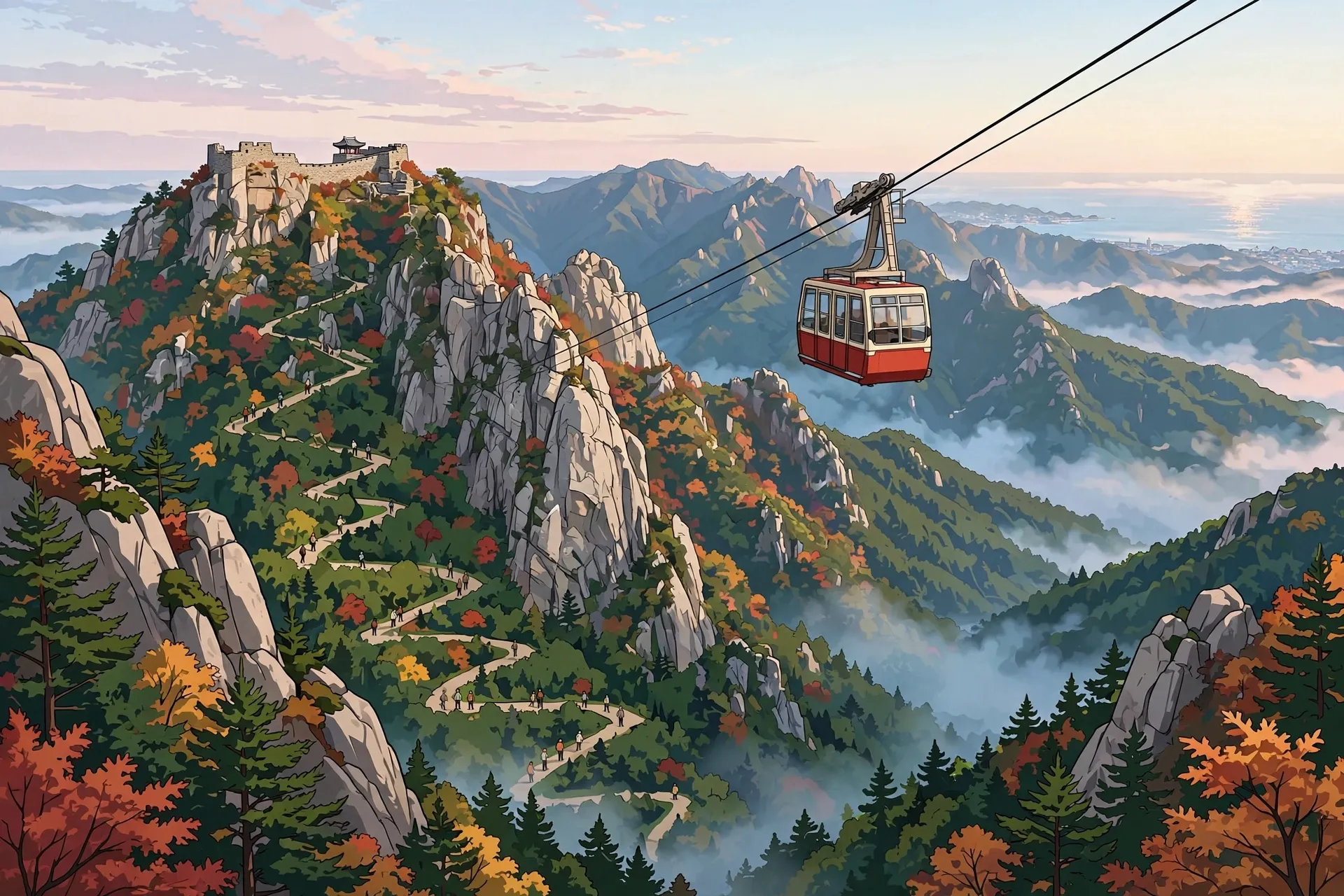
Seoraksan rises over Sokcho on Korea's east coast, and every Seoul-based itinerary asks the same question: cable car or hike? The honest answer is that it is not an either-or. The Seorak cable car — a five-minute ride up to Gwongeumseong Fortress at 15,000 KRW return — buys you the panorama. The trails below it buy you everything else: waterfalls, temples, and the rock formations the park is known for.
Getting there is the real logistical question. Sokcho sits about two and a half hours by express bus from Seoul, which makes a day trip tempting and a dawn departure nearly mandatory in autumn, when the foliage crowds descend. This guide lays out the cable car versus hiking choice, the Seoul–Sokcho bus math, the foliage calendar, where to eat in Sokcho, and whether you should stay the night.
Cable car or hike: picking the right mountain move
From Seoul, the smartest Seoraksan move is the cable car first in the morning. Timed tickets sell out by mid morning in autumn, so buy yours the moment you arrive, then pick a trail that fits your fitness: Biryong Falls at 2.4 km, or Ulsanbawi with 800 steps.
The cable car and the trails are not competitors. They solve different problems: the cable car gets you to the ridge fast, and the trails get you into the valleys. On a short visit, the winning formula is almost always the cable car first, plus one walk that matches your legs. Decide the combination before you board the bus in Seoul, because the order of operations at the park matters — ticket counter first, everything else second.
The cable car: what 15,000 KRW buys
The Seorak cable car runs from the Seorakdong area up to Gwongeumseong Fortress, and the ride takes about five minutes. A few facts shape every plan built around it:
- Return ticket only. There is no one-way option. Adults pay 15,000 KRW; children pay 11,000 KRW.
- Day-of tickets only. There is no advance reservation system. Tickets are sold in timed, first-come slots, and when a slot is gone, it is gone — this is the single most important fact in this guide.
- Operating hours run roughly 8:30 or 9:00 to 17:30, with cars departing every 10 to 15 minutes. The exact hours for a specific day are published one day ahead on sorakcablecar.co.kr, so check the evening before you go.
- The base station sits about a five-minute walk from the Seorakdong park entrance, so there is no shuttle or taxi leg to budget for.
The practical upshot: buy your cable car ticket the moment you reach the park, then go see Sinheungsa while your slot approaches. This is the move experienced visitors make — the ticket is the scarce resource, and everything else in the park can wait for it. Do not make the rookie error of hiking first and "getting the cable car later." Later often does not exist.
In autumn, the scarcity is real. Waits for the cable car can stretch past two to three hours on peak weekends, and the timed slots sell out by mid-morning. The cable car is a morning activity, full stop — which is why the foliage section below and the overnight verdict at the end of this guide both point the same way.
The hiking menu: match the trail to your fitness
Park entry itself is free, so the only question is which trail earns your hours. The standard menu, from easiest to hardest:
- Biryong Falls — 2.4 km, easy, about an hour each way. The default pick for a first visit: a valley walk to a waterfall, manageable for anyone in normal walking shape. This is the trail to choose when the cable car ate your morning or when you want a relaxed afternoon after the ride.
- Biseondae — 3 km, easy. Another gentle valley option, good for a slow morning if you arrived too late for a cable car slot and want to salvage the day gracefully.
- Ulsanbawi — 3.8 km with 800-plus steel steps, about 2 hours up and 90 minutes down. This is the signature Seoraksan climb: a stair-heavy ascent to a dramatic rock face. It is a workout, not a stroll — bring water, wear proper shoes, and start early enough that you are descending with daylight to spare.
- Daecheongbong — full day, hard. The main summit is a serious all-day undertaking. It does not belong in a Seoul day trip under any itinerary; treat it as a separate trip with its own planning.
If you are torn between the cable car and a hike, do both at the scale you can handle: cable car in the morning plus Biryong Falls in the afternoon is a realistic and satisfying combination that fits inside a day trip. Ulsanbawi pairs better with an overnight stay, because the climb plus the bus schedule leaves almost no margin for a missed connection. And if you are heading up Ulsanbawi or attempting Daecheongbong, sort out travel insurance before you leave Singapore — steep steel steps and tight bus connections are exactly the combination coverage exists for.
The Seoul–Sokcho bus math
Sokcho is an express-bus city, and the math is friendlier than most Seoul day trips — as long as you leave from the right terminal and early enough. There is no train to Sokcho, so the bus is not one option among several; it is the plan. Get the terminal choice right and the rest of the day unlocks.
Seoul Express Bus Terminal vs Dong Seoul
Two Seoul terminals serve Sokcho, and they are not interchangeable:
- Seoul Express Bus Terminal → Sokcho: about 2 hours 20 minutes. First bus at 6:00, last bus at 23:30, roughly 36 departures a day. Adult fare from 17,200 KRW.
- Dong Seoul → Sokcho: 2 hours 10 minutes to 3 hours depending on traffic and routing. Adult fare from 16,400 KRW.
Book at kobus.co.kr. If your foreign card will not go through on the Korean booking site, Klook sells the same routes and is the standard workaround for overseas cards. One English guide reports fares from 18,700 KRW since October 2026 — the figures above were checked on 20 October 2026, so reconfirm the fare when you book rather than budgeting to the won.
For most visitors, Seoul Express Bus Terminal is the default: more departures across the day, the earliest possible start, and a last bus late enough (23:30) to keep the day trip viable even if you linger over dinner. Dong Seoul is the backup to know about — slightly cheaper, slightly less frequent, and worth considering if you are staying on the east side of Seoul. On a tight schedule, though, the frequency gap at Seoul Express Bus Terminal matters more than the small fare difference.
Whichever terminal you choose, book the outbound leg the night before during foliage season. Thirty-six departures a day sounds like plenty until a peak October Saturday fills the early ones.
The last mile: Sokcho terminal to the park
From Sokcho Express Bus Terminal, city buses 7 and 7-1 run to the national park in about 24 minutes. Park entry is free, and the cable car base station is roughly a five-minute walk from the Seorakdong entrance — no taxi needed unless you are cutting it fine on time.
Add it up door to door: a 6:00 departure from Seoul Express Bus Terminal puts you in Sokcho around 8:20, at the park entrance around 8:50, and — if you walk straight to the cable car ticket counter — holding a timed slot before 9:00. That is the day-trip timeline everything else has to fit inside. Notice how little slack it contains: one late bus, one long ticket queue, and the morning plan compresses. This is why the foliage calendar matters so much, and why the overnight option exists.
The foliage calendar that changes everything
Seoraksan's autumn foliage is the single biggest variable in this whole plan. It does not just change the scenery — it changes the queues, the ticket math, and whether a day trip is sane. If you are visiting between late September and early November, read this section twice and plan around it.
When the color moves down the mountain
The foliage starts at the summit in the last days of September and works its way down the slopes, reaching the valleys around Sinheungsa around mid-October. That mid-October window is peak season: the mountain at its most photogenic and its most crowded, with weekend visitors arriving from across Korea.
The crowds concentrate on the cable car because it is the bottleneck — one ride, fixed capacity, timed slots. On peak autumn weekends the cable car sells out by mid-morning, and waits for the remaining slots can exceed two to three hours. This is not a line you can outwait with patience; the timed slots simply run out, and no amount of standing around creates more of them. The trails, by contrast, absorb crowds far better — Biryong Falls at 10:00 on a peak Saturday is busy but walkable, while the cable car queue at the same hour is a write-off.
The 8:00 rule
The working rule for foliage season: be at the park before 8:00, or come midweek. An 8:00 arrival means a cable car ticket in hand before the slots vanish. A 10:00 arrival on a peak Saturday means you are hiking by default, ticket or no ticket. There is no third option and no insider trick — the arithmetic of fixed capacity does not negotiate.
Two planning notes for the season:
- Cable car operating hours for a specific day are published one day ahead on sorakcablecar.co.kr. Check the evening before, especially in shoulder season when the schedule shifts between the 8:30 and 9:00 openings.
- If your dates are fixed on a peak weekend and you cannot arrive early, reset expectations now: build the trip around the trails (Biryong Falls, Biseondae, or Ulsanbawi) and treat the cable car as a bonus if a slot opens. The mountain is still worth the journey — the disappointment comes from expecting the cable car and not getting it, not from the trails themselves.
Outside foliage season, the pressure eases considerably. Spring and early summer bring comfortable hiking weather with a fraction of the cable car competition, and winter turns the mountain into a snow landscape for visitors prepared for the cold. The 8:00 rule is a foliage-season rule; in other months, a 9:00 arrival is usually fine.
Timing Sokcho's food street: Daepo Port and Jungang Market
Sokcho has a genuine reputation as a food city, and the two names every visitor should know are Daepo Port and Jungang Market. The catch is timing: both reward an unhurried visit, which makes the food itinerary another quiet argument for staying the night rather than racing back to Seoul.
Daepo Port fish market
Daepo Port is Sokcho's fishing-port food stop — the fish market that the overnight itinerary builds its first day around. The recommended rhythm is an afternoon arrival-day visit: take the bus from Seoul at whatever civilized hour you like, wander the market stalls, eat at the port, and let the afternoon set a relaxed pace for the evening. It is the low-effort, high-reward half of the trip, and it pairs naturally with an early night before the dawn mountain start on day two.
Daepo Port works as a day-trip add-on only if you skip the mountain's afternoon trail — which defeats the purpose of coming. Be honest with the schedule: the port belongs to the overnight plan.
Jungang Market and dakgangjeong
Jungang Market, in central Sokcho, is the stop for dakgangjeong — Sokcho's signature sweet-and-savory fried chicken, sold from dedicated stalls in the market. It is the city's defining snack and the standard souvenir run: visitors buy boxes to carry home, and the stalls are set up for exactly that.
Unlike Daepo Port, Jungang Market fits a day trip. It sits in the city, on the natural path between the bus terminal and everywhere else, so day-trippers can slot it in before the return bus without breaking the mountain schedule. If you only have time for one food stop, make it this one — the dakgangjeong run takes under an hour and delivers the single most Sokcho-specific taste of the trip.
Day trip vs overnight: the honest verdict
So: can you do Seoraksan in one day from Seoul? Yes — but autumn makes it a different trip than spring does, and the answer depends on what you refuse to miss. Here are both versions, with the trade-offs stated plainly.
The day-trip itinerary (the hard version)
The day trip works if you accept its terms — early start, tight sequencing, no dawdling:
- 6:00 — first express bus from Seoul Express Bus Terminal.
- ~8:20 — arrive Sokcho; city bus 7 or 7-1 to the park, about 24 minutes.
- ~8:50 — walk straight to the cable car ticket counter and buy your timed slot. Do not detour to the temple or the trailhead first; the ticket is the scarce resource.
- Morning — cable car up to Gwongeumseong Fortress, then Sinheungsa while you wait for (or after) your slot.
- Afternoon — one valley walk. Biryong Falls at 2.4 km is the realistic pick; Biseondae at 3 km is the alternative.
- Evening — back to Sokcho terminal. Jungang Market dakgangjeong if the schedule allows; express buses back to Seoul run until 23:30.
The failure mode is arriving late in foliage season: the cable car slots are gone by mid-morning, and your day becomes a hiking day by force rather than by choice. If that happens, do not chase the cable car — Biryong Falls and Biseondae are genuinely good walks, and the mountain does not owe you the panorama. Reset, hike, eat dakgangjeong, and go home satisfied.
The overnight itinerary (the recommended one)
One night in Sokcho changes the whole equation:
- Day 1 (afternoon) — bus from Seoul at whatever hour suits you. Daepo Port fish market in the afternoon, Jungang Market and dakgangjeong in the evening. Sleep early.
- Day 2 (dawn) — at the park by 7:30. Cable car ticket first, Gwongeumseong in the morning, then your pick of trails — even Ulsanbawi, which the day trip cannot fit. Afternoon bus back to Seoul.
The overnight costs one hotel night and buys you the 8:00 rule without a 4:30 alarm, the full food itinerary without rushing, and a buffer against the cable car selling out. In foliage season it is not a luxury — it is the plan that actually works. Outside foliage season the day trip is far more forgiving, and the overnight becomes a choice about food and pace rather than a necessity.
The verdict: day trip from spring through early autumn if you leave on the 6:00 bus and accept the terms; overnight in October, no debate. Either way, check cable car hours on sorakcablecar.co.kr the night before, and reconfirm bus fares at kobus.co.kr when you book.
Prices and timetables in this guide were checked on 20 October 2026. Fares and schedules change — reconfirm before you travel.