Nami Island and Petite France in one day: the sequencing that works

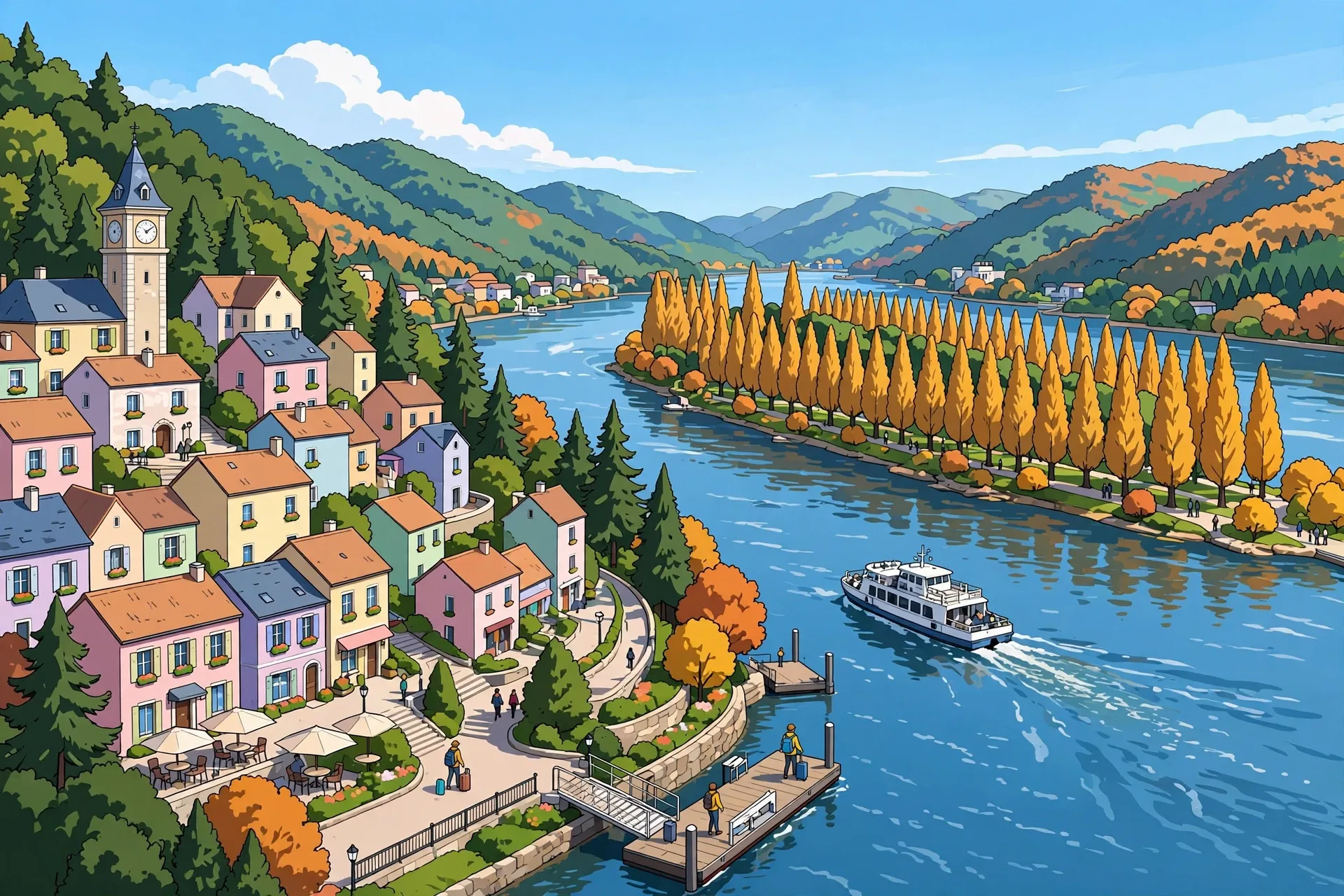
Nami Island and Petite France sit in the same corner of Gyeonggi-do, about 60 kilometers northeast of Seoul, and every day-trip itinerary tries to pair them. The question is not whether you can see both in a day — you can. It is the order. Get it wrong and you spend the afternoon sprinting between bus stops; get it right and the day falls into place with time to spare.
Do Petite France first, then Nami Island. Petite France is a compact hillside village that rewards about an hour and punishes lingering; Nami is a full half-day of tree-lined lanes and waterfront walks. Put Nami first and you cut it short or miss Petite France's 18:00 closing. Put Petite France first and its fixed hours do the scheduling for you.
The sequencing answer: Petite France first, then Nami
Do Petite France first, then Nami Island. Take the ITX-Cheongchun from Cheongnyangni to Gapyeong, ride the Gapyeong Tour Bus (8,000 KRW day pass) to Petite France, then transfer to Gapyeong Wharf — the ferry runs every 10–20 minutes with admission bundled at 16,000 KRW.
Three mechanics make this order work. First, the Gapyeong City Tour Bus runs a loop that passes both Petite France and the Nami ferry wharf, so you board once and ride the same day pass all day. Second, Petite France opens at 9:00 and closes at 18:00 — a fixed window that caps your time there naturally, while Nami's ferries run until 21:00 and give you a much longer afternoon. Third, the tours that run this route daily have converged on the same order: Petite-France-first itineraries are the standard two-attraction tour product, which means the shuttle timing and bus schedules are built around it. When the whole local transport ecosystem assumes an order, that order is the path of least resistance.
The reversed order — Nami first, then Petite France — is not impossible, but it has one structural weakness: you spend the flexible, open-ended half of the day at the attraction with no fixed end, and you compress the fixed-window attraction into whatever time is left. Travelers who start on Nami almost always report the same thing: the island took longer than expected, and Petite France got squeezed into 40 minutes at dusk. If Petite France matters to you at all, protect its hour by going there first.
One more sequencing note: the Garden of Morning Calm is the classic third stop on Gapyeong day trips, and some itineraries squeeze all three into one day. Be realistic. Petite France plus Nami is a full, satisfying day. Adding the garden turns the day into a bus-timetable puzzle with little margin for error. Save it for a second trip, or commit to a longer day and accept the rush.
What the day actually looks like
A workable skeleton, using the Gapyeong City Tour Bus and the ferries:
- 8:10 — ITX-Cheongchun departs Cheongnyangni, arrives Gapyeong around 8:50 (39 minutes, 5,700 KRW; reserve at letskorail.com).
- 9:00–9:30 — City Tour Bus from Gapyeong Station area to Petite France.
- 9:30–10:45 — Petite France: about an hour for the lanes, photo spots, and a street performance.
- 11:00 — Bus transfer toward Gapyeong Wharf for the Nami ferry.
- 11:30–14:30 — Nami Island: two to three hours on the island, including lunch.
- 15:00 — Ferry back, bus to Cheongpyeong Station or Gapyeong Station.
- 16:30–17:30 — Back in Seoul.
These are real clock times from documented DIY itineraries, not estimates. The transfers are the soft spots — budget 20 to 30 minutes of slack at each one, and the day holds.
Why this works even in peak season
Spring blossom and autumn foliage weeks pack Nami with crowds, and ferry queues can stretch. The Petite-France-first order still holds in peak season, for a simple reason: the ferry runs every 10 to 20 minutes with five-minute crossings, so it absorbs volume far better than the tour bus. A queue at the wharf costs you one sailing; a missed hourly bus costs you an hour. Put the bus-dependent stop first, when the buses are running to schedule, and put the high-frequency ferry second, when it can absorb the crowd.
Seoul to Gapyeong: ITX, subway, or a tour
Three ways to get from Seoul to the Gapyeong cluster, with a clear pecking order.
ITX-Cheongchun: the default choice
The ITX-Cheongchun from Cheongnyangni Station reaches Gapyeong in 39 minutes for 5,700 KRW. It is fast, reserved-seat, air-conditioned, and timed exactly for day-trippers: the first trains leave early enough to put you at Gapyeong Wharf before 10:00. Reserve at letskorail.com the day before at the latest — morning trains sell out on weekends and in autumn foliage season, and this is the single most common point of failure for DIY plans. Unreserved cars exist on some services, but do not gamble your morning on them.
The catch: you have to get to Cheongnyangni first. From Myeong-dong or central Seoul that is a 20 to 30 minute subway ride. Budget it into your wake-up time, not your train-booking time.
The Gyeongchun subway line: the budget option
The regular subway (Gyeongchun Line) runs from central Seoul to Gapyeong for 2,400 KRW — less than half the ITX fare. The cost is time: 80 minutes or more, depending on connections, and you stand or sit in commuter conditions. On a day with this much transfer coordination, the ITX's 40 minutes of time saved are worth more than the 3,300 KRW fare difference. Take the subway only if you are traveling genuinely off-peak and your morning has slack to spare.
Package tours: when they make sense
Day tours covering Nami plus Petite France (and often the Garden of Morning Calm) sell for roughly $50 per person for two-attraction routes, departing from central Seoul with hotel pickup. The value proposition is real: no train booking, no bus-timetable reading, no ferry navigation. The cost is flexibility — you move at the group's pace, and the island time is typically capped at two to three hours.
Take the tour if: your Korean is nonexistent and you are nervous about transfers, you are traveling with older family members who cannot handle bus standing, or it is peak foliage season and you want someone else to own the logistics risk. Go DIY if you want the full morning on Nami and you are comfortable with one transfer. The cost difference is small; the control difference is large. One practical tip if you go DIY: for a day trip with trains, buses, and a ferry, travel insurance for Korea, Japan, and China is worth a look before you leave — missed-connection coverage is the part of the policy this itinerary actually exercises.
The Gapyeong City Tour Bus day pass
This is the machine that makes the DIY route work. The Gapyeong City Tour Bus runs a loop connecting Gapyeong Station, Gapyeong Wharf (the Nami ferry), Petite France, the Garden of Morning Calm, and other local attractions. The day pass costs 8,000 KRW and pays for itself against two taxi rides.
How to use it
Buy the pass when you board at Gapyeong Station — the tour bus stop is near the station, well signed, and drivers are used to day-trippers. You ride the loop all day, getting off at Petite France first, then reboarding toward the wharf when you are done. Schedules change seasonally, so check the current timetable at gptour.go.kr before the trip; the 8,000 KRW price and the loop structure have been stable, but frequencies move.
Taxi as backup, not as plan
A taxi from Gapyeong Station to Petite France takes about 25 minutes and costs roughly 20,000 KRW; station to wharf is about five minutes and 5,000 KRW. Two people sharing a taxi to Petite France is 10,000 KRW each — barely more than the bus day pass — so for pairs, taxis are a legitimate alternative on the Gapyeong-to-Petite-France leg. The trap is the return: afternoon taxis from Petite France back toward the wharf can be scarce, because drivers know tourists are stranded there and demand spikes. Use taxis as a backup for missed buses, not as the primary plan. Solo travelers should just take the bus.
Reading the timetable the night before
The single highest-leverage preparation step takes ten minutes the evening before: open the current Gapyeong City Tour Bus timetable and write down three departures — Gapyeong Station to Petite France in the morning, Petite France to the wharf midday, and the wharf side back to Cheongpyeong in the afternoon. Screenshot them. The loop's frequencies shift with the seasons, and having the times in your phone means you never stand at a rural bus stop guessing whether you missed it or it simply hasn't come yet.
The navigation pitfall that breaks DIY plans
When you navigate to the ferry, navigate to Gapyeong Wharf (가평나루) — the dock — not to the Nami Island pin. Navigation apps that send you toward the island pin route you to the water's edge with no ferry. The island is only reachable by ferry from Gapyeong Wharf (or by zip-wire), and the dock is a five-minute taxi or tour-bus ride from Gapyeong Station. This is the single most reported DIY failure on this route, and it costs people their morning.
Nami Island ferry and admission, line by line
The ferry mechanics, with the numbers as checked on the day this guide's packet was assembled (reconfirm before travel — prices and timetables move).
Ferry schedule
First sailing departs Gapyeong Wharf at 8:00; the last return sailing leaves Nami Wharf at 21:00. During daytime hours, 9:00 to 18:00, boats run every 10 to 20 minutes, and the crossing takes five minutes. You do not need to reserve; you queue and board. In peak season the queue can add 20 to 40 minutes — this is why the afternoon slot works better for Nami, when morning crowds are dispersing rather than converging.
Admission
The adult fare bundles ferry and island admission at 16,000 KRW per person. This is the "VISA fee" (entrance plus ferry) — one price, one ticket, no separate gate charge. Children and seniors pay less; check the current tiers at the island's official page rather than old blog prices, which go stale.
The zip-wire alternative
If queues look grim, the zip-wire (Skyline ZipWire) from the mainland to Nami costs 49,900 KRW and drops you onto the island in about a minute. It is a thrill ride, not a commuter option — the price is three times the ferry — but it is a real pressure valve on packed autumn weekends, and for some travelers it is the highlight of the day. Height and weight restrictions apply; check before queueing.
How long on the island
Two to three hours is the sweet spot: the central tree lanes (metasequoia, ginkgo, cherry depending on season), the waterfront walk, the gardens, and lunch. The island has restaurants and cafes, so plan lunch here rather than at Petite France — more options, better prices, and it fills the natural midday gap between your Petite France hour and the return leg. If you are on the zip-wire or the first ferry, you can stretch to four hours, but the island's marginal returns drop after three.
Petite France practicals
Petite France opens 9:00 to 18:00. A single-park ticket runs 12,000 KRW; a two-park pass bundling Petite France and the Italian Village runs 19,500 KRW. (Older posts quote 10,000 KRW — confirm at the gate.) One hour is genuinely enough: the village is compact, the lanes photograph fast, and the street performances — marionette shows, organ performances — run on a schedule you can catch in a single pass through. Arrive when it opens and you will have the lanes nearly empty for photos, which is the main reason the morning-first order photographs better too.
The return leg: which station to leave from
After Petite France, you have two return options, and picking the wrong one adds 30 to 60 minutes.
Cheongpyeong vs Gapyeong
Returning from Petite France, Cheongpyeong Station is the nearer exit to Seoul. The geography of the day points this way: Petite France sits between Gapyeong and Cheongpyeong, and after you have done Nami in the afternoon, backtracking all the way to Gapyeong Station is extra travel for no gain. Route: ferry back from Nami to Gapyeong Wharf, tour bus or taxi toward Petite France side, then the local connection to Cheongpyeong Station for the ITX back to Cheongnyangni.
If you took the tour bus all day, the loop serves both stations — check the timetable for the Cheongpyeong-bound direction before you board, because the loop's direction determines which station you reach first.
The rule that saves the day
Pick your return train before you leave Seoul. This is the advice that appears in every experienced guide to this route, and it is the one DIY travelers skip. Morning ITX trains get booked; afternoon return trains get booked too, especially on foliage-season weekends. When you reserve your 8:10 outbound at letskorail.com, reserve your 16:30-or-so return in the same session. An unbooked return turns the last hour of the day into a standing-ticket gamble.
End of day, in Seoul
From Cheongpyeong, the ITX runs back to Cheongnyangni on the same line — 39 minutes in reverse. Budget subway time from Cheongnyangni to your hotel or dinner. A realistic door-to-door end time is 17:30 to 18:30, which leaves the evening open in Seoul. That is the whole point of the Petite-France-first order: the day ends with slack, not with a sprint.
One thing worth saying about doing this solo
Solo travelers sometimes hesitate on DIY day trips, worried the transfers will be harder alone. On this route, solo is actually the easiest configuration: you board the tour bus without a seat negotiation, you fit on the next ferry sailing without splitting a group, and the one itinerary decision that matters — Petite France first, Nami second — needs no consensus. If anything, go a little slower on Nami and take the extra hour for the waterfront walk. The afternoon has the slack for it.