Hakone day trip from Tokyo: the loop course, passes, and timing

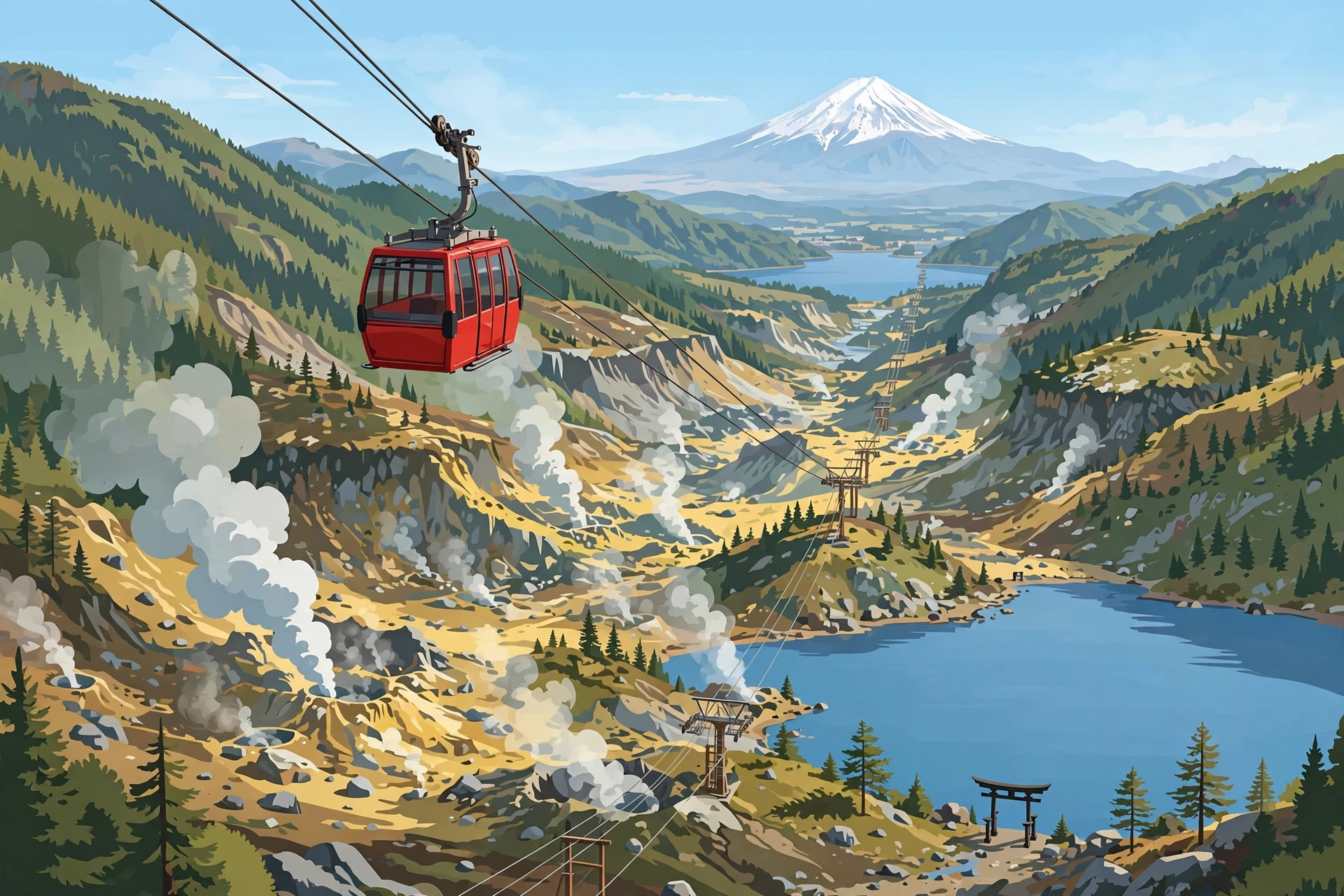
If you have a spare day in Tokyo and a clear-enough sky, Hakone is the highest-value day trip you can do without a JR Pass itinerary falling apart. It is close (about 90 minutes from Shinjuku), it packs hot springs, a mountain railway, a ropeway over an active volcanic valley, and a lake cruise into one continuous loop, and with the right pass the whole transport circuit costs less than a single sushi dinner in Ginza. This guide breaks the day into the five decisions that actually matter: which direction to run the loop, which pass to buy, when to ride the ropeway for Mount Fuji, where to fit an onsen, and how to get back to Tokyo without a last-train panic.
Clockwise vs counter-clockwise: which loop direction fits your day
Yes — the Hakone loop fits a day trip: train from Hakone-Yumoto to Gora, cable car to Sounzan, ropeway over Owakudani to Togendai, a Lake Ashi cruise, then bus back. Buy the ¥7,100 2-day Freepass from Shinjuku, leave by 8am, and ride the ropeway in the morning for Fuji odds.
The classic loop starts at Hakone-Yumoto, the town at the base of the mountains where the Odakyu Line ends. From there the order is fixed: Hakone Tozan Railway up to Gora, Tozan Cable Car to Sounzan, Hakone Ropeway over the Owakudani valley to Togendai, the Lake Ashi sightseeing (pirate ship) cruise to Moto-Hakone or Hakone-machi, and finally a Hakone Tozan bus back down to Hakone-Yumoto. That is the loop, and the question is only which direction you run it.
Counter-clockwise — train first, bus last — is the standard recommendation for day-trippers, and it is standard for good reasons. You start the loop at Hakone-Yumoto the moment you arrive, which means the earliest, most Fuji-likely hours go to the ropeway, the one leg where weather actually matters. The Tozan mountain railway in the morning is also at its best: mist in the cedar forests, the switchbacks near the summit stations, and fewer tour groups than the afternoon. By midday you are crossing Lake Ashi when the light is flat and forgiving, and the bus ride back down from Moto-Hakone is just transit — it asks nothing of the weather.
Clockwise — bus up to the lake first, ropeway in the afternoon — has one real advantage: you see Hakone Shrine and the lake with smaller crowds if you arrive at Hakone-Yumoto before 9am and go straight to the bus terminal. Some travelers also prefer getting the onsen out of the way at Gora/Yumoto in the late afternoon and riding the Tozan Railway downhill into town for dinner. But for a first visit, the afternoon-ropeway gamble is the wrong trade. Mount Fuji is clearest in the morning; by early afternoon the summit often hides behind clouds that formed over the valley, and a day trip with no Fuji view feels like a missed main event. Run it counter-clockwise, train first.
How long the loop actually takes
A comfortable full loop takes 6–8 hours including stops at Owakudani, the Lake Ashi cruise, and Hakone Shrine. Door to door from Shinjuku is about 9 hours without big detours. Add the Hakone Open-Air Museum — a serious open-air sculpture park between Gora and Chokoku-no-Mori that is worth 90 minutes — and the day stretches to about 11 hours. That is still a day trip, but it commits you to the first trains out and the last reasonable trains back, and it leaves no room for an onsen. Pick two of the three: museum, onsen, relaxed dinner. All three needs an overnight stay.
When the loop breaks: weather and maintenance
Two things can break the loop on any given day, and both are common enough to plan for. First, wind and volcanic gas at Owakudani can suspend the ropeway with no notice; when that happens, replacement buses cover the gap between Sounzan and Togendai, and your Freepass stays valid, but the bus ride is slower and the Fuji viewpoint from the gondola is gone. Second, scheduled maintenance closes whole ropeway sections: the Owakudani–Sounzan section is closed 7–24 December 2026, and the Togendai–Owakudani section is closed 12 January to 26 February 2027. If your trip falls in those windows, check the ropeway operator's status page the night before — the loop still runs via replacement buses, but you should budget an extra 30–45 minutes and expect the Owakudani stop to feel diminished.
Which pass to buy (and when it does not pay off)
The Hakone Freepass is the default answer, and it is usually the right one — but not always. The math decides, and the math is simple.
From Shinjuku, the adult Freepass costs ¥7,100 for 2 days and ¥7,500 for 3 days. That pass covers the Odakyu Line round trip between Shinjuku and Odawara/Hakone-Yumoto plus 8 types of transport around Hakone itself — the Tozan Railway, the Tozan Cable Car, the Hakone Ropeway, the Lake Ashi cruise, the Tozan buses, and three more — and it discounts entry at roughly 70 facilities. If you are starting from Odawara instead (for example, if you arrived by Shinkansen), the Odawara-area pass is ¥6,000 for 2 days and ¥6,400 for 3 days, covering the same Hakone network but not the Odakyu round trip from Shinjuku.
Now the break-even. A solo day-tripper doing the full loop pays about ¥9,360 buying each leg separately, against ¥7,100 for the 2-day Shinjuku pass. The ropeway and the sightseeing cruise round trips alone run about ¥6,000 combined, so the pass pays for itself comfortably on a full loop. Where the pass loses money is the short trip: a bus-only run from Hakone-Yumoto to Lake Ashi and back costs about ¥4,960 in single tickets, which is ¥2,140 cheaper than the pass. If your plan is just the lake and the shrine — no ropeway, no cruise — skip the Freepass and buy singles.
How to buy it
Digital passes through the EMot app are the smoothest option: you buy the Freepass on your phone, it lives as a QR code, and tapping through the gated legs (Odakyu Line, ropeway) is quick. Paper passes are still sold at Odakyu stations, including the Shinjuku West Exit Odakyu Sightseeing Service Center, which is also where you buy Romancecar seat reservations. Buy the pass before you leave Shinjuku if you plan to use it for the outbound leg — you cannot retroactively apply it.
The Romancecar upgrade
The Odakyu Romancecar, the limited-express with the panoramic front seats, runs Shinjuku to Hakone-Yumoto in about 80 minutes (75 minutes on the best March 2026 timetable runs). The Freepass covers only the base fare — the limited express supplement is ¥1,200 one way, or ¥50 less if you book through EMot online — and every Romancecar seat is reserved, so book ahead on weekends and holidays. Is it worth ¥1,200 each way? On the outbound morning leg, yes if you value the hour saved and a guaranteed seat over standing-room commuter trains; on the return, the supplement buys you a calmer end to a long day. It is an upgrade, not a requirement. The regular Odakyu express also reaches Hakone-Yumoto, just slower and with transfers.
The ropeway timing window for Mount Fuji views
This is the section that decides whether your Hakone day is a great story or a nice-but-forgettable one, so take it seriously: ride the ropeway in the morning.
The Hakone Ropeway runs 09:00–17:00 from February to November and 09:00–16:15 in December and January. The Sounzan–Togendai ride via Owakudani takes about 25–30 minutes, with cabins departing roughly every minute — so there is no meaningful "catch the ropeway" scheduling pressure once you are on it; the pressure is all about which hours you allocate to it. Mount Fuji views from the ropeway and from Lake Ashi are best on clear mornings. Clouds can swallow the summit even on otherwise fine days, and there is no second chance on a day trip. The classic timing: be on the Tozan Railway out of Hakone-Yumoto by 8:30–9:00, which puts you at Sounzan around 9:30–10:00 and on the ropeway while the morning window is still open.
Counter-clockwise sequencing matters again here. If you run the loop clockwise and reach the ropeway at 2pm, you have burned the morning Fuji window on the bus and the lake, and the afternoon cloud build-up over Owakudani is working against you. Morning ropeway, afternoon lake. That order also aligns with the cruise: the pirate ships run all day, the lake views of Fuji are a bonus rather than the plan, and by midday you are eating lunch in Moto-Hakone regardless.
The Owakudani stop
Budget 30–45 minutes at Owakudani, the mid-ropeway station in the volcanic valley. The draw is the sulfurous landscape itself — steaming vents, the smell of sulfur, and the famous black eggs (kuro-tamago) boiled in the hot springs, sold at the station shop. On a clear morning this is also the best Fuji viewpoint on the loop, better than the gondola. Do not plan Owakudani as skippable: it is one of the two signature stops, and if the ropeway is suspended for gas or wind, this is the section you lose. When service is suspended, the replacement bus goes around the valley, which is functional but misses the whole point — another reason to go in the morning, when suspensions are less likely than in gusty afternoons.
What to do if Fuji is hidden
Some days the mountain simply does not show. It happens on roughly a third of winter days and more often in summer, and no amount of planning fixes it. If the forecast is bad, shift your expectations rather than the trip: the Open-Air Museum, the onsen, and the lake are all weather-independent, and a cloudy Hakone with a good bath still beats a Tokyo shopping day for most travelers. What you should not do is pay the Romancecar supplement specifically "for the view" on a day the forecast says overcast — that is money spent on a window you cannot see out of.
Onsen stops that fit a day-trip schedule
An onsen on a day trip is absolutely doable, but it needs a realistic slot: 60–90 minutes including changing, and it has to sit at the right point in the loop. The two placements that work are a late-morning stop at Gora/Yumoto on the way up (counter-clockwise, before the ropeway) or a late-afternoon stop back at Hakone-Yumoto after the bus returns (around 4–5pm, before the train to Tokyo). The afternoon placement is better: you are done with the loop, you are clean for the ride home, and you avoid carrying a wet towel all day.
Hakone Yuryo, near the Tonosawa area, is the practical pick for day-trippers. Day-use entry runs about ¥1,700–1,800 on weekdays and ¥2,000–2,200 on weekends and holidays, with towels available for a small extra fee. It is a large public bathhouse with indoor and outdoor pools, it is easy to reach from the loop transport, and it does not require a ryokan reservation or an overnight stay. Go in the late afternoon, soak for 45–60 minutes, and you will board the return train feeling like the day was twice as long in a good way.
Onsen etiquette, the short version
If this is your first Japanese onsen: wash thoroughly at the showers before entering any bath, keep your towel out of the water, tie long hair up, and note that most public baths do not admit guests with tattoos (Hakone Yuryo is among the more lenient, but check the current policy). These are not suggestions — staff will stop you. None of this is difficult; it just needs to be done in the right order.
Budgeting the full day
A realistic full day, priced for one adult: the Freepass (¥7,100), return Romancecar supplements (¥2,400, or ¥2,300 via EMot), the Open-Air Museum (¥1,800 booked online, ¥2,000 on the day), and a public onsen (around ¥2,000 with towel). That totals roughly ¥13,000–15,000 before food — the number to budget against. Food on the loop is flexible: convenience-store breakfast at Shinjuku, a soba or curry lunch around Moto-Hakone, and you are still under ¥17,000 for the day. If you are watching costs across a Japan trip, our guide to eating well in Japan on a budget covers the conbini-and-izakaya strategy that keeps daily food spend low without eating badly — the same approach works on a Hakone day.
Getting back to Tokyo: last-train math
The return leg is where day trips die, so do the math before you leave Shinjuku in the morning, not at 7pm in Hakone-Yumoto. Three options, in order of practicality:
Regular Odakyu express. Covered fully by the Freepass, no supplement, no reservation. From Hakone-Yumoto to Shinjuku takes roughly 2 hours with a transfer at Odawara. The last departures that still connect comfortably leave Hakone-Yumoto around 9–10pm. This is the default, and for most day-trippers it is the right call — you are tired, the train is direct enough, and it costs nothing extra.
Romancecar. 80 minutes, reserved seat, ¥1,200 supplement each way. The last Romancecars leave Hakone-Yumoto in the early evening (the exact last departure shifts by timetable — check the day you travel). If you want the comfort upgrade on the way home, you must commit to it by mid-afternoon at the latest, because once the last Romancecar is gone it is gone. Do not assume you can decide at the platform.
Shinkansen via Odawara. A Kodama from Tokyo Station reaches Odawara in 33 minutes, and the Tozan train covers Odawara to Hakone-Yumoto in 14–15 minutes. This is the fastest way back to central Tokyo if you are staying near Tokyo Station or need the speed, but it is the most expensive option, and the Japan Rail Pass covers the JR leg to Odawara only — not the Odakyu line, not the Hakone loop. The Odawara-start Freepass (¥6,000) pairs with a JR Pass nicely if your whole trip is JR-based, but do not buy the Shinjuku Freepass and then also ride the Shinkansen; pick one system and commit.
The buffer rule
Whatever option you choose, be at Hakone-Yumoto station 30 minutes before your intended departure, and treat 8pm as your soft deadline to be heading down the mountain. The bus from Moto-Hakone back to Hakone-Yumoto can run 30–40 minutes in traffic, the Tozan Railway is single-track in sections and delays cascade, and a missed connection at Odawara turns a long day into a stressful one. The loop is a closed circuit — you always end where you started, which is the design's mercy. Use it: plan the return first, then fill the day backwards from it.
A sample timeline that works
For reference, here is the day this guide describes, counter-clockwise, with the morning ropeway window and an afternoon onsen:
- 7:30 — Shinjuku, Freepass in hand (EMot), Romancecar booked if upgrading
- 8:00 — depart Shinjuku; 8:45–9:00 arrive Hakone-Yumoto
- 9:00–10:00 — Tozan Railway to Gora, Cable Car to Sounzan
- 10:00–10:45 — Ropeway over Owakudani to Togendai (Fuji window)
- 11:00–12:30 — Lake Ashi cruise to Moto-Hakone, Hakone Shrine
- 12:30–13:30 — lunch in Moto-Hakone
- 13:30–15:30 — bus back toward Hakone-Yumoto; optional Open-Air Museum stop (adds ~2 hours, drops the onsen)
- 15:30–17:00 — onsen at Hakone Yuryo
- 17:30–18:00 — depart Hakone-Yumoto; Shinjuku by 19:30–20:00
Nine hours door to door, Fuji window protected, onsen included, and back in Tokyo in time for dinner. That is the whole trick of Hakone: it is not a rushed day trip if you sequence it right. It is one of the best-planned circuits in Japan, and the plan above is simply what the circuit was designed for.