Gion at night: the evening walk and geisha-spotting etiquette

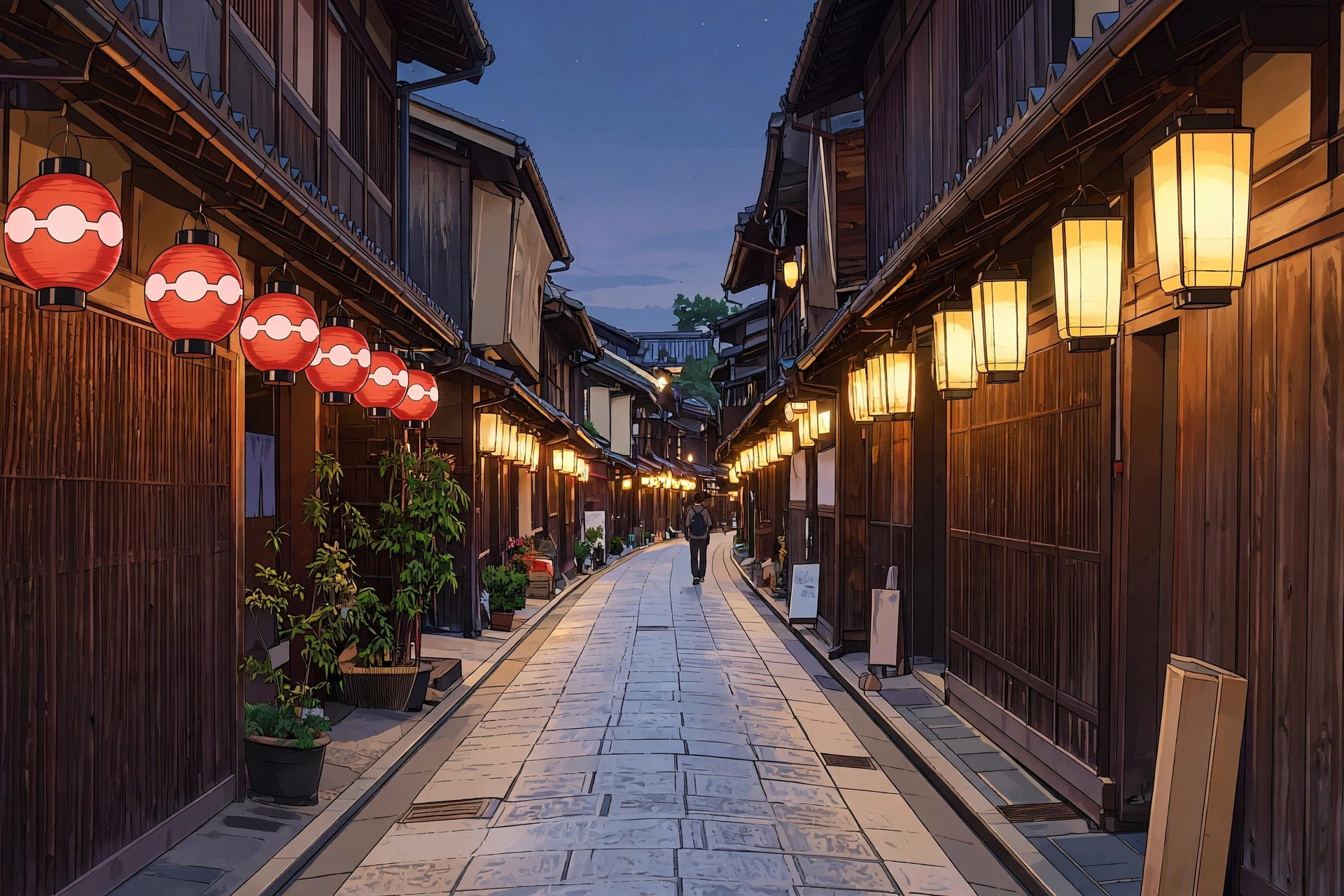
Gion after dark is the Kyoto most visitors picture when they close their eyes: wooden machiya glowing under paper lanterns, a narrow street gone quiet, and then a flash of white face paint and a silk obi disappearing around a corner. The problem is that most evening visitors treat this living neighbourhood like a film set, and the district has had enough of it.
This walk reframes the evening as exactly what it should be: a respectful stroll through one of Japan's most intact historic districts, on the public streets, with the real rules explained. You will know where to walk, what the signs mean, and how to behave if you are lucky enough to see a geiko or maiko on her way to work. And when the walk is done, you will know where to go for dinner.
The evening route: Hanamikoji and the side streets
Walk Hanamikoji-dori, keep to the public streets, and treat any geiko or maiko you see as a commuter, not a photo opportunity. Avoid the private alleys, where a 10,000 yen fine applies, photograph the architecture instead, and book a performance if you want the real thing up close.
Start at the north end, where Hanamikoji crosses Shijo-dori. The busiest crossing point is a short walk east of Keihan Gion-Shijo station, which makes this an easy evening to slot in on the day you arrive in Kyoto — and if you are still working out how to get there, the guide on how to reach Kyoto from Tokyo without the national rail pass covers the transport side so you can spend the evening on the ground instead of in transit. From the crossing, head south along Hanamikoji-dori. The first blocks are the most commercial: kimono rental shops, souvenir stands, and cafés. The character of the street changes as you go deeper south, where the wooden facades close in, the lanterns multiply, and the traffic noise from Shijo-dori falls away.
This southern stretch, between roughly Shijo-dori and the Yasaka Shrine side streets, is the part of the walk that matters. The ochaya — the private teahouses where geiko and maiko entertain — sit behind these facades, and this is where you have the best chance of spotting one crossing from an okiya (the lodging house where maiko live) to an evening engagement. The window is narrow: roughly 17:00 to 20:00, with Fridays and Saturdays the busiest. Sightings are never guaranteed, and treating them as the goal of the walk is precisely the mindset that caused the district's problems. Walk the street for the street.
From Hanamikoji, detour east along the Shirakawa canal. The canal-side lanes around Shirakawa-minami-dori are noticeably quieter than Hanamikoji, with stone bridges, willows, and a row of preserved townhouses that photograph beautifully in the early dark. This is a good place to slow down and let the Hanamikoji crowds thin. Then loop back west and continue south toward Yasaka Shrine, which sits at the district's eastern edge. The shrine is lit in the evening and makes a natural midpoint: the main hall and its rows of lanterns are open to visitors, the grounds are free, and the atmosphere shifts from commercial street to sacred space in about fifty metres.
South of the shrine, the lanes of Gion Higashi continue the walk, but this is where you need to start reading the street rather than following it. Many of the narrow lanes branching off here are privately owned roads. If a sign at the mouth of a lane tells you not to enter or warns against photography, that sign is your answer — walk past it on the public street. The main thoroughfares — Hanamikoji-dori and the canal-side walk — remain open to everyone, and they contain everything the walk needs.
Plan for about ninety minutes of unhurried walking, including the Shirakawa detour and a pause at Yasaka Shrine. Wear comfortable shoes; the streets are narrow, uneven in places, and the side lanes are cobbled. The walk works in any season, but the early dark of autumn and the warm lantern light against winter's early nightfall are the best versions of it.
Geisha-spotting etiquette that matters
If a geiko or maiko appears on the street, the single most important thing to understand is that she is at work. A maiko in full dress crossing Hanamikoji at dusk is not performing for you; she is commuting to an appointment, on a schedule, through her own neighbourhood. Every rule that follows flows from that one fact.
Do not follow her. Do not block her path to frame a photo. Do not touch her kimono or obi, reach for her sleeve, or call out for her to turn and look at the camera. All of this has happened, repeatedly, to the point where the district's residents started calling the worst offenders "maiko paparazzi" — tourists chasing women through narrow lanes with phones held sideways, treating a working professional like a character in a theme park. That pattern of behaviour is what produced the private-street ban, and continuing it on the public streets will keep the district's patience exactly where it is now: exhausted.
Do not photograph a geiko or maiko without her consent. On the public streets, photography of the architecture is fine; photography of a person without asking is not. If you want to ask, the phrase is "shashin wo totte mo ii desu ka" (may I take a photo?). Accept a no gracefully — and expect that most of the time the honest, respectful answer is not to ask at all, since she is on her way somewhere. Admire from a distance and keep walking.
Keep your voice down in the residential lanes after dark. People live behind these facades — the ochaya staff, the okiya residents, the families who have occupied these houses for generations — and the evening crush of tour groups is loud. A quiet street that suddenly fills with raised voices is exactly how a neighbourhood stops feeling like a neighbourhood. The same applies to eating and smoking while walking: don't. It is considered poor manners on Japanese streets generally, and in a historic preservation district at night it reads as carelessness.
Travel in a small group if you can, or walk the street solo. Large guided groups move loudly and block the narrow lanes; if you do join an evening walking tour, pick one that explicitly briefs its guests on the etiquette before setting out, and treat any operator that promises guaranteed sightings or close encounters as a warning sign. The good tours frame themselves as cultural walks with a possible sighting, not a chase.
What the private street signs mean
In April 2024, the Gion residents' council — the local association of residents and shop owners — barred tourists from the private lanes of the district. The signs posted at the mouths of these alleys say, in Japanese and English, that entry is prohibited and that violations carry a 10,000 yen fine. This is the sign to understand literally: if it is there, the lane behind it is off limits.
A few points of precision matter here, because the ban is widely misreported. First, it applies only to designated private streets — the narrow alleys branching off Hanamikoji and the lanes behind the ochaya. Hanamikoji-dori itself is a public road and remains fully open to visitors; the Shirakawa canal walk is public too. Gion is not closed to tourists, and anyone telling you the whole district is off limits is working from an outdated or exaggerated version of the story.
Second, the rule comes from the residents' council, not from national law or the city government. It is a private-property rule enforced by the council for its own streets, and Kyoto city has publicly backed it with official notices. That distinction does not make it optional. Treat the signs as binding wherever you see them; the council's enforcement, including patrol staff in the evenings, is active, especially during peak seasons.
Third, the fine is attached to entering the designated private lanes, and the signage also warns against photographing geiko and maiko in these areas. The 10,000 yen figure — roughly 65 US dollars — is the number printed on the signs. Whether every violation is actually penalised on the spot is beside the point; the sign is the community telling you, in writing, in your language, that you are not welcome in that lane. Ignoring it is a choice to be the kind of visitor the district is trying to keep out.
Practically: when a lane's entrance has a notice, stay on the main street. When you are unsure whether a lane is public or private, treat it as private. The main streets contain the entire evening walk — the facades, the lanterns, the shrine, the canal — and nothing in a private alley improves on it enough to justify the fine or the intrusion. The signs are doing you a favour by removing the guesswork.
Tea houses vs restaurants: what tourists can enter
The wooden facades along Hanamikoji look like restaurants. Most of them are not — at least, not in any sense a tourist can use. Understanding which doors are real options and which are closed worlds is the difference between a frustrating evening and a good one.
An ochaya is a private teahouse where geiko and maiko entertain guests over kaiseki meals and sake. From the street, ochaya look like shuttered wooden townhouses: no signboard, no menu in the window, no listed phone number. The Ichiriki Ochaya, the most famous, has stood on the corner of Hanamikoji and Shijo-dori for over 300 years, and its red exterior wall is among the most photographed in Kyoto. You cannot walk in. The reason is the "ichigen-san okotowari" rule — no first-time guests without an introduction from a trusted existing client. Ochaya run on long trust networks because guests pay monthly accounts rather than settling bills on the night, so without an introduction from someone the house already knows, a visitor cannot make a reservation regardless of budget. This is not snobbery and it is not negotiable; it is how the institution has worked for centuries, and it is the same principle that keeps the private lanes private. The ochaya decides whom it receives, on the strength of relationships that money alone cannot buy.
A restaurant is everything else, and restaurants in Gion are open to anyone who can get a table. The renovated machiya along Hanamikoji and the canal house some of Kyoto's best kaiseki counters, obanzai pubs, and sake bars, and none of them require an introduction. The practical move for most visitors is simple: eat at a restaurant, not an ochaya. If a doorway has a menu, a noren curtain, or a visible signboard, it wants your business; if it looks like a beautiful blank wall, it does not.
Between those two categories sit the experiences built specifically for visitors who want to see geiko and maiko culture without a private connection. Gion Corner, the theatre at the south end of Hanamikoji, stages condensed traditional-arts performances — Kyoto-style dance, koto, tea ceremony — performed by real geiko and maiko, with shows typically in the evening and lasting about an hour. It is the easiest legitimate way into the world, and it fits neatly after the walk. The district's two public dance theatres also open their doors seasonally: Gion Kobu stages the Miyako Odori every April, a month of daily performances dating to 1872, and Gion Higashi answers with the Gion Odori each November. Both are ticketed and open to anyone who reserves a seat, putting the training the private lanes protect onto a public stage on the district's own terms.
Two more options exist for a closer look. The Gion Kagai Art Museum pairs an exhibit on geiko and maiko culture — kimono, kanzashi hair ornaments, personal items — with kyomai dance performances by a geiko or maiko, scheduled several times through the afternoon. And a handful of operators arrange ozashiki-style evenings — a private dinner with a maiko, dance, conversation, and parlour games — through established venues with a connection to the hanamachi. These are real, structured, and arranged through intermediaries rather than walk-in bookings; book through a reputable operator, confirm the format and group size in advance, and treat the evening's etiquette rules (photography only as the host permits, follow the geiko's lead) as binding.
The honest summary: the ochaya door is closed to you, and that is fine, because everything else — the walk, the theatre, the museum, the arranged dinner — is open, bookable, and better than a street chase.
Pairing it with Pontocho dinner
A Gion evening walk pairs naturally with dinner across the river in Pontocho, and the pairing is the standard Kyoto evening for a reason: Gion gives you the atmosphere, Pontocho gives you the table, and the two sit ten to fifteen minutes apart on foot.
Pontocho is the narrow alley running north-south between Sanjo-dori and Shijo-dori, one block west of the Kamo River. From the south end of the Gion walk, cross Shijo Bridge westward and turn onto the first small street on your right — the whole transfer takes about four minutes. The alley itself is one of Kyoto's great dining streets: a tight lane of wooden townhouses holding kaiseki counters, obanzai pubs, counter sushi spots, standing bars, and izakaya, with many kitchens starting service around 17:00. The riverside terraces (kawadoko) that extend over the Kamo River in summer are the famous version, but the alley is worth it in every season.
The alley has three entrances, and the choice matters at dinner hour. The southern entrance at Shijo-Kiyamachi is the most crowded between 18:00 and 20:00; the northern entrance at Sanjo-Kiyamachi is quieter and preferred by locals; the mid-point near Rokkaku Street is unmarked and easy to miss. Entering from the north during the dinner rush lets you walk with the foot traffic instead of against it.
Pontocho also has its own smaller hanamachi — geiko and maiko work these streets too, on the same introduction-based system as Gion's — so the evening's etiquette travels with you across the bridge: no chasing, no blocking, no intrusive photography of anyone actually working.
The sequence that works: start the Gion walk around 17:30, give it the full ninety minutes including Yasaka Shrine, and cross to Pontocho around 19:00 to 19:30, when the alley is at its liveliest and the lantern light is doing its best work. Book dinner ahead if you have a specific restaurant in mind — the well-known counters fill up — or walk the alley and pick a spot with a visible menu and an open seat, which in Pontocho is a perfectly good strategy. Some places run Japanese-only menus, so check for an English menu in advance if that matters to you. Finish with a walk back along the Kamo riverbank, where the city's lights reflect on the water, and the evening is complete: the walk, the rules respected, dinner done, nothing chased.