Long layover at Incheon: the free transit tour and what you can do

A long layover at Incheon Airport is a gift most travelers waste on a departure-lounge seat. If you have four hours or more between flights, you have enough time to leave the airport entirely — legally, cheaply, and with a guide who handles the logistics. Incheon runs an official free transit tour program for passengers with layovers between four and twenty-four hours, and it is the simplest way to turn a connection into a short trip to Seoul or the Incheon waterfront.
The catch is that everything about the program is conditional: your nationality's entry rules, your exact layover window, which tours run on your travel date, and how fast you get yourself to the registration desk. This guide walks through the arithmetic so you can decide in advance whether the tour works for your connection, or whether you are better off with a self-guided Seoul run or a quiet hour in the terminal's cultural programs.
Free means free — the bus, the guide, and the schedule are covered — but the program is built for travelers who can clear Korean immigration and be back in time. Work through the sections below in order and you will know before you land whether the tour is your answer, what it actually costs, and how much buffer to protect your onward flight.
Check the eligibility window first
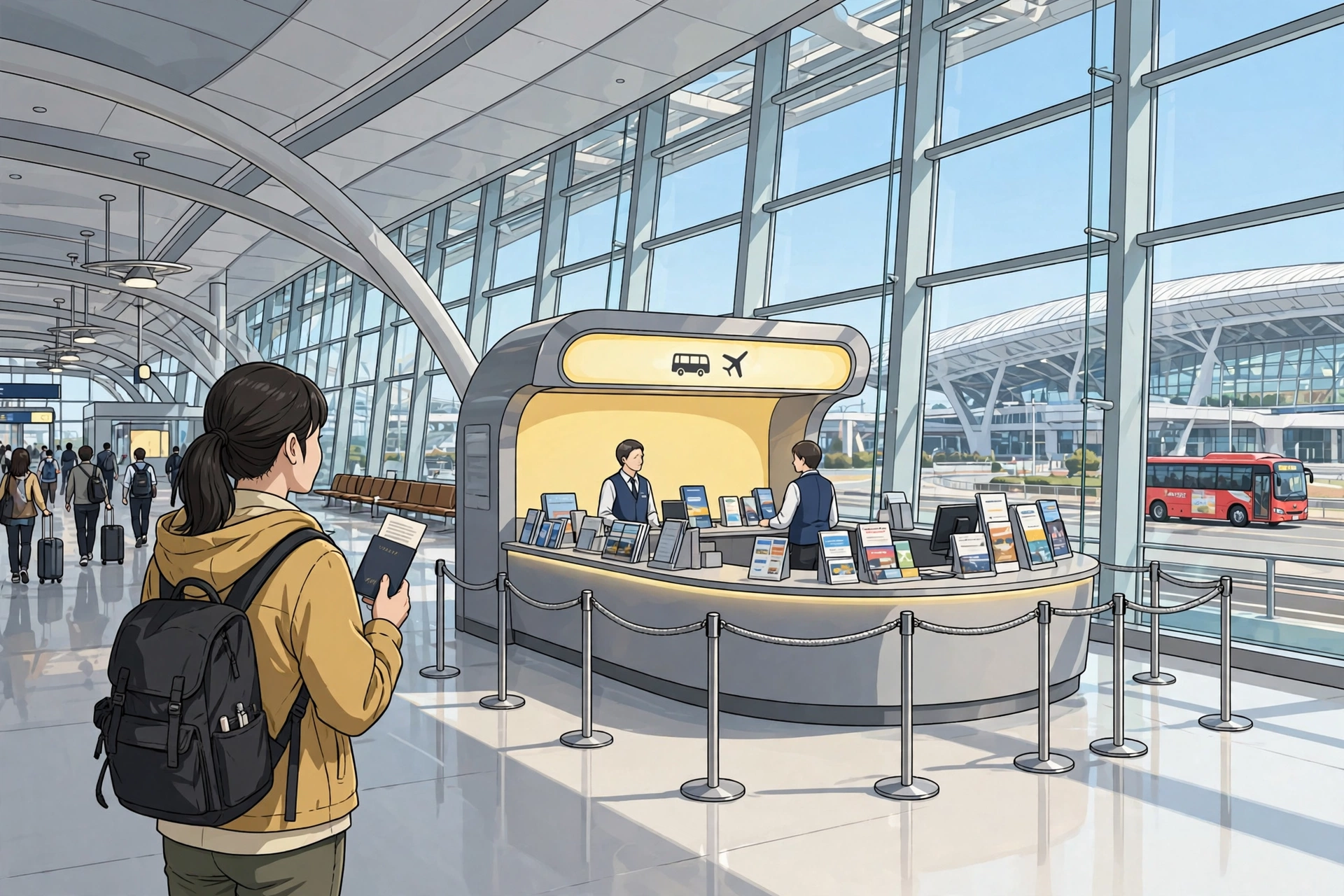
Incheon Airport runs free guided transit tours for passengers with four to twenty-four hour layovers. Bring your passport and both boarding passes, register at the first-floor transit tour desk, and choose a one, three, or five-hour course. The bus and guide are free; budget amounts for entry fees and meals.
That sentence covers the core of the program, but eligibility has edges worth checking before you count on a tour. The official requirement is a layover of twenty-four hours or less — anything longer disqualifies you. The practical floor is about four hours: below that, immigration, the tour, and re-clearing security do not fit together safely. Your onward boarding pass must be confirmed at registration, so this is for real transit passengers, not open-ended stopovers.
Registration is first-come, first-served, both for online bookings and walk-ups. An online reservation helps but is not a guaranteed seat — the airport releases unclaimed seats to a waiting list thirty minutes before each departure, so even a confirmed booking evaporates if you arrive late. Programs change without notice, which means the course list you research at home is a menu of possibilities, not a promise. Confirm what is running on your travel date at the desk when you land.
Sort out entry clearance before you commit
Joining a transit tour means legally entering South Korea, and the airport is explicit about this. You need one of three conditions: visa-free entry for your nationality, transit-without-visa status (for example, holding a valid visa or permanent residency from the United States, Canada, Australia, New Zealand, or one of the covered European countries while transiting to or from one of those places), or a general transit passenger status that immigration accepts for the tour. Even visa-exempt travelers may need a K-ETA approval unless their country is covered by a temporary exemption — check your status on k-eta.go.kr before you fly, not in the immigration hall.
Two details catch people out. First, staying airside (not leaving the airport) needs no K-ETA or visa for nearly all nationalities, but the moment you clear immigration for a tour, normal entry rules apply. Second, Korea's Ministry of Justice does not allow two entries into the country during a single visit: if you already cleared immigration to see Seoul independently on the same trip, you cannot also join the free tour program on the same visit. Plan one or the other.
For Singapore-based travelers, the practical takeaway is simple: verify your entry status on the official visa portal (visa.go.kr) and the K-ETA site at least a few days before departure. Entry exemptions change — K-ETA exemption arrangements have expiry dates — and an airline will not let you leave the transit flow if your documents do not check out. If your entry status is uncertain, the terminal alternatives in this guide need no immigration at all.
Get to the transit tour desk fast
Every minute between landing and registration is a minute taken from your tour window, so know the desk locations before you touch down. In Terminal 1, the transit tour registration desk is on the first floor, after immigration, near Gates 1 and 2 (desks 19 and 20). In Terminal 2, it is on the first floor on the landside after immigration, across Exit 4 (desks 5 and 6). Both terminals also have information desks on the second and third floors that can point you in the right direction.
The single most useful trick is routing: after clearing immigration, do not go up to the departure level on the third floor from the arrivals level on the second floor. Instead, head directly down to the first floor through the Ministry of Justice entrance on the second floor — the airport's own guidance flags this as the time-saving route. If you land at the Concourse, take the shuttle train on your own to Terminal 1 or Terminal 2 first, then find the desk on the first floor.
Bring your passport and the boarding passes for both your arrival and departure flights — these are the registration documents, and the desk will not process you without them. Arrive at least thirty minutes before the tour's scheduled start; that is the cutoff after which your seat can be reassigned to someone on the waiting list. If you want to ask questions before your trip, the airport lists dedicated lines: Terminal 1 at +82-32-741-3139 and Terminal 2 at +82-32-741-0060, plus email at transferinfodesk@gmail.com.
Pick a tour matched to your layover length
Tours are grouped by duration, and the right choice is the one that leaves you a real buffer — not the longest tour that technically fits. Course lineups rotate with operations, so treat the categories below as the current shape of the program and confirm availability at the desk.
One hour: stay near the airport
The shortest courses stay in the airport's orbit — Paradise City's art exhibitions and the seaside walks near Incheon Airport are the typical shape. These are the pick for layovers in the four-to-five-hour range where immigration and re-entry alone will consume a big slice of your time. You get off the bus, see something that is definitively not a departure lounge, and get back with margin to spare.
Two to three hours: the Incheon area
The mid-length courses reach the historic and coastal side of Incheon: Jeondeungsa Temple, one of the oldest temples in the region, Bomunsa Temple, or Wolmi Park. This is the sweet spot for a six-to-eight-hour layover — enough time for a proper stop or two without the highway time a Seoul run demands. Temples and waterfront parks also photograph well and need no entrance-fee planning beyond small change.
Four to five hours: Seoul proper
The long courses go into central Seoul: Gyeongbokgung Palace, Insadong's shopping and craft streets, the Blue House area, Hongdae, or Gwangjang Market. Only consider these with nine or more hours between flights — the bus needs real highway time in both directions, and palace visits add entry fees and walking time. The palace course is the program's signature, but it is also the one most sensitive to schedule slips, so build extra buffer if you choose it.
The DMZ option
A special course visits the Odusan Unification Observatory for a look at the divided peninsula's history, typically paired with nearby sites. It carries a small entry fee (around four dollars for the tunnel sections on some courses) and a longer drive, so it suits travelers whose layover is generous and whose interest is history rather than shopping. As with every course, confirm it is running on your date — this is the one most likely to be adjusted or suspended.
One more planning note on course selection: the program's published schedule lists several more courses than run on any given day, and the lineup shifts with the season and operations. Do not build your whole layover around a single specific stop you saw in a blog post from two years ago. Instead, arrive with a ranked preference — for example, Seoul palace course first, Incheon temple course as backup — and take what the desk confirms. The desk staff handle hundreds of transit passengers a week and will tell you straight which course fits your remaining window.
What the free tour actually costs
The bus and the guide genuinely cost nothing — that is the program's whole proposition, and it has run for years on that basis. What is not free are the small personal expenses along the way. Palace entry fees, market snacks, a coffee in Insadong, or a meal stop add up to roughly 2,000 to 10,000 KRW per person depending on the course and your appetite. Two of the longer courses carry small fixed entry fees: about three dollars for the palace course and about four dollars for the DMZ tunnel sections.
Practical advice: carry a small amount of Korean won or a working credit card. Tour buses are not set up for large-luggage storage either — if you have heavy bags, use the airport's luggage storage before joining, since most tour vehicles cannot accommodate them. Storage counters sit on the basement level and the third-floor departure level, and they charge a fee, so factor in a few extra minutes each way to drop and collect your bags. Joining a tour with just a daypack keeps boarding quick and your seatmates happy. None of these costs approach what a private layover tour would charge, which is exactly why the program exists: it makes a guided Korea stopover accessible to any transit passenger who qualifies.
What to do inside the terminal instead
If your layover is under four hours, your entry status is uncertain, or you simply prefer not to gamble on timing, Incheon itself is a better airport than most cities' downtowns. Both Terminal 1 and Terminal 2 host Korean Traditional Culture Centers in the departure corridors — free programs of about thirty minutes where you can try on hanbok for photos or make a traditional craft to take with you. These are airside, so no immigration, no entry clearance, and no risk to your connection.
Beyond the culture centers, the terminal rewards slow exploration: viewing decks, the transit-area gardens, and long duty-free stretches that are genuinely pleasant to walk. Pair the hanbok photo session with a proper Korean meal in the transit area, and a four-hour layover stops feeling like a wait at all. The key advantage of staying inside is certainty — you never trade a tour against a boarding call. For layovers in the two-to-four-hour range, the culture center plus a proper meal is a complete plan, and it beats white-knuckling a tour that does not fit.
Going solo: Seoul by AREX without a tour
With eight or more hours and confidence in your navigation, the self-guided Seoul run is the flexible alternative to the group tour. The AREX airport train runs from Incheon to Seoul Station in about 43 to 51 minutes on the express service, or 59 to 66 minutes on the all-stop train — budget 60 to 90 minutes each way door to door once you include immigration and the final leg into the city. Hold a strict three-hour buffer before your outbound flight: that means arriving back at the airport three hours before departure, not leaving Seoul three hours before.
The DIY route suits travelers who want one specific thing — a meal in a particular neighborhood, a palace at their own pace, shopping on a list — rather than a bus window of the greatest hits. It also demands more from you: buying tickets, navigating transfers, and owning the return timing with no guide herding you back. If you have never cleared immigration as a transit passenger before, build extra time for the unfamiliar steps rather than assuming the fastest published transit time. For a fuller breakdown of the airport-to-Seoul options, see our Incheon Airport to Seoul transport guide for the train-versus-bus-versus-taxi decision.
Note the same entry-clearance rules apply: leaving the airport on your own requires the same visa, K-ETA, or transit-without-visa status as joining the tour. And if your trip involves another airport transfer entirely — a different gateway city on the way home — the same planning logic applies; see our airport arrival transfer chooser for how to weigh time, cost, and certainty at an unfamiliar airport.
Get back to your gate with a buffer
Every option in this guide lives or dies on the return leg. The tour coaches run tight schedules — guides say it plainly and stragglers do get left — and the airport's own FAQ puts it bluntly: if you miss the meeting point and the group has left, getting back is entirely your responsibility, by whatever is fastest. That is not the program being harsh; it is the program protecting everyone else's connections.
Work backward from boarding, not from departure. If your flight boards at 18:00, you want to be airside, through security, and at the gate area by 17:40 at the latest — which means the tour must return you to the terminal well before that, and you must clear exit formalities and security between the bus and the gate. For the five-hour Seoul courses, that arithmetic is the whole decision: a nine-hour layover gives the tour five hours plus four hours of immigration, buffers, and security, which is comfortable. An eight-hour layover gives the same tour three hours of slack, which is workable but leaves no room for a delayed bus.
The same buffer discipline applies to the DIY AREX run and even to staying in the terminal: know your gate's location (the Concourse requires a shuttle train ride from the main terminals), keep your onward boarding pass accessible, and set a phone alarm for the moment you must head back, not the moment boarding starts. A layover well spent is one where the last hour is boring — seated, hydrated, and already past security.