Kobe day trip from Osaka: beef, harbor, and Arima onsen

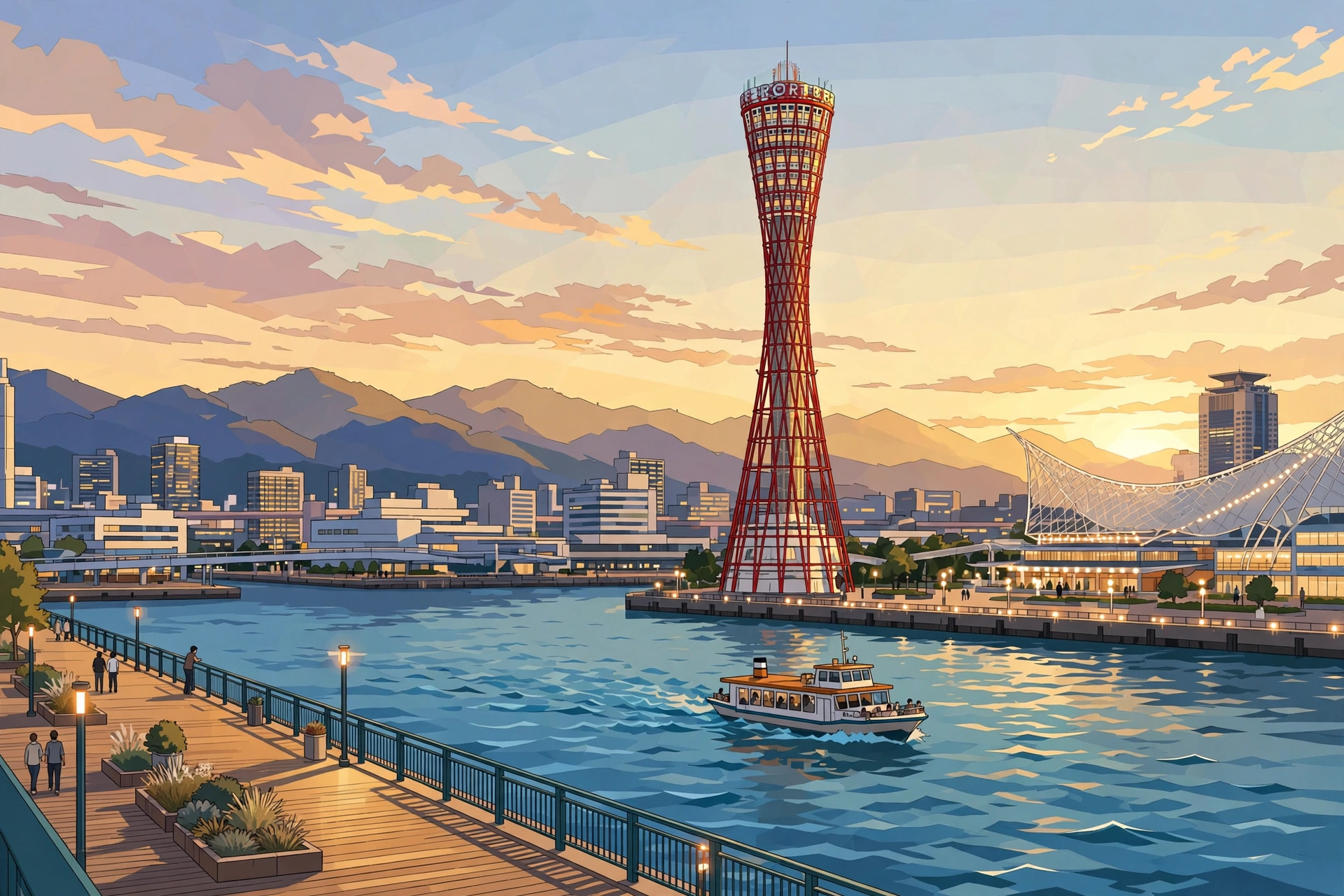
Kobe sits about 30 minutes west of Osaka, and it packs three things Osaka can't quite match into a very walkable footprint: real Kobe beef at lunch prices, a proper waterfront, and one of Japan's oldest hot spring towns in the hills behind the city. The trick to the day trip is sequencing by geography. Eat in Sannomiya, walk through Chinatown to the harbor, then head uphill to Arima onsen for the finish. Nothing backtracks.
Getting there: Hanshin vs JR
From Osaka's Umeda district, the fastest cheap ride to Kobe is the JR Special Rapid: about 22 minutes to Sannomiya for ¥420. Hanshin's direct express takes roughly 31 minutes for ¥330, so JR saves about ten minutes for ¥90 more. Both run frequently and need no reservation.
That is the whole decision for most day-trippers, but the details matter once you are on the ground. All three competing lines leave from Umeda, but from different stations within it. The JR Kobe Line departs from JR Osaka Station (the big one). The Hanshin Main Line departs from Hanshin Osaka-Umeda Station. The Hankyu Kobe Line departs from Hankyu Osaka-Umeda Station. They are all within a few minutes' walk of each other underground, so pick the one closest to wherever you surface.
Why JR usually wins
Speed is the main argument. The JR Special Rapid runs up to 130 km/h and does Osaka to Sannomiya in 21 to 22 minutes; to Kobe Station itself is 27 to 32 minutes for ¥460. Hanshin's direct express needs about 31 minutes to Kobe-Sannomiya for ¥330. The Hankyu Kobe Line is similar to Hanshin — roughly 27 to 33 minutes for ¥330. If you hold a Japan Rail Pass or a JR West Kansai Area Pass, JR is also free at the point of use, which makes the ¥90 fare difference irrelevant. The private lines (Hanshin, Hankyu) are not covered by any JR pass.
The secondary argument is destination. In Kobe, the three lines land in slightly different spots. JR Sannomiya is the main hub and the best starting point for a beef lunch near Sannomiya or a subway transfer to Arima. The Hanshin station (Hanshin Kobe-Sannomiya) sits a little to the south, marginally closer to the harbor. The Hankyu station sits a little to the north, marginally closer to the mountain side. For a day trip built around lunch, harbor, and onsen, JR Sannomiya is the simplest base.
The Hankyu option and IC cards
Hankyu deserves one mention because its limited expresses are comfortable and the ¥330 fare is the joint-cheapest of the three. If you are staying near Hankyu Umeda anyway, take it. Otherwise JR is faster. Whichever you choose, tap an IC card (Icoca, Suica, or any compatible card) and walk through — there is nothing to book, and trains run every few minutes all day. A Shinkansen from Shin-Osaka to Shin-Kobe exists (about 12 minutes), but at ¥2,100+ it makes no sense for a day trip when the local lines are this fast.
The return leg
Plan the return after Arima, not after the harbor. The direct Hankyu highway bus from Arima back toward Osaka-Umeda costs about ¥1,400 each way and removes a transfer, which is worth knowing if your legs are done. Otherwise, reverse the train route you came on. Last trains run well past midnight, so an evening onsen finish is never a problem.
Kobe beef: lunch sets that are worth it
Here is the math that makes the whole day trip worth doing: a Kobe beef lunch set typically costs ¥3,000 to ¥15,000 and is served between roughly 11:00 and 14:00, while the same grade of meat at dinner can easily run two to three times that. Lunch is the arbitrage. You eat the same certified beef, cooked the same way, for the price of a nice dinner anywhere else.
Steakland: the classic budget pick
Steakland Kobe, a short walk from Sannomiya Station in the Kitanagasadori area, is the name that comes up in every budget guide, and it is there for a reason. Its Kobe beef lunch set — about 150 grams of teppanyaki-grilled Kobe beef with rice, miso soup, grilled vegetables, pickles, and a coffee or juice — runs roughly ¥3,000 to ¥3,500. A chef cooks it on the iron griddle in front of you, which is half the experience. It is not a white-tablecloth room; it is a busy, fast-turnover teppanyaki hall, and the value is the point.
Two practical rules for Steakland. First, order the set explicitly labeled "Kobe Beef" — the menu also has ordinary (non-Kobe) beef sets, and the price difference is the whole point of being there. Second, arrive early. Queues form before the lunch window opens, and the restaurant turns tables fast, so a 11:00 or 11:30 arrival beats a 12:30 one.
Mid-range and splurge lunches
If you want a calmer room, the Kissho Kichi group's Wa no Miya runs limited-time lunch courses around ¥6,500 per person, combining Kobe beef steak with seafood teppanyaki over about 90 minutes. At the harbor end of the spectrum, Gochikura in Mosaic Harborland sells a Kobe beef "enjoyment set" for about ¥12,000 — steep, but it sits you at the waterfront and has historically bundled extras like a Ferris wheel ticket. Pick the tier that matches your budget; the beef itself is certified either way.
How to make sure it is actually Kobe beef
Kobe beef is not a generic term for good Japanese beef. Genuine Kobe beef comes from Tajima cattle raised in Hyogo Prefecture, graded by the Kobe Beef Association, and restaurants authorized to serve it display the association's bronze cow statue and registration. If a lunch menu says "wagyu" without the word "Kobe," it is not Kobe beef. Ask or check the statue by the door. The marbling you are paying for — the fat that melts at a lower temperature than regular beef — is exactly why the chef sears it fast and serves it medium-rare; overcooking it melts the flavor away.
Budgeting the meal
Treat ¥3,500 as the floor for a real Kobe beef lunch set and ¥7,000 as a comfortable mid-range ceiling. Drinks and side orders inflate the bill fast at teppanyaki counters, so check the menu before you sit and order only what you came for. You will be eating again in Chinatown within two hours anyway.
Harborland and the earthquake memorial
From Sannomiya, the harbor is a 15 to 20 minute walk south, or one stop on the subway to Minato Motomachi. Budget two to three hours here in the afternoon, including the waterfront promenade.
Harborland, Mosaic, and Meriken Park
Harborland is the shopping and dining complex on the waterfront — the umie malls on one side, the Mosaic building with its open-air waterfront restaurants on the other, and a Ferris wheel between them. It is pleasant in daylight and genuinely good after sunset, when the whole waterfront lights up. Walk east along the water from Harborland into Meriken Park, the seaside park with the big red "BE KOBE" monument that everyone photographs.
The landmark in the middle of all this is Kobe Port Tower. The 108-meter red tower — shaped like a tsuzumi hand drum, all lattice steel piping — closed in 2021 for seismic strengthening and a full renewal, then reopened on April 26, 2024 with a new rooftop observation deck and a 360-degree rotating cafe. The lower floors (shops, a restaurant with a terrace) are free to enter; the observation area with its five decks and rooftop is ticketed, around ¥1,000 for the deck. Entry to the main observation area uses date-and-time tickets, and buying ahead is recommended on weekends to avoid waiting. Go up if the sky is clear; skip it on hazy days and spend the time walking instead.
The earthquake memorial: worth the detour
The Great Hanshin-Awaji Earthquake Memorial — officially the Disaster Reduction and Human Renovation Institution, or DRI — commemorates the January 17, 1995 earthquake that killed over 6,400 people and destroyed much of the city. It is in HAT Kobe, east of the city center: about 10 minutes on foot from Hanshin Iwaya or Kasuganomichi stations, or 12 minutes from JR Nada. Hours are 9:30 to 17:30 with last admission at 16:30, closed on Mondays (and the New Year holiday); admission is free on the 17th of every month.
The visit starts with a seven-minute film recreating the 5:46 a.m. quake, then moves through a diorama of the destroyed streets, a documentary on the reconstruction, survivor stories, and interactive disaster-preparedness exhibits. English signage is good. Allow 90 minutes. It is the one stop on this itinerary that changes how you see the rest of the city — the harbor you just walked was rebuilt from this.
Note the geography, though: the memorial is east of Sannomiya, while the harbor and everything else today is south and west. It is a detour of about an hour round-trip including the visit. If you are doing Arima in the evening, go to the memorial right after lunch (13:30 to 15:00) and treat the harbor as the late-afternoon walk on the way back west. If you are short on time, the memorial is the stop to cut — Harborland and the tower keep the day intact.
Arima onsen as a half-day add-on
Arima is one of Japan's three oldest hot spring towns, sitting in the hills behind Kobe but still inside the city limits. It is the natural finish to this itinerary: you have walked all day, and the town exists to fix exactly that. The question is whether you have three hours to spare, because that is what Arima takes door to door from the harbor area.
Getting there from central Kobe
The standard route from Sannomiya: Kobe municipal subway from Sannomiya to Tanigami, cross the platform to the Shintetsu (Kobe Electric Railway) Arima Line, ride to Arimaguchi, change to the one-stop Arima Onsen branch. Through-tickets are sold at Sannomiya subway station; the combined fare is ¥680 and the trip takes about 38 minutes. From Osaka, budget 60 to 90 minutes total depending on the route, which is why Arima works best as the tail end of a Kobe day rather than a standalone trip from Osaka.
The budget alternative is the bus: several daily departures from Sannomiya bus terminal take about 50 minutes for ¥720, no transfers. And the best-value ticket in town is the JR bus Arima Onsen Yokubari Kippu — a Sannomiya round trip bundled with entry to both public bathhouses for ¥2,400. If you plan to try both springs, that bundle is cheaper than train plus separate admissions.
Kinsen vs Ginsen: the two springs
Arima's fame rests on two very different waters. Kinsen, the "gold spring," is iron-rich and turns reddish-brown on contact with air; it is the one people picture when they think of Arima. Ginsen, the "silver spring," is clear, carbonated, and gentle. The town's two public bathhouses split them: Kin no Yu (gold) and Gin no Yu (silver). Kin no Yu charges roughly ¥700 to ¥800 for adults and is open 8:00 to 22:00 (closed the 2nd and 4th Tuesdays); Gin no Yu is cheaper, around ¥550 on weekdays. A combination ticket for both runs about ¥1,200.
If you only have time for one bath, pick Kin no Yu — the gold spring is the signature experience. Bring your own towel or buy one there, and note that visible tattoos are generally not permitted in the public bathhouses; some ryokan private family baths accept tattooed guests, but confirm directly before going.
Fitting it into the day
The realistic Arima add-on looks like this: leave the harbor area by 15:00, reach Arima by 16:00, soak and stroll the town's lanes (try the carbonated rice crackers baked fresh at the shops near the station) until 18:00 or 18:30, and be back in Osaka around 20:00. The town itself is small — winding lanes, temples, sweet shops — and an hour of wandering plus an hour of bathing is the right dose.
The trade-off is the earthquake memorial. Doing both the memorial and Arima in one day is possible but rushed; the comfortable version of this itinerary picks one. If hot springs are the priority — and after a full day of walking they should be — the harbor-to-Arima sequence is the better evening. If you are traveling with someone who wants the history, do the memorial and save Arima for a dedicated half-day on another trip. Either way, decide by mid-afternoon; Arima's last admissions are not late.
Nankinmachi Chinatown: eat on the walk
Nankinmachi sits directly on the route between Sannomiya and the harbor, which is why it belongs in this itinerary as a walking stop rather than a destination. From Sannomiya it is 10 to 15 minutes on foot; from Motomachi Station on the Hanshin or JR line it is 2 to 5 minutes. You will pass it on the way to the water — plan to arrive hungry and graze.
The district centers on a small square with covered arcades running to gates at each cardinal direction, all red lanterns and tiled roofs. It dates to the 19th century, when Chinese merchants settled near the newly opened port, and it was rebuilt twice — after wartime bombing and after the 1995 earthquake. Today it is about a hundred shops and stalls in a compact grid, and the correct way to do it is on foot with cash in hand.
Eat the street food, not a sit-down meal — you had the beef an hour ago. The greatest hits: butaman (steamed pork buns), xiaolongbao (soup dumplings — bite, sip the broth, then eat), pan-fried gyoza with Kobe's local miso-based dipping sauce, and chimaki (sticky rice in bamboo leaves). Roshoki's pork buns, five for ¥600, draw the longest line in the district but move fast. Panda buns, sesame balls, and fried snacks run ¥200 to ¥300 each. An hour and ¥1,000 to ¥1,500 of grazing covers it.
Two practical notes. Most stalls are cash-only, so hit an ATM before you arrive. And go in the afternoon, not the evening — many shops close around 21:00 to 23:00, and the daytime version with the stalls open is the experience you came for. On the way out, you are already pointed south toward Harborland; the walk from Nankinmachi to the waterfront is about 10 minutes.
Putting the day together
The geography does the planning for you. Morning: JR Special Rapid from Osaka to Sannomiya, arriving by 10:30. Late morning: Kobe beef lunch set near Sannomiya (budget ¥3,500 to ¥7,000, out by 13:00). Early afternoon: walk through Nankinmachi grazing on street food (13:30 to 14:30), continue to Harborland and Meriken Park, up the Port Tower if the sky cooperates (14:30 to 17:00). Then choose your ending: Arima onsen for the soak (out by 18:30, back in Osaka by 20:00) or the earthquake memorial for the history (13:30 to 15:00, harbor after).
Total damage for the comfortable version, excluding shopping: about ¥420 train each way, ¥5,000 beef lunch, ¥1,500 Chinatown grazing, ¥1,000 Port Tower, ¥1,500 onsen and snacks — roughly ¥10,000 for the day, or about ¥8,000 if you skip the tower and take the Yokubari bundle to Arima. Still undecided between Kobe and its rival day trip? Read Nara vs Kobe: which day trip from Kyoto fits your travel style to settle it before you commit the day.