Zhangjiajie: how many days, which gates, and the cable-car order

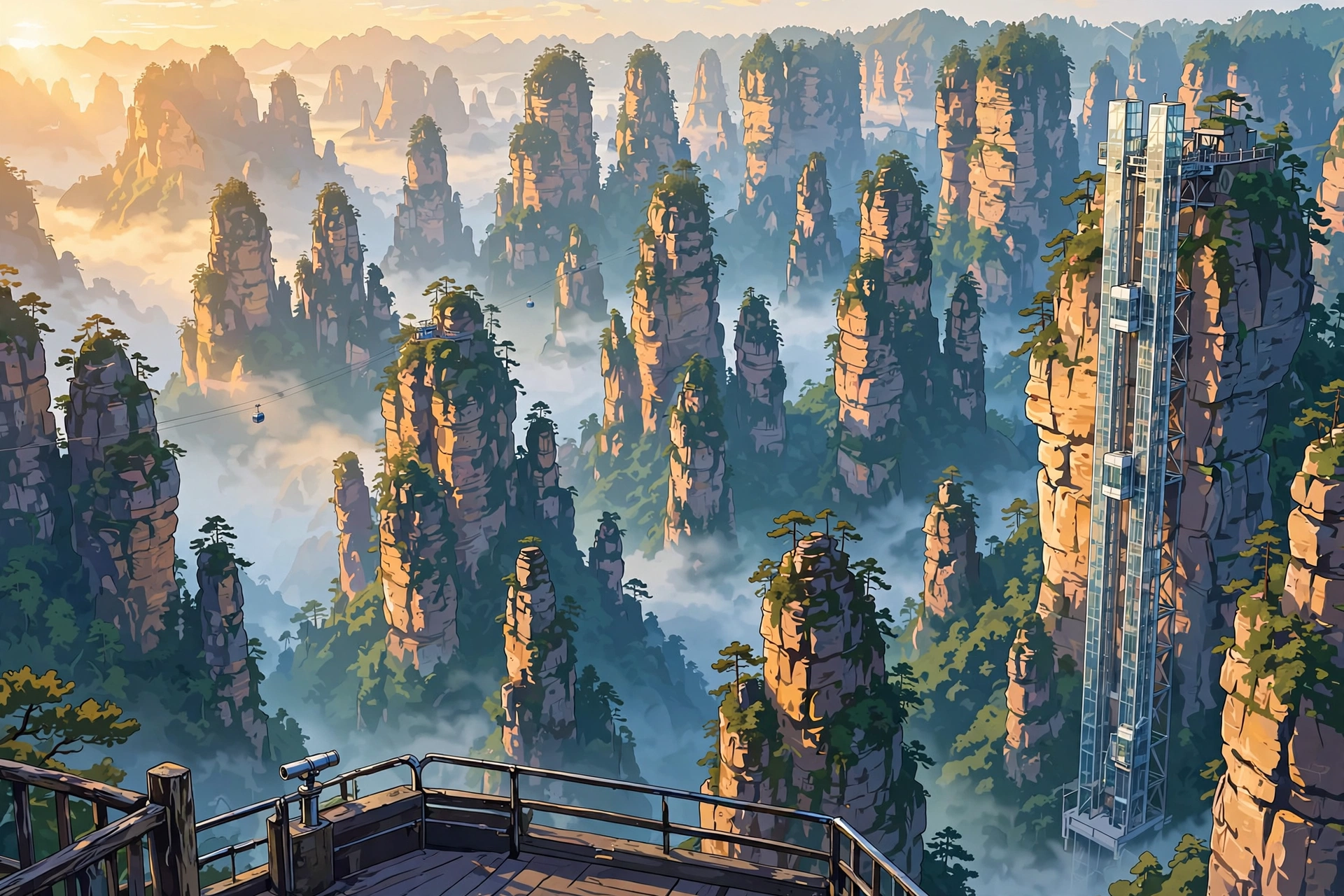
Zhangjiajie planning has one expensive trap, and almost everyone falls into it before they arrive: thinking the name describes a single park. It doesn't. "Zhangjiajie" is shorthand for three separate scenic areas spread across two towns — the National Forest Park with its pillar mountains, Tianmen Mountain with its long cable car, and a third scenic area most short itineraries can safely skip. Each one sells its own ticket, each one needs its own day, and the gates you enter from decide whether you queue for an hour or walk straight in.
This guide gives you the working order: three full days in the forest park plus one full day for Tianmen, which gate to start from each morning, the lift order that beats the queues, and the ticket prices and booking rules you need before you land. Get the sequencing right and the pillars do the rest.
Forest park or Tianmen Mountain? They are different parks
They are separate parks in different locations. Zhangjiajie National Forest Park holds the pillar mountains, the Bailong Elevator, and Yuanjiajie; Tianmen Mountain sits beside Zhangjiajie city, about 40 minutes away, with its own 288 RMB ticket. Plan them as two destinations, not one.
This is the single most common planning mistake for Zhangjiajie, and it starts on booking sites where everything within an hour of the city gets lumped under one name. The National Forest Park is the one with the pillar mountains made famous by every postcard — the quartz sandstone columns rising out of the mist in Wulingyuan. Tianmen Mountain is a completely separate park beside Zhangjiajie city itself, roughly a 40-minute drive from the forest park. It runs on its own ticket, its own timed entry, and its own cableway routes. Trying to "pop over" from one to the other midday burns hours of transit for almost no payoff.
The practical consequences are simple. The forest park ticket (239 RMB for adults aged 18–59) covers four consecutive days and includes the eco-bus network that links its zones. Tianmen Mountain sells one combined ticket at 288 RMB that covers admission, the cableways, the shuttle, and the through-mountain escalators. They are separate purchases on separate days. If your itinerary says "Zhangjiajie, 2 days" and treats the two parks as interchangeable, the itinerary is wrong — it will leave you with a half-seen forest park and no time for Tianmen at all.
There is also a third scenic area in the Zhangjiajie cluster. On a four-day trip built around the forest park and Tianmen, you do not need it; this guide covers the two areas that actually determine your planning decisions.
The one-line rule for telling them apart
If a photo shows hundreds of pillar mountains, that is the forest park in Wulingyuan. If it shows a long cable car rising over the city or a mountaintop loop, that is Tianmen Mountain beside Zhangjiajie city. Two parks, two towns, two tickets.
This split also explains the forest park ticket's four-day validity. The ticket is not generous; it is realistic. Yuanjiajie, Yangjiajie, Tianzi, Huangshizhai, and Golden Whip Stream are five distinct areas joined by mountain roads, and covering them at a pace that leaves room for viewpoints takes three full days. The fourth day on the ticket is your buffer — bad weather, a slow morning, or a lift queue that ate an hour. Treat the ticket as a three-day plan with insurance, not as permission to arrive late.
How many days: the honest answer is three plus one
Three full days in the National Forest Park, plus one full day for Tianmen Mountain. That is the honest minimum, and the park's own four-day ticket exists because that is genuinely how long it takes to see the place properly. Anyone telling you to do the forest park in one day has either never been or is selling a rushed tour.
Here is the workable shape, which follows how the park's zones actually connect:
Day 1 — East gate, up early. Enter from the east gate in Wulingyuan town, ride the Bailong Elevator before 9am, spend the morning on the Yuanjiajie viewpoints, then head to Yangjiajie in the afternoon. This pairs the two areas that connect most naturally on the mountaintop.
Day 2 — Tianzi Mountain at first light. Tianzi is the sunrise option — the north Tianzi gate serves it, and arriving at first light gives you the best shot at the cloud sea. Spend the day working across the Tianzi plateau and its viewpoints.
Day 3 — Huangshizhai morning, Golden Whip Stream recovery. Huangshizhai in the morning, then the Golden Whip Stream as a recovery walk — it is flat, 7.5 km, and runs along the valley floor between the peaks. After two days of climbing and viewpoints, your knees will thank you.
Day 4 — Tianmen Mountain. A separate day for a separate park. Leave the forest park ticket behind; you will need the Tianmen combined ticket and your passport for the timed entry.
Where to sleep
Sleep in Wulingyuan town, not Zhangjiajie city. Wulingyuan sits right at the east gate, while the city is about 40 minutes each way — and those 40 minutes get subtracted from every single morning of your forest park days. Base yourself at the east gate for three nights, then move to the city the evening before your Tianmen day. The Tianmen cableway lower station is in the city itself, so you can start that morning without a transfer.
Wulingyuan's restaurant streets are geared to tourists but run on Chinese-only menus at the local spots. If you cannot read Chinese, it is worth having a system before you sit down — our practical playbook for ordering food in China when you can't read the menu covers picture menus, translation apps, and the pointing protocol that actually works.
What two days actually gets you
If you only have two days, be honest about the trade-off. Two days covers the Yuanjiajie core and a rushed Tianzi pass, usually with Bailong queues eating an hour you do not have. Tianmen becomes a maybe. The four-day ticket is not a upsell — it is the park telling you, in its own pricing, how the visit actually works.
The eco-bus is your transit spine
The eco-bus network included in the 239 RMB ticket is not a perk; it is the only way the park functions. The zones are linked by mountain roads that private vehicles cannot use, which is exactly why the entry-plus-shuttle product exists at 236 RMB against 165 RMB for entry alone. Taxis and ride-hails can get you to a gate, but they cannot drive the internal roads between the scenic areas. Plan your days around the bus routes: they run between the gates and the lift stations, and the last buses of the day set a hard deadline for when you must be heading down. A useful habit is to check the day's last-bus time the moment you arrive each morning and work backward from it — missing the last bus out of a zone means a very long walk back to the gate road.
Which gate to enter from each day
The forest park has five gates, and one ticket works at all of them. That is the key mechanic: the gate is not a constraint, it is a choice. Pick the gate to match the day's plan, not out of habit.
East gate (Wulingyuan town). The best default. It serves Yuanjiajie and the Bailong Elevator directly, and since you are sleeping in Wulingyuan anyway, it is also the fastest start. Use it on Day 1 — and on any morning where the plan starts with the elevator.
South gate (Forest Park gate). The choice when the day starts low rather than high. It suits Golden Whip Stream and Huangshizhai first, so use it on Day 3. Starting from the south means you walk the stream before the midday crowds and ride up to Huangshizhai from the quieter side.
North gate (Tianzi gate). The sunrise option. Use it on Day 2 when Tianzi at first light is the objective. Getting to the Tianzi plateau before the day-trippers arrive is the difference between a cloud sea and a crowd.
The remaining two gates exist but do not change the plan above — for a four-day itinerary built around these three zones, you will never need them.
The gate rule in one line
East for Bailong and Yuanjiajie days, north for Tianzi sunrise, south for the Golden Whip Stream day. One ticket, any gate, every day.
The cable-car order that beats the queues
The lifts are the queues, and the queues are the trip. Every lift in the forest park is charged separately on top of the park ticket, so the order you ride them in decides both your wait times and your spending.
Bailong Elevator: 65 RMB one-way, 130 RMB return. This is the glass elevator that shoots up the cliff face to Yuanjiajie, and it is the single longest queue in the park. Between 10am and 2pm in high season, the wait can exceed an hour. The fix is mechanical: ride it before 9am, or take it down instead of up. Going up by the eco-bus mountain road and coming down by the elevator inverts the crowd flow — everyone else is queuing to go up while you walk straight onto the down car.
Tianzi Mountain cable car: 72 RMB one-way, 144 RMB return. Your Day 2 lift. Riding it up early puts you on the Tianzi plateau for the morning light, and it connects cleanly to the plateau walking circuit.
Yangjiajie cable car: 76 RMB one-way, 152 RMB return. Your Day 1 afternoon lift. Yangjiajie pairs with Yuanjiajie on the mountaintop, so riding this one after the morning's Bailong ascent keeps you at altitude instead of dropping back to the valley.
Huangshizhai cable car: 65 RMB one-way. Your Day 3 lift, and the cheapest decision of the trip — a short ride up, viewpoints on top, and then the Golden Whip Stream waiting below.
The combination pass
Combination lift passes run around 238 RMB for four one-way rides, which beats buying singles if your day plan uses four lifts across the trip. Do the arithmetic against your actual gate plan before buying: a pass only saves money if you were going to ride all four. On the Day 1–3 shape above, you ride Bailong, Tianzi, Yangjiajie, and Huangshizhai — exactly four — so the combination pass is the natural buy. If you are cutting Yangjiajie for a two-day sprint, buy singles.
Tianmen's own cableway order
Tianmen Mountain runs a separate lift logic with three routes. Route A rides the city cable car up — the long, famous ascent from the city center. Route B takes the express cableway up and queues least, which makes it the best choice in peak season. Route C is the express both ways, the fastest round trip. In high season, default to Route B: the city cable car queue for Route A is where Tianmen days go to die. In shoulder season, Route A is worth the longer ride for the views on the way up.
The queue math that drives the whole plan
Every lift in this guide has the same shape: nearly empty before 9am, crushing between 10am and 2pm in high season, thinning again late in the afternoon. Bailong is simply the worst of them because it is the fastest route to the most famous viewpoints, which is why the before-9am or ride-down rule is the single highest-leverage decision in the trip. The second-highest-leverage decision is entering from the right gate: a gate matched to the day's first lift shortens the line you start in. Day 1's east-gate-plus-Bailong-before-9am pairing and Day 2's north-gate sunrise run are the same tactic applied twice — be at the lift before the tour buses arrive, and the rest of the day unfolds without the park's worst lines.
Tickets, prices, and the real-name booking rule
Prices and timetables below were checked on 2026-10-20; reconfirm before travel, since scenic-area pricing and lift operations shift with the seasons.
The forest park ticket
The National Forest Park adult ticket (ages 18–59) is 239 RMB, valid for four consecutive days, and includes the eco-bus network that links the zones. Note the split product at the gate: entry only is 165 RMB, and entry plus the shuttle bus is 236 RMB. First-time visitors need the shuttle version — the zones are linked by mountain roads that private vehicles cannot use, so without the shuttle you cannot actually move between the areas your ticket covers. The old winter discount was discontinued in 2026, so pricing is now single and year-round; there is no off-season fare to hunt for.
The lifts, in RMB
Bailong Elevator 65 one-way / 130 return. Tianzi Mountain cable car 72 / 144. Yangjiajie cable car 76 / 152. Huangshizhai cable car 65. All lifts are charged separately from the park ticket. A combination lift pass covering four one-way rides runs around 238 RMB.
Tianmen Mountain
One combined ticket at 288 RMB covers admission, the cableways, the shuttle, and the through-mountain escalators. There is no meaningful way to split it further — it is designed as a single-day product. (One open item at research time: whether Tianmen's upper cableway rebuild has an announced reopening date — as of the source check, none was announced. Check the current status before you commit to a route.)
The real-name booking rule
Both parks run real-name, timed entry, and this is the part that catches foreign visitors. The forest park's official channel is a WeChat mini-program with real-name registration; foreigners without WeChat Pay should book through platforms or tour operators instead of fighting the mini-program at the gate. For Tianmen Mountain, booking in English on Trip.com works, and you enter with your passport — the passport is the ticket, so keep it on you and make sure the name on the booking matches exactly.
Book the forest park ticket and the Tianmen ticket before you arrive, not the morning of. Timed entry means your date and time slot are fixed; arriving to discover the morning slots are gone is a planning failure, not bad luck. With tickets booked, gates chosen, and the lift order set, the only thing left is to start early — in Zhangjiajie, the early hour is the whole strategy.
One last check before you fly
Run through this list a week out. Forest park ticket: entry plus shuttle (236 RMB), real-name registration completed, name matching your passport. Tianmen ticket: 288 RMB combined, timed slot on Trip.com in English, passport packed. Lift plan: combination pass math done against your four-ride day shape. Accommodation: three nights in Wulingyuan, one in the city. Every item on this list is sourced from prices and booking rules checked on 2026-10-20 — prices, timetables, and the cableway rebuild status can all shift, so reconfirm each one against the current source before you travel. The plan itself does not expire: gates, lift order, and early starts work regardless of the year's price list.