Busan in two days: Haeundae, Gamcheon, and the food in between

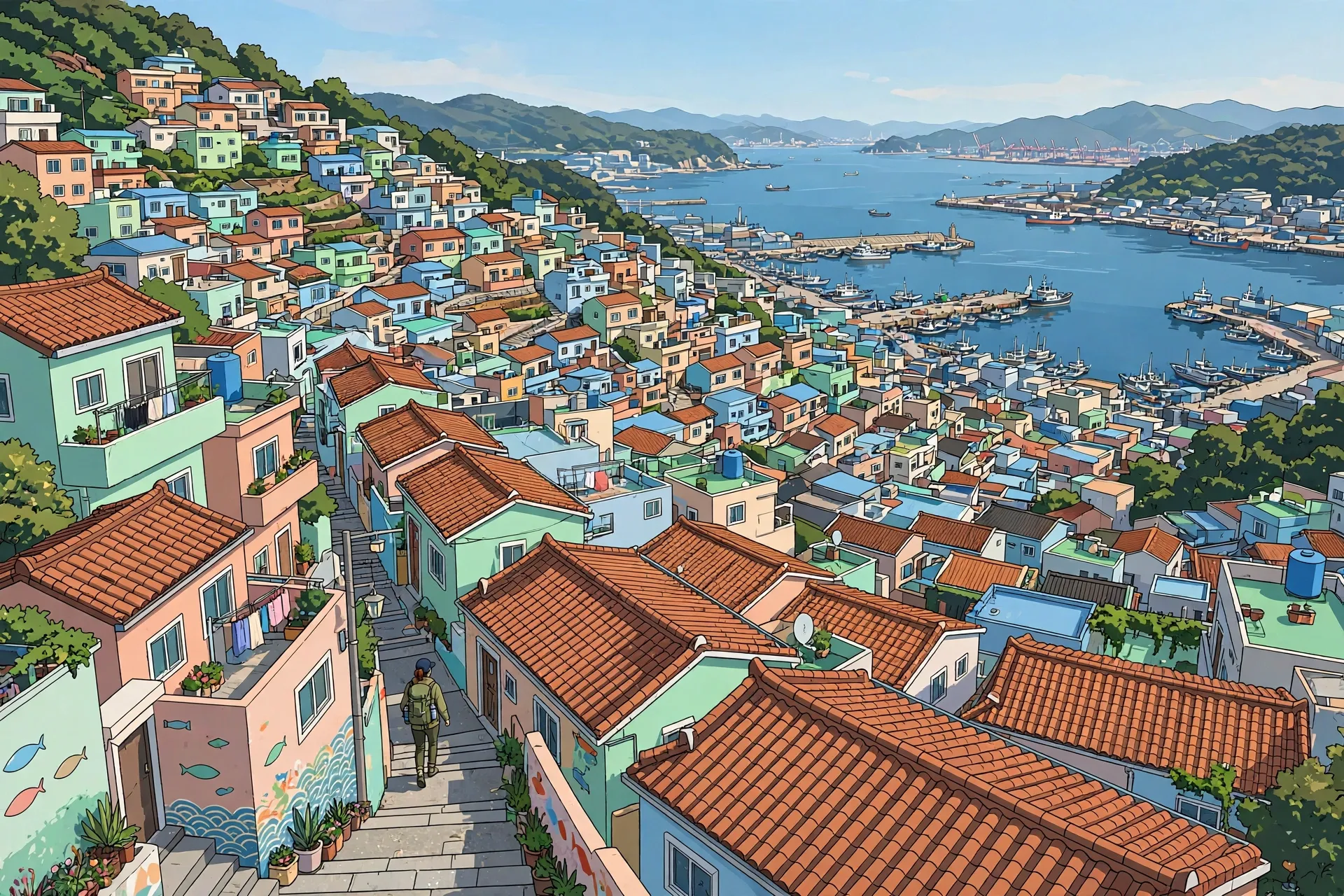
Two days in Busan is not a lot of time, and the city is spread out. The old downtown (Gamcheon Culture Village, Jagalchi Market, BIFF Square) sits on one side of the map and the coastline (Haeundae, Dongbaekseom, Blueline Park) on the other, with Gwangalli somewhere in between. The mistake most first-timers make is bouncing between the two clusters every day — the transit math quietly eats the trip.
There is a cleaner way to play it. Pick a base where the two clusters meet, spend one full day on the old-downtown side, and spend the other on the coast. This guide walks through exactly that split: why Seomyeon works as the two-day base, the most efficient order for Gamcheon, Jagalchi and BIFF Square on day one, and how to fit Haedong Yonggungsa, Haeundae and the Sky Capsule into day two — plus the street-food logistics that hold the whole trip together.
Why Seomyeon is the two-day base
Seomyeon is the practical base for your two days because it sits at the transfer hub between the old downtown and the coast. Staying in Haeundae or Nampo-dong saves one cluster's ride but doubles the other; Seomyeon splits the difference so neither day opens with a long ride.
The base-choice logic
Think of Busan as two half-cities. The old downtown block — Gamcheon Culture Village, Jagalchi Market, BIFF Square, Nampo-dong — runs along the harbor and the old commercial streets in the west. The coastal block — Haedong Yonggungsa, Haeundae Beach, Dongbaekseom, Blueline Park — stretches east along the water. The ride between the two is real: roughly 30 to 45 minutes depending on mode and traffic, and treating map-app estimates as estimates is wise advice from local sources.
If you stay in Haeundae, the coastal day is effortless, but the old-downtown day starts with a long subway ride west. If you stay in Nampo-dong, the reverse is true. Seomyeon sits at the center of the transfer network — Seomyeon Station is the main interchange where the east–west flow changes hands — so neither day starts with a cross-city slog. You go west on day one, east on day two, and every ride is a short hop rather than a commute.
Seomyeon itself is also a functioning neighborhood rather than a hotel strip. It is one of Busan's busiest food streets, which matters when you are on a two-day sprint: you can eat well within walking distance of your room on both nights without spending transit time on dinner. A bowl of dwaeji gukbap — Busan's signature pork soup — runs about 6,500 KRW in Seomyeon, a solid benchmark for how cheap a proper meal can be here.
On the practical side, Seomyeon is dense with mid-range hotels and guesthouses, so you can stay cheap without drifting away from transit; the late-night food streets around the station mean a late return from Gwangalli or BIFF Square still lands you within walking distance of a meal. Haeundae wins if the beach is the whole point of your trip and you are happy to commute west on day one; Nampo-dong wins if you want to walk to Jagalchi. For a split trip with two equal days, neutrality is the feature — Seomyeon is the only base that does not penalize either day.
Getting there
Most visitors arrive from Seoul on the KTX, which takes about 2.5 hours to Busan Station. Since September 2026, KTX and SRT have operated as one network, and fares have dropped roughly 10% — worth knowing because many older guides still quote the old prices. Booking happens in the Korail+ app. If you are flying into Korea for this trip, sort out travel insurance for Korea, Japan, and China before departure: domestic rail trips are low-risk, but international arrivals should check coverage for medical care and travel disruption.
Getting around
Busan's subway is straightforward, and a T-money card works across all metro lines and buses in the city — tap in and out, no separate tickets needed. For Gamcheon you will combine the subway with a bus or taxi for the climb (more on that below). For everything else in this itinerary, subway plus walking covers it.
Day 1: Gamcheon, Jagalchi and the old downtown
Day one stays on the old-downtown side. The order below is built around one principle: do the climbing when your legs are fresh and keep everything else downhill or flat.
Morning: Gamcheon, downhill
Start with Gamcheon Culture Village, the hillside neighborhood of pastel houses that has become Busan's most photographed sight. The routing matters more than the timing. The efficient way in is from above: take the subway to Toseong Station, then catch bus 1-1 up to the village, and work your way downhill on foot. Walking up through Gamcheon is the classic rookie error — the village stacks steeply, and the photo spots are laid out to be enjoyed on the descent.
Visit Busan's official advice applies here: start at the village information center to get oriented, wear comfortable shoes (this is a hillside of stairs and alleys, not a promenade), and remember that people live here. Gamcheon is a working residential neighborhood, not a theme park — keep voices down in the lanes and respect the no-photography signs on private homes.
Afternoon: Jagalchi and Nampo-dong
After Gamcheon, ride back down toward the harbor and Jagalchi Market, Korea's largest seafood market. The afternoon timing is deliberate: the market is active, the food stalls are open, and you still have daylight for the harbor walk afterward. The purchase flow is covered in the street-food section below — the short version is that you pick your seafood downstairs and eat it prepared upstairs, the same system as Seoul's Noryangjin Market.
Jagalchi bleeds into Nampo-dong, the old commercial heart, and Yongdusan Park with Busan Tower. The tower is a modest detour (entry around 4,000 KRW) and the park gives you a skyline orientation of the harbor — useful context before you head east the next day. If you need a rest stop between Jagalchi and the evening, this is the slot for it.
Evening: BIFF Square street food
Finish the old-downtown day at BIFF Square, the film-district street a short walk from Jagalchi. This is your street-food anchor for day one: the famous ssiat-hotteok (seed-stuffed hotteok pancakes) and eomuk (fish-cake) skewers are the two signature bites, and both are cheap enough to graze on before a real dinner. The square stays lively after dark, so it works as the wind-down stroll before you ride the subway back to Seomyeon — a short trip, which is exactly why the base choice pays off.
If you still have energy after BIFF Square, Huinnyeoul Culture Village is a possible add-on on the coast side of old downtown — smaller and quieter than Gamcheon, with harbor views. Treat it as optional: it is the first thing to cut if the day ran long.
Day 2: Haeundae coast and the Sky Capsule booking
Day two belongs to the east. Start early, because the coastline rewards mornings and the Sky Capsule rewards advance planning.
Dawn: Haedong Yonggungsa
Begin at Haedong Yonggungsa, the temple on the rocks at the water's edge, before the crowds. From Haeundae Station, bus 181 reaches the temple area in about 30 minutes — take the earliest comfortable departure so you arrive with the light. The temple sits right on the shoreline, waves breaking against the rocks below, and the approach from the parking area is a short downhill walk. This is the only stop in the itinerary that demands an early start, so stack it first and let the rest of the day relax into a natural pace.
Late morning: Haeundae Beach and Dongbaekseom
Ride back to Haeundae for the beach itself. Late morning is the sweet spot: the sand is awake but not packed, and the long beachfront promenade is easy walking. The beach is Busan's most famous stretch of sand, and even if you are not swimming, the promenade and the cafes along it make for an easy hour. At the western end of the beach, Dongbaekseom island — now connected to the mainland — offers a shaded walking loop with sea views and the APEC House, a fine low-effort add if the day is ahead of schedule.
Afternoon: Blueline Park and the Sky Capsule
This is the anchor of day two and the one item that must be arranged before the trip. Blueline Park runs along the old coastal rail line: the Beach Train hugs the water, and the Sky Capsule — the small raised capsule cars gliding above the coast — is the headliner. The capsules sell out, and the official site is where bookings open. Book your slot online before you travel, ideally as soon as your dates are fixed; same-day availability is unreliable. Treat this like a flight booking, not a walk-up attraction. Pick your time slot with the day's flow in mind: late afternoon gives you the coast in good light and leaves the evening open, but those slots go first, so have a backup time ready when you book. Check the official site's weather and operating notices on the morning of the ride — coastal runs can pause in bad weather, and you want a plan B (the Beach Train covers similar ground) rather than a wasted afternoon.
The standard move is Mipo Station to Cheongsapo (or the reverse), with the capsule one way and the Beach Train back — or the capsule round-trip if you want the water views both directions. Cheongsapo has the harbor-side snack stalls and the photogenic lighthouse, a good turnaround point before heading back toward Haeundae for dinner.
Street-food logistics: what and where to eat
Food is half the point of Busan, and the logistics of eating well here are simple once you know the systems. Three set pieces cover almost everything: the pork soup in Seomyeon, the market flow at Jagalchi, and the street bites at BIFF Square.
Dwaeji gukbap in Seomyeon
Dwaeji gukbap — pork soup with rice — is Busan's signature dish, and Seomyeon is a fine place to have it: about 6,500 KRW for a proper bowl in the neighborhood around your base. It is the natural day-one lunch after arriving from Seoul (or before heading west to Gamcheon) and an equally good day-two dinner when you ride back from the coast. Ordering is minimal Korean: point, pay, eat. The soup arrives rich and milky, with noodles, rice, and side dishes to assemble to taste.
Jagalchi: the two-floor purchase flow
Jagalchi Market works like a system, and first-timers who do not know it end up overpaying or confused. The flow: on the ground floor, vendors sell live and fresh seafood by weight — crab, clams, sea squirts, whatever is in season. You pick your items, negotiate if you like, and then carry (or have carried) your purchase upstairs. Upstairs restaurants cook it to order — sashimi, grilled, steamed — for a per-person cooking fee. This is the same structure as Seoul's Noryangjin fish market, and it is the intended way to eat here: the market downstairs, the table upstairs.
Practical notes: prices are quoted per kilogram and seasonality matters, so ask what is good today rather than fixing on a specific species in advance. The cooking fee is standard and posted; agree on it before handing over your seafood. And go with at least two people — a solo traveler can do it, but the variety-to-cost ratio improves with a small group.
BIFF Square: ssiat-hotteok and eomuk
BIFF Square's street food is built for grazing between meals. The two signatures: ssiat-hotteok, the hotteok pancake stuffed with seeds (a Busan variant of the nationwide winter snack), and eomuk skewers — fish-cake skewers served in a cup of hot broth, the default Busan street food. Both are a few thousand won each. Eat them standing at the stall, then walk off the sugar before dinner.
Pacing the meals
Two days, three food systems, and no room for a bad call. The working order: dwaeji gukbap for lunch on day one (fast, filling, near the base), BIFF Square grazing in the evening (light bites between stops), Jagalchi as the day-one late-afternoon anchor or a day-two lunch (the one meal that wants a group and a table), and Seomyeon again on the second night (you are already there). The trap is treating every meal as a destination restaurant: on a two-day sprint, the best meal is often the one closest to the next stop.
Gwangalli at night vs the second beach
After dinner, Busan offers two competing evening scenes, and the choice defines the end of the trip.
Gwangalli at night
Gwangalli Beach faces the Gwangan Bridge, and at night the bridge becomes the show: the suspension cables run light programs that change color across the water, visible from the entire beachfront. The promenade is lined with cafes and bars built around the view, and the whole setup is designed for lingering — this is the evening the bridge puts on for you. One calendar note matters: the Busan Fireworks Festival falls on Saturday, November 7, 2026, and it is staged over Gwangalli. If your trip lands on that weekend, expect packed hotels, crowded transport, and a bridge that earns its reputation — but plan accordingly, because the whole coast fills up.
The second beach option
The alternative is to stay on Haeundae for the evening. Haeundae's beachfront at night is a different mood: the wide sand, the lit skyline, and the row of seafood restaurants and cafes behind the promenade. It is calmer than Gwangalli's bridge-facing theater and closer to your day-two route if you end the afternoon at Blueline Park. On day one, Gwangalli pairs naturally with the old-downtown circuit (it sits between the clusters, on the way back toward Seomyeon); on day two, Haeundae after the capsule is the path of least resistance.
Either way, the structure holds: two days, two clusters, one base in the middle, and the food filling every gap between them.
Logistically, both evenings are easy from Seomyeon: Gwangalli sits between the old-downtown circuit and the base, and Haeundae pairs with the capsule afternoon. Neither requires the kind of cross-city commitment that a Haeundae-to-Gamcheon hop would demand — which is, again, the whole point of the base.