The Ultimate 10-Step Korean Skincare Routine for Beginners

Quick Navigation
- Part of the [K-Beauty and Shopping in Korea] series.
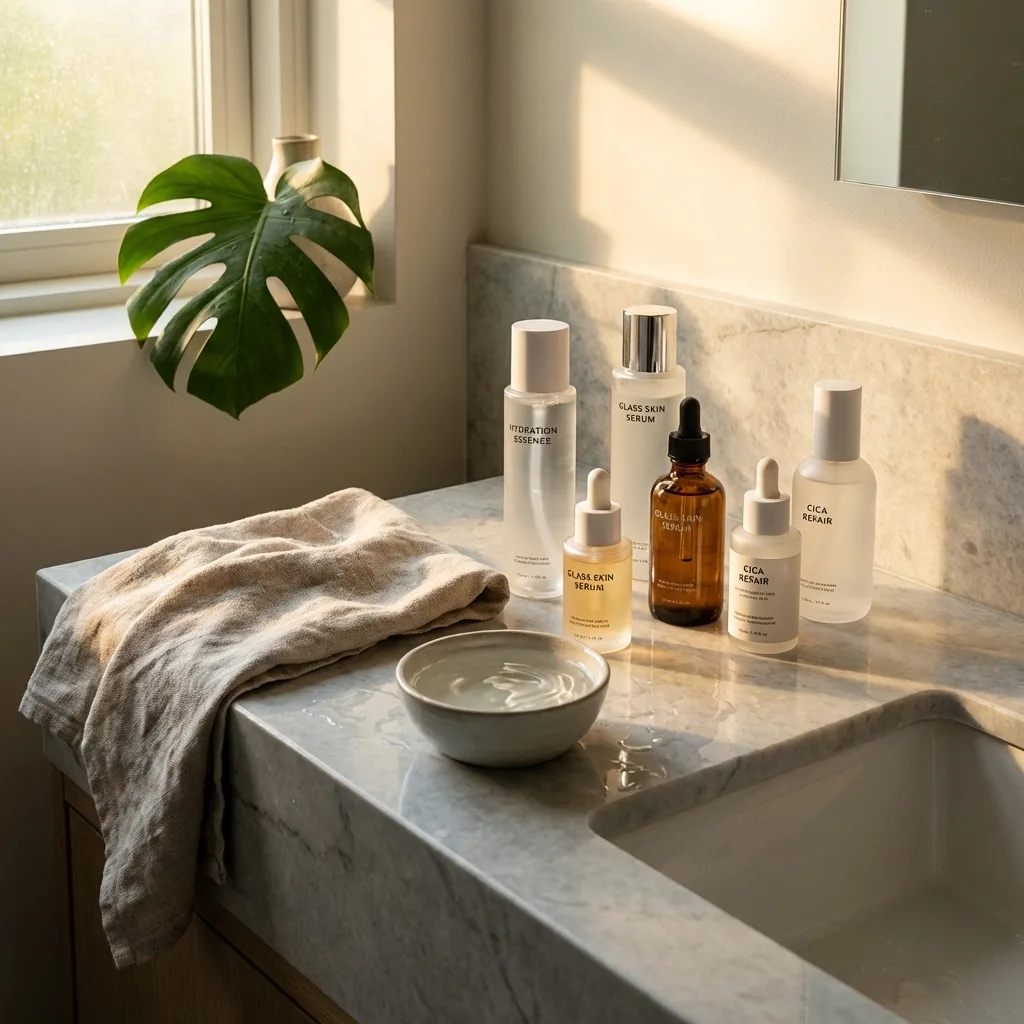
If you’ve spent more than five minutes on social media in the last year, you’ve likely seen the term "Glass Skin"—a complexion so hydrated, smooth, and clear that it looks like a pane of polished glass. This isn't just a filter; it's the gold standard of K-beauty, and it’s achieved through a meticulous, yet surprisingly meditative, 10-step skincare routine.
In the West, we are often taught to treat skin problems after they appear. We reach for the spot treatment when a pimple surfaces or the heavy retinol when we notice a fine line. In South Korea, the philosophy is flipped: Prevention is the priority. Skin is treated as a delicate barrier that needs consistent nourishment, hydration, and protection.
The famous "10-Step Routine" can sound daunting—expensive, time-consuming, and perhaps even unnecessary. But here is the secret: you don't have to do all ten steps every single day, and you certainly don't have to do them all in the morning. At its heart, this routine is about understanding the logic of layering.
In this guide, we’re going to strip away the myth and provide a practical, beginner-friendly roadmap to the ultimate Korean skincare routine.
1. The K-Beauty Philosophy: Prevention over Cure
Before we dive into the products, we have to understand the "Why." In Korea, skincare is considered a form of self-respect. It’s not uncommon for children to be taught the importance of sunscreen and hydration as early as elementary school.
The core of the routine is The Science of Layering. Imagine your skin as a sponge. If you pour a thick cream onto a dry, hardened sponge, it just sits on top. But if you dampen that sponge with water first, it becomes soft, porous, and ready to soak up everything you give it. This is why we apply products from thinnest to thickest consistency—starting with watery toners and ending with occlusive moisturizers.
2. Step 1: The Oil-Based Cleanser (Evening Only)
The biggest mistake beginners make is skipping the first half of the "Double Cleanse." Water-based cleansers simply cannot dissolve oil-based impurities. Think about it: your sunscreen is designed to be water-resistant, and your makeup is often smudge-proof.
An oil-based cleanser (like the viral Anua Heartleaf Pore Control Cleansing Oil) works on the principle of "like dissolves like." As you massage the oil into your dry face, it breaks down sebum, pollutants, and long-wear makeup. When you add water, it emulsifies into a milky texture and rinses away clean.
3. Step 2: The Water-Based Cleanser
Now that the oil and heavy debris are gone, step two—the water-based cleanser—can actually reach your skin. This is the step that clears away sweat and dirt.
For beginners, the key is to avoid that "squeaky clean" feeling. If your skin feels tight after washing, your cleanser is too harsh and is likely stripping your moisture barrier. Look for "Low pH" options like the COSRX Low pH Good Morning Gel Cleanser. It cleanses effectively without disrupting your skin’s natural acidic balance.
4. Step 3: Exfoliator (1-3 Times a Week)
We aren't talking about those harsh apricot scrubs from the 90s. Korean exfoliation is gentle. Whether you use a physical peeling gel or a chemical exfoliant (AHA/BHA), the goal is to sweep away dead skin cells that clog pores and make your complexion look dull.
By removing this debris, you ensure that the expensive essences and serums you're about to apply don't just sit on a layer of dead skin.
5. Step 4: Toner (The Damp Sponge)
As mentioned, toners in K-beauty are not the stinging, alcohol-laden "astringents" of the past. They are the first layer of hydration. A good Korean toner (like the Anua Heartleaf 77% Soothing Toner) balances your skin’s pH after cleansing and acts as that initial "dampening" of the sponge.
The "7 Skin Method"—pattings on seven thin layers of toner—is a popular K-beauty hack for deep hydration, though for beginners, one or two layers is usually plenty.
6. Step 5: The Essence (The Heart of the Routine)
If you ask a Korean skincare expert which step is the most important, they will likely say the essence. This category is unique to Asian beauty. An essence is a hybrid between a toner and a serum—watery enough to penetrate deep into the skin but concentrated enough to deliver powerful nutrients.
The COSRX Advanced Snail 96 Mucin Power Essence has become a global cult favorite for a reason: it heals, hydrates, and gives that "glow" that defines the glass skin look.
7. Step 6: Serums and Ampoules (The Problem Solvers)
This is where you customize. Serums are concentrated treatments for specific concerns. Do you have dark spots? Look for Niacinamide or Vitamin C. Worried about fine lines? Reach for Peptides or Ginseng.
Ampoules are even more concentrated versions of serums—think of them as a "booster shot" for your skin during times of crisis (like a breakout or extreme dryness).
8. Step 7: The Sheet Mask (The Meditative Step)
Sheet masks are the soul of K-beauty. While they aren't a daily requirement, using one two or three times a week provides an intensive infusion of hydration. Because the sheet prevents the essence from evaporating, your skin is forced to absorb it.
It’s also an excuse to sit still for 15 minutes. In the words of Soko Glam founder Charlotte Cho, "Skincare is a ritual, not a chore."
9. Step 8: Eye Cream
The skin around your eyes is the thinnest on your body. It has no sebaceous glands to produce natural oils, which is why it’s the first place to show fine lines. A specialized eye cream provides targeted hydration and protection without being so heavy that it causes milia (small white bumps).
10. Step 9: Moisturizer (The Sealant)
Now that you’ve layered all that hydration, step nine is about locking it in. A moisturizer creates an occlusive barrier that prevents all the "good stuff" from evaporating into the air.
In the humid Korean summer, you might choose a lightweight gel. In the dry, bitter winters of Seoul, you’ll want a thick, nourishing cream.
11. Step 10: Sun Protection (The Non-Negotiable)
This is the most important step of all. If you do steps one through nine but skip the sunscreen, you are wasting your time and money. UV damage is the #1 cause of premature aging and hyperpigmentation.
Korean sunscreens (like the Beauty of Joseon Relief Sun) are famous for being elegant. They feel like a lightweight lotion, leave no white cast, and sit perfectly under makeup. Protecting your skin from the sun is the ultimate anti-aging secret.
Morning vs. Night: The Reality Check
No one has time for 10 steps twice a day. Here is how the pros actually do it:
Morning (Focus on Protection):
- Water-based Cleanser
- Toner
- Essence
- Moisturizer
- Sunscreen (SPF 50+)
Night (Focus on Repair):
- Oil Cleanser
- Water-based Cleanser
- Exfoliator (twice a week)
- Toner
- Essence
- Serum
- Sheet Mask (twice a week)
- Eye Cream
- Moisturizer
Beginner’s Starter Kit: Best Products per Step
If you’re building the routine from scratch, here are the most beginner-friendly, consistently well-reviewed products at each step:
| Step | Product Recommendation | Price Range (KRW) | Why It Works |
|---|---|---|---|
| Oil Cleanser | Anua Heartleaf Pore Control Cleansing Oil | 18,000–24,000 | Gentle, effective, non-stripping |
| Water Cleanser | COSRX Low pH Good Morning Gel Cleanser | 12,000–16,000 | Correct pH, non-drying |
| Exfoliator | ANUA Heartleaf LHA Moisture Peeling Gel | 19,000–24,000 | Gentle, no micro-tears |
| Toner | Anua Heartleaf 77% Soothing Toner | 22,000–28,000 | Calming, lightweight, multipurpose |
| Essence | COSRX Advanced Snail 96 Mucin Essence | 18,000–25,000 | Repairs barrier, plumps, glows |
| Serum | Goodal Green Tangerine Vita C Serum | 25,000–32,000 | Brightens dark spots, stable formula |
| Sheet Mask | Mediheal NMF Intensive Hydrating Mask | 1,500–2,500/sheet | Dermatologist-tested, generous serum |
| Eye Cream | Some By Mi Eye Cream (Retinol) | 18,000–22,000 | Gentle retinol, non-migrating |
| Moisturizer | PURITO Seoul Bamboo Panthenol Cream | 15,000–20,000 | Fragrance-free, barrier-strengthening |
| Sunscreen | Beauty of Joseon Relief Sun | 12,000–15,000 | No white cast, SPF 50+, no reapplication tackiness |
Total starter kit cost in Korea: approximately ₩160,000–₩230,000 for all 10 steps using the above products — less than a single luxury moisturizer from a Western prestige brand.
Common Beginner Mistakes (and How to Fix Them)
Mistake 1: Using too many actives at once Don’t layer Vitamin C, retinol, AHAs, and niacinamide all in the same routine. Introduce one new active ingredient per week and observe how your skin responds. Over-stimulation causes redness, peeling, and a compromised moisture barrier — the opposite of glass skin.
Mistake 2: Skipping sunscreen on "cloudy days" UV-A rays (the ones causing premature aging) penetrate clouds. They also penetrate windows. Wear SPF 50+ every morning, indoors or outdoors.
Mistake 3: Using the same products year-round Korean skincare acknowledges that skin needs change seasonally. Summer in Korea calls for lighter gel textures and higher SPF reapplication. Winter requires heavier creams and more intensive moisturizers. Don’t be afraid to swap out your moisturizer as the seasons change.
Mistake 4: Rushing through the layers Let each layer absorb for 30–60 seconds before applying the next. If you apply a cream immediately over a wet toner, the heavier product traps moisture inconsistently and may cause pilling (products rolling up on the skin surface).
Mistake 5: Judging products by day 3 Most skincare takes 4–6 weeks to show measurable improvement in texture and tone. The one exception is instant hydration — you’ll feel toner and essence results immediately. But for acne reduction and brightening, commit to a full month before assessing.
Customizing the Routine by Skin Type
Oily and Acne-Prone Skin Focus on lightweight, non-comedogenic textures. Swap cream moisturizer for a gel (COSRX Oil-Free Ultra-Moisturizing Lotion). Add a BHA serum (COSRX BHA Blackhead Power Liquid) 2–3 nights per week. Skip heavy sheet masks; use a clay mask instead. Sunscreen should be matte or velvet-finish (HaruHaru Wonder Black Rice Sunscreen).
Dry and Dehydrated Skin This skin type benefits most from the 10-step routine. Layer 2–3 applications of toner (the "7 Skin Method" variant). Use a sleeping mask 3–4 nights per week in addition to regular moisturizer. Choose richer cream textures (Laneige Water Sleeping Mask, Klairs Rich Moist Soothing Cream).
Sensitive and Reactive Skin Fragrance-free is essential at every step. Patch test all new products on the inner arm for 24 hours. Build the routine slowly — start with just cleanser, toner, and sunscreen for 2 weeks, then add one product per week. Core brands for sensitive skin: AESTURA, Klairs, Round Lab, PURITO Seoul.
Combination Skin Apply heavier products (cream, sleeping mask) only to dry areas (cheeks, around the mouth) and lighter textures on oilier zones (T-zone, forehead). This "multi-masking" approach prevents overloading oily areas while adequately nourishing dry patches.
How to Shop for K-Beauty Products in Korea
If you’re visiting Korea specifically to stock up on skincare, a few strategic approaches make the shopping experience more effective:
Hwahae App (화해) Download Hwahae before your trip — it’s Korea’s most comprehensive beauty review platform with ingredient analysis, skin concern filtering, and verified purchase reviews. Use it to look up any product before buying.
Olive Young’s Membership Program Create a free Olive Young membership (available at the register; no Korean phone needed at most locations) to accumulate points and access member-only discounts. Even a single shopping trip earns enough points for meaningful discounts on a return visit.
Sample hunting Request samples at brand counters (Innisfree, COSRX, Anua flagship stores) — Korean skincare culture encourages "trying before buying," and staff readily provide samples of serums and moisturizers.
Frequently Asked Questions
How long does the full 10-step PM routine take? A complete PM routine runs 10–15 minutes once you're practiced at it. The longest steps are the double cleanse (2–3 minutes) and sheet mask (15–20 minutes, done while doing other things). Without the sheet mask, 10 minutes is the average. Morning routines without oil cleansing run 5–8 minutes.
Can men do the 10-step routine? Absolutely. Many of the most dedicated K-beauty consumers in Korea are men — male skincare is a mainstream, normalized part of Korean culture, not a niche practice. The routine works identically for all skin regardless of gender. Men with oily skin will find the lightweight Korean textures particularly appealing compared to heavier Western moisturizers.
Is the 10-step routine suitable for acne-prone skin? With modifications, yes. The key is avoiding pore-clogging (comedogenic) ingredients. Replace rich creams with gel moisturizers, prioritize BHA-based exfoliants over AHA, and choose non-comedogenic sheet masks. The hydration-first philosophy of K-beauty — rather than stripping the skin dry — is actually well-suited to acne management.
Why do K-beauty products emphasize hydration so heavily? Korean dermatology and beauty philosophy holds that most skin problems — including oily skin, enlarged pores, and premature aging — are rooted in dehydration and a compromised moisture barrier. By maintaining optimal hydration consistently, the skin self-regulates better: oil production decreases, the barrier heals, and the complexion becomes more resilient. This is a preventative philosophy, not just an aesthetic one.
How much should I spend on the 10-step routine? A complete, functional routine using quality Korean products can be assembled for ₩100,000–₩200,000 in Korea (approximately $75–$150 USD). This compares favorably to Western regimes of equivalent efficacy. At the high end, luxury brands like Sulwhasoo and AmorePacific push the cost significantly higher — but the entry-level Korean products genuinely perform.
What is "skin cycling" and how does it relate to the Korean routine? Skin cycling — a Western-popularized trend involving scheduled use of actives across multiple nights — is essentially a simplified Western adaptation of what K-beauty practitioners have long practiced. Traditional K-beauty doesn't use actives every night; exfoliation (chemical or physical) is done 1–3 times per week, with recovery nights of pure hydration in between. If you follow the 10-step framework, you're already cycling by default.
Should I finish my existing Western skincare products before switching? You can layer or transition gradually. The most practical approach: keep using your existing cleanser and moisturizer, and introduce Korean essences and sunscreens first. These are the highest-impact additions and cause the fewest conflicts with existing routines. Transition to a full Korean routine once you've identified which products best suit your skin.
Conclusion
The 10-step routine isn’t about the products you buy; it’s about the consistency and care you show yourself. By following the "thin-to-thick" layering logic and prioritizing prevention over cure, you can achieve that healthy, radiant "glass skin" glow from the comfort of your own home.
And if you’re planning a trip to Korea to stock up on these essentials, don’t miss our Myeongdong Shopping Guide for the best deals on brands like COSRX and Anua. For those with reactive skin, our hypoallergenic K-beauty guide for sensitive skin will help you navigate ingredients to avoid. And when you’re ready to build your starter product kit, our top 15 K-beauty cult favorites covers the iconic products worth picking up in store.