Tokyo Disney planning: Disneyland vs DisneySea and the ticket windows

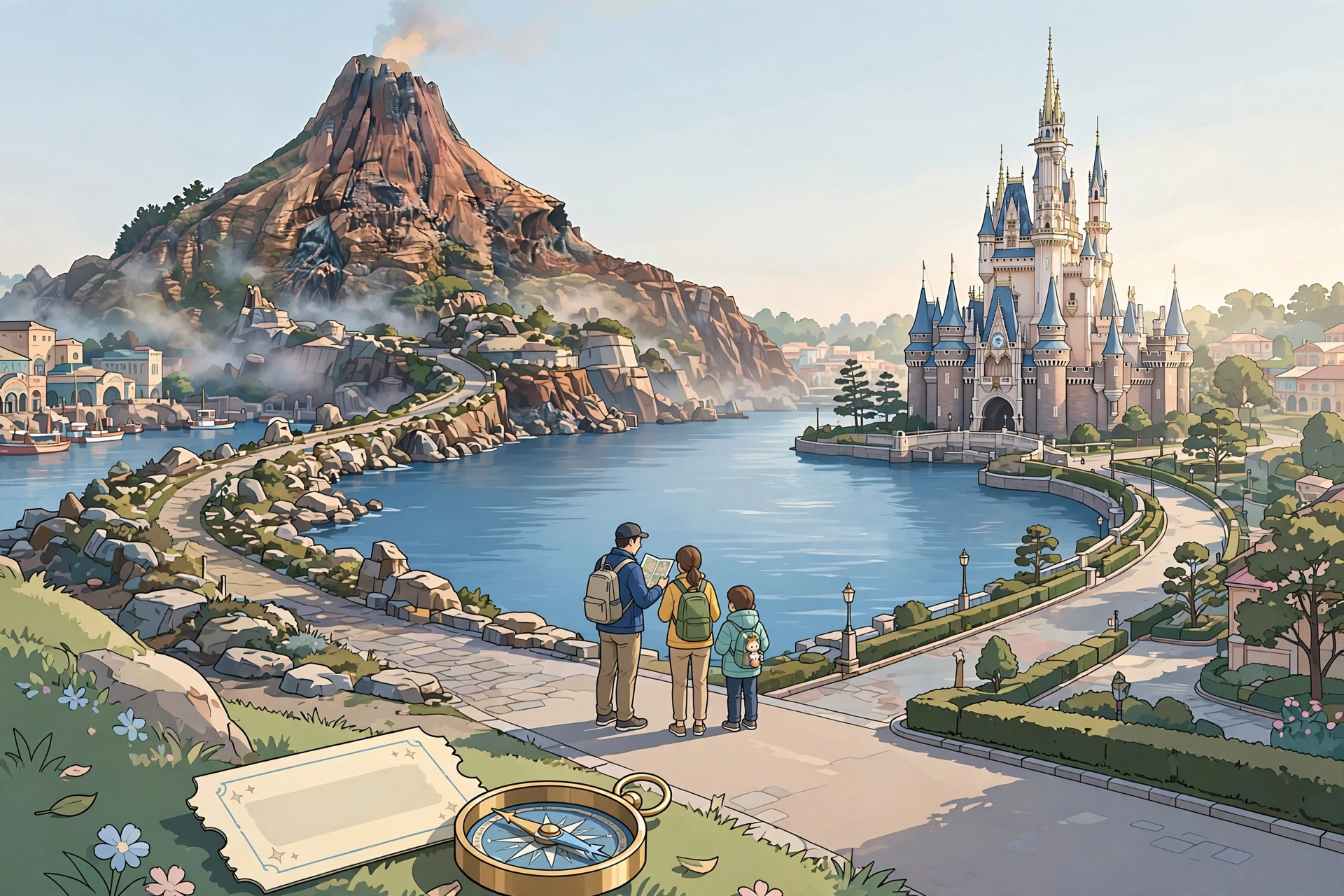
Planning Tokyo Disney is a different game from Orlando or Anaheim: there is no ticket booth, no same-day fix, and no park-hopping. Buy your dated ticket exactly two months out at 14:00 Japan time — DisneySea's peak Saturdays can vanish within hours of release. One ticket covers one park for the full day, and 2026 pricing runs from 8,400 to 12,400 yen for adults across seven date-based tiers. The big 2026 change is that the free skip-the-line pass is gone; the paid Disney Premier Access is now the only way to cut waits, and you buy it inside the park through the official app. Disneyland is the pick for kids and classic-Disney fans; DisneySea — especially after the Fantasy Springs expansion — is the stronger choice for everyone else.
Disneyland or DisneySea: the 30-second decision
DisneySea beats Disneyland for most adults — the nautical theme, volcano centerpiece, and the 2024 Fantasy Springs expansion (Frozen, Tangled, Peter Pan) make it the more distinctive park. Disneyland is the better pick for children, character fans, and first-time Disney visitors.
Pick Disneyland if this sounds like your group
Tokyo Disneyland is the classic. It opened in 1983 and follows the familiar Magic Kingdom formula: Cinderella Castle at the center, character meet-and-greets, parades, and the rides you already know from Orlando or Anaheim. If you are traveling with young children, if this is someone's first Disney park ever, or if your group mostly wants the recognizable Disney hits — princesses, Mickey, the castle photo — Disneyland is the right call. First-time Disney visitors consistently get more out of the familiar park, because the experience matches what they have seen in movies and photos their whole lives.
Disneyland is also the safer ticket to buy when dates are flexible. It generally sells out more slowly than DisneySea, so if your itinerary is still shifting and you cannot commit at the 60-day window, you have a better chance of finding Disneyland tickets in the days after release.
Pick DisneySea if this sounds like your group
Tokyo DisneySea is the one-of-a-kind park. Opened in 2001, it is built around nautical and adventure themes with a volcano — Mount Prometheus — dominating the center, and there is nothing quite like it in Orlando, Anaheim, or Paris. The Fantasy Springs expansion, which opened on 6 June 2024, added Frozen, Tangled, and Peter Pan lands and raised DisneySea's draw even further. Since 1 April 2025, Fantasy Springs no longer requires a separate timed-entry pass: standby or Disney Premier Access (DPA) gets you in, though DPA is strongly recommended on peak dates since the Frozen standby queue regularly exceeds 90 minutes.
DisneySea is the right pick for adults, repeat Disney visitors, couples, and anyone who wants the park they cannot get anywhere else. Just note the trade-off: DisneySea sells out faster than Disneyland, so the 60-day window matters more for it. If DisneySea is your priority, treat the ticket release like a booking deadline, not a suggestion.
The one-park rule
One important planning fact that shapes everything: your ticket admits you to one park for the entire day. A Disneyland ticket gives you no DisneySea entry the same day, and there is no same-day switching or park-hopping upgrade. Pick the park that matches your group's strongest interest, because you are committing to it for the full day.
The ticket window: exactly when to buy (and why gate sales don't exist)
Tickets go on sale exactly two months out at 14:00 JST
Tokyo Disney tickets go on sale exactly two calendar months before your visit date, at 14:00 Japan time. If you are visiting on 25 October, tickets release on 25 August at 14:00 JST. This is a fixed clock, and for peak dates — weekends, holidays, and school-vacation periods — the best dates, especially DisneySea, sell out within hours of release.
Put this in your calendar as an actual event with a reminder. Decide which park and which date beforehand, have your official-site account created and logged in, and be ready to check out at 14:00. Treating it like a flight booking on sale day is the right mental model: the travelers who get the dates they want are the ones who show up at release time.
There is no ticket booth anymore
The park booths are closed for day-of purchases. Every ticket must be booked online in advance — through the official site (tokyodisneyresort.jp), the official app, or a third party like GetYourGuide. If you show up at the gate expecting to buy a ticket the way you might at other theme parks, you will be turned away. This is not a soft rule with exceptions; it is how the resort operates now.
That means the ticket is the first thing to lock in, before hotel nights and transport. Your Disney day is date-specific and park-specific, and since tickets cannot be changed to another date or park after purchase, the park-and-date decision is final at checkout. Build the rest of the itinerary around it.
Official site vs. third parties
The official site is the default and usually cheapest route, and it is where the full release inventory appears. GetYourGuide and similar third parties sell the same dated, park-specific tickets and are a legitimate alternative — particularly useful if your foreign credit card gets rejected on the official site (see the payment section below). Third-party tickets sometimes sell out earlier than official inventory, so check the official site first at release time and keep the third party as a backup channel, not the first choice.
2026 date-based pricing: which days cost what
The seven tiers
The 1-Day Passport uses seven date-based pricing tiers. The system expanded from five tiers to seven in 2026, with the top tier added in October 2026, so 2026 is the first full year of this wider range. Adult prices run from 8,400 yen at Tier 1 (quiet weekdays) to 12,400 yen at Tier 7 (peak periods such as Golden Week, summer vacation, and the Christmas season). Junior tickets range from 7,000 yen to 10,200 yen.
The tier system is the resort's crowd-management tool: cheaper days are the days they want more visitors on, and expensive days are the days that would fill regardless. In practice, the price is a crowd forecast. A Tier 1 or Tier 2 day is cheaper for a reason — lighter crowds, shorter waits — and a Tier 7 day is expensive for the same reason in reverse.
Shifting days can save real money
Because the tiers move with demand, shifting your Disney day by one or two days can change the price meaningfully. If your itinerary has any flexibility, compare adjacent days on the official calendar before buying. A Wednesday instead of a Saturday can drop you two or three tiers — the difference between roughly 8,400 and over 10,000 yen per adult, multiplied across a family. This is one of the highest-return planning decisions in the whole trip: five minutes of calendar comparison against several thousand yen per person.
Also factor in that cheaper days tend to be better park days, not just cheaper ones. Lower-tier days generally mean thinner crowds, which means more rides per hour and less DPA spending. The tier system aligns price and experience here, so picking the cheapest workable day is usually the best decision on both axes.
Park-specific, date-specific, no changes
Repeating this because it is the most common source of regret: tickets are park-specific and date-specific. A Disneyland ticket admits no DisneySea entry the same day, and there is no option to change the date or the park after purchase. Double-check the date, the park, and the number of adults and juniors before you pay. If plans might shift, this is another argument for buying at the release window only when you are sure — and for choosing a lower-tier day where rebuying would be less painful if it comes to that.
Line-skipping after the free pass ended: DPA, costs, and rules
The free pass is gone
The single biggest 2026 change to know about: the free 40th Anniversary Priority Pass ended on 31 August 2026. There is now no free skip-the-line option for rides at all. The Standby Pass system that remains currently controls entry only to a handful of popular shops — not rides. If your guide is from 2024 or 2025, it is out of date on this point, and budgeting for the paid option is now mandatory, not optional, for a high-ride-count day.
Disney Premier Access: the prices
Paid Disney Premier Access (DPA) is the only way to shorten attraction waits. It is priced per ride per person, fixed per ride rather than per date. The 2026 prices:
- Beauty and the Beast — 2,500 yen
- Frozen Journey — 2,500 yen
- Soaring — 2,500 yen
- Rapunzel's Lantern Festival — 2,000 yen
- Peter Pan's Neverland Adventure — 2,000 yen
- Toy Story Mania — 2,000 yen
- Journey to the Center of the Earth — 2,000 yen
- Tower of Terror — 1,500 yen
- Big Thunder Mountain — 1,500 yen
- Haunted Mansion — 1,000 yen (DPA sold until 7 January 2027)
Two rides at 2,500 yen each is already 5,000 yen per person — more than half the price of the ticket itself on a mid-tier day. A family of four targeting three headline DPA rides is looking at 20,000–30,000 yen in line-skip spending alone. Set this budget before you arrive, because the in-park decision pressure is real and it is much easier to overspend when you are watching a 90-minute standby line.
How DPA works in practice
DPA can only be purchased inside the park, through the official app — you cannot buy it in advance or from a third party. After buying a DPA, the next one unlocks either 60 minutes after purchase or when your current ride's time window starts, whichever comes first. So the practical strategy: buy your first DPA as early as possible after entering (headline rides sell their DPA slots), then set a timer for the 60-minute unlock.
Prioritize the rides where standby is genuinely punishing — Frozen Journey's standby regularly tops 90 minutes on peak days, which makes its 2,500-yen DPA one of the better values. Rides with steadier throughput or shorter lines are where standby is fine, and saving the money is the better call.
Getting in and beating the queues: arrival, app, and access
Getting to Maihama
The resort sits at Maihama, in Chiba, just east of Tokyo. Take the JR Keiyo Line from Tokyo Station — it is about 15 minutes and costs 253 yen with an IC card, and the fare is covered by the JR Pass if you have one. From Maihama station, the Disney Resort Line monorail circles the resort (Tokyo Disneyland, Tokyo DisneySea, and the official hotels). The monorail costs 300 yen and is not covered by the JR Pass, so budget it separately or just walk from Maihama to Disneyland — it is close enough on foot, though DisneySea is the farther stop and the monorail is the practical way there.
Arrive before the gates open
The parks open around 09:00, and arriving between 08:15 and 08:30 is the most effective crowd strategy available — more impactful than any app trick. Early arrival gets you through security and into the park ahead of the bulk of visitors, which means your first hour can cover two or three headline rides at short waits, and — critically — you are first in line for DPA purchases, which sell out their best time slots. Treat the morning like this: first hour for headline standby rides, then buy your first DPA the moment you are through the gates.
The app is your park command center
Download the official Tokyo Disney Resort app before your trip, link your tickets, and make sure you are logged in. Everything in-park runs through it: DPA purchases, show lottery entries, restaurant bookings, and wait-time maps. The app is also where the foreign-card problem can bite (see below), so sort out payment before you go rather than discovering a declined card at the DPA checkout screen inside the park.
A smart day structure
A practical shape for the day: arrive 08:15–08:30, ride two or three headliners in the first hour on standby, buy your first DPA immediately on entry, use the midday hours (11:00–15:00, the worst standby window) for shows, meals, and lower-wait attractions, then spend the late afternoon and evening on your DPA windows and any remaining priorities. If Japan travel planning is part of a bigger trip — say you are timing the Disney day around another event — this guide to how foreigners buy Japanese baseball tickets covers the same advance-booking discipline for a completely different kind of Japanese entertainment.
Paying as a foreigner: the card problem and workarounds
Error 1-155 and the Visa problem
The official site has a documented problem — Error 1-155 — that rejects many foreign-issued Visa cards, apparently related to 3D Secure authentication. It is inconsistent: some foreign cards sail through and some fail repeatedly, which makes it hard to diagnose in advance. The practical first workaround is simply to try a different card network: Mastercard or Amex succeed where Visa fails often enough that it is worth having one ready before the 14:00 release window.
Do not discover this at release time. Test your card on the official site with a small action in advance if possible, and have a second card — ideally on a different network — on hand. A failed payment at 14:05 on a DisneySea Saturday is how dates get lost.
The GetYourGuide workaround
If the official site will not take your card at all, book through GetYourGuide. It accepts PayPal and Apple Pay alongside a wider range of cards, which sidesteps the 3D Secure rejection entirely. The tickets are the same dated, park-specific 1-Day Passports, and third-party tickets are legitimate — the trade-off is that third-party inventory can sell out before the official site's does, so use this route as a fallback when the official checkout fails, not as your default.
Inside the park: in-app payment
Remember that DPA purchases happen in the official app, inside the park — so the same foreign-card issue can surface at the DPA screen. Before your trip, make sure the card linked in your app account is one that the official system accepts. If only your Visa works nowhere on their system but your Mastercard does, set the Mastercard as the in-app payment method. This is a two-minute fix at home and a trip-saving one at the gate.
One last checklist before you commit
- Park picked (Disneyland for kids and first-timers, DisneySea for everyone else)
- Date locked, and adjacent days compared for tier pricing
- Calendar alarm set for the release: two months out, 14:00 JST
- Official-site account created, logged in, card tested
- Backup card on a different network ready; GetYourGuide as fallback
- App downloaded, tickets linked, payment method set
- DPA budget decided in advance — headline rides first, standby for the rest
Tokyo Disney rewards the planners and punishes the spontaneous. The 60-day window, the tier calendar, and the DPA budget are the three decisions that determine whether you spend the day riding or the day queuing — and all three are made at home, before you fly.