Day trips from Osaka: Nara vs Himeji vs Kobe in one slot

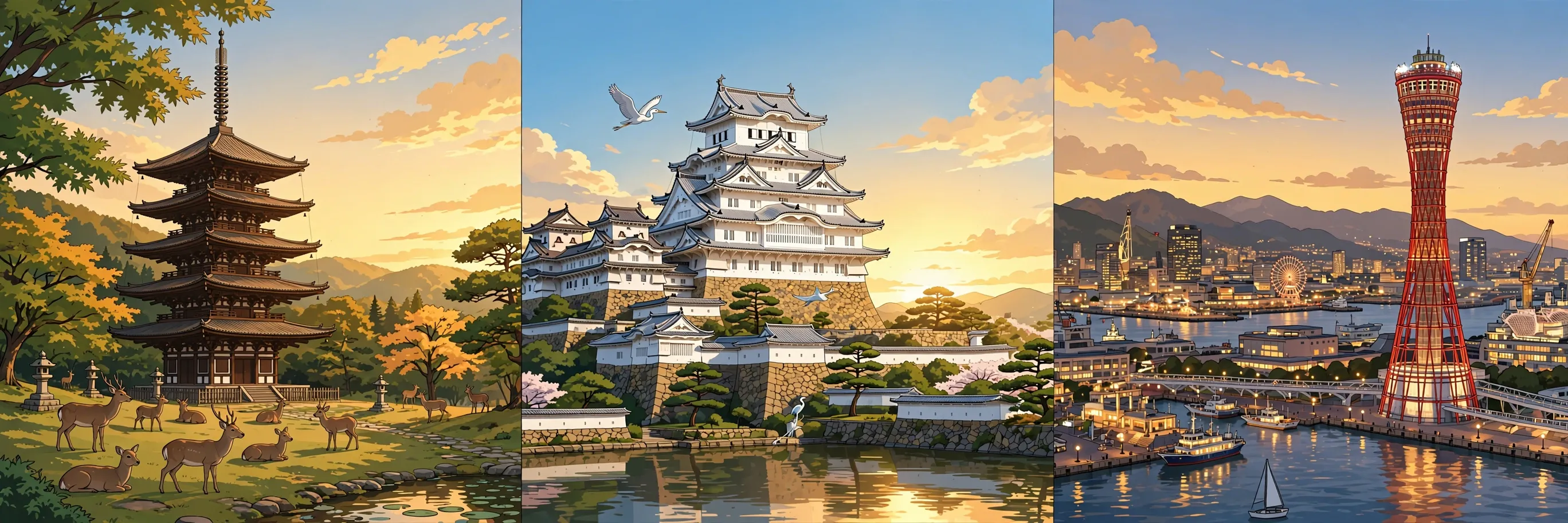
You have one free day in Osaka. Three famous destinations sit within an hour of your hotel — Nara, Himeji, and Kobe — and picking the wrong one means spending half your day on trains for a payoff that doesn't match the ride. The right choice depends on a single trade-off: how much of your day you're willing to give to travel time.
Nara gives you a full ancient capital in half a day. Himeji demands the whole day and repays it with Japan's finest surviving castle. Kobe is barely a day trip at all — it's an evening play: dinner and a night view 20 minutes from Osaka.
This guide compares all three head to head — distance, cost, and what each trip is actually for — then does the rail-pass math and gives you the two combinations that actually work in a single day.
The one-slot decision: distance, density, and what each trip is actually for
With one free day from Osaka: choose Nara for a half-day ancient capital (45 minutes, 680 JPY, Todai-ji and deer by 14:00); choose Himeji for a full-day castle trip (60 minutes, 1,520 JPY); choose Kobe for a 20-minute evening of dinner and night views.
Start with a rule of thumb that experienced Kansai travelers use: day trips with one-way travel under 60 minutes feel relaxed, because the transit never eats the day. Nara lands at 37 to 45 minutes depending on which train you take. Himeji sits right at 60 minutes on the rapid service. Kobe is a 20-minute hop. That ordering alone tells you most of what you need to know about how each trip consumes your day.
Nara's round trip costs you roughly 90 minutes of transit. That leaves six to seven usable hours even on a lazy schedule — more than enough for an ancient capital whose sights cluster inside one walkable park. Himeji's round trip costs two full hours, and the castle itself wants three to four hours of your attention. That is the entire day, spoken for. Kobe's round trip is 40 minutes, which is why treating it as a full day trip usually disappoints: you arrive, eat, look around, and wonder what to do with the remaining six hours. Kobe shines when it takes the evening slot instead.
What each trip is actually for
Think of the three options as answers to three different questions. Nara answers: "I want the most Japan per hour." The ancient capital packs Todai-ji's Great Buddha hall, the famous deer, Kofukuji, and Kasuga Taisha into one compact walking loop around Nara Park. No guide needed, no buses, no wasted motion — you walk from sight to sight, and the whole circuit fits comfortably in a half day.
Himeji answers: "I want to see the single best castle in Japan." Himeji Castle is not one attraction among several; it is the attraction. Completed in 1609 and never destroyed, it is the finest surviving original wooden castle in the country — a six-tier, 46-meter white facade that looks the way it looked four centuries ago. Unlike the castles in Osaka and Nagoya, which are post-war concrete reconstructions, Himeji is the real thing, and it is UNESCO-listed. You go for the castle, you give it half your day, and the trip is complete.
Kobe answers: "I want a great dinner and a view tonight." Kobe's daytime sightseeing is pleasant but thin compared with the other two. Its strengths are specific: Kobe beef, the harbor-side Meriken Park area, and the Mount Rokko night view. All three peak in the evening. So Kobe works best not as a day you "spend" but as the second half of a day you already spent somewhere else.
The travel-time budget, in numbers
Assume a standard sightseeing day of 08:00 to 18:00 — ten hours. Nara: 90 minutes of transit plus four to five hours of sights leaves you back in Osaka by early afternoon with the evening entirely free. Himeji: two hours of transit plus three to four hours at the castle and garden fills the day to about 17:00 or 18:00, with little left over. Kobe: 40 minutes of transit plus two to three hours of dinner and a night view fills an evening, not a day.
This is why the combos matter more than the single picks. Nara leaves half a day open, and Kobe is the perfect thing to fill it with. Himeji leaves an evening open, and Kobe fits that slot too. The rest of this guide gives you the exact trains, fares, and sequences for each option.
Nara: the half-day ancient capital (and why Kintetsu beats JR here)
The single most useful fact about getting to Nara: take the Kintetsu line, not JR. The Kintetsu Nara Line runs from Osaka Namba to Kintetsu Nara in 37 minutes on the express, for 680 JPY single. The decisive detail is where you arrive. Kintetsu Nara station sits about a five-minute walk from Nara Park. JR Nara station sits about 20 minutes away on foot. That 15-minute difference applies in both directions, so the Kintetsu choice saves you roughly half an hour of walking before you have even started sightseeing.
The JR alternative is the Yamatoji Rapid from Osaka Station: 45 minutes, 820 JPY single. It is slower, pricier, and drops you farther from the sights. The one reason to take it anyway is rail-pass coverage — the Kansai Area Pass covers JR lines but not Kintetsu, which is a private railway. If you are running a JR pass day anyway (more on the math below), the Yamatoji Rapid is free to you. If you are paying per ride, Kintetsu wins on every axis: faster, cheaper, closer.
Once you arrive, the day runs itself. Nara Park's main sights form a well-signposted walking loop: from Kintetsu Nara station, walk to Kofukuji, continue to Todai-ji, then on to Kasuga Taisha. You need no guide, no map beyond your phone, and no bus. The loop is compact enough that a comfortable half day covers it with time to spare for the deer.
Todai-ji is the centerpiece: the Great Buddha hall, entry 800 JPY. The bronze Buddha inside is one of the largest in Japan, and the wooden hall housing it is itself a landmark — the current building, rebuilt in the early 1700s, is still among the largest wooden structures in the world. Budget about 90 minutes here, including the walk through the park to reach it.
The deer are Nara's other signature, and the protocol is simple. Deer crackers (shika senbei) cost 200 JPY for a pack of ten, sold by vendors around the park. Bow to a deer before feeding and many will bow back — a learned behavior the Nara deer are famous for. Keep your map, tickets, and anything paper-like secured; the deer have learned that paper might be food.
A proven half-day sequence: depart Osaka on the Kintetsu express around 08:00, arrive Kintetsu Nara just after 08:30, walk the park loop with Todai-ji from roughly 09:00 to 10:30, continue to Kasuga Taisha, and you are done by early afternoon. The 08:00 departure matters because Todai-ji opens early and the tour-bus crowds arrive late morning; the first two hours are the quietest. Back in Osaka by around 14:00, you have the entire afternoon and evening left — which is exactly what makes the Nara plus Kobe combination work so well.
Himeji: the full-day castle commitment
Himeji is the simplest decision of the three and the most demanding. The train is the JR Special Rapid from Osaka to Himeji: 60 minutes, 1,520 JPY single, departing roughly every 15 minutes. No transfers, no strategy — you sit down and get off at Himeji. The faster option is the Shinkansen from Shin-Osaka, 30 minutes for 3,940 JPY, but that only makes sense if a rail pass is covering it; paying cash for 30 minutes saved is poor value.
The castle justifies the ride. Himeji Castle, completed in 1609, is the most beautiful surviving original wooden castle in Japan — six tiers rising 46 meters, its white plastered facade earning it the name "White Heron Castle." The key word is original: unlike Osaka Castle or Nagoya Castle, which were destroyed in the war and rebuilt in concrete, Himeji was never destroyed. What you walk through is a 400-year-old wooden keep, and it is UNESCO-listed. If Japanese castles interest you at all, this is the one to see.
Entry to the castle is 1,000 JPY. The combined ticket with Koko-en Garden next door is 1,050 JPY — fifty yen more for a well-kept Edo-period-style garden, which is an easy yes. Plan three to four hours in Himeji: the castle keep itself takes a solid two hours if you climb to the top floor (the stairs are steep, original, and worth it), and Koko-en plus lunch fills the rest.
Photographers should note the south moat viewpoint, about 30 minutes before sunset — the castle reflects in the water and the white facade takes on warm light. That timing detail shapes the day: if you want that shot, you stay into the late afternoon rather than rushing back.
The standard full-day sequence: leave Osaka around 08:00, arrive Himeji just after 09:00, walk the 15 minutes from the station to the castle (it is visible from the station plaza, straight up the main street), tour the keep and grounds until midday, lunch, Koko-en Garden in the afternoon, and head back in the early evening. You are trading your whole day for one world-class sight. For castle enthusiasts, it is the best single day trip in Kansai.
Kobe: the 20-minute dinner-and-night-view add-on
Kobe is the easiest trip logistically and the hardest to justify as a full day. The JR Special Rapid from Osaka to Sannomiya takes 20 minutes, costs 410 JPY single, and runs about every 10 minutes. You could go after work. That frequency and price are exactly why Kobe works as an evening add-on rather than a standalone day: the transit cost is so low that bolting it onto another day is nearly free.
The main event is dinner. Kobe beef is the draw, and the budget reality is: expect 8,000 to 15,000 JPY per person for a proper dinner course at a reputable teppanyaki restaurant. The budget strategy is lunch: many of the same restaurants serve lunch courses from around 4,500 JPY — roughly half the dinner price for the same beef. If Kobe beef is a must-do but the dinner price stings, do the Nara morning, take the train to Kobe at midday, and eat the beef as a late lunch. You get the experience at the lunch price and still have the evening for the night view.
The night view is Kobe's other signature. The classic is the Mount Rokko night view, counted among Japan's great night vistas. The standard route is bus plus cable car, about 2,000 JPY round trip and 60 minutes total, with the best viewing window roughly 19:00 to 21:00. Alternatively, the harbor area around Meriken Park offers a perfectly good evening waterfront walk for free — the illuminated port tower and the maritime museum make a fine low-effort evening.
A note on evening entertainment more broadly: if your trip coincides with baseball season, a night game is another strong evening option in the Kansai area. The Hanshin Tigers play at Koshien Stadium, between Osaka and Kobe, and the atmosphere is famously electric. If that appeals, read our guide to watching baseball in Japan as a foreigner for how ticketing works and what game day looks like.
The honest assessment: Kobe's daytime sightseeing — the harbor, Chinatown, the Kitano foreign-residence district — is pleasant but does not compete with a full day in Nara or Himeji. Kobe's dinner and night views do compete with anything. So don't spend a day in Kobe. Spend an evening there.
Rail math: the Kansai Area Pass vs point-to-point fares
Here is the fare table that decides everything, using the verified June 2026 figures (unreserved seats; reconfirm before travel as prices can shift):
- Osaka to Kobe (JR Special Rapid): 410 JPY single, 20 minutes
- Osaka to Nara (Kintetsu express): 680 JPY single, 37 minutes
- Osaka to Nara (JR Yamatoji Rapid): 820 JPY single, 45 minutes
- Osaka to Himeji (JR Special Rapid): 1,520 JPY single, 60 minutes
- Kansai Area Pass: 2,870 JPY per day, covering JR lines to Kyoto, Nara, Kobe, and Himeji
The break-even math is straightforward. A Himeji day trip alone costs 3,040 JPY round trip (1,520 x 2) — already more than the 2,870 JPY pass. So any day that includes Himeji justifies the Kansai Area Pass on its own, with the pass then covering whatever else you add that day. This is the pass's best use case.
A Nara day trip on Kintetsu costs 1,360 JPY round trip — well under the pass price. But remember the Kintetsu caveat: the pass covers JR, not Kintetsu. If you hold the pass and want Nara covered, you take the JR Yamatoji Rapid (820 JPY single, 1,640 round trip) instead of Kintetsu. Even then, 1,640 is far below 2,870. A Nara-only day does not justify the pass; buy the Kintetsu tickets point to point.
A Kobe evening costs 820 JPY round trip — nowhere near the pass price. Never buy the pass for Kobe alone.
Now the combinations, which is where the pass earns its keep. Himeji plus Kobe in one day: 3,040 for the Himeji round trip plus 820 for the Kobe round trip equals 3,860 JPY — the 2,870 JPY pass saves you about 1,000 JPY and removes all ticket friction. The pass pays off. Nara plus Kobe: 1,360 (Kintetsu) plus 820 equals 2,180 JPY — under the pass price, so buy point to point. The packet also notes the pass pays off when stacking Kyoto with Nara on the same day, by the same logic: two JR legs beat the daily price.
One more caveat: pass pricing was verified in June 2026, and rail passes in Japan do get repriced. Check the current Kansai Area Pass price before your trip and redo this arithmetic with the live number. The method stays the same; only the inputs change.
The two combos that work: Nara + Kobe, Himeji + Kobe
Nara plus Kobe is the classic, and it works because the two halves complement each other: culture in the morning, indulgence in the evening, with the cheap Kobe leg nearly free in both time and money. The exact sequence: depart Osaka on the Kintetsu express at 08:00, arrive Kintetsu Nara just after 08:30, walk the park loop — Kofukuji, Todai-ji (09:00 to 10:30), Kasuga Taisha — and finish by 13:00. Train back toward Osaka, then continue to Sannomiya in Kobe, arriving mid-afternoon.
From here you have two plays. The budget play: Kobe beef as a late lunch from around 14:30 or 15:00 at lunch-course prices (from ~4,500 JPY), then the Mount Rokko night view 19:00 to 21:00, and back in Osaka by 22:00. The splurge play: wander the harbor in the afternoon, Kobe beef dinner around 17:00 to 18:00 (8,000 to 15,000 JPY), a waterfront night stroll, and back by 21:00. Either way the day's rail cost is 1,360 plus 820 — 2,180 JPY point to point, no pass needed.
Himeji plus Kobe is the power day: the best castle in Japan plus the best dinner in Kansai, and the one combination where the rail pass clearly wins. The exact sequence: JR Special Rapid out of Osaka at 08:00, arrive Himeji just after 09:00, walk to the castle, tour the keep and grounds through midday, lunch, Koko-en Garden in the afternoon. Depart Himeji mid-afternoon for Kobe (about 40 minutes west-to-east on the JR line), arriving late afternoon.
Evening in Kobe follows the same two plays: beef dinner around 17:00, then either the Mount Rokko night view or the harbor walk, back in Osaka by 21:00 to 22:00. Rail cost: 3,860 JPY point to point versus the 2,870 JPY Kansai Area Pass — buy the pass for this day and save roughly 1,000 JPY.
What doesn't work: Nara plus Himeji in one day. The transit alone is 90 minutes plus 120 minutes round trip, the sights want four hours and three to four hours respectively, and you would spend the day sprinting between stations instead of seeing anything. Kobe plus Kyoto is fine but that is a different article. For one free day from Osaka, the answer is one of these two combos — or a single destination done properly, with the evening left open for whatever Osaka itself offers.