Mogao Caves: Official Ticket, Digital Centre and Cave Shuttle

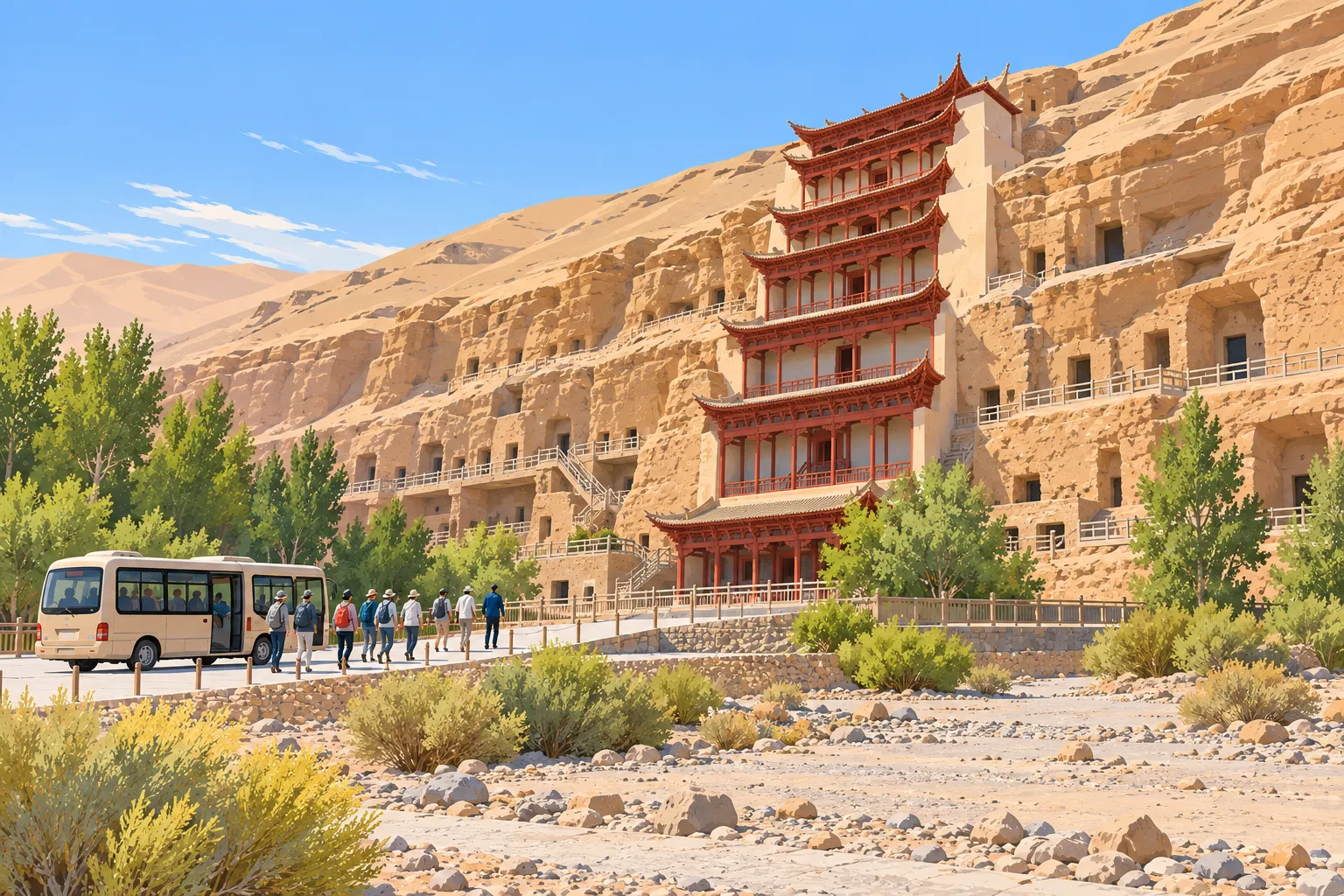
The Mogao Caves are not an attraction where you drive to a cliff, buy a ticket at the gate and wander into any chamber you choose. They are protected Buddhist cave-art heritage near Dunhuang, with timed, real-name tickets and a managed visit that begins at a Digital Exhibition Centre. Getting the product and starting point right matters more than memorising a list of famous cave numbers.
This guide is for a Singapore-based traveler planning a first Mogao visit. It uses the Dunhuang Academy's 2026 visitor notice, ticket page and later ticket-sales warning. Operating seasons, prices and procedures may change, so follow the Academy's latest notice for your date. In particular, check how the current system handles a foreign passport before committing to a nonrefundable Dunhuang itinerary.
Reserve the correct Mogao Caves official ticket and entry slot
Mogao uses timed, real-name admission with capacity limits. Choose the official product before paying: the regular visit includes digital exhibition content and more physical caves than the emergency visit described in the Academy's 2026 notice. A cheaper or later listing is not equivalent simply because both say “Mogao Caves.”
The Dunhuang Academy's 2026 opening notice says regular admission covers a digital film programme and eight physical caves in the peak-season plan. Its emergency mode, used as capacity management requires, covers four physical caves and is a different product. The Academy's Mogao visitor page lists seasonal hours and ticket categories, including a winter regular arrangement. These are operator facts for the cited period, not a permanent guarantee of a particular cave count or price.
For a foreign passport, follow the booking path named in the Academy notice. It directs foreign-passport visitors to the official “Mogao Caves Visiting Reservation” WeChat service account and its Ticket Booking menu. The Academy also names its reservation website and other official channels. Check the current notice to see which route applies to an individual overseas visitor on your date. Do not assume that a travel marketplace claiming “official authorization” is an operator-approved seller.
The Academy's July 2026 ticket-sales statement specifically warns that supposed internal channels, guaranteed tickets and third-party authorizations are false. It points visitors to its listed official platforms. A vague promise from a reseller is particularly risky because your ticket must match your identity document at entry. If the official inventory is gone, changing the visit date is safer than sending passport details and money to an unknown account.
If the booking page offers a concession, inspect who qualifies and which original document proves it. A lower price shown for a Chinese resident category is not automatically available to an overseas traveler. Select a product based on the visitor's actual eligibility, not the lowest number in a search result. If the document category is unclear, confirm it through the Academy's published support route before paying. A reservation that cannot be validated at the check-in counter can cost more than the apparent saving.
For a mixed group, complete each visitor's identity details carefully. Parents should verify the current child admission category and documentation; friends booking together should check that every person's name and passport number are correct. Do not assume one purchaser's passport covers the group. The Academy's visitor system separates the payment account from the identities that must pass the real-name gate.
Match the booking identity to the person at the gate
The 2026 notice requires the ticket, identity document and visitor to match. Enter the same passport name and document number you will use at check-in, and carry the original valid passport when visiting. Do not swap a friend's booking or rely on a photograph of the passport if the operator requires the original. The notice also explains that regular visitors may need to obtain a paper purchase information slip at an official window or machine before proceeding through checks.
Review exactly what your confirmation calls the product: date, timed slot, regular or emergency mode, visitor name, document type, group size and any child or concession terms. A tour company may package transport with admission, but the admission itself still has to satisfy the Academy's real-name process. Ask the seller to identify the official underlying ticket and entry procedure before treating a bundle as confirmed.
Do not book a tight flight, train or desert excursion immediately after the cave visit. Timed admission controls when you present yourself; it does not guarantee a fixed time at which every film, shuttle and guided cave section ends. Leave a practical half-day block and allow more room if you are changing hotels or carrying luggage.
Reach the digital exhibition centre before the cave shuttle
The first destination is the Mogao Caves Digital Exhibition Centre, not the protected cliff area. The Academy states that ticket handling and checks happen at the centre and that there is no ticket office or visitor parking at the cave core. Its 2026 notice asks visitors to arrive 30 minutes before the reserved time. Route your taxi, public transport or tour drop-off to the centre named in your current confirmation.
This distinction prevents a common mistake. A map search for “Mogao Caves” may direct a driver toward the grottoes themselves. Tell the driver the full Digital Exhibition Centre destination and show the address printed on the official notice or booking. The 2026 notice places the centre at 8899 Yangguan East Road in Dunhuang. Confirm the location in the current app or notice before travel because a changing entrance arrangement could alter the drop-off.
At the centre, allow time for security, document checking and any paper slip exchange. Keep the passport and purchase information available through the visit; the notice says the slip can be checked at both the centre and cave area. Do not pack it into a suitcase or hand all documents to a guide without understanding when you will need them. If you have booked multiple people, make sure each has the correct identity document and the group knows its assigned time.
The digital programme is part of the regular visitor sequence, not an optional decoration to skip if you are late. It introduces context for the art and helps manage entry to fragile caves. Follow staff directions from the exhibition section to the managed transport. Do not assume you can drive yourself to the cliff after watching a film; the Academy's route and capacity controls are integral to the visit.
Plan the approach from Dunhuang without inventing a shuttle timetable
Check how you will reach the Digital Exhibition Centre from your Dunhuang accommodation and how you will return afterward. The most reliable plan uses the current official address, an arrival margin and transport that you can actually arrange for your day. Public route information and taxi availability can change; a travel article's old bus number or fare should not be the deciding evidence for a timed ticket.
If a hotel or tour operator offers a transfer, confirm that it goes to the Digital Exhibition Centre before your reserved check-in window, not merely to a photo viewpoint or a nearby parking area. Ask where you will be collected after the managed cave visit. Keep the operator's contact details separate from the ticket seller's contact details so you know whom to ask about transport and whom to ask about admission.
Travel light. The Academy notice prohibits suitcases and packages of 20 inches or more in the cave area, alongside pets and drones. Arrange hotel storage for large luggage before setting off. Keep water, sun protection, a light layer and essential medication in a small permitted bag, while checking current centre and cave-area rules for what may be carried onward.
Understand guided cave access and photography restrictions
An admission ticket does not grant open access to all caves. Mogao's murals and painted sculptures are protected cultural heritage. The Academy limits capacity and directs visitors through managed cave access; its 2026 notice lists regular, emergency and limited special-cave arrangements separately. Do not promise yourself one named cave solely because it appears on a poster or another visitor's itinerary.
UNESCO's Mogao listing explains why this system exists. The caves hold centuries of Buddhist art and Silk Road cultural exchange, with fragile wall paintings and sculpture. The purpose of a timed, managed sequence is not just queue control; it supports conservation of the art and the cave environment. A visitor can appreciate the site more fully by accepting that protected access is part of what keeps it available.
The Academy's 2026 rules forbid photographing or filming inside the caves, touching the art, leaning on barriers, crowding and loud behaviour. Follow the current on-site signs even if another person raises a phone. An image you saw online may have been created under special permission or in a digital reproduction. It does not establish a right to photograph a physical cave.
Listen to the guide and remain with the assigned group. If you want an English-language explanation, check the current language arrangements with the Academy or authorized service in advance rather than assuming a guide will be assigned automatically at your preferred slot. The Academy's cultural department describes multi-language services, but availability and booking details are operational questions for your date.
Take a moment at the digital exhibition to understand what you will see in person. A film or reproduction can show details that are difficult to study inside a dim protected cave, where the guided group has limited time and photography is prohibited. That preparation makes the physical visit more rewarding without increasing pressure on a fragile mural. If you want an image for later study, use authorized digital collections or museum publications instead of making your own photograph inside.
Regular, emergency and special access are distinct
The 2026 regular mode and emergency mode differ in content. A regular ticket's digital programme and cave count should not be described as the same as an emergency ticket. The Academy may activate emergency access during busy periods to manage capacity. Read the exact product information at checkout so you know what you are buying.
Special caves are a further limited category. The 2026 notice says their access depends on capacity and management conditions and that related procedures take place after the regular or emergency visit at the cave area's special-cave office. This is not a promise that a visitor can pay to add a famous cave on arrival. Treat it as a possible operator-controlled option, never the centerpiece of a fixed itinerary unless confirmed through the official process.
In the regular visitor area, cave selection can vary for conservation or operational reasons. Do not write a self-guided “must-see cave 45 then cave 57” walking route as though each doorway were a museum gallery. The useful preparation is to understand the major periods and themes, ask questions respectfully, and make space for whichever caves the managed visit includes.
Keep weather and capacity changes in the Dunhuang plan
The cave area can close for conservation and safety reasons. The Academy's 2026 opening notice says heavy rain or sandstorm conditions can cause closures. It also publishes notices when operations change. Check its official site and reservation account close to the visit, especially when the weather is unsettled. Do not take a hotel desk's informal assurance as the final word on cave access.
This is not hypothetical. The Academy closed Mogao on 29 July 2026 after rain, citing pooled water, slippery walkways, higher cave humidity and rockfall risk. Its notice described refund and rescheduling routes for affected ticket states. That specific event does not predict another closure or guarantee the same refund terms in the future; it shows why an operator notice must outrank a fixed travel itinerary.
Keep your Dunhuang schedule flexible enough to absorb one changed activity. If the caves are closed, do not drive to the protected area hoping to enter anyway or accept an unauthorized replacement ticket. Save the official closure notice, follow the reservation platform's instructions for your booking and choose a different Dunhuang activity only after checking its own weather and opening status.
The site also uses daily capacity limits, according to the Academy notice. A sold-out day is not a puzzle to solve through social-media brokers. If your trip has one possible Mogao date, secure the correct official reservation before adding nonrefundable side trips. If you have two possible dates, keep the second as a real backup rather than filling it with another timed activity.
Protect the rest of the trip
If you are flying or taking a train out of Dunhuang, do not place that departure immediately after the estimated cave finish. A delay at the centre, a changed shuttle arrangement or a longer guided sequence can compress a tight connection. Leave a buffer you are comfortable with and keep transport details offline in case mobile service is weak.
If the official reservation interface does not accept your passport or payment method, use the Academy's published consultation route to resolve it. Do not let a stranger “fix” the problem by collecting your passport image and booking through a personal account. The Academy's anti-resale warning exists because false guarantees create both entry and personal-data risks.
A decision sequence for a first visit
First, check the Academy's latest opening notice for your travel date. Second, choose the regular or other official product based on what it actually includes and complete the real-name booking using the route provided for foreign-passport visitors. Third, route yourself to the Digital Exhibition Centre with the passport, booking proof and arrival margin. Fourth, follow the digital programme, ticket checks, managed transport and guided cave access. Fifth, check the current closure and prohibited-item notices before leaving the hotel.
The broad Chinese culture guide places Buddhist heritage within a wider trip. For Mogao, the Academy's own instructions govern admission. UNESCO supplies the heritage context; it does not sell your ticket or decide that day's cave access.
The most important distinction is between seeing Mogao and assuming ownership of an unrestricted cave itinerary. Your ticket gives access to an operator-defined visit, subject to identity checks, capacity, weather and conservation rules. Plan around that real sequence and you can spend your attention on the art rather than an avoidable ticket or transport mistake.