Chongqing in two days: hotpot, the monorail, and Hongyadong

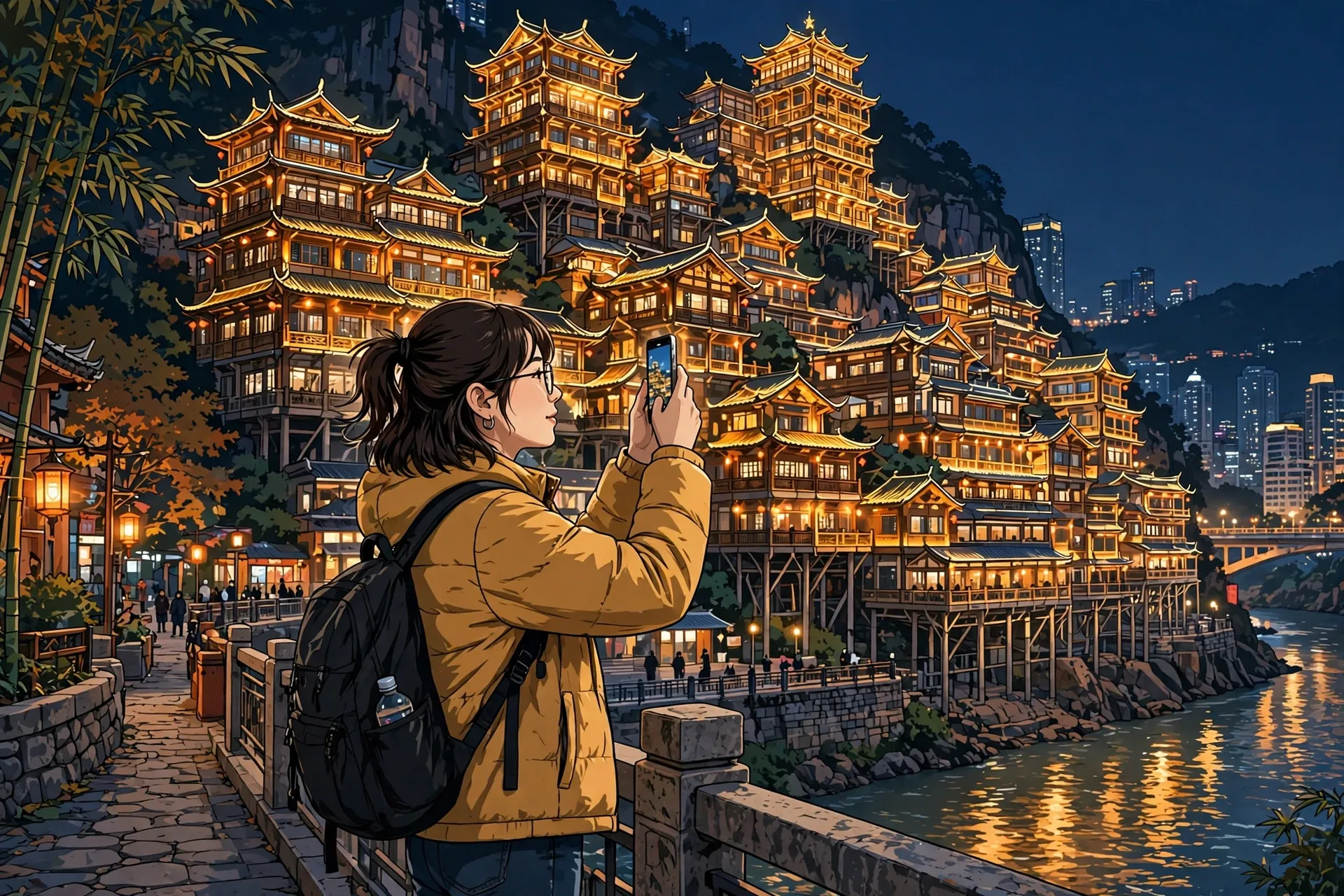
Two days is short for a city built like a video game level, but Chongqing's greatest hits sit closer together than its three-dimensional geography suggests. The trick is treating the metro as your personal shuttle, grouping sights by neighborhood, and timing the one thing that punishes latecomers: Hongyadong after dark.
This plan covers the monorail that threads straight through a residential building, the cliffside stilt-house complex at its lit-up best, and hotpot the way locals actually eat it — with none of the taxi roulette or surprise staircases that derail most Chongqing itineraries. Here is how to run it.
Getting there and where to base
Base yourself in Jiefangbei or nearby in Yuzhong, cluster each day's sights geographically, and ride the metro instead of taking taxis. Time Hongyadong for just after the lights switch on, visit Liziba in mid-afternoon or early morning, and close Day 1 with a late hotpot dinner.
Jiefangbei sits in central Yuzhong district, the district where almost everything on this itinerary is located. Staying here means Liziba, Hongyadong, and the cableway are all short metro hops away, and the area is dense with hotels at every price point. A twenty-minute orientation walk around the square on arrival pays for itself: you get your bearings in Chongqing's vertical core before the itinerary starts.
Most flights land at Chongqing Jiangbei International Airport (CKG). From there, take the metro into central Yuzhong rather than queuing for a taxi — the airport leg is exactly the kind of trip where Chongqing's traffic turns a short distance into a long wait, and the metro skips all of it.
Before you reach the gates, sort out payment. Foreign visitors can ride Chongqing's metro by scanning an Alipay or WeChat QR code with an overseas Visa or Mastercard linked — but complete the passport verification step in the app before you arrive at the station, not while a queue builds behind you. If you prefer a no-phone fallback, the single-journey token machines accept small bills and coins (don't count on them taking large notes). Fares are distance-based, starting around ¥2 with a cap near ¥10, and the lines run roughly 06:30 to 23:30, so late hotpot nights still have a ride home.
Two pieces of Chongqing-specific infrastructure decide whether your two days feel smooth or chaotic. First, navigation: use Baidu Maps or Amap. Google Maps is unreliable in China, and you need a map app that understands stairs. Second, respect the terrain. Chongqing's map distances lie about elevation — a "10-minute walk" can involve 200 vertical meters, and a 15-minute metro ride can become a 90-minute taxi trip. The metro is the default. Walking is for short, confirmed-flat stretches. Taxis are the last resort.
Pack for stairs, not for show
Chongqing will test your shoes and your luggage. Pack one small day bag and leave the big suitcase at the hotel: narrow lanes, escalators that substitute for streets, and staircases that appear mid-route all punish heavy bags. Shoes with grip matter more than style — wet stone steps and steep grades are the norm, and the city gets rain. A light rain shell beats an umbrella in the wind tunnels between towers. And bring a portable charger: you'll be leaning on your map app all day, and navigation plus translation drains batteries fast.
Hongyadong at night: timing the crowds
Hongyadong (Hongya Cave) is an 11-story stilt-house complex — diaojiaolou, traditional riverside architecture — built onto the cliff over the Jialing River. During the day it's a busy warren of shops and food lanes; after dark, when the whole cliff face lights up in amber, it becomes the single most photographed sight in Chongqing. Entry is free, which is partly why the crowds get so heavy.
The lighting schedule is what you plan around. The lights switch on at dusk — roughly 18:00 in winter, around 19:00 from March to May, and closer to 19:30 in summer — and stay on until about 23:00. On this itinerary, you arrive around 19:00, just as the lights come on. That window matters: you want to see the complex transition, not arrive after the peak crowds have already filled every viewpoint.
Here is the practical play. Arrive 30 to 45 minutes before lights-on and walk the interior levels while the lanes are still navigable. The inside is worth an hour, but the best exterior photos are not taken from inside at all — the money shots come from Qiansimen Bridge or the opposite riverbank, where the full lit cliff face is visible. Plan your exit accordingly: browse the interior first, then walk out to Qiansimen Bridge for the light-on moment and the classic wide shot. Weekend evenings are extremely crowded, so if your two days include a weekend, put Hongyadong on the weekday night.
Getting there is part of the timing strategy. Take Metro Line 1 or 6 to Xiaoshizi Station, use Exit 7 or 9, and walk about eight minutes. Don't rely on a taxi for the evening leg — crowd control can restrict or divert taxis near the complex on busy evenings, which makes the metro the only reliable option when you need it most.
Inside the complex: what to do with your hour
Inside, Hongyadong works in layers — literally. The upper levels hold the food lanes and souvenir shops; the lower levels sit closer to the river. Work top-down so gravity is on your side, and treat the interior as a warm-up for the exterior view rather than the main event. The food stalls skew tourist-priced, so snack lightly and save your appetite: the real dinner is the hotpot waiting after. When the crowds peak, the stairwells and narrow passages bottleneck — keep drifting toward the exits as lights-on approaches, so you're on Qiansimen Bridge, not in a stairwell, when the cliff face lights up.
The monorail through the building
The famous photo — a train sliding out of a mid-rise apartment block — is Liziba Station on Chongqing Rail Transit Line 2. The station occupies floors six through eight of a 19-story residential building in Yuzhong district, and it isn't a retrofit: the station and the building were designed and built together, completed in March 2004 and opened to service on 18 June 2005. Residents live above and below the tracks; the whole arrangement is engineered, with the station structure separate from the building's residential frame.
Trains run roughly every six to ten minutes, from about 06:30 to 23:30, so you will never wait long for the shot. Across the street sits a dedicated viewing platform — about 1,367 square meters total, with roughly 840 square meters of viewing and photo space, including a glass walkway and a tourist-coach drop-off. Visiting the platform is free, and thirty minutes is enough to get your photos and watch several trains pass.
Light and timing shape the visit. The best light is early morning (7–9 AM, with the fewest crowds) or late afternoon (5–7 PM). On this itinerary, you visit around 15:00 — not the golden window, but the slot that fits the day-one sequence, and midday still delivers the essential "train through a building" moment. Peak photo times can get very crowded on the platform, but with trains passing every few minutes, waits stay short either way.
There are two ways to experience Liziba, and they're not mutually exclusive. The platform gives you the exterior shot of the train entering the building. Riding Line 2 through the building yourself gives you the passenger-side view: board at a nearby station, ride one stop, and watch the apartment block swallow the train around you. On the day-one plan, the ride-through works best on your way back toward Hongyadong — it's a functional metro trip that happens to pass through a building.
Making the most of thirty minutes
Thirty minutes is enough, but spend them deliberately. Get the exterior shot first — trains come every few minutes, so you'll have several chances, and the light changes fast in late afternoon. Then walk the glass-walkway section for the straight-down view of the tracks. If you're riding through, sit on the side facing the building on approach. Don't overthink it: Liziba is a precision stop, not a half-day attraction. Get in, get the shot, ride through, and keep the day moving.
Hotpot: the Chongqing style and spice survival
Chongqing hotpot is not Chengdu hotpot turned up slightly — it runs a full gear spicier, built on a beef-tallow broth loaded with dried chilies and Sichuan peppercorns. That tallow base is the signature: rich, numbing, and aggressive in a way that rewards a specific ordering strategy.
For first-timers, the classic entry point is Peijie (Pei Sister) Old Hotpot, whose Hongyadong branch on Cangbai Road — level 4F — serves the beef-tallow broth that defines the style. Expect evening queues, so go early or be prepared to wait; it stays popular precisely because it's the benchmark. More broadly, the old-school local shops (Peijie, Yuzong Laozao) pour a stronger, more aggressive broth than the national chains. If you want easier spice control on night one, Haidilao or Xiaolongkan are the gentler on-ramps — same format, dialed back. Budget depends on the shop and how much you order.
Order the nine-grid pot — jiugongge — if the table offers it. The grid sections create different heat zones, letting you cook delicate items in milder sections and the hardy stuff in the full-strength zones. The canonical Chongqing order: maodu (beef tripe), cooked with the "7 ups, 8 downs" dip — seven dunks, eight lifts, counting the rhythm so the tripe stays crisp instead of rubbery; duck intestine, which needs only seconds; and huanghou (beef aorta), for texture. Everything gets finished in the oil dish: sesame oil with garlic and cilantro, which coats the mouth and cuts the heat between bites.
Spice survival is a strategy, not bravery. Start at wei la (mild) — and understand that mild in Chongqing is still hot by Singapore standards, because spice levels aren't standardized between restaurants. The safer play is a yuanyang pot, half-and-half with a clear or mushroom broth on one side, so everyone at the table has an escape lane. Drink the oil dish, not water, between bites; eat the starchy sides (noodles, potatoes) when your mouth needs a break; and remember the peppercorn numbness builds over the meal, so the first ten minutes are not representative of the last thirty.
Ordering like you mean it
A few mechanics make the meal smoother. Order the broth first and let it come to a full rolling boil before anything goes in — lukewarm tallow is a different, worse dish. Cook in small batches; the nine-grid's zones exist so you can keep raw and cooked items separated. Tripe and intestine want seconds, not minutes — overcooked, they turn rubbery, which is the single most common first-timer mistake. Build your oil dish before the food arrives: sesame oil as the base, mashed garlic, a pinch of cilantro, and a spoon of the soup's surface oil if you like it richer. For drinks, the classic pairing is suanmeitang (sour plum drink), which cuts the grease between rounds. And pace the peppercorns: the numbing builds cumulatively, so the meal's last third is always spicier than its first.
On this itinerary, hotpot starts around 21:00, after Hongyadong. That's deliberate. Chongqing hotpot shops run late, the meal stretches two hours easily, and ending the day at a full boil — tired, happy, slightly numb — is the correct way to close a day of vertical city.
Ciqikou old town: worth the trip?
Ciqikou is the honest answer to "do I have a second day here, or is one enough?" — a Ming and Qing-era old town on the edge of modern Chongqing, preserved as a lane of teahouses, snack vendors, and traditional shopfronts. It's reachable on Metro Line 1, and the honest verdict is: worth the trip if you enjoy snack streets and old-town atmosphere, skippable if old towns blur together for you.
If you go, time it right. Ciqikou is busiest on weekend afternoons, so on this plan it slots into the Day 2 morning — after the cableway, before the crowds. The teahouses are the real draw: sit for a pot of tea, watch the street from a second-floor window, and graze the snack lanes (spicy tofu, glutinous rice treats, and the usual suspects of a Chongqing snack street). Two to three hours is the right dose.
If old towns don't move you, swap in the Three Gorges Museum and the People's Assembly Hall instead — a solid museum-plus-architecture morning with none of the snack-street shuffle. Either way, start Day 2 at the Yangtze River Cableway: this river-crossing gondola is best done in the morning, and you should buy at the station and go early for a window spot, because the queues grow long by late morning. Then close the trip with dinner on Nanbin Road across the river — grilled fish and shaokao skewers, with the skyline across the water — which is the right final meal after two days of tallow and spice.
When to skip Ciqikou
Skip it without guilt if any of these are true: you've already done two old towns this trip, your knees are protesting yesterday's stairs, or the weather is brutal. The Three Gorges Museum swap is genuinely good — it's one of China's better regional museums, and the Assembly Hall's domed silhouette is worth the exterior photo alone. And if you'd rather sleep in after the late hotpot night, nobody will judge you: the cableway queues are worst in late morning anyway, so a slower start pairs naturally with an afternoon museum visit and the Nanbin Road dinner finale.
One planning note if Chongqing is part of a longer China trip: pairs well with a city stop that contrasts with it. If Shanghai is also on your itinerary, our Shanghai travel guide covers the Bund, the French Concession, and the hidden corners that balance Chongqing's vertical chaos with something flat and walkable.
The two-day checklist
Day 1: orient in Jiefangbei (~20 min) → Raffles City skybridge for the two-river view → xiaomian lunch (¥10–20) → Liziba monorail around 15:00 (~30 min) → walk Qiansimen Bridge at dusk → Hongyadong as the lights come on (~19:00) → nine-grid hotpot from ~21:00. Day 2: Yangtze River Cableway in the morning → Ciqikou old town (or the Three Gorges Museum) → dinner on Nanbin Road. Throughout: metro over taxis, Alipay/WeChat QR set up before you fly, Baidu Maps or Amap on your phone, and shoes you can climb stairs in.