China's overnight high-speed sleepers: Beijing to Shanghai while you sleep

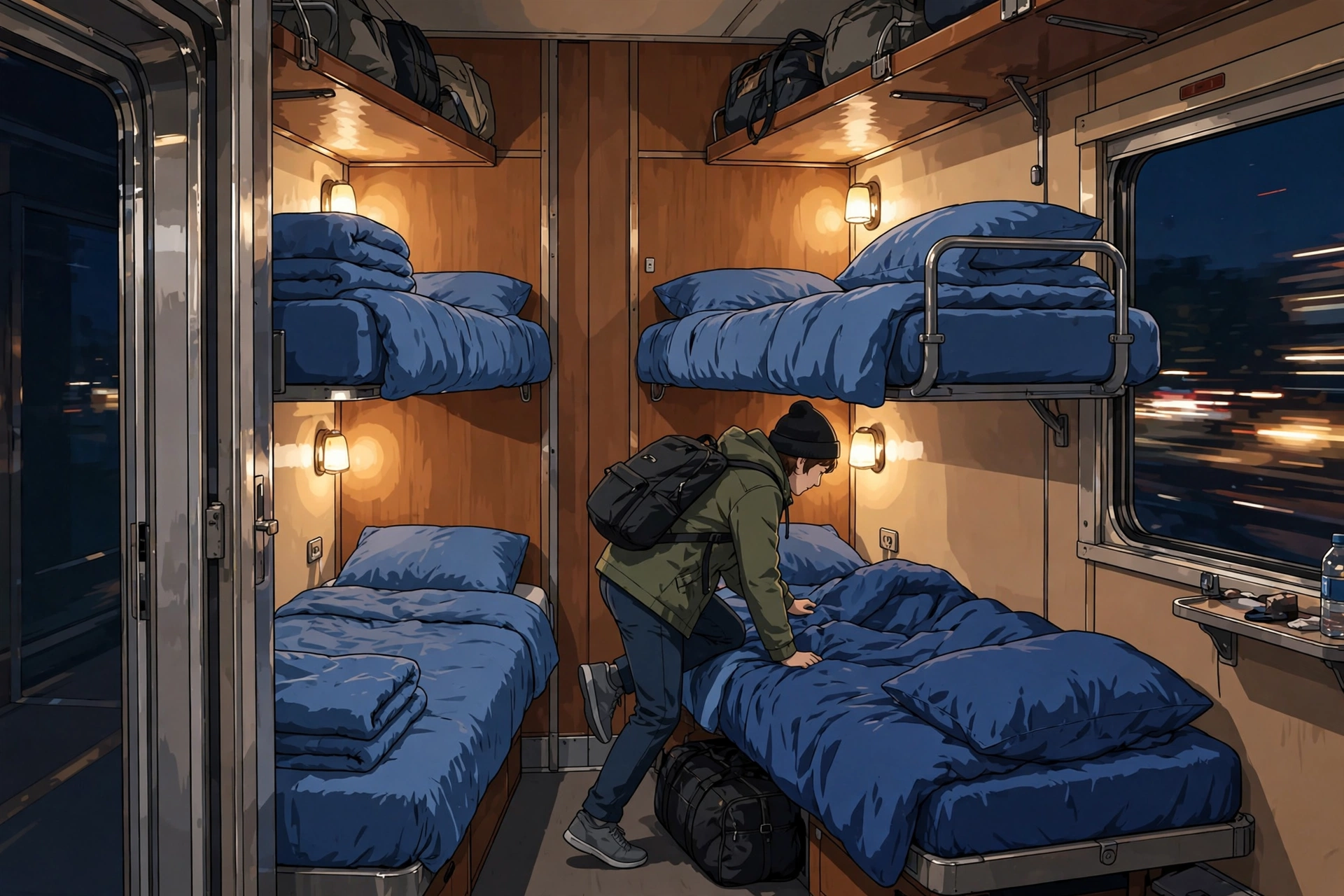
Board in Beijing at night, wake up in Shanghai. No airport security line at dawn, no red-eye scramble for a taxi at 2 a.m., no hotel room that you only occupy for five hours. China's overnight high-speed sleeper trains turn the 1,300-kilometer Beijing–Shanghai hop into a hotel night on rails.
For Singapore-based travelers building a multi-city China itinerary, the overnight sleeper solves a real planning problem. Daytime bullet trains are fast but eat a full sightseeing day; flights look short on paper but the door-to-door math — airport transfer, early arrival, baggage claim — often comes out worse. The sleeper gives you the night back: sleep through the distance, wake up downtown.
This guide covers exactly how the overnight sleepers work: which trains run, what the berths cost, how foreigners book, what boarding feels like, and what to do when you roll into Shanghai before 8 a.m. with a hotel check-in five hours away.
Which routes have sleeper HSR
Three overnight D-series bullet sleeper trains run nightly from Beijing to Shanghai, departing in the evening and arriving in the early morning. The journey replaces a hotel night, with berths instead of seats. Book fifteen days ahead, and pick your berth when you book.
Departures fall between 19:34 and 21:17, with arrivals between 07:41 and 09:15.
These are not the daytime G-series trains most visitors know. The G trains are built for speed: seated carriages, bright cabins, arrival before dinner. The D-series overnight trains are built for sleep. They run at roughly 150 km/h over the same corridor — slower than the daytime high-speed sets — and take about 12 to 12.5 hours. Every carriage is fitted with bunks instead of seats, the lights go down after departure, and the train rolls into Shanghai in the early morning.
Why the sleeper beats a flight on this route
A Beijing–Shanghai flight is about two hours in the air. That number is honest, but it is also the least important number in the comparison. Add the airport transfer on each end, the recommended early arrival, boarding, baggage claim, and the metro or taxi into Shanghai, and the "two-hour flight" easily consumes five to six hours of your waking day — plus a hotel night you paid for anyway.
The sleeper's accounting is simpler. You board after dinner, sleep roughly eight hours, and arrive in central Shanghai with the whole day ahead of you. The ticket price — around CNY 437 for a hard sleeper — is in the same neighborhood as a budget hotel room, which is precisely the point: it replaces the room, not just the transport. If you were going to spend the night somewhere anyway, the sleeper is often cheaper than flight plus hotel combined.
Who should take the sleeper
The overnight train fits a specific kind of trip. Take it if you are doing a multi-city loop — Beijing, then Shanghai, then onward — and want to protect your daytime hours for sightseeing. Take it if you sleep reasonably well on moving transport; the ride is smooth, but it is still a train. Skip it if you are a very light sleeper, if you have an early-morning meeting that cannot slip, or if your schedule has a buffer day you would rather spend awake. The sleeper is a logistics move, not an experience ride. It earns its place by saving a day, and that is the whole pitch.
For the broader rail system — how to read Chinese train numbers, what the letters mean, and how the booking ecosystem works — the site's China high-speed rail guide is the companion reference. Pair it with your Beijing sightseeing plan when planning the days before you board.
Berth types and what they cost
China's sleeper trains sell two classes of berth, and the difference is comfort, privacy, and a modest premium. Here is what each one actually gets you on the Beijing–Shanghai overnight D trains.
Hard sleeper (yingwo): about CNY 437
Despite the name, nobody is sleeping on wood. "Hard" here means basic, not painful. A hard sleeper carriage is an open-plan dormitory on rails: six bunks per bay, stacked three tiers high, with no door between your section and the aisle. Each bunk is about 60 cm wide — enough to lie flat, not enough to roll over luxuriously.
The open layout has trade-offs. It is social and well-ventilated, and it is the cheapest way to sleep between the two cities. But there is no privacy, the aisle lights and foot traffic are part of your night, and your luggage sits in shared space. If you are tall, aim for a lower or middle bunk; the top tier has the least headroom and the most climbing. Ticket prices vary slightly by berth position — lower bunks cost a little more than upper ones, for reasons that become obvious around 2 a.m.
Soft sleeper (ruanwo): about CNY 554
The soft sleeper is the upgrade that matters on an overnight run. Each compartment is an enclosed cabin with four bunks — two tiers on each side — and a door that locks. Bunks are about 75 cm wide, noticeably roomier, with better padding. The cabin feels like a small private room rather than a dormitory bay.
Soft sleeper typically costs 50 to 67 percent more than hard sleeper on this route, and the difference here buys meaningfully better sleep: a door, darkness, and quiet. For a train you are specifically taking to rest, that is the money working hardest in your whole itinerary.
Which one to book
Book soft sleeper if you need to function the next day — meetings, a full sightseeing schedule, a connecting train. The privacy of the locking door and the wider bunks translate directly into better sleep, and the price gap is small relative to the trip. Book hard sleeper if budget is the priority and you sleep anywhere; it is perfectly serviceable, and the money saved covers a good dinner in Shanghai. Groups of four can book all four berths in a soft-sleeper cabin, which is the only way to guarantee a private compartment — cabins are otherwise mixed-gender, with strangers assigned to open berths.
One warning worth repeating: fares move. The figures above reflect October 2026 published pricing, and small variations apply by berth position and season. Check the live fare when you book rather than memorizing a number.
For travelers watching the overall budget, the sleeper is one of the best single moves in a cost-conscious China itinerary precisely because it deletes a hotel line item.
Booking sleepers as a foreigner
This is the part that used to be hard and is now merely fiddly. China's rail network is fully paperless and foreigner-friendly in practice, as long as you use the right channel.
Trip.com: the practical choice
For most foreign travelers, Trip.com is the booking path of least resistance. You can register with any phone number — no Chinese mobile number required — pay with a foreign credit card, and complete the whole purchase in English. The platform charges a service fee of about CNY 20 to 30 per ticket, which is the price of skipping the alternative's paperwork.
Tickets go on sale 15 days before departure, and sleeper berths on popular routes sell out. This is not a route where you stroll up on the evening of travel and expect a lower bunk. Set a reminder for the 15-day mark, especially for Friday and Sunday departures and around Chinese public holidays.
12306: the official app, with a catch
China's official railway app, 12306, sells the same tickets without a service fee. The catch is identity verification: foreign passport holders must complete a manual passport review that normally takes 3 to 5 working days. If your trip is more than a week out, 12306 is worth setting up. If you are traveling within the week, use Trip.com — the verification timeline alone can close the official channel for you.
The passport is the ticket
China rail is fully paperless now, and this surprises first-timers: there is no ticket to print, no QR code to screenshot, no voucher to collect. The passport you used at booking is your ticket. At the station gate, you scan the passport at the reader, and your booking is verified against it. If the automated reader fails on a foreign passport, stations have a staffed manual lane — follow the signs or ask staff, and have the passport ready.
Practical booking notes:
- Names must match exactly. Enter your name precisely as printed in your passport. A mismatch between the booking and the passport can block you at the gate.
- One passport, one booking. Each traveler needs their own booking under their own passport details.
- Keep the confirmation. You will not need it at the gate, but keep the Trip.com confirmation accessible in case anything needs manual checking.
- Cancellations have rules. Refund and change policies depend on how close to departure you cancel; read them at purchase time rather than discovering them at 9 p.m.
Boarding and luggage on night trains
Night-train boarding in China is calm, organized, and — for a first-timer — slightly confusing in the ten minutes before it starts. Here is the playbook.
At the station
Arrive at the departure station 60 to 90 minutes before departure. Beijing has several major stations and they are far apart, so confirm which station your train uses when you book — showing up at the wrong one is the classic preventable disaster. Stations require security screening for all passengers, similar to airports but faster: bags through the X-ray, body through the scanner. Queues are longest in the 30 minutes before departure.
After security, find your waiting hall and watch the departure boards. Boarding for sleeper trains typically begins 20 to 30 minutes before departure. The gate announcement will be in Chinese first; the train number on the board is the thing to watch — D311, D313, D321 — not the destination name. Follow the crowd with the same train number.
Finding your berth
Your booking shows a carriage number and a berth number. Carriages are marked on the platform and on the train doors. Inside, berths are numbered on the bunks themselves. Conductors check bookings after departure — have your passport accessible, since the booking is tied to it. If you booked soft sleeper, locate your compartment, stow your bag, and lock the door when you settle in.
Luggage
Sleeper trains are generous with luggage space compared to flights, but the layout takes a little learning:
- Large suitcases go in the luggage racks at the end of the carriage or under the lower bunks.
- Daypacks and valuables stay with you on your bunk. In hard sleeper especially, keep your phone, passport, wallet, and anything irreplaceable within arm's reach while you sleep.
- Bring a small padlock or cable lock. It is standard advice for Chinese overnight trains and costs almost nothing.
Pack an overnight kit you can reach without unpacking: earplugs and an eye mask, a warm layer (air conditioning runs cold), slip-on shoes for the corridor and toilets, snacks and water, and toilet paper. Hot water dispensers sit at the end of every carriage — free, and the reason experienced riders carry instant noodles or tea.
Onboard facilities
A few things to know before lights-out. Power outlets are limited, so board with your devices charged and consider a power bank. Toilets vary by train: newer D sets have Western-style toilets, while older trains mostly have squat toilets. Cabins are mixed-gender unless your group books all four berths. The conductors will wake the carriage before arrival — set your own alarm anyway, because sleeping through your station is an expensive mistake.
If this trip gives you a taste for rail travel beyond the Beijing–Shanghai corridor, the wider overnight-train network runs on the same booking rules.
Arrival: early morning station strategy
You will roll into Shanghai or Shanghai South station between roughly 07:41 and 09:15 — rested, but with a problem: your hotel room is not ready for another five hours. This section is the difference between a graceful morning and a grumpy one.
Know your arrival station
The overnight D trains arrive at either Shanghai station or Shanghai South, depending on the train. The two stations are in different parts of the city with different metro connections, so check your booking and plan the onward route from the right one. Check which metro lines serve your arrival station the night before, so you are not decoding a metro map at 8 a.m.
The check-in gap playbook
Most Shanghai hotels check in at 2 p.m. or 3 p.m. You have three good options for the morning:
- Drop bags at the hotel first. Nearly all hotels will store luggage before check-in, even budget ones. Go straight there, drop the bags, and you are free.
- Breakfast, then sights. Shanghai does mornings well. Find a breakfast spot near your hotel — shengjianbao (pan-fried soup buns) and soy milk from a local shop beats the hotel buffet you cannot access yet — and start with an outdoor sight. The Bund in the morning light, before the crowds, is one of the city's genuinely great free experiences. Plan the rest of the day around the neighborhood you are staying in.
- Ask about early check-in. If the hotel has rooms available, many will check you in early for free or a half-day charge. Ask at the desk; the worst answer is no.
Do not plan a nap as your morning strategy unless you have somewhere to take it. A sleeper-train night is good sleep, but it is not eight hours in a real bed — budget one lower-energy morning rather than a full-speed sightseeing day, and schedule the demanding stuff for day two.
Onward connections
If Shanghai is a stopover rather than the destination — onward to Suzhou, Hangzhou, or elsewhere — the morning arrival is actually ideal. You land with the full day ahead and can catch a morning G train onward. Just leave a comfortable buffer: deboarding, metro transfers, and a second station's security screening take longer than the map suggests. Ninety minutes between scheduled arrival and an onward departure is the minimum; two hours is comfortable.
The overnight sleeper between Beijing and Shanghai is one of those travel moves that sounds like a compromise and turns out to be an upgrade. You trade nothing — the night was going to pass anyway — and you gain a full day in Shanghai plus the price of a hotel room. Book the soft sleeper, bring earplugs, set an alarm, and wake up downtown.