One palace day in Seoul: Gyeongbokgung, Bukchon, and Insadong walking route

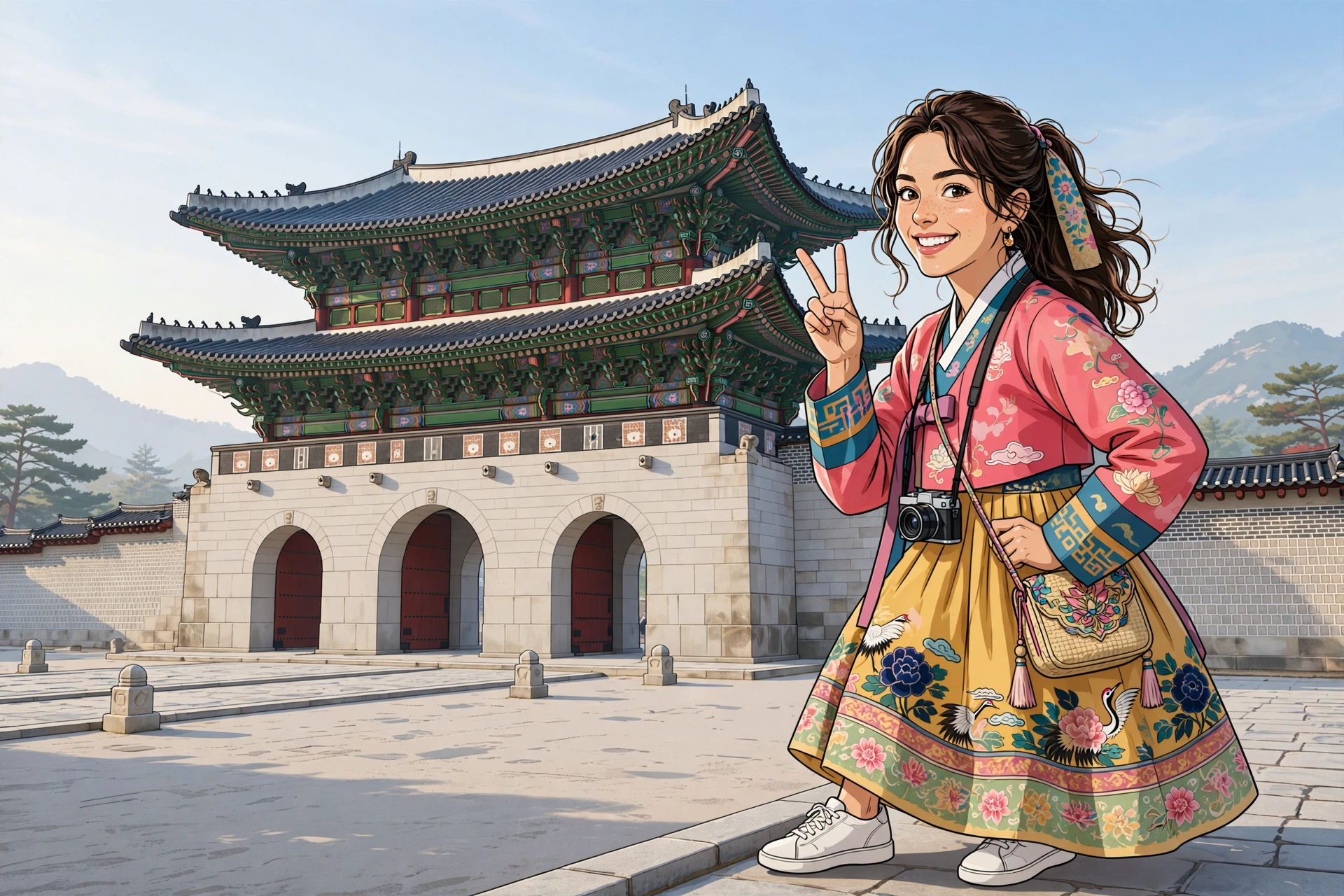
Gyeongbokgung, Bukchon Hanok Village, and Insadong sit within about three kilometers of each other in northern Seoul, yet plenty of visitors burn half the day walking the loop in the wrong order: arriving at the palace after the guard ceremony has finished, queuing for tickets in an outfit that does not qualify for free entry, hitting Bukchon at its most crowded hour, or ending the day with a long backtrack to where they started. The fix is simple. Rent a hanbok first for free palace entry, watch the 10:00 guard ceremony at Gwanghwamun Gate, tour the palace for about two hours, walk fifteen minutes east to Bukchon during the permitted visiting window, and finish downhill in Insadong for food, tea, and shopping. Every step moves forward; nothing gets repeated.
The route order that avoids backtracking
Rent a hanbok near Gyeongbokgung first, watch the guard ceremony at Gwanghwamun, tour the palace for two hours, walk east to Bukchon during the permitted visiting window, then head downhill to Insadong for tea and dinner. The loop covers three kilometers in five to six hours.
Why west-to-east works
The whole day runs west to east. You start at Gyeongbokgung on the western edge of the palace district, because that is where the hanbok rental shops cluster and where the day's only timed event — the guard ceremony — takes place. Renting the hanbok before anything else matters for two reasons: you need to be dressed in time for the 10:00 ceremony, and a qualifying hanbok gets you into the palace for free, which turns the ticket window into a formality instead of a queue.
After the palace, the walk to Bukchon is only about fifteen minutes east, either along Samcheong-ro or from the Anguk side. Bukchon is a residential neighborhood with restricted tourist visiting hours, so it fits naturally in the midday slot. From Bukchon, the route falls downhill along Gyedong-gil into Insadong — the easiest walking of the day lands last, exactly when your legs want it. Any other order forces a climb or a repeat stretch: starting in Insadong and walking up to Bukchon means climbing the slope you could have descended, and pushing the palace to the end means crossing the whole district twice.
What to carry for a five-hour walking day
Actual walking time is only forty to forty-five minutes, but you will be on your feet for five to six hours on cobblestone alleys and uphill paths. Wear comfortable shoes with real grip — not new sandals. Bring a portable phone battery: you will be checking maps all day, since Naver Map and KakaoMap are noticeably more accurate in Korea than Google Maps, and translation apps drain power fast.
Water and snacks are easy to find along the route, but stock up before the palace. Convenience stores are everywhere around Gyeongbokgung Station, and they carry exactly what a walking day needs: water, sunscreen, portable fans, blister patches, and cold drinks. If you have not shopped in a Korean convenience store before, our Korean convenience store buying guide lists what is actually worth buying at CU, GS25, and 7-Eleven, so you can grab the useful items and skip the tourist-trap snacks. A small day bag is enough; the rental shops give you a locker for your street clothes, and the lighter you walk, the longer you last in the afternoon.
Hanbok rental: where, how long, and the free-entry rule
What the free-entry rule actually requires
Wearing a hanbok grants free admission to four royal palaces — Gyeongbokgung, Changdeokgung, Deoksugung, and Changgyeonggung. But the Royal Palaces and Tombs Center applies a strict standard, clarified in 2026, and staff check at the gates — most visibly at Gyeongbokgung's Heungnyemun entrance. They can and do refuse entry to non-qualifying outfits.
A qualifying hanbok means a jeogori (the upper jacket) with a proper overlapping collar worn with a separate skirt or trousers. The following do not qualify: a one-piece hanbok-style dress, a jeogori paired with jeans, a skirt worn with an ordinary t-shirt, or an outer robe such as gonryongpo, dopo, or cheollik worn alone without the layers beneath. The basic full hanbok sets that rental shops hand you are built to this standard, so a normal rental works fine. One more change worth knowing: gender no longer decides eligibility — men in skirt-style hanbok and women in trouser-style hanbok have been accepted since July 2019.
How much it costs and how long to book
Hanbok rental shops cluster around Gyeongbokgung in Tongui-dong and Sagan-dong, most within a five-to-ten-minute walk of the palace gates. Pricing is straightforward. A basic rental for two to four hours runs 15,000–25,000 KRW. Themed or premium outfits — deeper color palettes, embroidered designs, more elaborate sets — run 25,000–40,000 KRW. A full-day rental runs 35,000–50,000 KRW.
Most shops include free hair braiding and accessory rental (hairpins, purses, parasols) in the base price, so the upsells are minimal. The one fee to watch is the late-return charge: most shops bill per ten minutes over your cut-off time. Confirm your exact return time when you check in and set a phone alarm for fifteen minutes before it.
For this itinerary, the basic two-to-four-hour rental is enough if you keep the day moving: you need the hanbok roughly 9:30–14:30 for the ceremony, the palace, and the Bukchon walk. If you want hanbok photos in Insadong too, book a longer window — returning the outfit by 15:00 instead of 13:00 is usually only a small step up in price.
Rental-day logistics: lockers, returns, and hair
Arrive around 9:00. Choose your outfit and size (the staff dress tourists all day and work fast), get your hair braided if you want the full look, and lock your street clothes and valuables in the shop's locker. You walk out with just your phone, card or cash, and maybe a small bag.
One practical note: hanbok skirts are voluminous and the rental shoes are thin-soled. If your feet are sensitive, wear your own comfortable shoes under the outfit rather than the thin rental slippers — the look still works, and your feet will thank you on the palace's gravel paths and Bukchon's hills.
Gyeongbokgung timing: guard ceremony and ticket windows
The guard ceremony comes first
The Royal Guard Changing Ceremony takes place at 10:00 AM and 2:00 PM at Gwanghwamun Gate — and critically, it happens outside the ticket area. Plan your arrival around the 10:00 ceremony: be dressed and at the gate by 9:50. The 2:00 slot exists as a backup, but it breaks the route order, pushing Bukchon into the late afternoon and compressing the whole day.
There is a trap here that catches plenty of visitors: admission tickets are single-use. If you enter the palace grounds before watching the ceremony, you cannot re-enter afterward without a new ticket. Watch the ceremony first, from outside the gate, then go through the ticket window and enter. With a qualifying hanbok you skip the ticket fee entirely — walk up to the gate staff in your outfit and they wave you through.
Ticket windows and the closed day
Standard adult admission is 3,000 KRW, and it is free with a qualifying hanbok. The palace is closed on Tuesdays — check your calendar before committing to this itinerary, because a Tuesday plan needs to become a Changdeokgung day instead. The fastest route in is Subway Line 3, Gyeongbokgung Station, Exit 5, which drops you right at the gate.
The palace opens at 9:00, so arriving by 9:30 gives you a relaxed forty minutes before the ceremony. Use that time for photos at Gwanghwamun Gate and the wide plaza in front of it — the morning light is good and the crowds have not peaked yet.
The two-hour loop inside
Built in 1395, Gyeongbokgung is the grandest of Seoul's five palaces, and about two hours covers the main halls and loops you back toward the exit. The must-sees are Geunjeongjeon, the throne hall where state ceremonies were held; Gyeonghoeru, the pavilion set on a pond that makes the classic palace reflection photo; and the National Folk Museum inside the palace grounds, which is worth thirty minutes if you want context on how the buildings were actually used.
Work the loop in order and you exit near where you need to be: out through the east side toward Samcheong-ro, in the direction of Bukchon. Expect to finish around 12:30 — perfectly timed for the next leg.
Bukchon without the crowds: streets and photo etiquette
The Red Zone hours and why they exist
Bukchon Hanok Village is a living residential neighborhood, not a museum — and since March 2025, its densest lane area (the Red Zone around Bukchon-ro 11-gil, about 34,000 square meters of hanok lanes) has legally restricted tourist visiting hours: 10:00–17:00 only. Being in the Red Zone between 17:00 and 10:00 the next morning can draw a 100,000 KRW fine, and the rule applies to foreign tourists too. Sunday is designated a rest day for the alleyways, so plan this day for Monday through Saturday. Since January 2026, chartered buses have also been restricted in the area, with fines from 300,000 KRW — the rules keep tightening because residents pushed back against tour-bus crowds.
These rules actually shape your timing for the better. Arriving from the palace around 12:30–13:00 lands you in Bukchon squarely in the permitted window and — on a weekday — during the quietest hours. Weekday visits between 10:00 and 17:00 see far fewer people than weekends; tour groups peak in the afternoon, so the earlier you start the lane walk, the emptier the streets.
Quiet-tourism etiquette
The rules are simple because they exist to keep the neighborhood livable. Keep your voice down — sound echoes between the hanok walls. Walk single file in the narrow alleys rather than spreading across the lane. Never enter a private home or courtyard, even if the gate is open. Drones are prohibited. Treat the lanes the way you would treat walking through someone's front yard, because functionally, that is what you are doing.
If you want orientation, stop at the Bukchon Traditional Culture Center first — it hands out free maps, takes about twenty minutes, opens 9:00–18:00, and is closed Mondays. And if fatigue sets in mid-walk, bail out east or downhill: the lanes empty into Samcheong-dong or Insadong, where cafes and tea rooms are waiting.
Streets and photo etiquette
The famous Bukchon view — tiled hanok roofs stepping down the hill with the modern city behind — is found along the Red Zone lanes near Bukchon-ro 11-gil. You do not need to hunt for one specific corner; the lanes all climb and dip, and the rooflines photograph well from almost any elevated point. Go slowly, let faster walkers pass, and take your photos from the lane itself rather than stepping onto doorsteps or leaning into gates.
Be mindful of what is in the frame: residents live behind those doors, and a long-lens shot into someone's courtyard is the photo version of the noise problem. Wide shots of rooflines and lane geometry respect everyone's privacy and, honestly, look better. If a resident or a sign asks you to keep moving, keep moving — no photo is worth the friction.
Picking the right day of the week
This itinerary works best Monday through Saturday. The Bukchon Red Zone lanes observe a Sunday rest day, so a Sunday visit breaks the route's timing, and the Traditional Culture Center is closed Mondays if you wanted the free map. Tuesdays are out too, because Gyeongbokgung itself is closed. Wednesday through Friday mornings are the sweet spot — quiet Bukchon lanes, a normal palace day, and no crowds competing for the best hanbok sizes at 9:00 AM.
Insadong finish: tea, galleries, and dinner spots
Lunch first: the timing that worked out
By the time you walk downhill along Gyedong-gil into Insadong, it is around 14:30–15:00 — past the lunch rush, which is exactly what you want. A sit-down lunch along Insadong-gil or its side alleys runs about 12,000–15,000 KRW, and the slightly off-peak arrival means shorter waits. Traditional restaurants here serve the classics — bibimbap, bulgogi, stews — in wood-and-paper interiors that extend the day's theme.
For something lighter, Insadong's street food fills the gap between meals: tteok skewers (spicy rice cakes on a stick), hotteok (sweet filled pancakes), and ginseng candy from the market stalls. Graze as you walk; dinner can wait until the evening.
Tea houses: the afternoon ritual
Insadong is Seoul's tea-house district, and a traditional tea house is the right way to rest after the walking day. Expect around 10,000 KRW for a proper tea service — often served in a low-lit, floor-seated room with a view over a small courtyard. The best-known houses hide on the upper floors and side alleys off the main street; look for the wooden signs rather than the neon ones. Budget forty-five minutes to an hour, and let your feet recover before the shopping stretch.
Craft shopping and the evening wind-down
Insadong-gil, the wide pedestrian main street, is lined with shops selling calligraphy supplies, hanji (traditional Korean paper), ceramics, and crafts — plus the Ssamziegil shopping complex, a spiral courtyard building of artisan shops worth a slow loop. This is the part of the day for souvenirs that actually mean something: a ceramic bowl, a set of hanji stationery, a brush or ink stone if you are artistically inclined.
For dinner, the main street and its alleys hold traditional restaurants that stay open into the evening, and the street-food stalls carry you through if you would rather graze than sit down. If the hanbok is already returned and the day is winding down, the nearby Jogyesa Temple is worth the short detour — its lantern-lit courtyard is one of Seoul's prettiest evening stops. Anguk Station is a few minutes' walk from everywhere in Insadong, and if you need water or snacks for the ride home, the convenience stores around the station have you covered.