DMZ tour from Seoul: half-day vs full-day, booking rules, and what to verify

The DMZ is the one Korea day trip where the booking rules matter more than the itinerary. You cannot just show up: entry to the Civilian Control Zone requires a passport check, an authorized guide, and an official tour bus, and tours can be cancelled by the military with little notice. Choose the wrong tour type, or book the JSA tour that no longer exists, and you burn a whole day in your trip. This guide compares half-day and full-day tours honestly, explains the JSA closure that reshapes every itinerary on sale, and lists exactly what to verify — documents, dress code, closed days, refund terms — before you pay a cent. For travelers flying into Incheon for a short Korea trip, getting this booking right is the difference between a highlight day and a wasted one.
Half-day vs full-day (JSA): what each one actually shows you
Book a half-day tour for the essential DMZ stops in five to six hours, or a full-day tour with lunch plus one extra stop. Both visit Imjingak, the Infiltration Tunnel, Dora Observatory, and Dorasan Station, while the JSA at Panmunjom remains closed.
Every DMZ tour from Seoul runs the same backbone course, because the military controls which sites are visitable. A half-day tour typically picks you up in Seoul around 7–8am and returns by 1–2pm, lasting five to six hours door to door. A full-day tour runs eight to nine hours and adds lunch plus one extra stop — commonly a suspension bridge (Gamaksan or Majang Lake), the DMZ gondola, or a North Korean defector Q&A session, depending on the operator. Everything else about the two formats is identical: same checkpoint procedures, same core stops, same passport requirement.
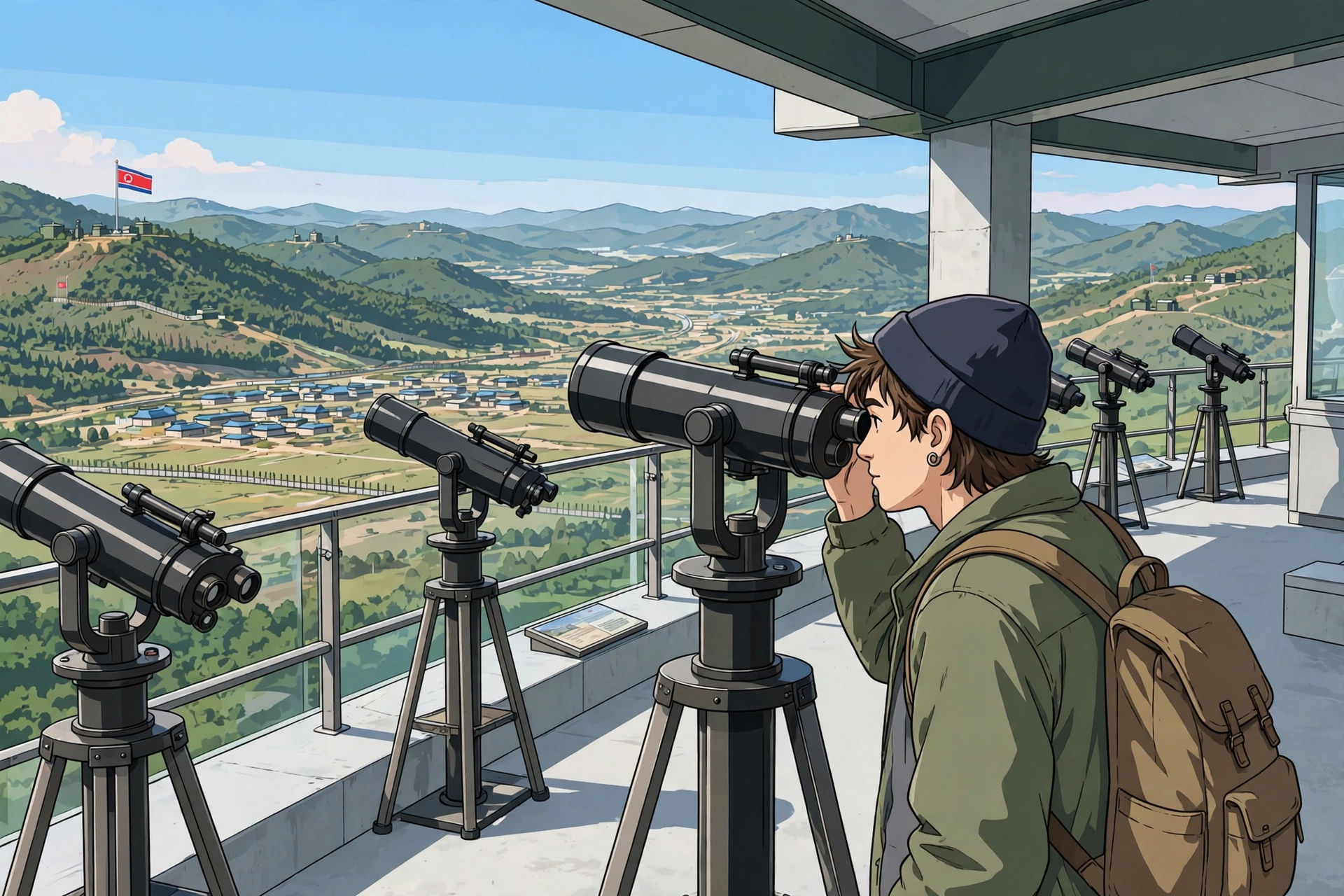
The honest way to choose: the half-day tour is the better value for most travelers. The four core stops — Imjingak Park, the 3rd Infiltration Tunnel, Dora Observatory, and Dorasan Station — carry the whole meaning of the trip. Imjingak Park is the memorial and staging area at the edge of the zone, with the Freedom Bridge, Mangbaedan Altar, and rows of flags; Dora Observatory's telescopes point across the border at Kaesong on clear days; Dorasan Station is the northernmost station of the South, built for a rail link to the North that mostly sits unused. The full-day add-ons are decent but secondary: a suspension bridge walk, a gondola ride over the Imjin River, or a Q&A with a defector. None of them changes what the DMZ itself teaches you.
Pay for the full day only if one of two things is true. First, you specifically want the add-on the operator lists — read the listing carefully, because "full-day" is a duration label, not a content guarantee, and add-ons differ by operator. Second, you want a slower pace with lunch handled. If neither applies, the half-day tour gets you back in Seoul by early afternoon with money left for the rest of your trip. One practical note: tour companies price in Korean won for walk-ins and US dollars on booking platforms, so compare like with like before deciding the full day is worth the premium.
Why "JSA tour" listings still exist
Here is the fact that reshapes everything on sale: the Joint Security Area at Panmunjom has been closed to public tours since July 18, 2023, after a US soldier crossed into North Korea during a tour. The Ministry of Unification's official Panmunjom tour calendar shows no tours on every date through November 2026. This is not a seasonal pause; it is an indefinite suspension, and any restart would be announced on the official Panmunjom tour site.
So what are the listings titled "JSA tour" or "JSA + DMZ combo" selling? A substitute. Operators replace the Panmunjom stop with the JSA Museum or the North Korea Experience Hall — indoor exhibits, not the blue huts on the Military Demarcation Line. Some listings bury this in small print; some put it in the title honestly. Before booking anything with "JSA" in the name, check the fine print for which site actually replaces it, and decide whether a museum is worth the price difference over the standard DMZ course. A tour that sells you a JSA visit without disclosing the closure is a tour to avoid entirely.
Booking channels that work for foreign passport holders
Foreigners cannot enter the Civilian Control Zone independently — not by car, not on foot, not with a private driver. Entry requires registration, a passport check, an authorized guide, and an official tour bus. Even travelers who drive to Imjingak Park themselves must transfer to the official shuttle to go further. A guided tour booked in advance is effectively the only legal option for seeing the DMZ proper.
The standard booking channels are the global platforms — Klook, Viator, GetYourGuide, TripAdvisor — where DMZ tours are among the best-reviewed half-day products out of Seoul, and the specialist operators' own sites (dmz-korea-tour.com is the longest-running). Prices run about US$40–60 (₩55,000) for half-day and US$63–90 (₩85,000) for full-day, with variation by operator, group size, and inclusions. Platform bookings usually show instant confirmation; specialist operators may take a day to confirm because they pre-register foreign visitors with the military.
A few channels exist outside the guided-tour default, with limits. The DIY alternative: take the Gyeongui–Jungang Line to Imjingang Station, walk to Imjingak, and buy the official Paju shuttle ticket on site — ₩9,200 for the tunnel on foot or ₩12,200 including the tunnel lift. This covers the core course without a Seoul pickup, but shuttle tickets sell 09:00–14:30 only, sell-outs and early closing are common, and it is still an official tour bus with a guide — just one you join at Imjingak instead of Seoul. It is not a way to wander the zone freely. Foreigners do not qualify for Paju's local fee discounts; children 6 and under ride free.
Book standard tours a few days ahead, and 1–2 weeks ahead in peak season (cherry-blossom April, autumn foliage October, any Korean public holiday week). The military pre-registration step means last-minute bookings can fail even when the platform shows seats. And critically — covered in detail below — schedule the DMZ for the early part of your trip, not the last day. Military cancellations are a real possibility, and an early booking leaves you room to rebook.
For the small logistics that surround the tour day — snacks for the early pickup, a convenience-store breakfast if your hotel does not do one — our guide to what to actually buy at Korean convenience stores covers the CU, GS25, and 7-Eleven staples that make 6am pickups bearable.
Closed days and what they cost you
DMZ tours do not run on Mondays, on weekday public holidays, or on Seollal and Chuseok day itself (the other days of those holiday periods are open). This closure pattern follows Paju City's official DMZ Peace Tour course. If your trip is short, check the calendar before locking hotel nights around a DMZ plan: a Tuesday-to-Thursday Seoul stay gives you two DMZ-eligible days; a Sunday-to-Tuesday stay gives you one, and if Monday falls inside, zero. Tour operators list their own blackout dates on top of this, so confirm on the specific listing — not all operators follow the identical pattern for holiday weeks.
The ID, dress code, and age rules to verify before booking
Passport: original, physical, name-matched
Every foreign visitor must carry the original physical passport — no photocopies, no phone photos, no expired passports. The military checkpoint refuses all of these, and the name on your booking must match the passport exactly. This is the single most common way travelers get turned away at the checkpoint with no refund, because most operators' terms treat document failure as the traveler's fault. Pack the passport the night before. If you booked under a nickname or an old spelling, contact the operator to correct it before the tour day — after pre-registration is submitted, changes may not be possible.
One related check for Singapore passport holders: your passport must of course be valid for travel anyway, but there is no separate visa procedure for the DMZ — the tour's pre-registration is the paperwork. Just bring the physical document.
Dress code: what gets refused
The DMZ enforces a dress code, and guides do turn people away over it. The rules: no torn jeans, no shorts above the knee, no sleeveless tops, and no clothing with political symbols. These rules read as conservative, and they are enforced as written — particularly the shorts rule, which catches travelers in summer. Closed-toe shoes are strongly recommended because the tunnel descent and some ground at the observatory stops are uneven; the tunnel in particular is a steep 350m walk down (the climb back is equivalent to about 25 stories) on a sloped concrete path. Sandals are not banned outright everywhere, but you will regret them. If your tour includes a suspension bridge add-on, the same closed-toe advice applies doubly.
Fitness and age: the tunnel is the filter
The 3rd Infiltration Tunnel is the physically demanding stop and the one to assess honestly. The descent is 350m down a steep grade, hard hats are required, and photography is prohibited inside. The climb back up is the equivalent of about 25 stories. The site is not recommended for visitors with heart conditions, asthma, or mobility issues — this is official guidance, not marketing caution. There is a lift option: since September 29, 2026, the tunnel lift runs five times daily (9:20, 10:30, 11:30, 13:00, and 14:00) with limited places per run, which makes the stop manageable for travelers who can walk but not climb. If the lift matters to you, confirm with the operator that your tour's timing aligns with a lift run, and ask how lift places are allocated — they are limited and not guaranteed.
Children: the course is generally fine for school-age kids, who tend to find the tunnel an adventure, but the descent is long for small children and there is no shortcut back up. Children 6 and under enter the Paju shuttle free, but the physical reality of the tunnel applies regardless of the ticket price. Seniors with good mobility handle it routinely; seniors with knee or heart issues should plan on the lift or skip the tunnel descent while the group goes in — discuss this with the guide at the start of the day, not at the tunnel entrance.
What a tour day really looks like, stop by stop
A typical half-day runs like this. Pickup in central Seoul between 7 and 8am — most operators offer hotel pickup in Myeongdong, Hongdae, and Gangnam, or a fixed meeting point if your accommodation is outside the route. The drive north takes about an hour, during which the guide briefs you on the passport check, the dress code recheck, and the no-photography zones. Expect a checkpoint stop where soldiers board the bus and inspect passports; this is routine and takes 15–30 minutes depending on the queue.
Stop one is usually Imjingak Park, the staging ground at the edge of the Civilian Control Zone. You get roughly 40 minutes to an hour: the Freedom Bridge (where POWs crossed back in 1953), the Mangbaedan Altar for separated families, the steam locomotive rusting where it was bombed during the war, and the flagpoles. If you are on the DIY shuttle version, this is also where you transfer to the official bus.
From Imjingak the official shuttle — guided tours transfer here too — heads into the zone proper. The 3rd Infiltration Tunnel comes next: helmet on, steep descent, a walk along the tunnel that North Korea dug toward Seoul (discovered in 1978), and the climb back. Budget about an hour including the wait. Then Dora Observatory: telescopes, and on clear days a view across to Kaesong and the North Korean flagpole in the propaganda village of Kijong-dong. Dorasan Station follows — the gleaming, mostly unused northernmost station, with its "to Pyongyang" signage. Some tours run the order observatory-then-tunnel; the military sets the sequence on the day.
Full-day tours add lunch — usually a Korean set meal near the zone or back toward Paju — and the add-on: the suspension bridge walk, the gondola over the Imjin River, or the defector Q&A. Return to Seoul lands around 1–2pm for half-day tours and 4–5pm for full-day.
Photography rules vary by stop and by the day's security level: the tunnel interior is always no-photos, and guides will tell you at each stop whether cameras are allowed. When in doubt, the rule is simple — if the guide has not said yes, it is no. Soldiers at checkpoints and in the zone are never photo subjects.
What to bring and what to leave
Bring: physical passport, comfortable closed-toe shoes, water, a light jacket (the tunnel is cool year-round and observatories are exposed), and cash or card for the Imjingak gift shops. Leave: drones (banned), tripods are usually fine but check, and anything you would not want inspected — bags can be checked at the military checkpoint. Large luggage is a bad idea on a tour bus; leave it at the hotel.
Cancellations and the military-closure backup plan
Military-related cancellation is not a rare edge case on DMZ tours — it is a built-in feature of visiting an active military border. Sites can close on short notice for security reasons: drills, VIP movements, or heightened alert levels. When that happens, operators typically substitute an alternate stop (often the War Memorial of Korea in Seoul or an extended Imjingak visit) or cancel outright. This is why the single most important booking decision is timing: put the DMZ early in your trip. A tour cancelled on day two of a five-day trip can be rebooked; a tour cancelled on your last day is simply lost.
Before paying, check the operator's refund and substitution policy for military cancellations specifically — not the generic weather policy. The questions to ask: if the military closes the zone, do I get a full refund or a substitute itinerary? If a substitute, which stops? Is the refund automatic or do I have to claim it? Policies differ meaningfully between operators, and the cheapest listing sometimes has the stingiest cancellation terms. Read the listing's cancellation section rather than assuming.
If your tour is cancelled and cannot be rebooked, Seoul has strong backup options for the same historical interest. The War Memorial of Korea in Yongsan is the natural substitute — extensive Korean War exhibits, free entry, and it takes half a day. The National Museum of Korean Contemporary History near Gwanghwamun covers the division and democratization story. Neither replaces standing at Dora Observatory looking north, but either one salvages the day's theme.
One final verification habit: the night before your tour, check two things. First, your operator's message channel — cancellations are usually announced the evening before or morning of, and some operators only notify via the platform's messaging, not email. Second, the weather: the observatory stops lose most of their value in heavy rain or fog, and while tours run in bad weather, you may prefer to rebook if your schedule allows. A DMZ tour is one of the few sightseeing products where the fine print genuinely matters more than the photos — verify the documents, the dress code, the closed days, and the refund terms, and the day itself takes care of the rest.