Which onsen town: Hakone vs Kusatsu vs Beppu vs Kinosaki

Japan's famous onsen towns make for completely different trips. Hakone and Kusatsu compete for Tokyo travelers, Kinosaki belongs to the Kansai side, and Beppu answers to Fukuoka — so the first decision is not which town is best, but which town your gateway city can actually reach without burning the day in transit. After that, the choice turns on bathing style: a single famous source, a walkable circuit of public baths, a steaming geothermal city, or the polished all-rounder with a mountain view. This guide compares them on access, bathing, and cost from operator and official sources, and ends with a decision table for day trips against overnights.
Start from your gateway: Tokyo vs Osaka vs Kyushu
Onsen town rankings mislead, because each of these towns serves a different region. From Tokyo, the real contest is Hakone against Kusatsu: one southwest of the capital in the mountains above the coast, the other northwest in the Gunma highlands. From Kyoto or Osaka, Kinosaki is the natural candidate and the other three are expeditions. From Fukuoka, Beppu is the home town and nothing else is close. Pick the gateway first, and the shortlist usually picks itself.
Hakone: the 90-minute all-rounder with private baths
Hakone is the default for a reason. The direct Romancecar ride from Shinjuku to Hakone-Yumoto takes about 80 minutes. One pass covers unlimited travel around Hakone, so the town doubles as a full activity day between baths.
That combination — a fast direct train and a pass that chains the local transport — makes Hakone workable as a day trip and comfortable as an overnight. It is also the easiest town for travelers who want a private bath: many ryokan rent reservable family baths or rooms with their own tub, so couples and tattooed travelers can soak without negotiating public-bath rules. Treat the private bath as a booking filter, not an afterthought, because the popular slots go first on weekends.
Kusatsu: the purist's mountain town, worth an overnight
Kusatsu asks more of the journey. JR trains run from Ueno in Tokyo to Naganohara-Kusatsuguchi Station in two and a half hours. A JR bus then takes 25 minutes to reach Kusatsu Onsen Bus Terminal.
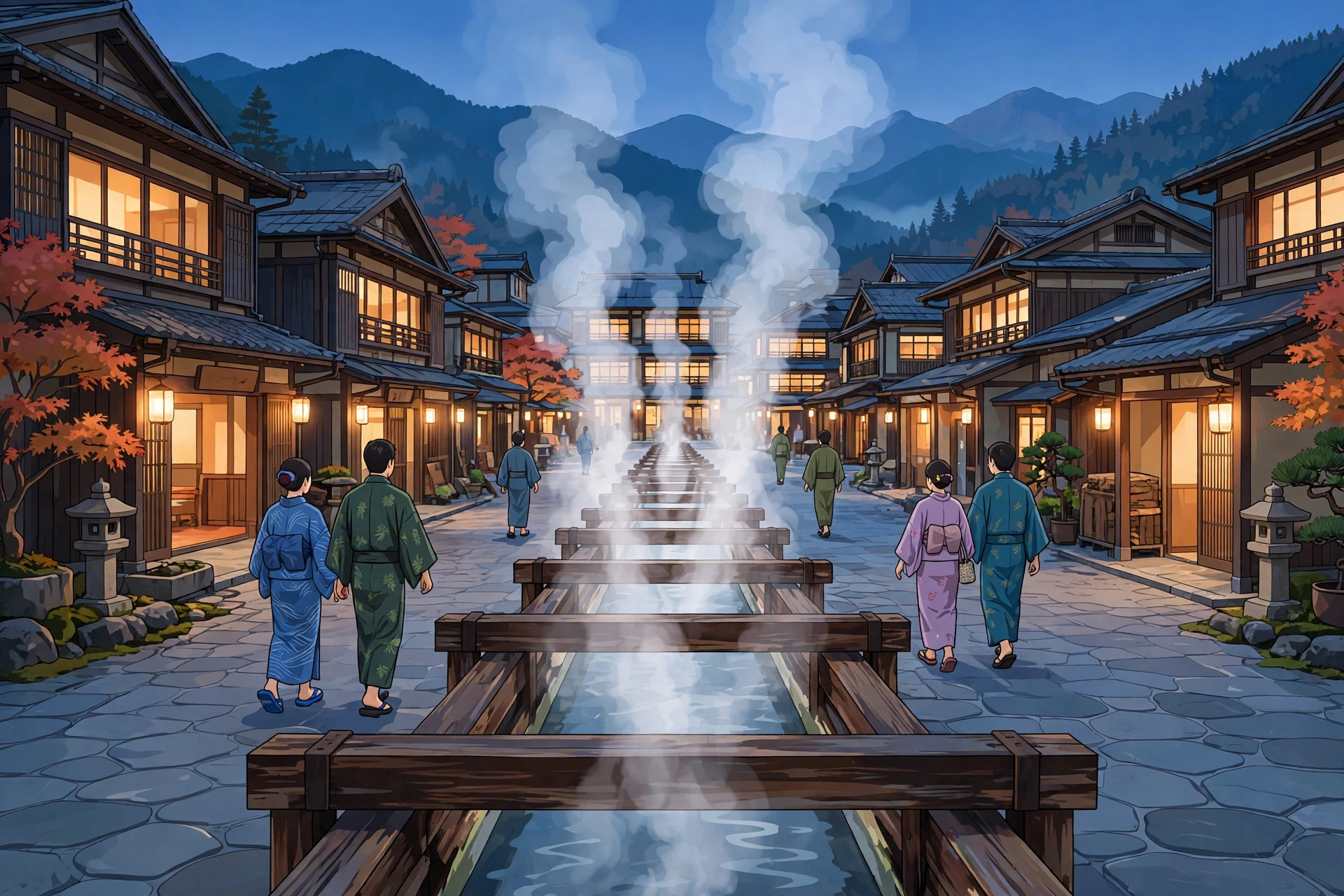
The payoff is a town built around one extraordinary source. The Yubatake, the symbol of Kusatsu, stands in the center of town, cooling the spring water before it reaches the baths. The onsen water is known for its high acidity. Bathers come here for the water itself, and the town's public baths draw from the same powerful source. The combined train-and-bus journey is exactly why an overnight beats a day trip: arrive, soak, stroll the steaming center after dark, and soak again in the morning rather than spending the best bathing hours on the road home.
Exact Kusatsu limited express fares are not stated because the operator page could not be captured from this network; check JR East before booking.
Kinosaki: the seven-bath walking town
Kinosaki Onsen is conveniently located 2.5 to 3 hours from Kyoto, Osaka, and Kobe. That distance settles the format: Kinosaki is an overnight town, not a day trip.
Kinosaki Onsen is renowned for its bath-hopping experience, featuring seven public baths. The ritual is the sotoyu meguri — bath-hopping between the public baths in a yukata, with the willow-lined canal as the evening backdrop. The Yumepa pass gives unlimited access to all seven public baths for a whole day, at 1,500 yen per adult. Importantly, all hot springs in Kinosaki Onsen are tattoo-friendly.
This guide could not verify same-day opening schedules for each bath; check locally on the day.
Beppu: the geothermal theme park of onsen
Beppu plays a different game entirely: a whole city steaming with separate spring districts, each with its own water and character. The Sonic runs from Hakata Station to Beppu Station in as little as 2 hours and 1 minute, and it operates 31 times a day. The fare is 6,380 yen one-way for a standard unreserved seat.
Start at the classic. At Takegawara Onsen, the regular bath costs 300 yen and the sand bath 1,500 yen. Takegawara Onsen lists tattoos as allowed. From that old-school bathhouse, branch out to the sand baths on the shore and the steaming jigoku ponds — Beppu rewards travelers who treat the town as a circuit of small baths rather than a single destination soak.
The decision table: day trip vs overnight, public vs private
| Situation | Choose | Format |
|---|---|---|
| Tokyo base, only one free day | Hakone | Day trip works |
| Tokyo base, water quality above all | Kusatsu | Overnight |
| Kyoto or Osaka base | Kinosaki | Overnight |
| Fukuoka base | Beppu | Day trip or overnight |
| Tattooed traveler | Kinosaki or Beppu | Public baths confirmed above |
| Private bath required | Hakone | Book a reservable bath at a ryokan |
The pattern underneath the table: distance decides the format, and bathing style decides the town. Staying longer in the region anyway? Our guide to buying baseball tickets as a foreign visitor covers another classic day out in Japan's cities.