Yellow Mountains Sunrise Photography: Where to Stand & What to Bring
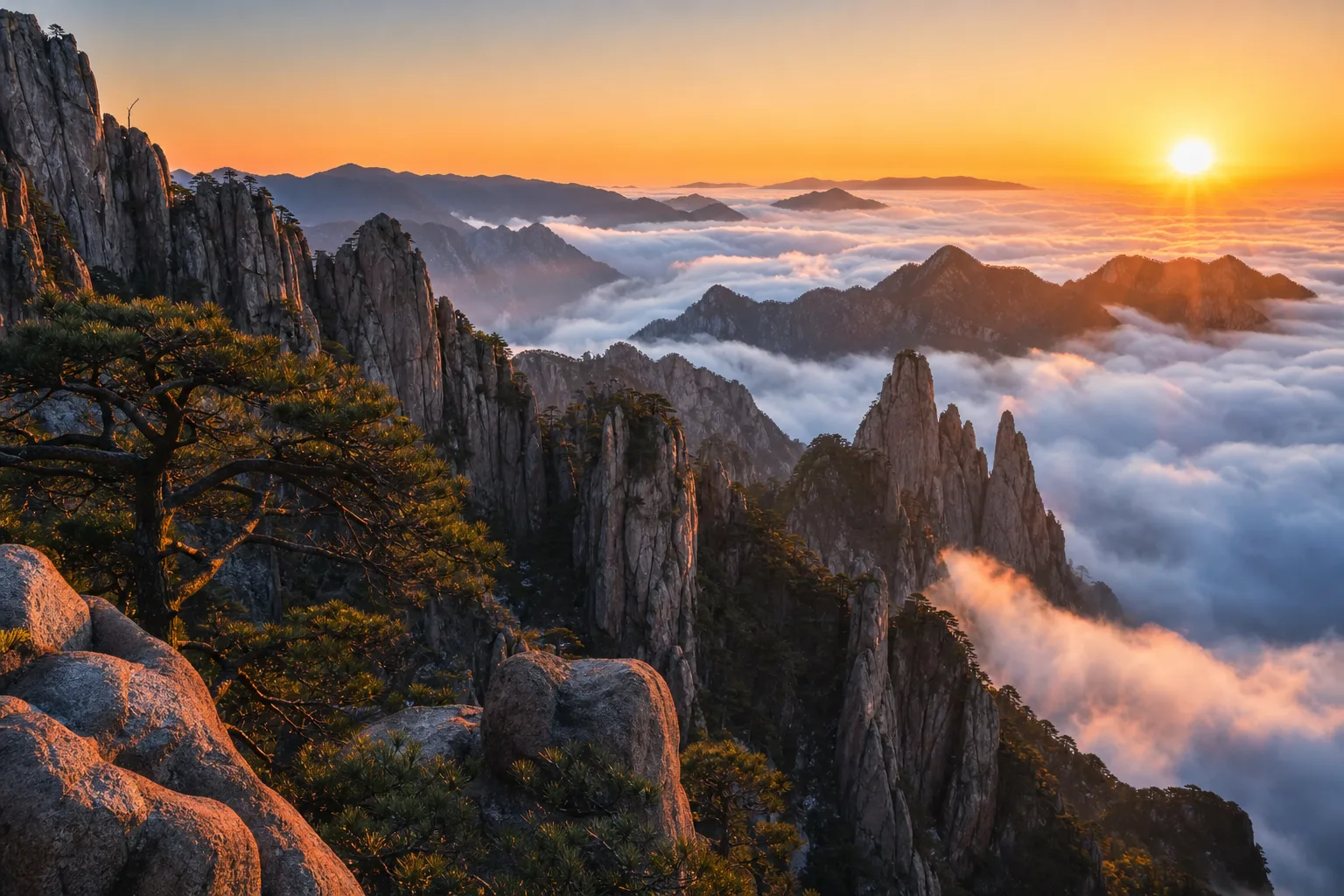
Huangshan rewards preparation more than it rewards luck. The people who come away with a clean sunrise frame usually arrived the day before, slept on the mountain, checked the weather twice, and chose their viewpoint with the horizon line in mind rather than by following the crowd.
Why Yellow Mountains Sunrise Is Hard to Photograph Well
The Yellow Mountains, or Huangshan, are one of China’s most famous sunrise locations because the scenery is dramatic even before the sun appears. Granite peaks, pine silhouettes, drifting mist, and cloud seas can all combine into a frame that looks almost unreal. The hard part is that the same conditions that make the scene beautiful also make it unpredictable. A good sunrise here depends on altitude, weather, timing, and where you stand.
If you have never photographed Huangshan before, the most important thing to understand is that sunrise is not a single viewpoint problem. It is a route-planning problem. The mountain is large, the walking time between points can be longer than expected, and the best angle for one morning may be unusable the next because of fog or crowding. That is why the best strategy is to arrive with a flexible plan: know two or three viewpoints, pack for cold and wind, and sleep as close to your sunrise spot as possible.
For a broader China itinerary that includes Huangshan, it helps to pair this trip with China Travel Planning: Visa, WeChat Pay, High-Speed Rail & Practical Guide, especially if you are connecting from Shanghai, Hangzhou, or Nanjing by rail. If you want more inspiration for framing landscapes and city scenes on the same trip, Best Photography Spots in China: Ancient Towns to Modern Skylines is a useful companion read. And if you are building a longer nature-focused route through the country, China's Natural Wonders: Zhangjiajie, Li River & UNESCO Nature Sites puts Huangshan in the context of other major natural destinations.
What makes Huangshan different from other sunrise spots
Most sunrise locations give you one obvious composition: stand here, point there, wait for light. Huangshan is more layered. You are often working with multiple ridgelines, a brightening sky behind a peak, and a foreground of pine branches or rock forms that can either strengthen the frame or clutter it. A scene that looks empty in daylight can become crowded at dawn as visitors move into place and tripods cluster around the most famous ledges.
That means the best Huangshan sunrise photos tend to come from photographers who think in three dimensions. You are not only choosing what is in the frame; you are choosing elevation, depth, and the direction of light. If the sun is behind the mountains, you may get a cleaner silhouette and richer color. If the sun is slightly off-axis, you may catch rim light on the peaks and a more textured cloud sea. Both can work. The trick is to arrive knowing what kind of image you want.
The real challenge is the last 30 minutes before sunrise
Photographers often focus on the instant the sun breaks the horizon, but on Huangshan the most useful light is often earlier. The pre-dawn blue hour can produce stronger contrast on the rocks, and the first color in the sky may be better than the actual sun disk if haze sits low in the valleys. In practical terms, this means your final setup time matters. If you are still unpacking when the light starts changing, you have already missed the best sequence.
This is why a sunrise plan for Huangshan should include a scouting walk the afternoon before. Even if you already know the major viewpoints, the exact position where you can set your tripod, stand safely, and avoid blocking others is different every time. A good scouting pass also tells you where the wind funnels, where the crowd tends to gather, and whether the scene is likely to be obscured by railings, branches, or a wall of people with phones raised at eye level.
Where to Stand for the Best Sunrise Angles
The best sunrise photo on Huangshan is usually the one that gives you open sightlines, layered peaks, and enough space to work without being pushed into a bad position. The exact best stand-by spot changes with weather and crowd flow, but the mountain has a few recurring vantage points that consistently reward early arrival and a flexible composition.
At a practical level, you are looking for one of three things: a horizon that stays open long enough for color to build, a foreground element that gives scale, and a position where you can move a step or two without leaving the best angle. If you get all three, you have the raw material for a strong image. If you only get one, you may still get a nice record shot, but probably not your best frame of the trip.
Bright Summit for the classic wide sunrise
Bright Summit is the most obvious sunrise reference point for many visitors because it offers a broad view and feels like the default “main stage” of Huangshan. That is exactly why it can be both excellent and frustrating. On a clear morning, it can deliver a wide, legible sunrise composition with mountain layers stretching into the distance. On a busy morning, it can also become the most crowded platform on the mountain.
Stand here if you want a straightforward, high-success-rate image and you are comfortable working around other people. The visual advantage is that you can often build a wide panorama with a strong sky-to-peak relationship. The drawback is that you may need to be patient and selective about your position. Do not anchor yourself too close to the first railing you see. Instead, walk the edge, check how the foreground reads, and look for a place where a peak occupies the lower third of the frame rather than cutting awkwardly across it.
If you arrive very early, Bright Summit is also one of the better places to wait through the deep pre-dawn phase because it gives you room to watch the sky evolve. That matters more than people think. Sometimes the best color appears long before sunrise proper, and if you are already composed and focused, you can capture a sequence rather than a single lucky frame.
Lion Peak for layered silhouettes and cloud texture
Lion Peak is a better choice when you want a more sculpted silhouette and a stronger sense of depth. The surrounding peaks can frame the sky in a way that feels more intimate than the broad sweep from a main platform. This is useful when the morning is slightly hazy or when the cloud deck is uneven, because the composition can stay interesting even if the sun itself is muted.
Use this location if you like images with more separation between foreground and background. A ridge line, pine branch, or rocky edge can make the frame feel anchored. The key is to keep the silhouette clean. A cluttered foreground defeats the purpose. If you are carrying a zoom lens, Lion Peak can also reward tighter compositions that isolate one or two peaks against a field of morning color.
The best thing about this spot is that it gives you a more distinctive result than the standard postcard composition. That matters if you are building a photo essay rather than just collecting a scenic proof shot. If you can show texture in the mountains and not just a bright sun, your Huangshan sunrise will feel more personal and less generic.
Begin-to-Believe Peak for strong foregrounds
Begin-to-Believe Peak is one of the most useful places for photographers who want a frame with visible foreground structure. The name sounds dramatic for a reason: this part of the mountain can create the feeling that the peaks are rising directly out of the mist. It is a particularly good option when cloud layers are sitting at mid-elevation and moving slowly across the scene.
This is a strong stand-point if you like composition choices. You can place the horizon high or low, include a pine in the foreground, or crop more tightly for a compressed mountain look. That flexibility helps when the sunrise is not spectacular but the surrounding atmosphere is. In other words, this is a “save the morning with composition” location. If the color is weak, the scene can still work because the structure of the peaks does the heavy lifting.
Bring patience here. The best frame may appear after the first burst of light, when the mist shifts and reveals a second layer of peaks that was hidden a minute earlier. If you leave too soon, you risk missing the actual payoff.
The Cloud Sea viewpoints when weather is the real subject
Not every Huangshan sunrise should be judged by the size of the sun disk. On many mornings, the cloud sea is the main event. When that happens, viewpoints with open valleys and clean downward sightlines become more valuable than any place focused purely on the horizon. The result can be a quieter, more atmospheric photograph in which the light is secondary to the moving texture below you.
Stand where you can see the mountain layers dropping into mist rather than just facing the sunrise direction like everyone else. This is especially effective when the sun is weak but the clouds are dynamic. A frame that shows the cloud sea flowing between peak tops often feels more memorable than a clean, empty orange sky.
This is also the right mindset if you are shooting for story rather than drama. A sunrise with depth, contrast, and visible weather movement often performs better in a travel article or portfolio than a generic “sun over mountain” shot. The mountain gives you atmosphere if you let it.
How to choose a spot when the crowd is already there
If you arrive and the obvious viewpoint is full, do not force yourself into the middle of the busiest knot of people. Work outward. Often the best angle is a little to one side where you still get the same background but with cleaner foreground lines. Look for a small step, a higher or lower platform, or a place where the crowd opens briefly because most visitors are concentrated at the center.
For photography, the least glamorous spot is often the most productive if it gives you room to set exposure and wait. A half-better angle with breathing room is usually superior to a perfect viewpoint where you spend the whole time fighting elbows. On Huangshan, your ability to stay calm and settle into one position can matter as much as your camera settings.
What to Bring for Cold, Wet, Fast-Changing Conditions
Huangshan sunrise photography is not a warm-weather hobby. Even when the lower cities feel mild, the mountain can be cold, windy, and damp at dawn. The cloud cover that gives the scene its beauty can also soak your clothing and glass. If you pack for a short scenic walk instead of a pre-dawn mountain session, you will feel underprepared very quickly.
The minimum useful kit is not large, but every item should solve a real problem: cold hands, wet lenses, low light, slippery ground, limited battery life, and the need to move quickly between viewpoints. That is the practical lens through which to pack.
Clothing and comfort
Start with layers. A moisture-wicking base layer, an insulating mid-layer, and a shell that blocks wind will do more for your photography than another lens if you are shivering. Gloves matter because they protect both your hands and your camera handling. A hat that covers your ears can make a real difference before dawn, especially on exposed ridgelines where the wind feels stronger than the forecast suggests.
Footwear should be more important than style. Grip and ankle support matter on damp steps and rocky surfaces. If you plan to walk before sunrise, bring shoes that you trust on uneven ground. Avoid anything that requires constant attention; you need to think about exposure and composition, not whether your footing is stable.
Also bring a small towel or microfiber cloth for your camera bag. Condensation appears quickly when you move between warm transport, cool mountain air, and humid morning mist. A cloth is one of the cheapest tools in your kit and one of the most frequently used.
Camera gear
A weather-sealed camera body and lens are ideal, but not essential if you protect your gear properly. A wide-to-standard zoom is the most versatile choice for sunrise because it lets you capture both the broad atmosphere and the layered landscape. If you prefer a telephoto lens, bring it for compression shots and details of ridges, cloud gaps, and peak silhouettes.
A tripod is helpful if you plan to shoot before sunrise or if you want bracketed exposures, but carry one only if you are willing to manage its weight and the space it occupies. On crowded platforms, a tripod can become more trouble than it is worth. In that case, stabilize against a railing or rock and keep your shutter speed as high as practical. A sturdy monopod can sometimes be a better compromise.
Spare batteries are essential because cold weather reduces battery performance. Keep one battery in an inner pocket rather than in the camera bag. Memory cards are less glamorous but just as necessary. There is no reason to risk a near-perfect sunrise over a full card.
Settings and technique
Before the light arrives, set your camera up for speed. Use manual exposure or aperture priority, depending on your comfort level, but know how to shift quickly when the brightness changes. Sunrises on Huangshan can move from dim blue to strong gold in a few minutes, and the camera’s meter may lag behind the scene.
Bracket exposures if the sky is high-contrast. The mountain’s light can be deceptive, and a single exposure is not always enough to preserve cloud detail and shadow texture. If you shoot RAW, you will give yourself more room to recover the glow in the sky or the detail in the darker ridges. If you are using a phone, lock focus and exposure once the composition is right and do not let the camera keep hunting.
Food, water, and timing supplies
Bring water even if you expect to be out for only a short time. A sunrise session can stretch longer than expected, especially if the cloud sea is evolving and you decide to stay for the second round of light. Energy bars, small snacks, and a thermos of warm drink can make a real difference to your concentration.
A headlamp is one of the most practical items you can pack. It keeps both hands free while you are walking before dawn, adjusting gear, or moving away from crowded edges. It also reduces the chance of missing a step while you are looking at the sky instead of the ground.
What not to bring
Do not overload yourself with lenses you will not use. Most sunrise sessions need one or two focal lengths, not a full professional kit. Do not pack bulky accessories that slow you down on stairs or in crowds. And do not carry more gear than you can safely manage in low light. A simpler kit often produces better photos because it keeps you mobile and alert.
Practical Guide
Huangshan is one of those places where the logistics determine the photo. If you get the routing wrong, sunrise turns into a rushed scramble. If you get the routing right, the actual photography becomes much easier because you wake up near the spot you want instead of racing toward it in the dark.
Hours, admission, and prices
The key thing to know is that Huangshan’s access, ticketing, and transport are managed in a seasonal, operational way rather than in a one-size-fits-all tourist schedule. Opening windows, ropeway operation, and trail access can change with weather, maintenance, holidays, and safety controls. For that reason, do not treat any printed number as final if your trip is several months away.
In practice, plan for three separate cost buckets:
- Mountain entry admission.
- Ropeway or shuttle transport if you are not hiking every segment.
- On-mountain lodging if you are staying overnight for sunrise.
The price structure is important because sunrise photography often makes the overnight stay the best value, even if it looks expensive at first. If you try to do the entire trip in one day, you may save one hotel night but lose the chance to photograph the mountain at its best. That is a poor trade for most photographers.
When you book, check whether your route requires one ropeway for ascent and a different route for descent. Some travelers assume they can “just walk it” and discover too late that the walking time and terrain do not fit their energy level, weather conditions, or camera load. A good sunrise plan starts with the descent as well as the ascent.
How to get there
The usual way to approach Huangshan for a sunrise trip is to come in by rail or air, transfer to the scenic area, and spend the night on or near the mountain. If you are arriving by high-speed rail, Huangshan North is the most practical rail gateway for many travelers. From there, you typically continue by vehicle transfer toward the scenic area and then use local shuttle transport to your chosen ropeway or trailhead.
For photographers, the important decision is not only how to get to Huangshan, but how to get to the correct side of the mountain for your sunrise target. The mountain is not a single viewpoint; it is a network of access points and overnight bases. If your hotel is on the wrong side, you may spend the best light walking instead of shooting.
That is why overnight planning matters so much. If you know you want a sunrise from a classic eastern-facing overlook, stay as close as possible to that route. If you want a more flexible cloud-sea composition, choose a base that lets you reach more than one viewpoint before dawn.
Booking strategy
Book the mountain stay before you finalize the rest of the itinerary. This is the part many first-time visitors get backward. They book the rail ticket, then a city hotel, then realize the best sunrise requires sleeping inside or near the scenic area. By then, the most convenient rooms may already be gone.
If your schedule is tight, consider using the mountain night as the core of the trip rather than an add-on. Arrive in the afternoon, scout before sunset, eat early, sleep, wake before dawn, and spend the next morning photographing. That sequence reduces stress and dramatically improves the odds of a strong image.
Suggested one-night sunrise flow
The simplest successful structure looks like this:
- Arrive in Huangshan in the morning or early afternoon.
- Transfer to the scenic area and check into your mountain base.
- Scout one or two sunrise positions before dark.
- Eat early and prepare all gear.
- Wake long before sunrise and walk to the viewpoint in darkness.
- Shoot through blue hour, first light, and the post-sunrise color.
- Stay a little longer than you think you need to, then descend after the light flattens.
That flow sounds basic, but it solves most of the failure points: late arrival, bad positioning, rushed packing, and missing the best color because you thought the sun was the only moment worth waiting for.
Tips & Common Mistakes
The difference between a good Huangshan sunrise and a frustrating one is often a series of small decisions. The mountain is photogenic enough that many people assume the image will take care of itself. In reality, the composition, the timing, and your physical comfort all shape the result.
Scout the afternoon before
This is the single most useful habit you can build. Visit the viewpoint before sunset if possible. Identify where the sun will rise relative to the peaks, where the crowd will gather, and where you can safely set up. The scene at dawn is much harder to read if you are seeing it for the first time in the dark.
Do not wait for the sun alone
Some of the best frames on Huangshan happen before the sun appears or after it is already above the horizon. The sky may still be building color while the peaks are in silhouette. The cloud sea may become more interesting once the light starts striking it from the side. If you pack up too quickly, you may miss the phase that would actually have made the trip worth it.
Use the weather, not against it
Fog is not automatically bad. Thin fog can produce depth and separation. A low cloud ceiling can simplify the scene. Even a weak sunrise can become powerful if the weather creates enough layers. Instead of asking, “Is the sunrise good?”, ask, “What kind of composition is this morning offering?” That shift in thinking often produces better images.
Avoid the center of the crowd
The front row is not always the best row. People at the center may block your angle, move unpredictably, or force you into a distracting frame. Stand slightly off-center when possible. A modest compromise in viewing position can give you a better final image because the foreground and horizon line become cleaner.
Respect your stamina
Huangshan is not a place to overestimate yourself. If you are carrying gear, walking on stairs in the dark, and trying to arrive before dawn, fatigue will show up in your photography. Sloppy setup, missed focus, and poor compositional choices often come from being physically rushed. Move earlier, not faster.
Check the direction of light
Not every mountain top works equally well for every weather condition. If the sun is going to strike one side of the peaks and leave the other in shadow, choose a viewpoint that benefits from that contrast. If you are facing a flat, hazy dawn, switch from a broad postcard frame to a tighter composition. Matching your angle to the light is more important than chasing a famous label.
Keep one simple backup composition in mind
When conditions disappoint, a backup frame can save the morning. This might be a tighter silhouette, a pine branch against the sky, a human figure for scale, or a set of stepping stones leading into the mist. Having a fallback idea prevents panic when the “main” shot does not materialize.
FAQ
What is the best season for sunrise photography in the Yellow Mountains?
Late autumn through early spring often gives clearer air, cooler temperatures, and a better chance of visible layers. Winter can be excellent if you are prepared for cold and possible ice. Rainier periods may produce more fog and cloud sea drama, which is less predictable but sometimes more photogenic. There is no perfect season, only a season that matches the kind of image you want.
Do I need to stay overnight on the mountain?
If sunrise is your main goal, yes, staying overnight is usually the smartest choice. It reduces stress, lets you scout in daylight, and puts you close enough to the viewpoint that you can arrive before the crowd. A day trip can work for general sightseeing, but it is a weaker option for serious sunrise photography.
Is a tripod necessary?
Not strictly, but it can help a lot before sunrise and during low-light color changes. If you do not want to carry one, shoot handheld with good stabilization, keep your shutter speed practical, and brace yourself whenever possible. A compact tripod is a good compromise if you expect to shoot multiple exposures or want maximum control.
What if the weather forecast looks bad?
Go anyway if the trip is already committed and the forecast is only moderately poor. Huangshan often looks best when the weather is not perfectly clear. Clouds, mist, and partial visibility can create the most memorable compositions. The main red flag is safety, not aesthetics. If the mountain is closed, hazardous, or transport is disrupted, follow the local rules and reschedule.
How early should I leave for the viewpoint?
Earlier than you think. Leave enough time to walk slowly, stop for gear adjustments, and arrive before the color starts changing. If you are unfamiliar with the route, add extra buffer for stairs, darkness, and crowd movement. Being late by ten minutes can turn a planned composition into a compromised one.
Can I get good sunrise photos without a professional camera?
Yes. Modern phones and compact cameras can do well if you focus on composition, stability, and timing. The biggest gains come from arriving early, choosing the right angle, and photographing the atmosphere instead of just the sun disk. A well-framed phone shot from the right viewpoint will beat an expensive camera used from the wrong place.
Conclusion
Huangshan sunrise photography is less about technical wizardry than it is about good mountain habits. Sleep near the viewpoint, scout the day before, pack for cold and moisture, and choose your stand-point based on the kind of image you want rather than the place where everyone else gathers. Bright Summit, Lion Peak, Begin-to-Believe Peak, and the cloud-sea viewpoints each offer a different answer to the same question: how do you turn a famous sunrise into a photograph with your own point of view?
If you remember only one thing, make it this: the mountain will give you strong material, but only if you arrive early enough and stay flexible enough to use it. Plan for weather, plan for crowding, and plan for more than the sunrise disk itself. That is how you leave Huangshan with images that feel deliberate instead of lucky.