Tongyeong: Korea's Naples and One of Its Most Underrated Port Cities

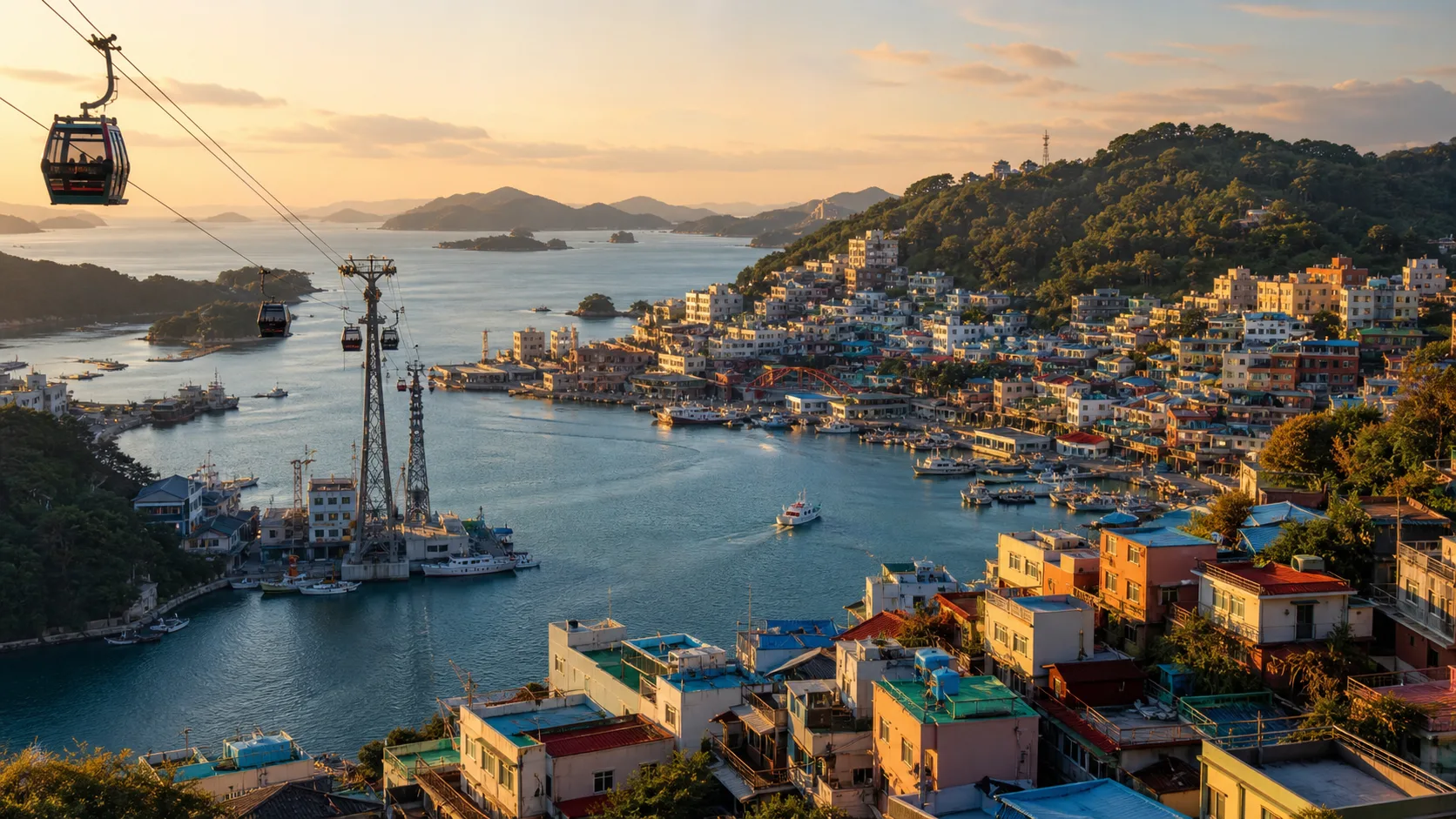
Tongyeong is the kind of city that rewards travelers who like places with edges. It is a working port, a ferry gateway, a seafood town, a hill city, and a maritime viewscape all at once. If Seoul is the obvious first trip and Busan is the easy second, Tongyeong is the place you go when you want the coast to feel a little less polished and a lot more memorable.
It is often called Korea's Naples, and the comparison makes sense once you stand above the harbor and look out at the islands. The water is never far away. Markets spill into the port. Murals, cable cars, and sunset viewpoints sit close enough to walk between. For travelers building a Korea itinerary that goes beyond the standard circuit, Tongyeong is one of the strongest answers to the question, "Where should I go if I want something beautiful, useful, and underrated?"
Why Tongyeong Is Called Korea's Naples
Tongyeong earns the Naples comparison because it combines a dramatic bay setting, a busy port economy, steep neighborhood views, and a long history of living with the sea rather than just looking at it. Like Naples, Tongyeong is not a museum city. It is a working coastal place where the scenery and the daily life are intertwined.
Tongyeong sits on Korea's south coast in South Gyeongsang Province, facing a maze of islands and channels. The city is shaped by water on all sides, which means your experience changes quickly as you move from harbor to hill to lookout point. One minute you are watching ferries and fishing boats; the next you are standing in a mural village or riding a cable car high over the strait. That constant shift is what makes the city feel bigger than its map.
Tongyeong is also a good example of a city that many first-time visitors overlook because it is not a default stop on the classic Seoul-Busan-Jeju route. That is exactly why it works so well. It gives you a sense of the southern coast without the crowds or the over-curated feeling that can come with more famous destinations. If you are already collecting ideas for a quieter, more distinctive Korea trip, it belongs in the same mental drawer as Hidden Korea: The Off-the-Beaten-Path Destinations Worth Visiting.
What makes it feel different from other Korean port cities
Tongyeong does not present itself as a single headline attraction. Instead, it works as a cluster of small experiences that add up well together: a harbor walk, a market meal, a hilltop view, a night light display, a ferry departure, and a seafood dinner. That structure matters because it makes the city flexible. You can visit Tongyeong for one full day, but it becomes much better if you stay overnight and let the evening atmosphere do some of the work.
The city also has a strong visual identity. The colors are not subtle. Blue water, white ferries, green hills, painted walls, neon nights, and seafood market signs all compete for attention. That is a big reason Tongyeong lingers in memory. It is not trying to be refined in the way a resort town is refined. It is trying to be alive.
The best kind of traveler for Tongyeong
Tongyeong is best for travelers who like coastal scenery, local food, and days that mix sightseeing with walking and eating. It is especially good for:
Travelers who want a one- or two-night detour from Busan or Jinju.
Travelers who prefer a place with strong visual payoffs and not too much logistics.
Travelers who want to pair culture, harbor views, and seafood in one stop.
Travelers who are already planning a broader route through the country and need a destination that balances the big-city stops in The Ultimate 10-Day South Korea Itinerary for First-Timers with something slower and more regional.
What To See In Tongyeong
Tongyeong works best when you treat it as a city of layered stops rather than a checklist of must-sees. The strongest visit usually mixes one heritage area, one view point, one harbor walk, one food stop, and one night-time experience. That balance gives you the city's character without overloading the day.
Dongpirang and the mural hill experience
Dongpirang is one of the easiest places to understand why Tongyeong became a favorite among South Korea's more travel-savvy domestic visitors. It is a hillside neighborhood with murals, alleys, harbor views, and enough slope to make every corner feel like a reveal. The attraction is not just that the walls are painted. It is that the district sits above the port, so the art and the scenery work together.
If you go in the middle of the day, the murals are easy to photograph and the walk is straightforward. If you go near sunset, the neighborhood feels more atmospheric because the harbor light changes quickly and the city starts to look layered rather than flat. The climb is not extreme, but it is still a neighborhood walk, so wear shoes that handle steps and sloped pavement comfortably.
Dongpirang is often the stop that convinces people Tongyeong is more than a "port town." It has enough visual personality to stand on its own, but it also acts like a gateway into the city's other moods. After you descend, the market and harbor are close enough to keep the day moving.
Gangguan Port and the market area
Gangguan Port is where Tongyeong feels most like a real maritime city. Ferries come and go, fishing life is visible, and the port area gives you a sense of how the city actually functions. This is not just scenery. It is infrastructure, commerce, and daily rhythm.
For visitors, Gangguan Port is valuable because it is practical. It is easy to combine with meals, market shopping, and a short stroll. If you are hungry, stop here first. If you are not hungry, you will probably be hungry soon. The port area and the central market together explain why Tongyeong's food reputation is so strong. Seafood is obvious, but the city also has a strong snack culture, with breads, kimbap, and casual dishes that make it easy to graze between sites.
The port area is especially useful for travelers who like a "walk, eat, repeat" style of sightseeing. You do not need a complicated plan here. The city rewards simple movement.
Tongjeyeong and the city’s historical core
Tongyeong has a historical dimension that many travelers miss because they focus too quickly on the harbor views. The area around Tongjeyeong connects the city to its military and administrative past, and it adds a different layer to a visit that would otherwise feel purely scenic.
This matters because Tongyeong is not only picturesque. It has long been tied to Korea's maritime defense and southern coastal history. That gives the city a sense of continuity that is easy to overlook when you are just photographing the sea. If you like a place more when you understand how it developed, make time for this part of the city. It gives context to the port, the fortification history, and the city's long-standing role as a strategic coastal hub.
Dpirang and the night-time side of the city
Tongyeong became much more compelling when it leaned into night tourism. Dpirang, the digital night attraction, is one of the clearest examples of how the city has turned its geography and darkness into a visitor asset. Rather than ending the day after dinner, Tongyeong gives you another reason to stay out.
Night tourism works well here because the city already has strong contour and shoreline contrast. Once lights come on, the hills, water, and port structures become part of the scene. That makes Tongyeong especially satisfying for travelers who do not want a day trip that collapses after sunset. It is one of the main reasons an overnight stay is better than a rushed return to Busan.
Seopirang and other viewpoint walks
If you enjoy city walks that mix slopes, views, and a little bit of guesswork, Tongyeong has the kind of ridgeline and stairway spaces that suit you well. Seopirang and similar hillside areas are not about one big destination object. They are about moving through a city from above and seeing the port from multiple angles.
These areas are where Tongyeong starts to resemble a layered Mediterranean or southern European coastal city more than a typical Korean small city. That is part of the Naples comparison too. The charm comes from the way the city holds itself on the hills and opens to the water.
How To Spend Your Time
The right Tongyeong itinerary depends on whether you are passing through or staying overnight. A one-day visit should prioritize one harbor area, one hill area, and one evening attraction. A two-day visit should add more time for food, a slower walk, and a ferry or island-related experience.
If you only have one day
Start in the harbor or market area so you can orient yourself quickly. Eat early, because Tongyeong is a city where meals help structure the day. Then move to Dongpirang or another viewpoint neighborhood before the afternoon heat and fatigue stack up. End with a paid attraction such as the cable car, a night installation, or a sunset viewpoint, depending on the season.
This order works because it follows the city's natural movement: low ground, midground, high ground, then back to an evening atmosphere. It also prevents the common mistake of beginning with the most physically demanding stop and then realizing you have not left enough energy for the city center.
If you have two days
Two days let you slow down enough to see why Tongyeong is worth more than a quick stop. Use day one for harbor, market, and one major viewpoint. Use day two for a cable car ride, a museum or heritage stop, and a relaxed food crawl. If the weather is good, leave room for a ferry or a coastal detour.
This is the version of Tongyeong that feels best for couples, photographers, and independent travelers. It is also the version that gives you the most flexibility if you are already in a broader Korea route and do not want your itinerary to feel over-scheduled.
What Tongyeong is not
Tongyeong is not a place where you should expect a giant theme park experience or a packed, checklist-driven historic core. It is also not the sort of city that rewards rushing. If you treat it like a transit stop, you will still see some nice harbor scenes, but you will miss the part that makes it special: the slow accumulation of views, food, and evening light.
That is why Tongyeong is easier to enjoy when you decide in advance that the city itself is the attraction. In other words, do not just ask, "What is there to do?" Ask, "What does the city feel like when I let the harbor, the hills, and the evening do their job?"
Practical Guide
Tongyeong is straightforward to visit, but a little planning makes a big difference. Most first-time visitors care about three things: how to get there, which attractions cost money, and how to avoid wasting time on the wrong part of the day. The short version is that Tongyeong works best as a southern-coast overnight trip, and the best experience comes from pairing one or two paid attractions with free walking areas.
Hours, admission, and prices
Current operating hours and ticket prices can change by season, weather, and holiday schedules, especially for cable cars, luge rides, ferries, and night attractions. Plan to check the official notices on the day you go.
As a practical budget guide, expect the major paid attractions to sit in the low-to-mid tens of thousands of won per person for single entries, with bundled or ride-based experiences costing more. Cable cars and luge-style attractions usually have separate pricing for adults, children, and package combinations. Night attractions may also use timed entry or date-specific operating windows.
For trip planning, the safest approach is:
Visit the official attraction page before departure.
Confirm whether the last ride or last entry time is earlier than the stated closing time.
Check whether weekends, holidays, or weather conditions affect operations.
Buy tickets in advance only if your schedule is tight or you are traveling on a peak day.
That may sound cautious, but in a coastal city like Tongyeong it is the difference between a smooth day and a frustrating one. A little pre-checking preserves the fun.
How to get there
Tongyeong does not sit on a major rail line, so most visitors arrive by intercity bus, car, or a connection through another southern city. For many travelers, the easiest route is to treat it as part of a wider Korea itinerary rather than a standalone transport mission.
From Seoul, Tongyeong is usually reached by intercity bus rather than train. That means you should allow most of a day if you are coming straight from the capital, especially if you want to arrive with enough energy to do anything after checking in.
From Busan, the trip is much more manageable and works well as a weekend extension. From Jinju or nearby southern cities, Tongyeong becomes a practical add-on rather than a major journey. If you are already moving through the southeast, the city is easy to fold into the route.
If you like to map a trip by its pacing, Tongyeong fits best after Seoul or Busan and before a more remote coastal or island segment. For a first-timer building a broader itinerary, it can sit comfortably between the major anchors of a larger Korea route and a deeper regional detour.
Getting around the city
Once you are in Tongyeong, the city is best handled with a combination of walking, short taxi rides, and one or two planned transfers. Some parts are best done on foot because the experience depends on small streets and hillside viewpoints. Other parts are more efficient with a taxi, especially if you are linking a harbor stop to a cable car or a night attraction.
Do not assume that public transit will make every transfer elegant. In many coastal cities, the transport network is functional rather than tourist-optimized. That is fine, but it means your schedule should be built around clusters of attractions rather than scattered one-offs.
Booking strategy
If you only book one thing in Tongyeong, make it whichever paid attraction is most likely to sell out or create a queue on your travel date. That is usually the thing tied to weather, sunset timing, or a special season. The rest of the city works well as flexible walking and eating time.
If you are the kind of traveler who likes packaging your major time-savers in advance, use the ticketing and booking pages before you leave your accommodation, not after you arrive at the attraction. That is especially useful when your itinerary already includes other high-intent travel stops across the country. If you are building a multi-city route, Tongyeong is one of those places that can slot in neatly after a planned city block and before a more relaxed coastal day. It is one of the reasons travelers who like Beyond Seoul: The Top 10 Must-Visit Cities in South Korea often end up considering Tongyeong as an alternate or additional stop.
Tips & Common Mistakes
Tongyeong is not hard to enjoy, but there are several avoidable mistakes that make visits feel less efficient than they should.
1. Treating it like a quick photo stop
Tongyeong is better than that. If you spend one hour taking harbor photos and leave, you will get a nice set of images but not the city's personality. The best parts of Tongyeong appear when you let the harbor, food, and hillside neighborhoods stack into a single visit.
2. Ignoring the evening
Many visitors use the daylight for the main sights and then try to exit too early. That is a missed opportunity. Tongyeong becomes much more distinctive after dark because the city has earned its reputation as a night tourism destination. Plan for dinner, lights, and one final walk rather than treating sunset as the endpoint.
3. Overcommitting to too many moving parts
Because the city has islands, ferries, viewpoints, markets, and paid attractions, it is tempting to try to do everything. In practice, Tongyeong is more satisfying when you choose a coherent set of stops. One hill area, one harbor area, one heritage area, one food block, one evening attraction. That is enough.
4. Underestimating the walking terrain
Tongyeong has slopes. Not every street is steep, but the city is not flat. If you plan to move between mural neighborhoods, viewpoint stairways, and harbor edges, wear shoes that can handle uneven ground and some elevation changes.
5. Not planning around meal timing
Food is not an accessory in Tongyeong. It is part of the itinerary. If you wait too long to eat, you will be less patient with the walking and less likely to enjoy the city. Build your stops around meals, not the other way around.
6. Assuming the weather will cooperate
Because the city is defined by views, poor visibility can affect your experience more than in a city with a museum-heavy itinerary. Check the forecast before you go, and if the weather shifts, move your indoor or market-based stops earlier.
Food Worth Making Time For
Tongyeong's strongest argument may actually be edible. The city is one of those places where a travel day becomes much better if you let meals do some of the storytelling. The harbor environment and the local food culture reinforce each other, which is why so many visitors remember the city as much for what they ate as for what they saw.
Seafood is the obvious draw, but not every meal needs to be a formal seafood feast. Tongyeong is also a good city for casual food stops between sites. That matters because it allows you to keep moving without sacrificing quality. When a city gives you a strong snack culture and a serious harbor identity, you do not need to force a grand lunch every time.
If you want to eat well in Tongyeong, think in layers:
Start with a harbor or market breakfast or early lunch.
Use a snack stop to bridge the afternoon.
Save the best dinner for the evening atmosphere.
This way the food becomes part of the city's pacing rather than a separate errand.
Why Tongyeong Works So Well As A Detour
Tongyeong succeeds because it gives you a rare combination: enough things to do to justify the trip, but not so many that it feels like a theme-park city. That makes it ideal for travelers who want a place with a clear identity and a lower crowd burden.
It also helps that Tongyeong is a city where your time investment feels visible. A small amount of planning turns into a much better experience here. Book the right transport. Pick the right neighborhood cluster. Stay long enough for nightfall. Eat on purpose. Those simple decisions unlock a city that would otherwise pass as "pleasant" when it can actually feel much richer than that.
Tongyeong is especially effective as a palate cleanser between high-density urban travel and more remote coastal movement. If you have spent several days in Seoul or Busan, Tongyeong gives you a change of scale without dropping you into inconvenience. That is a valuable travel position, and it is one reason the city deserves more attention than it usually gets.
FAQ
Is Tongyeong worth visiting on a first trip to Korea?
Yes, if you want one destination that shows a different side of the country. Tongyeong is not an essential first stop in the same way Seoul or Busan might be, but it is one of the best additions if you want your trip to feel broader and less repetitive.
How many days do you need in Tongyeong?
One full day is enough to see the headline areas, but one night is the better minimum. Two days is ideal if you want time for food, a relaxed pace, and an evening attraction without rushing.
What is Tongyeong best known for?
It is best known for harbor scenery, island views, seafood, mural neighborhoods, and night tourism. Many travelers also know it as Korea's Naples because the city feels so strongly shaped by the sea and the hills.
Can you do Tongyeong as a day trip?
You can, especially from southern cities, but it is not the format that shows the city at its best. A day trip works if your time is limited. An overnight stay works better if you care about atmosphere and pacing.
When is the best time to go?
Spring and autumn are usually the most comfortable for walking and views, but Tongyeong can work year-round if you adjust expectations. Summer brings stronger heat and humidity. Winter can still be rewarding if you focus on food, harbor views, and indoor or low-wind activities.
Conclusion
Tongyeong is one of those places that quietly improves a Korea itinerary once you make room for it. It has enough history to feel grounded, enough scenery to feel special, and enough food and night-life texture to feel like a real city rather than a sightseeing prop.
If you want a coastal destination that offers more than a single famous monument, Tongyeong is a strong choice. It is best approached with a simple plan: arrive early enough to walk, stay long enough for dinner, and leave time for night views. That combination is what turns the city from a port stop into a memorable trip.
For travelers planning a larger route, Tongyeong makes the most sense when it sits alongside other well-paced stops rather than competing with them. It can complement a classic route, deepen a regional loop, or serve as the "unexpected but excellent" city in a broader itinerary. If you are still shaping that wider plan, decide where Tongyeong fits in your version of Korea after you compare it with your broader city and coast list.