Terraced Rice Fields of Yuanyang Yunnan: Sunrise Seasons & Access Guide

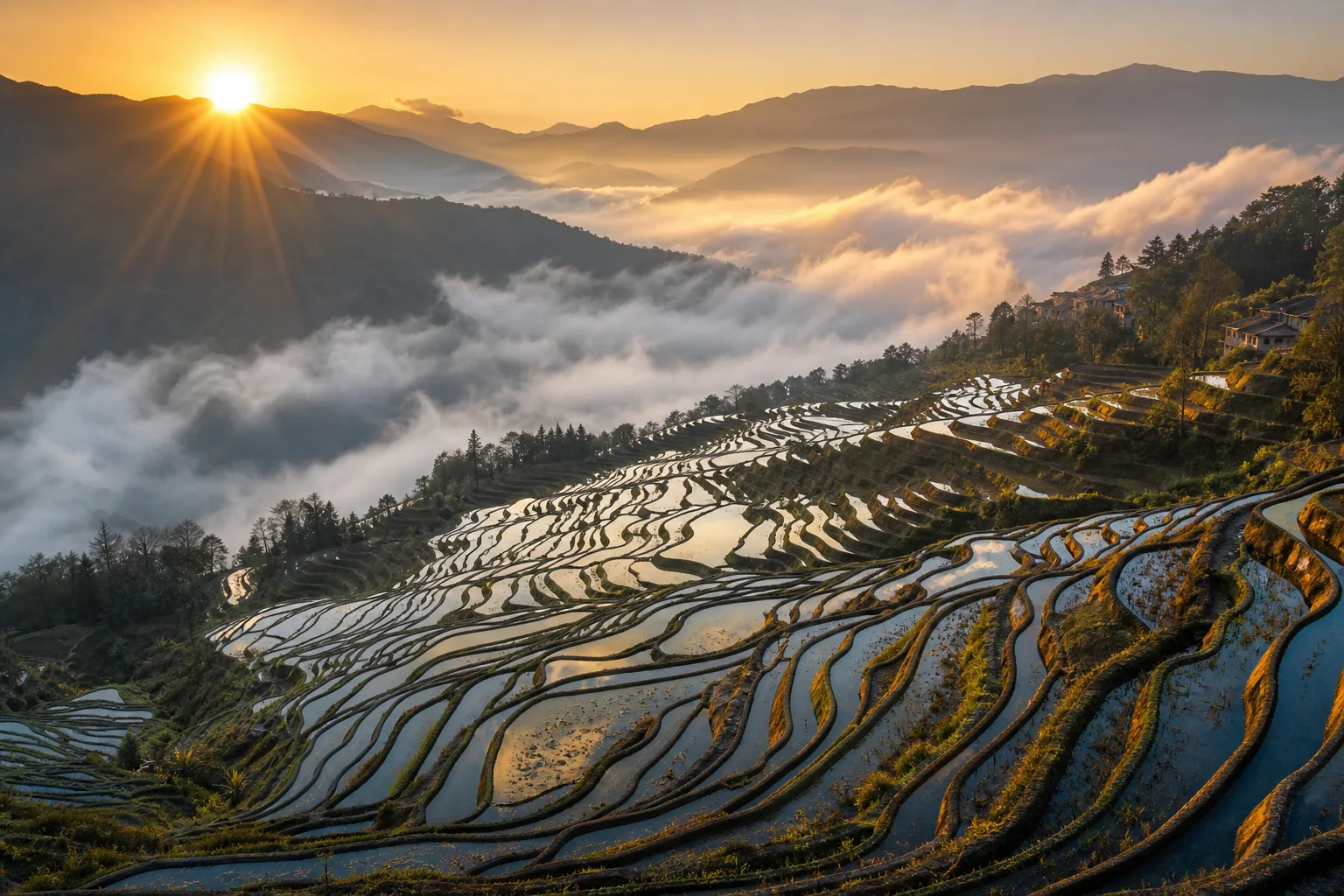
Yuanyang is one of the few places in China where the landscape, local culture, and farming calendar all matter just as much as the view itself. The terraces are not a static scenic spot. They change color, reflect the sky, and shift the rhythm of a trip depending on the season, weather, and even the time you arrive at the viewpoint.
If you are planning a first trip to the Terraced Rice Fields of Yuanyang in Yunnan, the hard part is not deciding whether to go. It is choosing the right season, understanding which viewpoints are worth your limited time, and building an itinerary that accounts for the long drive into the mountains, the altitude, and the fact that sunrise conditions can change fast.
Introduction
The Terraced Rice Fields of Yuanyang are one of the most recognizable cultural landscapes in southwest China, and for good reason. The terraces were shaped over generations by Hani communities who turned steep mountain slopes into a working agricultural system that is also visually dramatic. In the right conditions, the hills look like giant mirrors at sunrise, then shift into layered green, gold, or muddy-brown tones depending on the farming cycle.
This guide focuses on the practical questions most travelers ask before they commit to the journey. When should you go for the best sunrise? Which season is actually worth the long trip? How do you reach the terraces without wasting a day? And once you are there, how should you divide your time between viewpoints, village walks, and slow travel rather than trying to rush everything in one morning?
For travelers building a broader China trip around photography and scenery, the terraces fit naturally alongside other landscape-focused destinations such as China's Natural Wonders: Zhangjiajie, Li River & UNESCO Nature Sites.
Sunrise Seasons and What Changes Through the Year
The simplest way to plan Yuanyang is to think in terms of water, seedlings, and harvest. The terraces are most photogenic when they hold water, because that is when sunrise and cloud color reflect most clearly across the slope. When the rice is growing, the scene becomes more textured and green. Near harvest, the fields can turn warm and golden, which is a different kind of beauty but not the mirror-like one most first-time visitors imagine.
The key point is that Yuanyang is not a year-round “same view, different light” destination. It is a living agricultural landscape, so each season changes both the look and the local activity around it. If you are traveling primarily for scenery, the best trip is the one that matches the field condition you actually want, not the one that simply lands on a convenient holiday.
The water season
For many photographers and first-time visitors, the most appealing period is the water season, when the terraces are flooded and catch the light at dawn. This is the classic Yuanyang look that appears in travel brochures: layered contours, still water, and a sunrise that breaks into hundreds of small reflections. The effect can be especially strong when the sky is partly clear after a humid night or when clouds sit low over the ridges.
This is also the season when patience matters. If you arrive too late, the color can flatten quickly as the sun rises higher. A terrace that looks magical at first light may look ordinary an hour later. Plan to be at your viewpoint before sunrise rather than trying to “catch” the light after the fact.
The green season
Once the paddies are planted and the rice begins to grow, the terraces become an intricate green staircase across the mountains. The reflections are less dramatic than in the water season, but the landscape feels more alive because you can see the farming process at work. For travelers who prefer fewer crowds and a more agricultural atmosphere, this can be a better choice than chasing the most famous mirror shot.
Green season is also useful if you care about context. You can see local work patterns, water management, and the way the terraces fit into village life instead of seeing the site only as a photo backdrop. That makes the trip feel more grounded and less like a one-hour photo stop.
The golden season
As harvest approaches, the terraces can shift toward gold and amber. This is the most “autumn-like” version of Yuanyang, even though the exact timing depends on elevation and local farming decisions. It is a good season for broad landscape views, warm-toned sunrise shots, and travelers who prefer saturated color over reflection-heavy scenes.
One advantage of this period is that it often feels more spacious visually. The terraces are less about perfect mirror symmetry and more about pattern, contour, and texture. If you have already seen other reflective rice-field scenes in Asia, golden season may actually give you a more distinctive Yuanyang memory.
Why altitude matters
Yuanyang is spread across different elevations, so the same trip can feel like several micro-seasons at once. Higher terraces often change earlier or later than lower ones, and weather can vary sharply between viewpoints. That means a cloudy morning at one lookout does not automatically make the whole day a loss. If you have a flexible schedule, it is better to stay at least one night and build in more than one sunrise attempt.
This elevation spread is also why local advice matters. Drivers, guesthouses, and village hosts often know which viewpoint is clearing first, which road is slow after rain, and whether a particular valley has better light than the one you had planned. Yuanyang rewards travelers who leave room to adjust.
What photographers should prioritize
If your trip is photography-first, think less about “the terraces” in the abstract and more about three variables: the field condition, the weather, and the angle of light. Water season gives you reflections. Green season gives you color density and agricultural detail. Golden season gives you warmth and contrast.
The best images often come from combining a sunrise viewpoint with a second stop later in the morning when the light is harsher but the village life becomes more active. If you only shoot at dawn, you miss the human context that makes the site feel alive. A good reference point for building that approach is Best Photography Spots in China: Ancient Towns to Modern Skylines, which is useful for thinking about composition, timing, and how to avoid turning a landscape trip into a checklist.
Primary Topic Section: Where the View Comes From
Yuanyang is not one single terrace area. It is a network of villages, slopes, roads, and viewpoints spread across a rugged mountain landscape. The famous sunrise scenes are usually associated with the Duoyishu area, but the broader experience comes from moving between multiple vantage points and understanding how each one frames the same agricultural system differently.
The main reason the site feels so memorable is that the terraces are large enough to be immersive and small enough to feel intimate. You are not looking at a distant panorama from an observation deck in a city park. You are looking at a lived landscape where people still farm, walk, market, and maintain water channels in the same system that creates the visual spectacle.
Duoyishu and the classic sunrise
Duoyishu is the name most travelers hear first because it is associated with the classic sunrise reflection shot. If your goal is a first Yuanyang sunrise, this is often the most practical place to start. The terrain gives you layered depth, and when the water is still, the terraces can produce a wide band of reflected light across the slope.
The catch is that Duoyishu is popular for a reason. It can feel busiest at the exact time when the light is best. That does not make it a bad choice. It simply means you should arrive early, settle in, and avoid expecting to have the scene to yourself. If you are a photographer, the crowd is part of the cost of getting the iconic angle.
Bada and the wider landscape
Bada is often used as a broader landscape stop rather than a pure sunrise target. It is useful for understanding the scale of the terraces because the view tends to feel wider and more open. If Duoyishu gives you the close, famous frame, Bada helps you absorb the bigger pattern of the mountains.
Travelers who like to move slowly should consider Bada as a complement rather than a substitute. It is a better place to stop when you want to step back from the crowd, breathe, and see the terraced system as a whole instead of focusing on a single postcard composition.
Laohuzui and the dramatic contours
Laohuzui is often valued for shape and drama. Even when the lighting is not as soft as at sunrise, it can produce strong terrace geometry and a more theatrical sense of depth. For some visitors, this becomes their favorite viewpoint because it feels less “famous photo stop” and more “landscape with presence.”
If you have two days, a common strategy is to use one morning for the classic sunrise viewpoint and another time of day for a more sculptural overlook like Laohuzui. That split gives you both the recognized Yuanyang image and a less predictable interpretation of the same place.
Villages are part of the view
One mistake travelers make is treating the villages only as access points to viewpoints. In reality, the villages are part of the landscape experience. The terraces exist because the communities here built and maintained them over generations. That means the roads, homestays, small restaurants, markets, and footpaths all contribute to the sense of place.
If you have time, do not spend your entire visit standing at one railing. Walk a village street, stop for tea, look at how water is moved through the lower fields, and notice how the terrain changes from one hamlet to the next. The terraces become more meaningful when you understand that they are not isolated scenery but a working system.
Why Yuanyang stands out from other rice terrace destinations
China has several famous terrace landscapes, but Yuanyang stands out because of its scale, steepness, and cultural continuity. Some terrace destinations are easier to reach or more polished for tourism, but Yuanyang has a rawer quality. The slopes can feel broader, the views less domesticated, and the relationship between farming and scenery more direct.
That is why many travelers who enjoy landscape travel consider Yuanyang one of the most rewarding natural-culture hybrids in China. It belongs in the same mental category as the country’s other major scenic destinations, even though it is not a national park in the usual sense.
Secondary Topic Section: How to Plan the Visit Around the Landscape
Yuanyang is best visited slowly. A rushed day trip usually gives you a drive, a viewpoint, a meal, and a sense that you saw something impressive but did not quite understand it. A one-night stay is the minimum if you care about sunrise. Two nights is better if you want a backup weather window and time to move between viewpoints without pressure.
The most useful planning question is not just “what time should I arrive?” but “what kind of trip am I trying to have?” A photography trip, a cultural trip, and a relaxed scenic trip all need different pacing. If you want the terraces to feel special rather than exhausting, build the itinerary around the experience you want to repeat in memory.
If you are traveling for sunrise
Prioritize proximity to the right viewpoint over hotel aesthetics. A mid-range guesthouse that saves you an early pre-dawn transfer is usually better than a nicer place that forces you to wake up much earlier and drive longer on dark mountain roads.
Sunrise travel also means accepting uncertainty. Cloud cover, fog, and haze can all improve or ruin the experience in ways you cannot fully predict. The point is not to guarantee a perfect image. It is to increase your odds by being in place, early, and ready.
If you are traveling for culture
Spend more time in villages and markets, and less time bouncing between lookout points. Talk to hosts about the terrace system, the planting cycle, and local food. The landscape becomes richer when you learn how the Hani way of life fits into it.
Culture-first travelers often enjoy Yuanyang more when they combine the viewpoints with simple meals, tea, and time walking rather than trying to maximize “spots.” In other words, the more you slow down, the more the place reveals itself.
If you are traveling for photography
Think in terms of a shot sequence rather than a single iconic frame. A good Yuanyang photo day might include a dawn overlook, a village lane after breakfast, a midday texture shot of the terraces, and a late-afternoon ridge view. That gives you more variety and a better story.
It also helps to review how you frame similar destinations before you go. Landscape photography is less about finding one magical viewpoint than it is about knowing how light changes as you move.
If you are traveling for relaxation
Do not overbook your time. Yuanyang is not best experienced as a sprint. Give yourself slow breakfasts, one major sunrise plan, one backup viewpoint, and one or two flexible hours. The mountain roads and weather variability already add enough unpredictability. Your schedule does not need to add more.
Practical Guide
The practical side of Yuanyang is straightforward once you accept that it is a mountain destination rather than a city attraction. Access takes time, sunrise starts early, and the best plan usually involves staying overnight near the main viewing zone rather than trying to reach it from far away on the same morning.
This section avoids locking you into fragile details that can change with local policies, but it gives you the structure you need to make a sound trip plan.
Hours, admission, and prices
Visitor rules, ticketing, and access arrangements can change by season, district, and viewpoint cluster, so you should verify the current setup before you go. In practice, the terraces are best treated as a landscape area with managed viewpoints rather than as a single gate-and-ticket attraction. Some viewpoints or parking areas may have local collection points, and some guesthouse operators may bundle transport or viewpoint access information into a trip plan.
Because those details are the kind that can change without much notice, plan with a buffer. If you arrive and discover that a preferred viewpoint is crowded, closed for maintenance, or operating with different local rules, you still want enough time to switch to another lookout.
How to get there
Most travelers reach Yuanyang via a larger Yunnan city and then continue by road into the terraced area. The common pattern is to use rail or flight to a regional hub, then transfer by bus, private car, or driver to the Yuanyang area and finally into the terraces. Roads in mountain regions can be slower than they look on a map, especially if you are arriving after dark or during weather that reduces visibility.
If you are trying to combine Yuanyang with other Yunnan destinations, the logistics become much easier when you anchor the trip around an intermediate city rather than a single direct transfer. Jianshui is a common staging point for some travelers because it can simplify pacing and reduce the feeling of being in transit all day.
If your wider trip still needs a transport-and-payment reality check, the guide on China Travel Planning: Visa, WeChat Pay, High-Speed Rail & Practical Guide is the better place to sort out the non-scenic essentials before you head into the mountains.
Booking and transport strategy
For a destination like Yuanyang, it usually makes sense to book in layers. First, secure your city-to-region transfer if you are traveling on a fixed schedule. Second, choose a place to stay close enough to the viewpoint cluster that sunrise is realistic. Third, leave enough flexibility for the last-mile road segment, which is where time is often lost.
If you prefer not to negotiate local transport on arrival, a prearranged car or driver can be worth the extra cost. That is especially true if your trip window is short, you are traveling with photography gear, or you want to move between viewpoints without dealing with vague pickup times.
As for third-party booking platforms, use them where they genuinely reduce friction. They are most helpful when you need a packaged transfer, a small-group scenic route, or a hotel-night booking tied to a practical arrival schedule. They are less useful if they lock you into a rigid pace that ignores sunrise timing.
Where to stay
Stay where sunrise access is easiest, not where the room description sounds fanciest. In Yuanyang, convenience often beats amenities because the main event happens before breakfast. A simple, well-located guesthouse can outperform a more comfortable hotel that requires a long pre-dawn drive.
Look for lodging that is used to early departures, understands sunrise timing, and can help with local transport or wake-up coordination. If a place is geared toward photographers or scenic travelers, it will usually know how to respond when weather changes the plan.
Food, cash, and mobile payment
As in much of China, mobile payment is often useful, but it is unwise to assume every small vendor or remote guesthouse will handle your preferred app perfectly. Carry a backup payment method and keep some flexibility for meals, road snacks, and small local purchases.
For food, keep expectations practical. Yuanyang is not about high-end dining. It is about simple meals that support a mountain itinerary. The best trip is often the one where you eat enough, get out early, and do not overcomplicate the day.
Internet and navigation
Do not rely on a single live map assumption. Download offline maps if your setup allows it, and keep addresses in both English and Chinese where possible. Mountain roads can be confusing, and a small naming mismatch can waste more time than you expect.
Local drivers, host staff, and other travelers are often better real-time sources than generic map ratings. Yuanyang rewards the traveler who asks one more question before leaving the guesthouse.
Tips & Common Mistakes
Most Yuanyang mistakes come from treating it like a quick scenic stop instead of a weather-sensitive, rural, elevation-based landscape trip. If you avoid that mindset, the experience becomes much smoother.
Mistake 1: Arriving for sunrise without a backup plan
Sunrise is the headline, but not every morning delivers the same conditions. If your entire plan depends on one flawless dawn, the trip becomes fragile. Build a second shot list, a second viewpoint, or a second morning into the itinerary.
Mistake 2: Staying too far away from the viewpoints
This is one of the easiest ways to turn Yuanyang into a sleep-deprived scramble. The road time matters more than travelers expect. The closer you stay to the main viewpoint cluster, the more likely you are to make sunrise without stress.
Mistake 3: Expecting one viewpoint to do everything
Duoyishu is famous, but it is not the whole story. Laohuzui, Bada, and the surrounding village landscape all add different shapes, moods, and scales. A one-viewpoint approach makes the trip feel thinner than it really is.
Mistake 4: Ignoring the farming calendar
If you only care about the famous mirror effect, you may arrive in the wrong season and still force a positive interpretation onto the trip. Better to decide in advance whether you want water, green growth, or harvest color, then choose dates that match that goal.
Mistake 5: Racing between viewpoints
Yuanyang is not a checklist destination. If you rush, everything starts to blur together. Slow down enough to notice the water channels, village paths, and light changes. That is what makes the experience memorable instead of merely photogenic.
Mistake 6: Forgetting how local weather behaves
Fog, haze, and cloud layers are not just inconveniences. They can create the best scenes or eliminate the reflection entirely. That means you should treat weather as part of the landscape, not as a failure of the trip.
Mistake 7: Treating the terraces as a pure photo subject
The site is more meaningful when you remember that it is an agricultural system. If you only hunt angles, you miss the human logic of the place. Spend time in the villages, buy a meal locally, and understand why the terraces exist in the first place.
A few practical habits that help
Bring a light layer for early mornings, because dawn can feel much cooler than midday in the mountains. Leave room in your schedule for delays. Keep snacks and water handy. And if a host or driver offers a better light prediction than your original plan, listen carefully before you insist on your own route.
The more flexible you are, the better Yuanyang usually becomes.
FAQ
What is the best month to visit Yuanyang?
The best month depends on what you want to see. If you want reflective water terraces, aim for the period when the fields are flooded. If you want green paddies, go after planting. If you want warmer harvest tones, go later in the season. The right month is the one that matches the field condition you care about most.
Is one day enough for Yuanyang?
One day is enough for a quick impression, but not enough for a comfortable sunrise-focused visit. If you can, stay at least one night. Two nights is better because it gives you weather flexibility and enough time to move between viewpoints without feeling rushed.
Which viewpoint is best for sunrise?
Duoyishu is the most commonly recommended sunrise stop because it is associated with the classic reflection view. That said, the “best” viewpoint changes with weather, season, and crowd levels. If you have time, combine one famous sunrise stop with one broader landscape viewpoint.
Do I need a guide to visit the terraces?
Not always, but a guide or local driver can help if your time is short or you want less friction with transport and viewpoint selection. A guide is especially useful when the weather is uncertain or when you want cultural context in addition to the scenery.
Are the terraces worth visiting outside the water season?
Yes, if you know what you are going for. Green season and harvest season can both be beautiful. You just should not expect the same mirror-like effect that appears in water season. Many travelers are happier when they choose a season intentionally instead of assuming every trip should match the same photo they saw online.
How should I combine Yuanyang with the rest of Yunnan?
Use it as a scenic anchor rather than a side trip. Pair it with a logical route through nearby Yunnan destinations so you do not waste time backtracking.
Conclusion
The Terraced Rice Fields of Yuanyang are worth the effort because they are not just beautiful. They are seasonal, human, and alive. The best trip starts with the right expectations: choose your season based on the look you want, stay close enough for sunrise, and give yourself time to move between viewpoints instead of trying to see everything in one rush.
If you remember only three things, make them these: the terraces look different across the farming calendar, the sunrise experience depends heavily on where you stay, and the cultural context matters as much as the camera angle. That is what turns Yuanyang from a scenic stop into a memorable travel experience.
For travelers who want China scenery that feels both dramatic and grounded in place, Yuanyang deserves a spot near the top of the list. Use this guide to time the trip well, plan the access carefully, and leave yourself enough flexibility to enjoy the landscape instead of fighting it.