Magome to Tsumago Nakasendo Hike: Luggage and Return Bus Plan

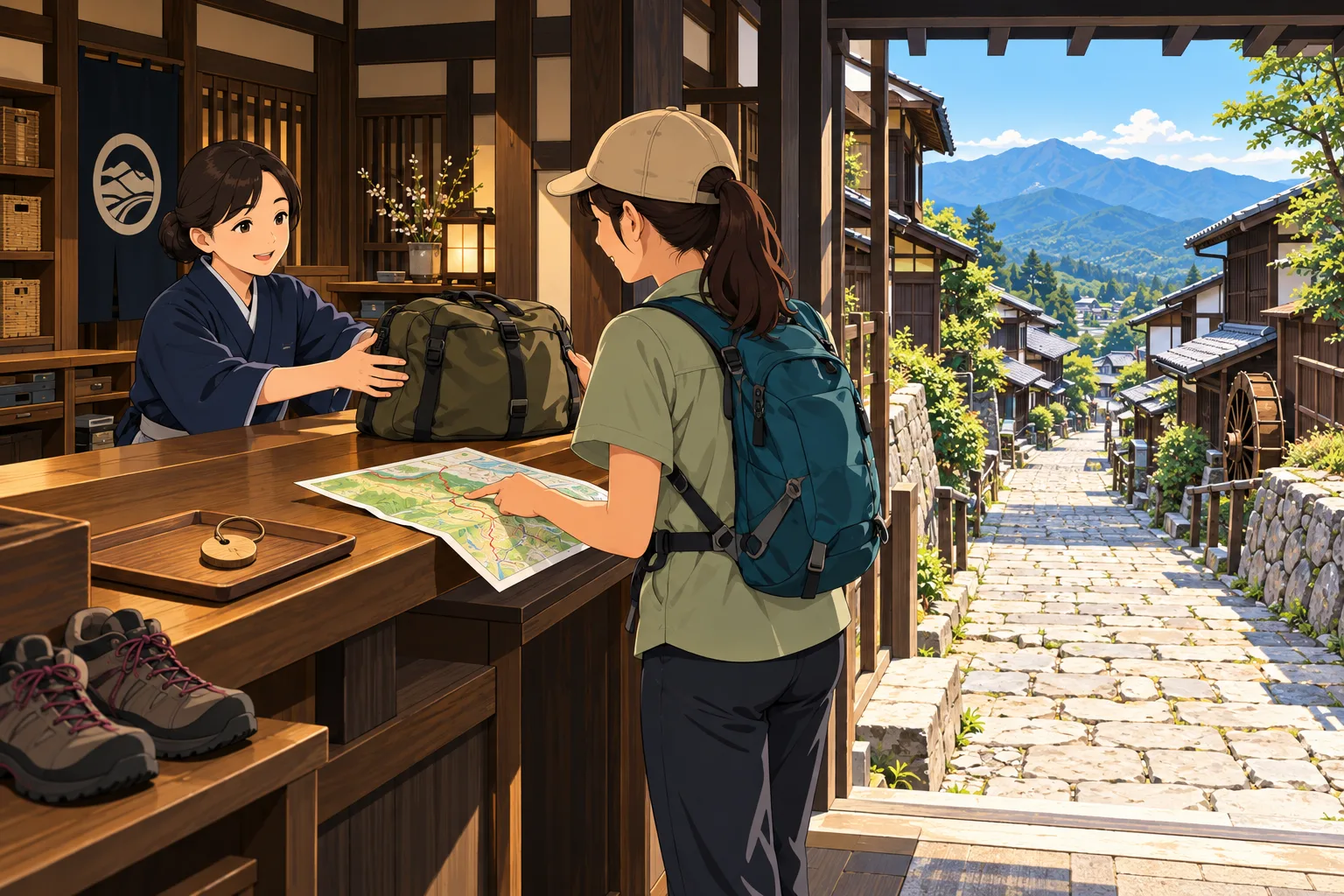
A Magome–Tsumago walk looks simple on a map: start in one preserved post town, follow the old Nakasendo through the Kiso Valley, and finish in the other. The difficult part is fitting a point-to-point hike into a real travel day. Your train arrives at a station outside the old towns, local buses may be infrequent, and the useful luggage service has a morning handover window. Plan those connections before choosing which direction to walk.
This guide is for a Singapore-based visitor considering the Magome–Tsumago section as a self-guided day hike, especially from Nagoya or while moving through central Japan. It separates stable route choices from schedules, prices and operating dates that can change. Check the linked local operators for your own travel date before paying for a train, room or onward connection.
Choose Magome-to-Tsumago or the reverse based on arrival station and elevation
For a day trip from Nagoya, check the train to Nakatsugawa and bus to Magome. Walk toward Tsumago, then connect to Nagiso for the return train. Reverse the walk if Nagiso fits your itinerary better. In either direction, verify the last bus and baggage collection hours first.
Magome and Tsumago are historic post towns, not major rail stations. JNTO's Magome access guide describes taking the JR Chuo route to Nakatsugawa and continuing by local bus to Magome. JNTO's Tsumago guide points to Nagiso Station as the rail gateway on the other side and cautions that buses are infrequent. This is the crucial geography: the walk connects the towns, but a train does not wait at either trail end.
Magome-to-Tsumago is a common arrangement when approaching from Nagoya through Nakatsugawa. It can make the day feel linear: reach Magome, walk, explore Tsumago, then move toward Nagiso. But “linear” does not mean there is a single through ticket or guaranteed connection. You still need to match a train, an inbound bus, walking time, an outbound bus or taxi, and a return train. If your accommodation is near Nagiso or you are coming from the north, Tsumago-to-Magome may make more sense.
Some guides present one direction as universally easier because of the rise toward Magome Pass. Treat that as a consideration, not the whole decision. The path has climbs and descents in both directions, stone and forest sections can be slippery, and a full day includes the uphill streets of the post towns and station transfers. A route that saves a little climbing but leaves you stranded after the final practical bus is the harder route overall.
Make a small route card before booking anything: arrival station, inbound bus stop, walking start, walking finish, baggage pickup point, outbound bus stop, rail station and a backup. If those seven locations are clear, the hike is much easier to manage. If you cannot identify the departure stop for the last connection, keep researching before you leave.
Decide whether this is a day trip or a travel day
A same-day return to Nagoya is one option. Another is to walk while changing accommodation, sending your larger bag ahead and sleeping in or beyond the Kiso Valley. These are different plans. A day-tripper may need to get back to the same hotel and retrieve a suitcase stored there; a traveler changing hotels may need a confirmed forwarding arrangement that reaches the next accommodation. The short inter-town tourist-information-center transfer should not be mistaken for hotel-to-hotel shipping.
Do not pack the day as though the trail were the only activity. Allow time to find the correct bus platform, use the toilet, buy water, locate the information center, read the current trail notice, photograph the town without blocking residents' entrances, and eat before kitchens close. A two-to-three-hour walking estimate is a starting point for a timetable, not a promise that the whole trip takes three hours. JNTO's articles give different approximate distances and times depending on the route description; plan with margin rather than reconciling them into a false exact figure.
Check the current bus timetable before committing to a same-day return
Work backward from the connection that is hardest to replace. If you must catch a particular train, identify the practical bus or taxi from your finishing town to the station. If you use the town-to-town baggage service, allow time to collect your bag before that bus. Then reserve a realistic walking window before the collection and departure sequence. Only after that should you pick the inbound train.
Nagiso Town publishes a community-bus timetable and fare chart, but a PDF found through search can outlive a schedule change. Open the town's current transport page, check the document's effective date and any seasonal or weekday notes, and compare the named stops with your trail end. Do the same for the Nakatsugawa–Magome side. A service running on a Saturday or holiday is not necessarily a dependable weekday fallback.
Write the last useful departure on your route card, along with one earlier departure. The earlier bus is your preferred target; the later one is a margin, not a license to start late. Check where you need to stand and whether you pay on board. If the online timetable is unclear, ask the tourist information center before starting the walk. The answer for your actual date is more valuable than a static travel article's copied departure time.
An inbound bus delay can make the bag handover window more important than the hiking pace. Do not assume you can drop a bag after the published cutoff because an office is still open. The transfer run may already have left. If you reach the town late, choose a different arrangement: leave the large bag at your hotel, use suitable storage at Nakatsugawa, arrange a confirmed private delivery, or carry only a bag small enough for the path. Never leave a suitcase unattended at the trailhead.
Build a realistic connection chain
Start with a train that arrives early enough to absorb a missed or full bus. Confirm the station name: Nakatsugawa is the usual rail approach to Magome, while Nagiso serves Tsumago. The two are not interchangeable, and a route planner may offer a faster train itinerary that still leaves a long local connection. Use the official local timetable to complete the last leg rather than trusting a station-to-station result alone.
At the finish, decide whether you are returning to the original city or continuing elsewhere. From Tsumago, Nagiso is the relevant rail link; from Magome, Nakatsugawa is the practical return gateway. If you finish on a day when the bus connection does not fit, a taxi may be possible, but availability and cost must be confirmed locally. It is a backup option, not an implied guaranteed shuttle.
Allow a separate buffer for the last kilometre of trail, town exploration and the walk from baggage collection to the bus stop. A visitor who reaches Tsumago at the predicted hiking time might still miss a bus while finding the office, queueing for a bag or buying a ticket. Add time for all three rather than treating “trail finish” as “bus ready.” If a late train or rain leaves too little margin, shorten the sightseeing plan or reschedule the hike.
Use the post-town baggage service only when its seasonal hours fit the hike
The useful service is point-to-point: leave a bag at the tourist information center in your starting town and collect it at the center in your finishing town. Go! Nagano's official walking guide describes baggage delivery between Tsumago and Magome, with morning drop-off and collection after 13:00, operating from late March to the end of November, and lists a current price of 1,000 yen per bag. Confirm the exact service dates, price, accepted bag types and handover hours directly before relying on it. Published pages have carried different prices over time.
The practical constraint is the drop-off window. Go! Nagano says bags can be handed in between 8:30 and 11:30. If your train and bus cannot get you to the starting information center before the cutoff, plan as if the service is unavailable. Also check the pickup closing time, especially if you intend to linger for dinner or connect to a late train. A bag sent between the towns will not automatically follow you to your hotel in Nagoya, Tokyo or Kyoto.
Nakatsugawa City's English Nakasendo brochure explains a separate storage option near Nakatsugawa Station and lists other luggage-transfer providers. The brochure was issued in 2024, so its charges and opening hours need a current check. Storage at Nakatsugawa can make sense if you are returning through that station; it can be inconvenient if you finish at Tsumago and depart via Nagiso. Map where your bag must be at the end of the day before choosing the cheapest-looking option.
If you are moving between hotels, ask both properties about standard parcel delivery and arrival timing. A hotel-to-hotel service may solve a different problem from the local tourist-center transfer. Obtain a receipt, photograph the bag and delivery label, keep medication, passports, keys, valuables and one change of clothing with you, and know what happens if the bag arrives after you do. Do not send a passport, wallet or urgent rail ticket into a system you cannot access during the day.
When the bag plan fails
There is no reason to force the walk with an unsuitable suitcase. If the handover window has closed, first check whether the bag can safely stay at your original accommodation until you return. If not, ask the station-area information center about current storage hours and whether collection fits your return route. A private transfer may be possible, but confirm the exact pickup and delivery points in writing. Otherwise, change the day plan.
Do not substitute the phrase “luggage forwarding is available” for a verified arrangement. Note the provider, office, accepted size, handover deadline, collection point, collection deadline, cost and contact method. That short checklist prevents the common mistake of reaching the opposite town with only a vague expectation that a bag will be waiting somewhere.
Carry rain and trail essentials while keeping large luggage off the path
JNTO describes the walk as a forest and village route with waterfalls, older stone sections and bear-warning bells. It is popular and signposted, but it is still an outdoor trail. Wear shoes with grip, carry water, a light layer and weather protection, and use a small daypack that leaves your hands free. The surface can feel very different after rain from a paved city walk.
Check the weather for the Kiso Valley, not only for Nagoya. If heavy rain, wind, a trail closure or a local warning makes the walk a poor choice, turn the day into a post-town visit by public transport or move the hike to another date. Do not treat a paid train ticket or prepaid accommodation as a reason to ignore a trail notice. Follow signs, local closures and instructions from information-center staff.
The trail passes through lived-in places. Stay on the marked path, keep gates as you found them, carry your rubbish, and give residents access to homes and work areas. A quiet village is not an open-air museum: the shopfront that looks picturesque may be someone's entrance. Photograph buildings respectfully and ask before photographing people up close.
Carry enough cash or another accepted payment method for small local purchases and transport, while checking current ticketing arrangements rather than assuming every bus or shop handles foreign cards. Keep a charged phone, offline route information, the transport timetable and a written accommodation address. Mobile coverage can vary on rural stretches, so a screenshot or printed timetable is useful when you cannot load a page.
Safety without turning the hike into an expedition
The JNTO walk account notes bear-warning bells on the path. Their presence is a local precaution, not a reason to improvise wildlife advice. Follow current local signs and staff guidance, avoid attracting animals with food, and do not leave the marked route for a better photo. If a section is closed, use the official detour or return the way you came; never climb around a barrier.
Hike at a pace that lets you read signs and manage wet steps. Do not plan around your fastest city walking speed. A companion who needs more breaks, a hot afternoon, or a wait at the information center can add meaningful time. If you are traveling with children or someone whose mobility is limited, check the actual surface and ascent in advance rather than relying on the label “easy.” A bus between the towns may provide a worthwhile visit without committing to the whole path.
Put the four decisions together before you leave
Here is a workable planning sequence. First, choose the rail station that fits your wider route. Second, check the local bus into the starting town and the final useful bus out of the finishing town on your actual date. Third, decide where the large bag ends up and whether the morning handover and afternoon collection are feasible. Fourth, set a walking start time with weather and rest margin. If any one piece is missing, the itinerary is unfinished.
For example, a traveler based in Nagoya might investigate an early train to Nakatsugawa, a bus to Magome, a morning bag drop at the Magome information center, a walk to Tsumago, bag collection, a local bus to Nagiso and a return train. This is a sequence to verify, not a recommended set of guaranteed departures. The first decision is whether the inbound bus reaches Magome before the bag cutoff. The second is whether the outbound bus leaves enough time for a comfortable walk and pickup. If either fails, change the bag strategy or the travel date before booking.
Another traveler may be continuing north rather than returning to Nagoya. Starting at Magome and finishing near Nagiso could remove a backtrack, but only if the next train, room check-in and bag delivery line up. Conversely, someone staying near Nagiso may prefer the reverse hike and return through Nakatsugawa. Both directions provide the historic path; the best one is the one that has a verified arrival, a manageable trail day and a secure finish.
Use Japan's broader nature guide to place the Kiso Valley walk among other outdoor stops. For rail planning beyond this local section, a broader Japan transport guide explains the larger transport framework. Keep those broad guides for context and use the town and transport operators for the final date-specific details.
Final check the evening before
Open the current bus timetable and confirm the operating day. Check the weather and any path notice. Confirm the baggage service with the offices or provider if you need it, including the return collection time. Save the accommodation address, the last practical bus and a backup taxi or station information number. Pack the small day bag and leave essentials out of the forwarded suitcase. Then your walk can be about the old road, villages and forest, rather than a race against a bus you never verified.