Korea Seoul Short Trip Neighborhood Guide for First Time Visitors

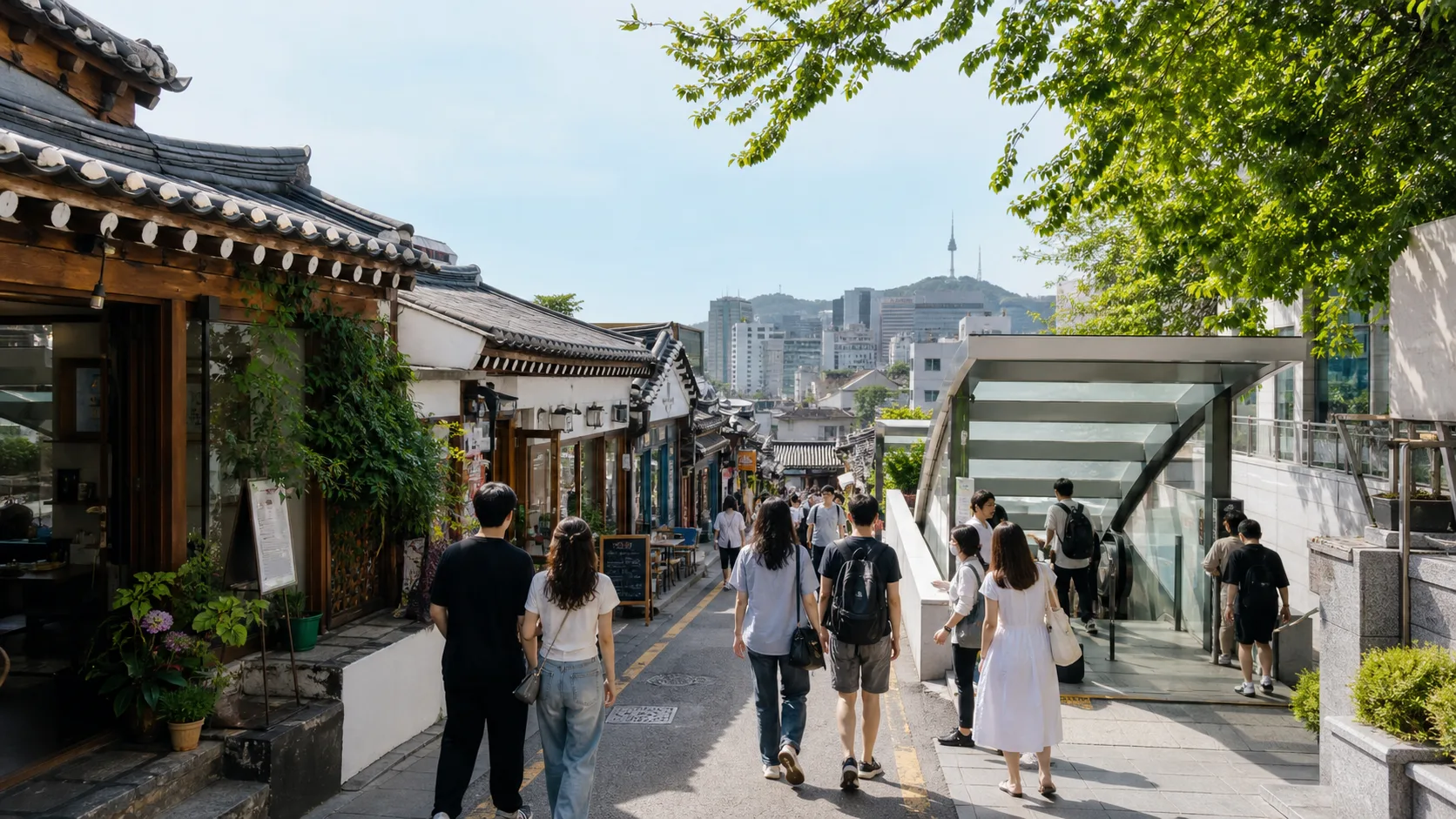
If you only have a short trip to Seoul, the best neighborhood is usually not the one with the most famous landmark. It is the one that matches your pace. First-time visitors usually do best by staying in a central, transit-rich area such as Myeongdong, Jongno, or Hongdae, then day-tripping to one or two nearby districts instead of trying to cover the whole city.
1. Fast Answer
For a first Seoul trip, think in neighborhoods rather than attractions. Seoul is large, but many of the places that matter most to a short visitor cluster into a few easy zones: Myeongdong for convenience and shopping, Jongno and Insadong for heritage and easy sightseeing, Hongdae for nightlife and a younger vibe, and Gangnam for polished malls, dining, and a more modern business-city feel.
If your trip is only two to four days, do not try to sleep in a different district every night. Pick one base near a subway interchange, then build your days around neighborhood pairs that are easy to combine. For example, Insadong and Bukchon work well together, Myeongdong and Namdaemun are close, and Hongdae pairs naturally with Yeonnam and Sinchon. That structure saves time, reduces taxi dependence, and keeps meals flexible.
For a Singapore-based traveler, the simplest rule is this: choose your neighborhood by what you want to do after dinner. If you want easy shopping and late snacks, stay in Myeongdong. If you want cafes, art, and walkability, stay in Hongdae or Yeonnam. If you want palaces, hanok streets, and traditional food, stay in Jongno or Insadong. If you want a slick city stay with strong retail and easy airport transfer options, Gangnam can make sense.
2. Context You Need
Seoul is not a city you experience all at once. It is a city of district logic. Each neighborhood has a different rhythm, and the most useful Seoul itinerary starts by understanding that rhythm rather than trying to force a single “best area” answer.
The historic core sits around Jongno, Gwanghwamun, Insadong, Bukchon, and the palace zone. This is the Seoul most first-time visitors picture: palaces, gates, museums, tea houses, and older streets that still feel layered with history. It is the best area for visitors who want to walk between cultural sights without relying on transport every hour. You can spend a morning at Gyeongbokgung, lunch in Insadong, then wander toward Bukchon or Samcheong-dong in the afternoon.
South of the river, Seoul changes tone. Myeongdong is dense and practical, with department stores, cosmetics shops, chain hotels, and enough food options that you rarely need to plan a meal too far ahead. Hongdae and nearby Yeonnam are younger and more casual, with cafes, bars, indie shops, and a stronger student-energy feel. Gangnam is more vertical and polished, with big-brand retail, business hotels, and a more urban, less “old city” atmosphere. Dongdaemun is a good late-night retail and market area, especially if you care about shopping hours, fabric markets, or wholesale-adjacent fashion districts.
For a short trip, these differences matter because your neighborhood changes how tired you feel. Seoul is easy to navigate, but it is still a big city. If your hotel is far from the areas you want to visit, you will spend too much energy on transfers. A first-time visitor often enjoys Seoul more by choosing a compact daily loop and then repeating that logic over several days.
The key thing to understand is that Seoul’s districts are connected by subway, but they are not identical in convenience once you step out of the station. A neighborhood with one excellent station can still be tiring if you are carrying luggage, arriving late, or trying to return after a long dinner. That is why “best neighborhood” should always be read as “best neighborhood for a specific trip style.”
3. Step-by-Step Guide
The smartest way to plan a short Seoul trip is to choose your base first, then assign each day a neighborhood cluster. That gives you a realistic plan for food, transit, and rest.
Step 1: Decide your trip style
Start with the version of Seoul you want most:
- Heritage-first: palaces, hanok streets, museums, tea houses, traditional markets.
- Food-and-cafe-first: cafe hopping, bakery runs, casual dinners, nightlife.
- Shopping-first: cosmetics, fashion, beauty devices, street shopping, department stores.
- Mixed-first-time itinerary: one palace day, one shopping day, one cafe and neighborhood-walk day.
If you are only in Seoul for a few nights, you will usually be happier with a mixed itinerary. It gives you enough variety without making every day feel like a logistics exercise.
Step 2: Pick a base that fits your after-hours behavior
This is the most important decision. Do you want to come back to your hotel at night and still have food, convenience stores, and easy transit around you?
If yes, choose one of these:
- Myeongdong: best for easy hotel options, straightforward transit, and late shopping.
- Jongno / Insadong area: best for culture and a more central old-Seoul feel.
- Hongdae / Yeonnam: best for cafes, nightlife, and casual walking.
- Gangnam: best for polished hotels, larger rooms in some properties, and upscale dining.
If you are traveling with parents or older relatives, Myeongdong or Jongno are usually the easiest because the day plan can be simpler and the transfers shorter. If you are traveling as a couple and want a more neighborhood-focused trip, Hongdae, Yeonnam, or Samcheong-dong can feel more interesting. If your flight timing is awkward and you expect to use airport transfer services, Gangnam or Myeongdong can also be practical.
Step 3: Build neighborhood pairs, not random attraction lists
On a short trip, Seoul works better when you group districts that are geographically sensible.
Useful pairings:
| If you stay near | Pair it with | Why it works |
|---|---|---|
| Myeongdong | Namdaemun, Namsan, Euljiro | Short transfers, lots of food and shopping options |
| Jongno / Insadong | Bukchon, Gyeongbokgung, Samcheong-dong | Cultural core with easy walking routes |
| Hongdae | Yeonnam, Sinchon, Hapjeong | Similar vibe, cafe-heavy, easy evening planning |
| Gangnam | COEX, Apgujeong, Seongsu | Modern retail and a broader city feel |
| Dongdaemun | Euljiro, Cheonggyecheon, central Seoul | Good for late shopping and central access |
This matters because first-time travelers often overestimate how much can be done in one day. Seoul is efficient, but every additional district adds time for exits, wayfinding, and food decisions.
Step 4: Use the subway as your default, taxis as your backup
Seoul’s subway is the simplest way to move between major neighborhoods. For a short visitor, the system is usually easier than it looks at first. The stations are frequent, the lines are reliable, and the fare system is designed for everyday use rather than one-off tourist stress.
A practical approach is:
- Use subway and walking for most daytime travel.
- Use taxis when you are tired, with luggage, or heading somewhere inconvenient after dinner.
- Keep a translation app and map app ready for station exits and neighborhood entrances.
If you are coming from Singapore, this part should feel familiar in spirit even if the system is different in detail. The real adjustment is not “can I get around?” but “how much walking do I want between subway exit and destination?”
Step 5: Plan each day around one main meal and one flexible block
Short trips get better when they are not overbooked. A good Seoul day often looks like this:
- Morning sightseeing in the core district.
- Lunch near the same area.
- One afternoon block for shopping, a cafe, or a museum.
- Dinner in the same district or one stop away.
- Return to the hotel before you are exhausted.
If you try to force too many neighborhood swaps, you will spend more time standing at station maps than enjoying the city. The goal is not to cover every famous place. It is to leave enough energy to appreciate the places you do visit.
Step 6: Match the neighborhood to the kind of evening you want
This is where first-time visitors often make the wrong choice. Seoul after dark is not one thing.
If you want:
- Convenient night snacks and beauty shopping: stay in Myeongdong.
- Busy youth nightlife, bars, and casual cafes: stay in Hongdae.
- A quieter evening with a more traditional street feel: stay in Jongno or Insadong.
- Big-mall, restaurant, and hotel-zone energy: stay in Gangnam.
The more clearly you define your evenings, the easier the whole itinerary becomes.
4. Costs, Hours, and Logistics
For 2026 planning, the biggest logistics advantages in Seoul are still transit, card payment, and neighborhood density. You do not need to budget around private transport unless you are traveling with a lot of luggage or have mobility constraints.
The subway is still the most practical default. A short city trip typically starts at around KRW 1,400 for a basic subway ride, with distance-based increases after that. T-money remains the easiest payment method, and it is widely useful beyond the subway, including buses and many convenience-store purchases. Contactless payment is also much more common than it used to be, so the city is increasingly easy for visitors who rely on cards or mobile wallets.
For neighborhood planning, think in broad cost bands:
- Budget stay: guesthouses, compact business hotels, and some simple hotels in outer edges of central districts.
- Mid-range stay: the sweet spot for Myeongdong, Jongno, Hongdae, and parts of Gangnam.
- Premium stay: larger international hotels, higher-end boutique properties, and quieter business districts.
Hours vary by area rather than by a single citywide rule. Myeongdong is a shopping district, so many retail and food options lean later into the evening. Hongdae and Yeonnam also stay active into the night, especially on weekends. Traditional spots like palaces, museums, and hanok areas keep more standard daytime schedules, so if those are your priority you should always start early.
There are also a few practical 2026 habits worth keeping:
- Check the last train time for your route if you are going out late. The subway is excellent, but it is still time-bound.
- Assume station exits matter. The “right” station can still have the wrong exit for your hotel or attraction.
- Use a map app that handles Korean addresses well, because English signage helps but does not eliminate confusion.
- If you are traveling in summer, plan for heat and walking. Seoul can be humid, and district-to-district walking becomes less pleasant in peak heat.
If you are building a one- or two-day Seoul stop, the most efficient logistics choice is usually a central hotel plus a simple fare card and a compact plan. If you are staying longer, you can be more selective and choose a neighborhood based on atmosphere rather than pure convenience.
5. Variations and Edge Cases
The best Seoul neighborhood changes depending on season, group size, and traveler type.
If you are visiting in winter
Winter makes short transfers more valuable. A neighborhood with easy indoor access, convenience stores, and direct subway links becomes more appealing. Myeongdong and Jongno are strong choices because you can minimize outdoor wandering between activities. If you are sensitive to cold, do fewer neighborhood swaps and more time in indoor attractions.
If you are visiting in summer
Summer Seoul can be sticky and tiring, especially if you try to walk everywhere. Hongdae and Yeonnam can still be fun, but your hotel’s location matters more than usual because you will appreciate quick returns to rest. This is also the season when cafe hopping makes sense, since indoor breaks become part of the itinerary.
If you are traveling with parents
Choose convenience over trendiness. Myeongdong, Jongno, and some parts of Gangnam are usually easier than more fragmented neighborhood zones. What looks “more interesting” on a map is not always easier in real life when multiple people want different things at the same time.
If you are traveling with young adults or friends
Hongdae is the easiest default if your group wants food, nightlife, and flexible decisions. Yeonnam is a useful calmer extension if you want to slow the pace down between late nights. Gangnam works better if your group prefers nicer restaurants, bars with a more polished feel, or bigger shopping decisions.
If your trip is very short
For a one-night stopover, stay in a central area and ignore the temptation to “see all of Seoul.” Pick one palace or one shopping district, then do one food neighborhood at night. For a two-night trip, add one more cluster. For a three- or four-night trip, you can start mixing a traditional core with one modern district.
If you care most about food
Do not overthink the famous neighborhoods alone. Some of the best food in Seoul is not where first-timers expect. Use your base for convenience, then hunt for specific meal types: traditional breakfast in Jongno, Korean barbecue in central or modern districts, cafe desserts in Hongdae or Yeonnam, and late-night snacks near wherever you sleep.
If you are shopping for beauty or fashion
Myeongdong and Dongdaemun are still the easiest names to understand quickly. Myeongdong is more visitor-friendly and straightforward, while Dongdaemun is better if you like late retail hours and a more market-driven feel. Gangnam and Apgujeong are better for a cleaner, more upscale shopping style.
6. Mistakes to Avoid
The most common mistake is choosing a hotel by price alone and then paying for it with time. A cheaper room far from the districts you actually want to visit can make a short trip feel fragmented.
The second mistake is treating Seoul like a single-district city. It is not. If you want palaces, cafes, shopping, and nightlife, those are all in different neighborhood systems. Trying to do them all in one afternoon usually leads to rushed meals and missed exits.
The third mistake is overestimating walking comfort. Seoul is walkable in many areas, but the city is still big, and summer heat or winter cold can make extra walking a real burden.
The fourth mistake is planning too many “must visit” places without choosing a neighborhood base. Once the base is chosen, the rest becomes easier. Without that base, you end up moving from attraction to attraction in a way that wastes time.
The fifth mistake is assuming every district is equally good at every hour. Some neighborhoods shine in the daytime, others at night. Match your schedule to the district instead of forcing the district to match your schedule.
7. FAQ
What is the best neighborhood in Seoul for first-time visitors?
There is no single best one, but Myeongdong is usually the safest answer if you want convenience, shopping, and easy transit. If you prefer more history and walkable heritage sites, Jongno and Insadong are stronger.
Should I stay in Myeongdong or Hongdae?
Stay in Myeongdong if you want central convenience, a very straightforward visitor experience, and easy access to shopping. Stay in Hongdae if you care more about cafes, nightlife, and a younger neighborhood atmosphere.
Is Gangnam good for tourists?
Yes, but it suits a specific style of trip. Gangnam is good if you want modern hotels, big retail, polished dining, and an upscale city feel. It is less ideal if your main goal is the traditional core of Seoul.
Can I do Seoul without taxis?
Yes, especially on a short trip centered on major districts. Subway plus walking is enough for most first-time itineraries. Taxis are useful when you are late, tired, or carrying luggage, but they are not required for a normal sightseeing day.
How many neighborhoods should I try to visit in one trip?
For a short trip, one base plus two or three neighborhood clusters is usually enough. If you try to cover too many districts, you will spend too much time in transit and not enough time in the city itself.
What is the easiest area for a one-night stopover?
Myeongdong or Jongno. Both give you central access, food, and easy transit without forcing a complicated plan.
Do I need to pre-book everything?
No. For most neighborhood-based Seoul trips, the main thing to lock in early is your hotel location. Some attractions and restaurants may require reservations, but the broader district plan can stay flexible.
Is Seoul expensive for short trips?
It can be as expensive or as affordable as you make it. Transport is efficient, food can range from casual to premium, and hotel prices vary widely by district and season. Picking the right neighborhood often saves more money than obsessing over small daily transit costs.
8. Next Steps
The best next step is to choose your base neighborhood before you start making restaurant or attraction lists. If you want the easiest first trip, use Myeongdong or Jongno. If you want more atmosphere, use Hongdae or Yeonnam. If you want a polished city stay, use Gangnam. Once the base is fixed, the rest of your Seoul short trip becomes much easier to book, route, and enjoy.
Related: korea-seoul-short-trip-airport-transfer-guide-for-singapore-travelers
Related: korea-seoul-short-trip-esim-and-wifi-guide-for-singapore-travelers
Related: korea-seoul-short-trip-itinerary-for-singapore-travelers