Where to Stay in Japan for a Short Budget Trip Holiday

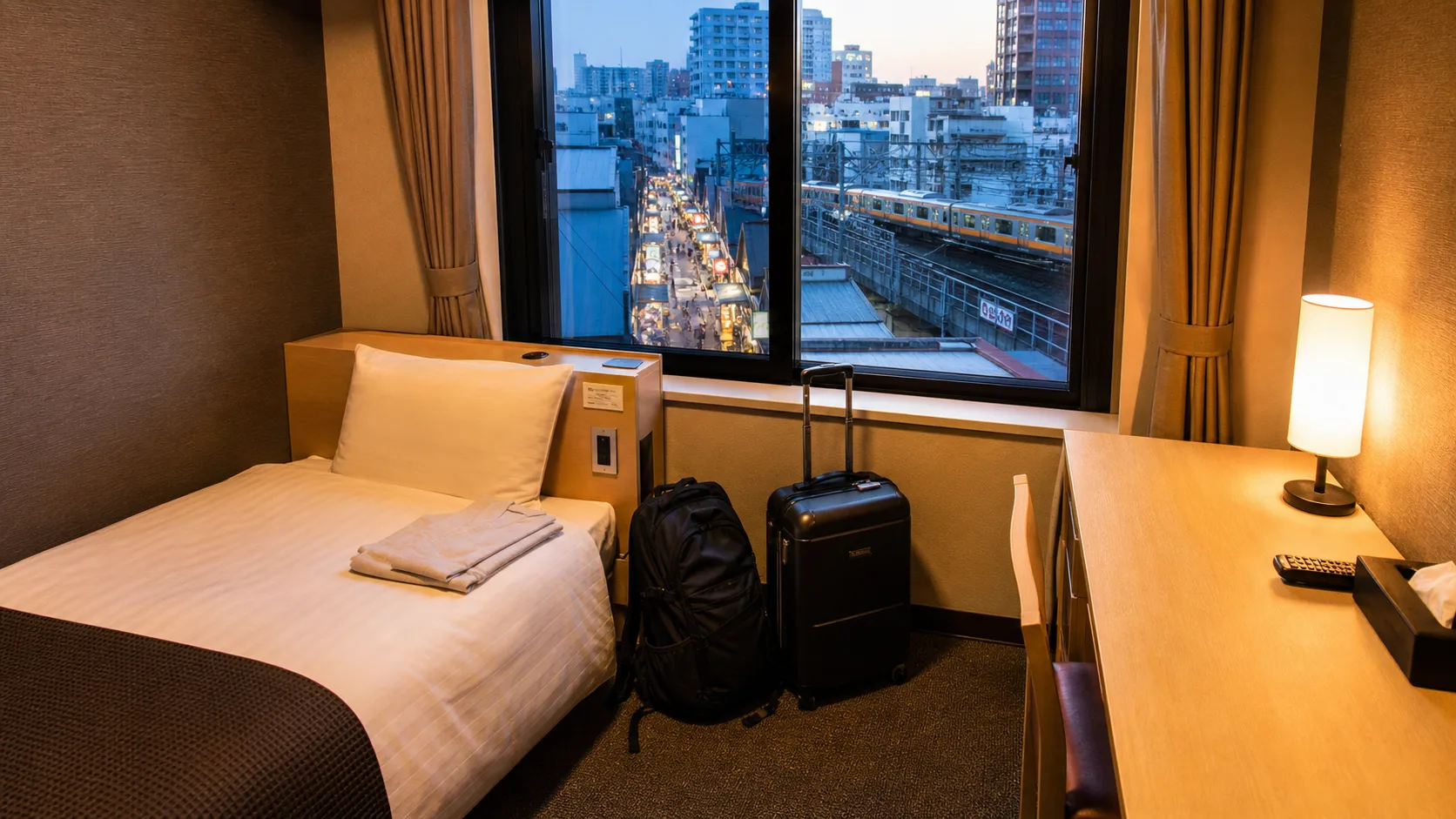
If you only have a few days in Japan and want to keep the trip affordable, the best place to stay is usually not the absolute cheapest room. It is the area that cuts airport transfer time, keeps train rides short, and lets you walk to food, convenience stores, and at least one major station. For most short budget trips, that means staying near a major rail hub such as Tokyo Station, Shinjuku, Shibuya, Ueno, Osaka Umeda, Namba, Kyoto Station, or a well-connected neighborhood a few stops away from them.
For a Singapore-based traveler, the real cost of a stay is not just the nightly rate. It also includes time lost on the first night, luggage handling, late check-ins, and how much you spend getting from the hotel to the sights you came for. A room that looks slightly more expensive can still be the cheaper choice if it saves two taxi rides, one complicated transfer, and an extra hour of sleep.
1. Fast Answer
For a short budget holiday in Japan, stay close to a major station rather than chasing the lowest room rate in a random suburb. In Tokyo, the safest budget bases are Ueno, Asakusa, Shinjuku, Shibuya, and parts of Ikebukuro. In Osaka, look at Namba, Umeda, and Tennoji. In Kyoto, the most practical budget base is usually near Kyoto Station, or a nearby area with simple bus and train access. If you are splitting time between cities, pick one city as your base and do day trips instead of moving hotels every night.
The reason is simple: Japan is efficient, but short trips punish bad location choices. A cheap hotel that requires two transfers every morning can waste the one thing you cannot buy back on a four-night holiday. Budget travelers should optimize for a clean room, easy station access, and predictable late-night return routes. That is more valuable than a slightly larger bed or a lower room category on paper.
For most travelers, the formula is: stay where the rail network is strongest, avoid deep residential suburbs unless you know the route, and pay a little more for a location that reduces friction. If your trip is mostly food, shopping, and first-time sightseeing, Tokyo and Osaka station neighborhoods give the best mix of convenience and value. If your trip is about temples, quieter nights, and one base for Kansai, Kyoto Station works best. If your budget is tight and you can tolerate compact rooms, capsule hotels, business hotels, and simple hostels near transit are usually enough.
2. Context You Need
Japan is a great budget destination precisely because the transport network is so good. That also creates a trap for first-time visitors: it is easy to assume that any neighborhood with a train station will work. In practice, staying in Japan is not only about finding a room. It is about choosing a launch point for your daily movements, luggage, meals, and late-night returns.
The main types of budget stays are familiar once you know the labels:
- Business hotels: compact private rooms, usually reliable, efficient, and good for short trips.
- Hostels: the cheapest option for many travelers, with dorm beds or simple private rooms.
- Capsule hotels: best for solo travelers who value location over space.
- Budget apartment-style stays: useful for groups or longer stays, but often less convenient for very short trips.
- Ryokan and minshuku: traditional Japanese stays that can be affordable in some places, but are not always the best value for a short budget city break.
For short holidays, the best area is usually the one that makes your airport arrival and first sightseeing day easy. That matters even more for Singapore travelers because many arrive on a late flight or with limited leave. If you land tired, navigate one complicated transfer, and then have to carry luggage through a neighborhood with poor signage, your cheap hotel starts to feel expensive very quickly.
It also helps to understand the difference between city centers in Japan and city centers in Southeast Asia. A place can look central on a map and still be inconvenient if it sits far from the station exit you need, or if it is on the wrong side of a river, hill, or rail junction. In Japanese cities, the best budget stay is often defined by the exact station exit rather than the district name alone.
That is why experienced travelers think in terms of access patterns:
- Tokyo: access to JR, subway, and airport trains matters more than a famous neighborhood name.
- Osaka: quick connection between Namba, Umeda, and Tennoji matters more than chasing a trendy side street.
- Kyoto: bus and rail access to the sights matters more than nightlife.
- Fukuoka, Sapporo, Hiroshima, and Nagoya: the same logic applies, but the scale is smaller and the “best” area often sits near the main station.
If your trip is short, your goal is not to “see Japan from everywhere.” Your goal is to minimize the number of times you pay a convenience tax in time and energy. Staying near the right station is the easiest way to do that.
3. Step-by-Step Guide
The smartest way to choose where to stay is to work backward from your route.
Step 1: Decide your trip shape
Start with one of these patterns:
| Trip shape | Best base | Why it works |
|---|---|---|
| First-time Tokyo trip | Ueno, Shinjuku, Shibuya, or Tokyo Station area | Easy transit, food, shopping, airport access |
| Osaka food and shopping trip | Namba, Umeda, or Tennoji | Strong local transit, simple day-to-day movement |
| Kyoto culture trip | Kyoto Station or nearby | Better for buses, trains, and luggage movement |
| Kansai short holiday | Osaka base with Kyoto day trip | More budget-friendly and flexible than moving hotels |
| Japan stopover trip | Near the airport line or the main intercity station | Less time wasted on arrival and departure |
For a three- to five-night holiday, one base is usually best. Changing hotels sounds efficient, but packing, checking out, and re-checking in eats into the trip. If you must split your stay, do it only when the route is obvious, such as Tokyo plus Osaka/Kyoto.
Step 2: Match the base to your arrival airport
Your arrival airport should influence your hotel area more than many travelers realize.
- Tokyo Haneda arrivals: central Tokyo is easier to reach, so you can prioritize comfort and train access.
- Tokyo Narita arrivals: Ueno, Asakusa, and Tokyo Station are often practical because airport rail links are straightforward.
- Osaka Kansai arrivals: Namba and Umeda are common because they connect well to airport transport and day trips.
- Kyoto arrivals: Kyoto Station removes a lot of friction if you are carrying luggage.
If you arrive late, choose the most direct first-night option, even if it is not your long-term dream area. The first night is when bad location decisions hurt the most.
Step 3: Decide what you can trade away
Budget travel in Japan usually comes down to three trade-offs:
- Smaller room for better location.
- Shared facilities for lower price.
- Fewer amenities for a cleaner, more efficient stay.
For a short holiday, the first trade-off is usually the best. A small but well-located private room is more practical than a larger room far from the station. If you are solo and do not mind minimal space, capsules can work very well in expensive districts. If you are traveling as a couple, a compact business hotel is often less stressful than a hostel with a less predictable sleeping setup.
Step 4: Filter by station, not just by district
When you search hotels, do not stop at the neighborhood name. Check:
- walking time to the station
- whether the walk is flat or uphill
- whether you need a long underground transfer inside a station
- whether the property is near the correct exit
- how long it takes to get to the rail line you will use most
This matters because a hotel “near Shinjuku” can still be a headache if it sits on the wrong side of a confusing station complex. The same goes for “near Kyoto Station” if the route involves repeated stair use or a long walk with luggage.
Step 5: Choose the accommodation type
For short budget stays, the type matters as much as the area.
- Choose a business hotel if you want privacy, predictability, and easy check-in.
- Choose a hostel if your top priority is price and you are comfortable with shared space.
- Choose a capsule hotel if you are solo and want a central location cheaply.
- Choose an apartment-style stay if you are with friends, staying longer, or want a kitchenette.
If you are on a tight holiday schedule, business hotels are often the best balance. They are compact, but the process is usually smooth, the amenities are standardized, and you are less likely to waste time learning how the property works.
Step 6: Book for convenience, not fantasy
Search results can make a city look more affordable than it is. Focus on the total trip cost:
- room price
- airport transfer cost
- likely taxi use
- extra meals caused by a poor location
- luggage storage or coin locker needs
A slightly higher nightly rate in the right area can reduce all the hidden extras. That is the difference between cheap and good value.
Step 7: Use a practical booking checklist
Before you book, check these items:
- Is the hotel a simple walk from the station?
- Is check-in time compatible with your arrival?
- Can you store luggage before check-in or after check-out?
- Does the room fit your actual bags, not just one carry-on?
- Are there food options within walking distance?
- Will you need an elevator if you have a big suitcase?
- Is the area lively enough at night to feel convenient, but not so noisy that sleep becomes a problem?
If three or more of these answers are weak, look for a better location.
4. Costs, Hours, and Logistics
Budget accommodation prices in Japan vary by city, season, weekends, and whether there is a major event or holiday period. For a short trip, the most important thing is not a single “average” number. It is the range you should expect in the area you choose.
As a rough planning rule:
- hostels and capsules are usually the cheapest urban options
- compact business hotels sit in the middle
- apartment-style stays can look affordable per person if you are sharing, but often rise in total cost
In the most popular central areas, the nightly price often rises because the location premium is real. That is normal. What matters is whether the premium saves enough time and transport cost to justify it. If you are staying only two or three nights, convenience is usually worth paying for.
Most business hotels and hostels in Japan have standard check-in windows in the afternoon and check-out in the late morning. Luggage storage is common, but you should not assume early check-in is possible. If you arrive before the room is ready, plan to leave bags at the front desk or in a locker and start sightseeing immediately.
Payment is usually easy in larger hotels, but do not assume every small property works the same way. Many budget properties accept cards, yet some smaller guesthouses or older inns may still have stricter payment or ID procedures. For a Singapore traveler, that means carrying at least one backup card and a little cash for incidentals is still sensible.
Other logistics to keep in mind:
- city accommodation taxes may be added separately depending on the area and property type
- some hotels collect payment on arrival rather than at booking
- family rooms and triple rooms sell out faster than singles and doubles
- late arrivals should be communicated clearly in advance
- station-facing rooms and smoking rooms may change the price and comfort level more than expected
The biggest 2026 reality is that good value sells out faster than the very cheapest listing. If your dates overlap with Japanese school holidays, long weekends, cherry blossom season, autumn foliage, or major event periods, book early and be flexible on the exact room type.
For transit, the hotel’s airport and station access often matters more than the surrounding district name. A hotel in Ueno with direct rail access may be a better budget choice than a lower-priced room deeper in a neighborhood that requires a complicated first and last mile. That logic applies in Osaka, Kyoto, and other major cities too.
If you are comparing options, build the comparison around “minutes saved per day.” A hotel that cuts 20 minutes from your morning and 20 minutes from your evening return can make a short trip feel much more relaxed. That is especially true if you are visiting more than one city and your energy is limited.
5. Variations and Edge Cases
The best area changes depending on travel style, season, and how many people are sharing the room.
Solo traveler
Solo travelers can use capsule hotels, small business hotels, and hostels more effectively than groups can. If you are alone, staying close to the station usually matters more than room size. A compact room in a strong location is often ideal. You can leave early, return late, and keep logistics simple.
Couple
For couples, the cheapest option is not always the best value because very small rooms become harder to live in. A small private room near transit often beats a cheaper shared setup. If your stay is only two or three nights, comfort matters more than in a longer backpacking trip.
Family
Families should prioritize space, laundry access, and a simple route from station to hotel. In Japan, families often pay more because larger rooms are limited. If you are traveling with children, staying near the main station in each city usually reduces stress more than a savings-focused suburban hotel.
First-timer in Japan
If this is your first Japan holiday, stay in a district that is easy to understand on day one. Ueno, Shinjuku, Namba, Umeda, and Kyoto Station are easy enough to explain to a taxi driver, easy enough to navigate on foot, and well-connected enough that you can make mistakes without ruining the trip.
Late-season or peak holiday travel
During peak periods, the cheapest hotel may be far away from the station or attached to inconvenient check-in rules. Do not assume a low base rate means a good deal. In peak season, a sensible location can outperform a cheap room in a poor one.
Rainy weather or winter travel
Bad weather changes the equation. If you expect rain, snow, or heavy luggage movement, choose the nearest practical station access over a “nice walkable neighborhood.” A five-minute uncovered walk may be fine in April but unpleasant in January.
Food-focused trip
If your goal is food markets, ramen hopping, izakaya, and late-night convenience, Osaka often gives better short-trip value than trying to stay in a perfectly central Tokyo location. Tokyo still works, but Osaka can feel easier and cheaper for casual eating and short transfers.
Temple and culture trip
If you are staying mainly in Kyoto, remember that many sights are spread out and bus-heavy. A cheap hotel far from transport can create more friction than it saves. In Kyoto, proximity to the station often matters more than a picturesque side street.
6. Mistakes to Avoid
The most common mistake is choosing the cheapest room without checking where it sits relative to the station. In Japan, location is not a luxury add-on. It is part of the core cost of the trip.
Another mistake is moving hotels too often. On a short holiday, every move has a packing penalty. Unless the route is obvious, stay in one base city and use day trips.
Do not overrate “nice-looking neighborhoods” that are weak on transport. A calm side street sounds appealing until you are dragging luggage back after dinner and cannot find the station exit you used earlier.
Finally, do not ignore room size. Japan rooms can be very compact. If you are traveling with two large suitcases, check dimensions and storage space before booking. A room that is affordable on paper can be hard to use in practice.
7. FAQ
What is the best area to stay in Japan for a short budget trip?
For most first-time short trips, stay near a major station in Tokyo, Osaka, or Kyoto rather than in a random cheap suburb. In Tokyo, Ueno and Shinjuku are strong budget bases. In Osaka, Namba and Umeda are the most practical. In Kyoto, Kyoto Station is usually the best all-round choice.
Is it better to stay in Tokyo or Osaka for a budget holiday?
If your trip is mostly shopping, food, and easy transport, Osaka can feel cheaper and simpler. If your priorities include major attractions, big city variety, and first-time Japan sightseeing, Tokyo gives you more options. For a very short holiday, choose the city that matches your route instead of trying to squeeze both into a rushed plan.
Are capsule hotels worth it?
Yes, if you are solo, light on luggage, and mainly need a central place to sleep. They are less ideal if you want privacy, have bulky baggage, or value a lot of unpacking space. For one or two nights, a capsule can be a smart budget move if the location is excellent.
Should I stay near Tokyo Station?
You should if you want simple train access, especially for intercity travel or airport connections. It is not always the cheapest area, but it is extremely convenient. If your trip is focused on nightlife or shopping, Shibuya or Shinjuku may be a better fit. If your budget is tighter, Ueno often gives better value.
Is Kyoto Station too boring to stay in?
No. For a short trip, boring can be good. Kyoto Station is practical because it is easy to understand, easy to reach, and efficient for luggage movement and bus/train transfers. If you want a scenic neighborhood, you can still visit one during the day without paying a location premium for your sleep.
How far from the station is too far?
For a short budget trip, try to stay within a comfortable walk, ideally with a direct route and no confusing transfers through large station complexes. If you expect to arrive tired, arrive late, or travel with luggage, “a little farther but cheaper” is often a false economy.
Do budget hotels in Japan usually include taxes?
Not always in the way travelers expect. Some listings show a base rate and then add local taxes or fees at checkout. Always compare the final payable amount, not just the nightly headline price.
Should I book early?
Yes, especially if your dates fall near holidays, peak seasons, or major events. The best budget rooms near major stations disappear first. Early booking gives you more choice and usually better value.
8. Next Steps
The best next step is to choose one base city, then pick the station area that fits your arrival airport and sightseeing plan. If you are unsure, start with a shortlist of Ueno, Shinjuku, Namba, Umeda, or Kyoto Station and compare the total trip cost, not just the room rate.
Once the base is set, build the rest of the trip around simple rail access, one or two day trips, and a hotel that makes your mornings easier. For a short budget holiday in Japan, convenience is the real savings.
Related: japan-budget-trip-itinerary-for-singapore-travelers
Related: japan-budget-trip-neighborhood-guide-for-first-time-visitors